 By Andre Atallah, CEO of EP Advisory
Short answer: Yes. Expatriates fill about 3 in 4 private-sector jobs in Oman, 1.42 million people in September 2026. But Omanisation closes 247 professions to foreigners today, and 249 from January 2027. So check the list first. Then target employers in health, education, oil and gas and engineering. The employer gets a Ministry of Labour work licence, the police issue your visa, and your salary is tax-free until 2028.
This guide is for skilled professionals applying to Oman from abroad. That includes nurses, doctors, teachers, lecturers, engineers and oil and gas specialists from India, Pakistan, the Philippines, Egypt, Africa, Europe and Russian-speaking countries.
Below are the closed job lists, the visa steps, the new 2026 fees, the licences for teachers and nurses, pay, where to search, documents and scam signs. Rules and figures are current as of November 2026.
For nearly 10 years, we’ve helped more than 5,000 professionals find jobs abroad. Want to know if your CV will pass screening in Oman? Check your CV for free: a score in 30 seconds, then a fix for each problem.
Oman still hires from abroad, but only where no Omani is available
Oman’s private sector depends on foreign staff. In September 2026, 1,421,478 expatriates worked in private companies, against 449,631 Omanis (NCSI, Monthly Statistical Bulletin, October 2026). Expatriates are 43.7% of the whole population, according to the national statistics centre.
The law sets the order of priority. Work is a right of Omani citizens, and the minister sets an Omanisation percentage for each sector (Labour Law, Royal Decree 53/2023, Articles 18 and 23). An employer can recruit you only with Ministry of Labour approval. One condition is that no Omani has the skills for the job (Article 27).
That shapes who gets hired. Fewer than 1,000 expatriates work in clerical jobs, out of 1.8 million in the private and household sectors. About 45,000 are specialists and about 31,000 are technicians. So Oman hires foreigners for skills it cannot find at home, not for office support roles.
| Your situation | What it means in Oman | Your first move |
|---|---|---|
| Your job title is on the closed list | No new work permit for that title | Retarget to a related title that is open, if your experience supports it |
| You are licensed in health | Demand is real, but you need a Ministry of Health licence | Book the OMSB classification exam for your profession |
| You teach or lecture | Schools and universities hire abroad, with extra approvals | Get your degree attested and equivalent early |
| You work in oil, gas or engineering | Open, except a few named engineering titles | Check your exact title against the 2022 and 2024 lists |
If you are weighing Oman against its neighbours, our guide to jobs in the Gulf compares the region. Our guides to jobs in Qatar and jobs in Kuwait cover two of them in the same detail.
Check your job title against the Omanisation list before you apply
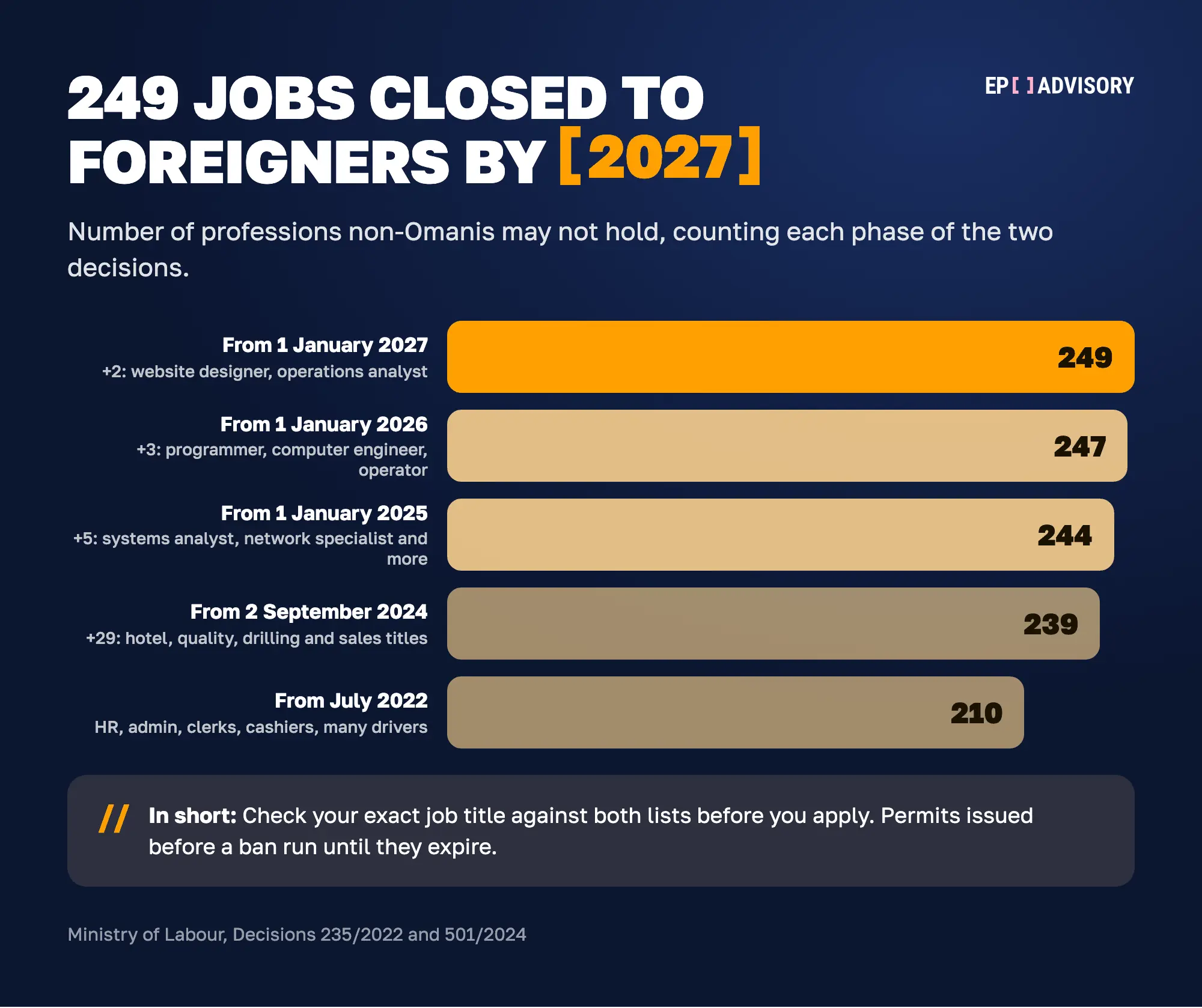
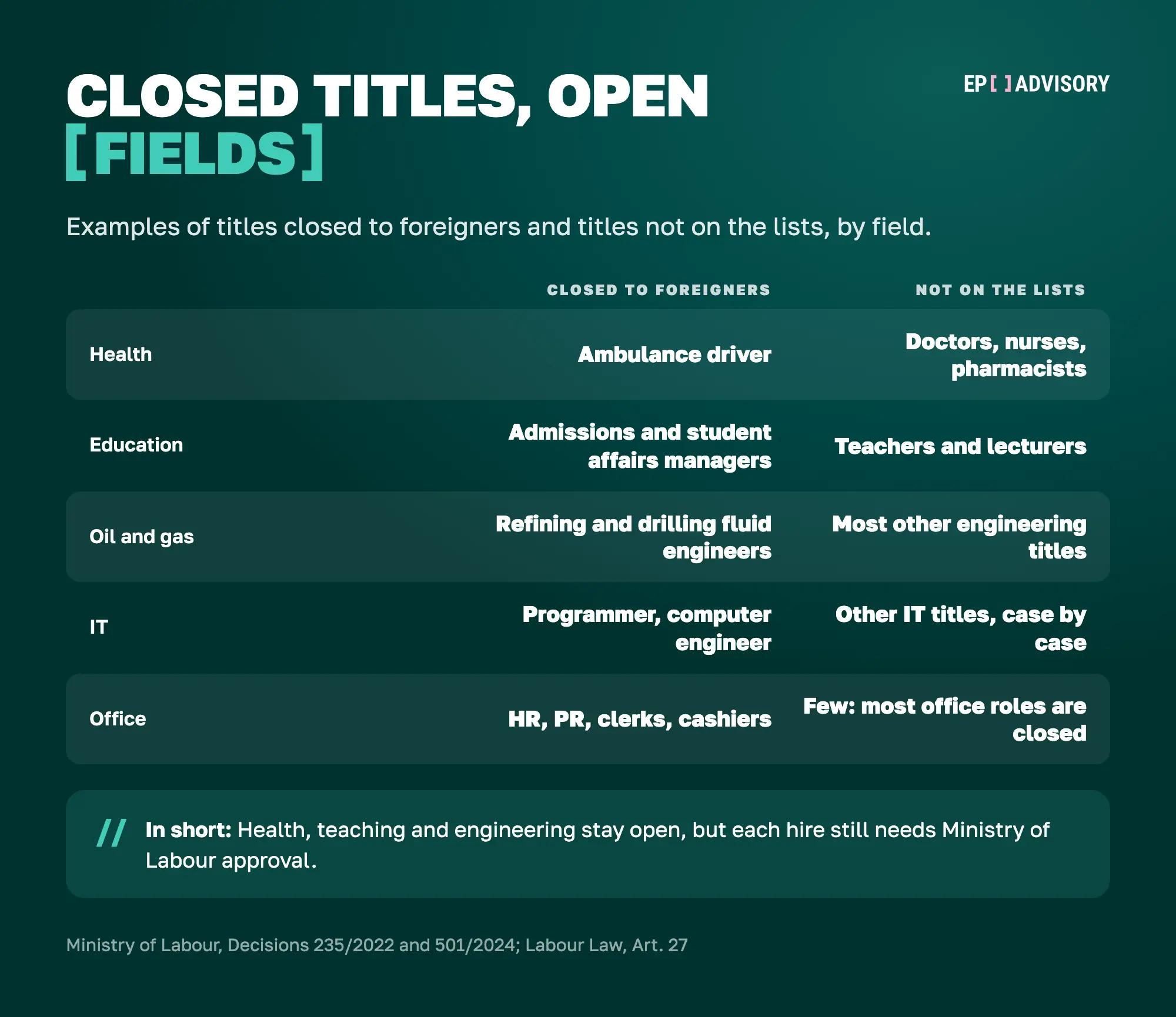
Oman does more than set quotas. It also bans foreigners from named professions. Ministerial Decision 235/2022 closed 210 professions to non-Omanis in July 2022 (Decision 235/2022). Decision 501/2024 added 39 more, in phases up to January 2027 (Decision 501/2024). Work permits issued before a ban stay valid until they expire.
Many websites still say “32 jobs” or “207 jobs”. Both numbers are out of date. Here is how the list has grown.
| From | Professions added | Examples |
|---|---|---|
| July 2022 | 210 | HR, PR, admin and recruitment managers and specialists; deputy and assistant general managers; chemical and refining engineers; most clerks; cashiers; general accountants; guards; many drivers |
| 2 September 2024 | 29 | Hotel reception manager, travel agent, quality control manager and inspector, drilling fluid engineer, drilling officer, maintenance technicians, marketing specialist, sales representative |
| 1 January 2025 | 5 | Systems analyst, network specialist, marine controller, ship traffic controller, computer maintenance technician |
| 1 January 2026 | 3 | Computer programmer, computer engineer, computer operator |
| 1 January 2027 | 2 | Website designer, operations analyst |
The IT rows matter most for job seekers abroad. A “computer programmer” title is closed from 2026. Doctors, nurses, pharmacists and teachers are not on either list. Most engineering titles are not on it either. Oil and gas has a few closed titles, such as refining, drilling fluid and drilling measurements engineers, and safety inspectors.
The lists name job titles, so read the Arabic list for your exact title. If your title is closed, ask the employer whether a different, accurate title fits your real job. Never accept a title that does not match your real work.
Score your CV in 30 seconds, then fix its biggest problems one by one. Both free.
Free, no card. A free account unlocks every fix.

The work visa runs through the Ministry of Labour first, then the police
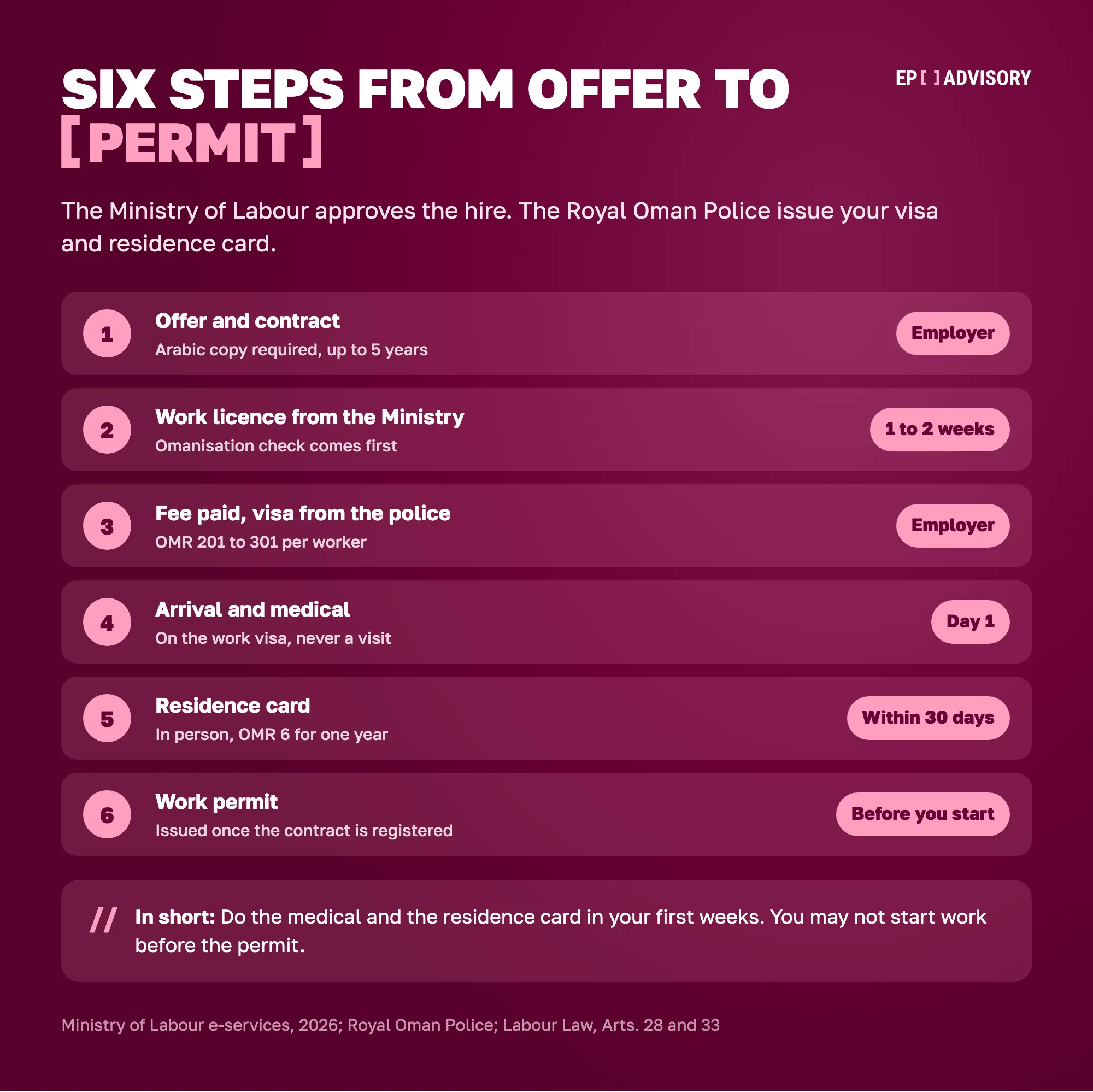
To work in Oman, you need two bodies to say yes. The Ministry of Labour (MoL) approves the employer’s request and issues your work permit. The Royal Oman Police (ROP) issue your entry visa and your residence card. Your employer files almost everything. Your part is the documents, the medical and one visit to the police.
- Offer and contract. The contract must be in Arabic, or in another language with an approved Arabic copy (Labour Law, Article 33). A fixed-term contract can run up to 5 years, and probation is up to 3 months (Articles 34 and 37). Check that the job title matches the offer.
- Work licence from the MoL. The employer applies online or at a Sanad service office. The ministry says this takes 1 to 2 weeks, depending on its Omanisation check, the documents and any inspection (MoL e-service). Health and education jobs also need approval from the body in charge of that profession.
- Fee and visa. The employer pays the licence fee online and prints the initial approval. The ROP then issue your work visa.
- Arrival and medical. You enter Oman on that visa, never on a visit. You then pass the medical examination.
- Residence card. You must get your card within 30 days of entry, in person, with your passport and the medical form. It costs OMR 6 for one year or OMR 11 for two, plus OMR 10 for each month late (Royal Oman Police).
- Work permit. The employer registers your wage and contract with the MoL, and the permit is issued at once. You may not start work before you have it (Article 28).
Procedures and fees change, so check the current rules with the official authority, the Ministry of Labour, before you rely on a date. Our guide to UAE and Saudi work visas shows how the neighbouring systems compare.
Since February 2026, the employer pays less for a permit when it meets Omanisation
A new regulation on work licences and permits took effect on 15 February 2026 (Decision 602/2025). It links the fee for each foreign worker to the employer’s Omanisation record. The employer pays these fees, not you.
| What the employer pays per worker | Standard fee | Omanisation target met | Target missed |
|---|---|---|---|
| Category 1 profession | OMR 301 | 30% less | Double |
| Category 2 profession | OMR 251 | 30% less | Double |
| Category 3 profession | OMR 201 | 30% less | Double |
| Move to a new employer | OMR 5 | Paid by the new employer | |
The same regulation sets three more rules that affect you:
- The licence is valid for 24 months. The employer’s approval to recruit you cannot be renewed, so a stalled hire may need a new request.
- The permit lasts up to 24 months. It can be renewed. Late renewal costs the employer OMR 10 a month, up to OMR 500.
- The fee comes back if you fail the medical. It is also refunded if the police refuse your visa.
Use this in your search. An employer that meets its Omanisation target pays 30% less for each foreign hire, so it has a reason to keep hiring. Ask in the interview how the company stands on its target.
Nurses, doctors and teachers need a licence on top of the visa
Health and education are the most open fields for foreigners. They also have the extra step most guides skip.
Health. Nobody may practise medicine or an allied health profession without a Ministry of Health licence and malpractice cover (Royal Decree 75/2019, Article 7). The route runs through the Oman Medical Specialty Board (OMSB). It holds the Omani Occupational Classification Examinations at Pearson VUE test centres. They cover nurses with a bachelor’s degree, diploma nurses, general practitioners, pharmacists, physiotherapists, dentists and more. The OMSB also verifies health certificates (OMSB examinations).
For nursing jobs in Oman, book the exam for your exact category early. Prepare your registration, transcripts and experience letters for certificate checks at the same time. Recruiters move faster when you can show a result.
Education. The MoL lists education jobs among those that need approval from the body in charge. For teaching jobs in Oman, the key document is an attested degree. The Ministry of Higher Education, Research and Innovation (MoHERI) runs an e-service for attestation and equivalency of qualifications (MoHERI). Ask your employer which attestation it needs before it files your visa.
Engineering and technical jobs. The Labour Law lets the minister require professional exams for listed occupations before a permit (Article 28). Ask the employer early whether your title needs one.
Pay is tax-free until 2028, so compare the full package
Oman does not tax salaries today. From 1 January 2028, a personal income tax of 5% applies to net income above OMR 42,000 a year (Royal Decree 56/2025). That line is OMR 3,500 a month. Higher earners should plan for it in any contract that runs past 2027.
Gulf offers split pay into parts. Ask for each in writing: basic salary, housing, transport, flights, medical cover and schooling. The basic salary matters most, because the law ties your end-of-service gratuity to it. For workers outside the social protection scheme, that is at least one month’s basic wage for each year of service (Labour Law, Article 61).
The law also fixes your time. Hours are 8 a day and 40 a week. In Ramadan, Muslim workers work 6 hours a day (Article 70). You get at least 30 days of paid leave a year after 6 months (Article 78).
Next: benchmark your offer against Gulf pay in our salaries in Dubai guide, then read our salary negotiation guide before you answer.
Apply to employers in the open sectors, then use the Gulf job boards
Start with employers’ own career sites, then LinkedIn. Focus on the sectors the lists leave open.
- Energy and industry. OQ careers, Oman’s state energy group. Search LinkedIn for oil field service firms with Oman operations too.
- Higher education. Sultan Qaboos University and the University of Technology and Applied Sciences post academic vacancies.
- Telecoms. Omantel careers, for specialist roles that are not on the closed list.
- Health. Private hospitals and clinics, once you hold your OMSB result.
- Job boards. LinkedIn Jobs, Bayt and GulfTalent. Filter by Oman and check that each title is open.
Muscat holds the most expatriate workers, 694,434 in September 2026. Al Batinah North, around Sohar, is next with 281,250, then Dhofar, around Salalah, with 219,795. Search Muscat first, then those two regions.
Make your CV pass the Omanisation check at a glance. Put a job title that matches an open profession at the top, then your licence, years of experience and notice period. Getting ready to apply for jobs in Oman? Check your CV for free: see it the way a recruiter does, then fix each problem. Then tailor a short cover letter for a job abroad to each employer.
The first interview is usually a video call. Prepare with our guide on how to pass a job interview, and have your licence and degree attestation status ready to explain.
Oman accepts the apostille, so your degree is quicker to prepare
Oman joined the Hague Apostille Convention in 2011, and it took effect on 30 January 2012 (HCCH status table). If your country is also a member, an apostille on your degree replaces the long embassy chain. That is not true everywhere in the Gulf. Qatar, for example, still requires consular legalisation.
- Get the apostille on your degree and transcripts in the country that issued them.
- Request attestation and equivalency from MoHERI, if your employer or licensing body asks for it.
- Send health certificates to OMSB for verification, if you work in health.
- Keep certified translations into Arabic or English, as your employer requests.
If your country is not in the convention, ask the Omani embassy in your country how to legalise the documents. Start this before you get an offer, because it is the step that usually delays a start date.
Never pay for a job in Oman
The Labour Law bans charging a worker any amount for employment (Article 31). From 1 January 2027, the new rules for recruitment offices repeat that they may not take any money from the workers they recruit (Decision 390/2026). Walk away if you see any of these signs:
- A request for money for a visa, “processing”, a medical or a job slot. The employer pays the permit fee.
- An urgent offer with no interview. Ads for “urgent jobs in Oman” that skip the interview are a warning sign. Real employers interview, usually by video.
- A job title on the closed list. If the advert offers a programmer or HR manager post to foreigners, the permit will not be issued.
- “Come on a visit and start work.” You may not work before your work permit is issued.
- Someone keeps your passport. The employer may not hold it without your written consent (Article 6).
- A contract that differs from the offer. Check the Arabic copy too.
If an agency contacts you, ask for its Ministry of Labour licence number before you send any documents. If you get no replies at all, our guide on why you can’t find a job covers the usual reasons and the fixes.
Key takeaways
- Expatriates fill about 3 in 4 private-sector jobs in Oman, 1.42 million people in September 2026.
- 247 professions are closed to foreigners today and 249 from January 2027, including computer programmers since January 2026.
- Doctors, nurses, pharmacists, teachers and most engineers are not on the closed lists.
- The employer gets a Ministry of Labour work licence in about 1 to 2 weeks, then the police issue your visa and residence card.
- Since 15 February 2026, permit fees are OMR 201 to OMR 301, 30% less for employers that meet Omanisation and double for those that miss it.
- Oman accepts the apostille, and health staff need an OMSB exam and a Ministry of Health licence.
- No employer or agency may charge you for a job, and salaries stay tax-free until 2028.
See what a recruiter sees, then fix it before you apply. An instant score, then the fix for every problem.
Free, no card. A free account unlocks every fix.
Frequently asked questions
Can foreigners get jobs in Oman in 2026?
Yes. In September 2026, 1.42 million expatriates worked in Oman’s private sector, about 3 in 4 of its workers. You need an employer who gets Ministry of Labour approval for your job, and your job title must not be on the Omanisation list of closed professions.
Which jobs are closed to foreigners in Oman?
Ministerial Decisions 235/2022 and 501/2024 close 247 professions to non-Omanis today and 249 from 1 January 2027. They include HR, PR and admin managers, most clerks, cashiers, general accountants, many drivers, sales representatives, computer programmers and computer engineers. Website designers and operations analysts follow in 2027.
Are there jobs in Oman with visa sponsorship?
Yes. To work in Oman as a foreigner, you need an employer behind you. The employer applies for the work licence and pays the fee of OMR 201 to OMR 301 per worker. The police then issue your work visa. You cannot apply for a work visa on your own.
How long does an Oman work visa take?
The Ministry of Labour says the work licence takes 1 to 2 weeks, depending on its Omanisation check, documents and any inspection. Health and education jobs need extra approvals. After you arrive, you have 30 days to get your residence card, and the work permit is issued once your employer registers your contract.
How do nurses get licensed in Oman?
Nurses need a Ministry of Health licence before they practise. The usual route is the Omani Occupational Classification Examination for nurses, run by the Oman Medical Specialty Board at Pearson VUE centres. The board also verifies your certificates. Book the exam early, because employers prefer candidates with a result.
Do I pay income tax on a salary in Oman?
Not today. From 1 January 2028, Oman will charge 5% personal income tax on net income above OMR 42,000 a year. That is OMR 3,500 a month. Your home country may still tax you, so check its rules too.
Does Oman accept an apostille?
Yes. Oman has been part of the Hague Apostille Convention since 30 January 2012. If your country is also a member, an apostille on your degree replaces embassy legalisation. Your employer or licensing body may also ask for attestation and equivalency from the Ministry of Higher Education.