 By Andre Atallah, CEO of EP Advisory

Short answer: Yes. Foreigners hold 95.9% of private-sector jobs in Kuwait, according to official figures for March 2026. You need a job offer first. Your employer gets a work permit from the Public Authority for Manpower (PAM), then a work visa and residence from the Interior Ministry. There is no job-seeker visa. If you want to search on the ground first, our guide to job seeker visas in Europe lists the countries that allow it. Salaries carry no income tax, and since July 2025 you need an exit permit to leave the country.
This guide is for professionals planning a move to Kuwait from abroad. That includes engineers, nurses, accountants, IT staff, sales and logistics people from South Asia, the Arab world, Africa, Europe and the Russian-speaking countries.
Below you will find who Kuwait hires now, what Kuwaitisation means for you, the visa steps, the 2025 and 2026 rule changes, pay, where to search, documents and scam signs. Rules and figures are current as of November 2026.
For nearly 10 years, we’ve helped more than 5,000 professionals find jobs abroad. Want to know if your CV will pass screening in Kuwait? Check your CV for free: a score in 30 seconds, then a fix for each problem.
Kuwait’s private sector runs on foreign staff, so that is where you aim
Kuwait had 2,281,383 workers at the end of March 2026. Of these, 1,845,811 were not Kuwaiti, which is 80.9% (Central Statistical Bureau, labour market dashboard). The Central Statistical Bureau is Kuwait’s official statistics office.
The split by employer type matters more than the total. Private companies employed 1,798,292 people, and 73,473 of them were Kuwaiti. That makes the private sector 95.9% foreign. Government employed 483,091 people, and 75.0% of them were Kuwaiti. So your realistic target is a private company, from a bank or retailer to a contractor, hospital group or logistics firm.
The biggest foreign groups in the workforce are from India (580,412), Egypt (467,535), Bangladesh (205,424), Nepal (111,617), Syria (76,055), Pakistan (73,555) and the Philippines (62,311). Europeans number 6,713 and North Americans 7,688 (CSB, top 10 nationalities). Employers in Kuwait hire from many countries. So focus on what you control: your skills, your documents and how clearly your CV shows them.
Your right to live in Kuwait comes from your job. The employer is your sponsor for the work permit and the residence. You cannot apply for a work visa on your own. If you are weighing Kuwait against its neighbours, our guide to jobs in the Gulf compares the region, and our page on jobs in Oman for foreigners covers the next country down the coast.
Kuwaitisation targets government jobs, so private employers stay open
Kuwaitisation is the policy of moving jobs to Kuwaiti citizens. Most of the news you will find about it concerns the public sector. In 2021 the Civil Service Commission limited new foreign hiring in government to medical staff and to teachers in subjects where no Kuwaiti candidate is available (Gulf News, June 2021).
Later steps followed the same line. In August 2024 the municipal minister ordered an end to the contracts of degree-holding foreign staff in municipal jobs (Gulf News, August 2024). In the oil sector, 1,211 jobs at Kuwait Petroleum Corporation subsidiaries were set aside for Kuwaitis in 2024. These included 629 at Kuwait Oil Company and 507 at KIPIC, the refining and petrochemicals firm (Gulf News, January 2024).
Here is what this means for your search:
- Ministries and municipal posts. Treat these as closed unless you are a doctor, nurse or specialist teacher. Then apply to the ministry’s own recruitment channel.
- State oil companies. Some roles are now set aside for Kuwaitis. Check the oil companies’ careers pages, and look at the service firms that work for them too.
- Private companies. This is where 95.9% of staff are foreign. Banks, retail groups, logistics, construction, healthcare and IT services all hire through their own careers pages and the Gulf job boards.
If a recruiter tells you a role is “government”, ask whether you would be employed by the ministry or by a contractor. The answer changes your visa type, your pay and your rights.
Your employer files the work visa, and you prepare the papers
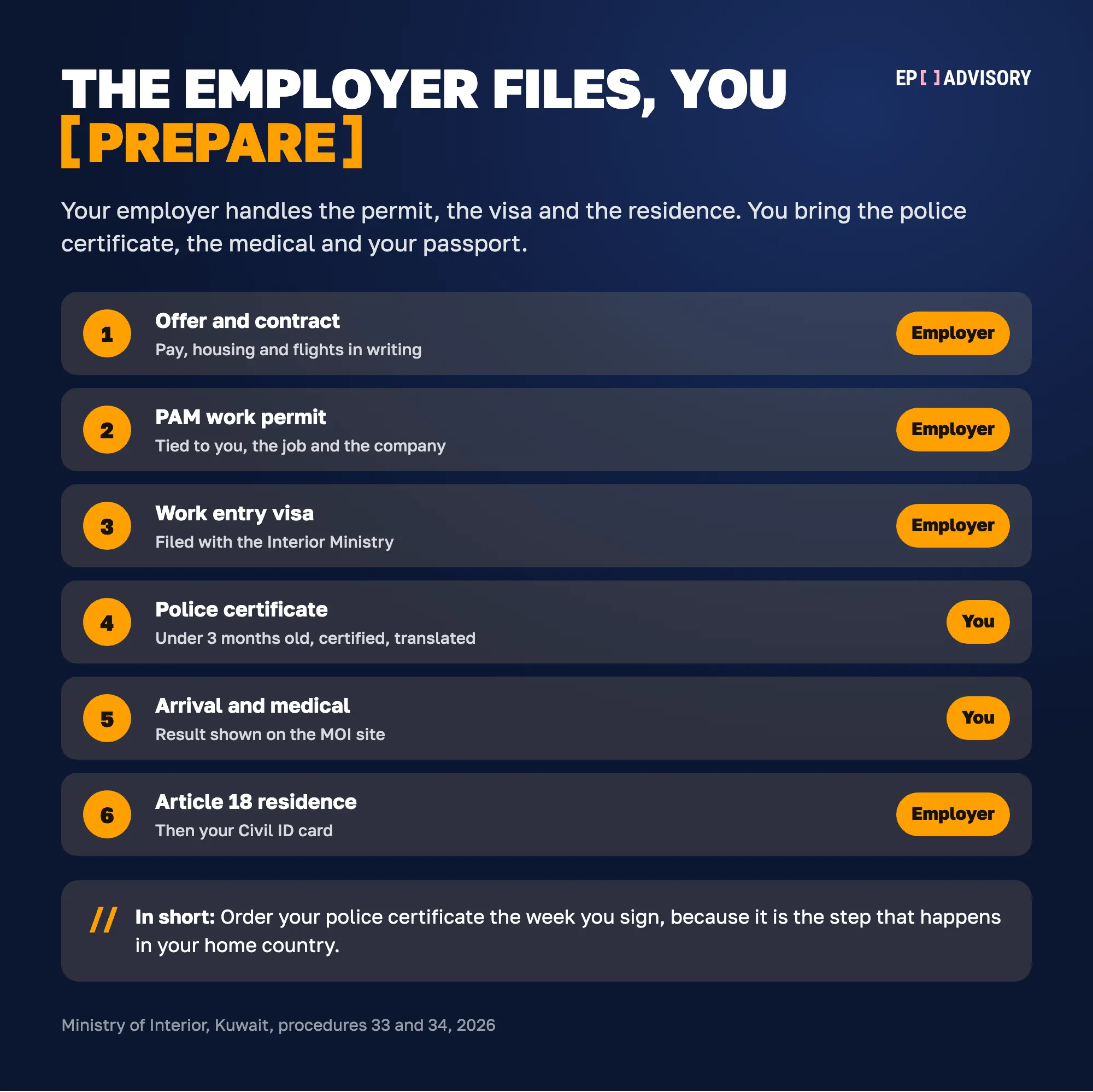
Kuwait has several residence types, each named after an article of the residence law. A private-sector job gives you Article 18 residence. Government staff hold Article 17, and family members hold Article 22 (Ministry of Interior, residence services). The order is usually the same:
- Offer and contract. Get basic salary, housing, transport, flights and leave in writing before anything is filed.
- Work permit. Your employer applies to PAM for a work permit tied to you, the job and the company.
- Work entry visa. The employer files with the Interior Ministry. The ministry asks for the application form, the PAM work permit, a copy of the company’s signature authentication and a copy of your passport (MOI, work entry visa).
- Police certificate. You get a criminal record certificate from your home country. It must be under 3 months old, certified by your foreign ministry and the Kuwaiti embassy, and translated.
- Arrival and medical. You enter on the work visa, then complete the medical check. You can follow the result on the MOI health check page.
- Residence and Civil ID. The employer files the Article 18 residence with your original passport, the visa, the police certificate, the medical, 2 photos and a health insurance certificate (MOI, first work residence). Your Civil ID card then serves as proof of residence. It replaced the old passport sticker in 2019 (Fragomen).
Step 4 is the one that slows people down, because it happens in your home country. Order the police certificate as soon as you have a signed offer. Ask the employer’s PRO, the staff member who handles government paperwork, how it should be certified and translated. Under the current rules, a passport with at least 6 months’ validity is enough for a new residence.
Five rules changed in 2025 and 2026, and each one is manageable
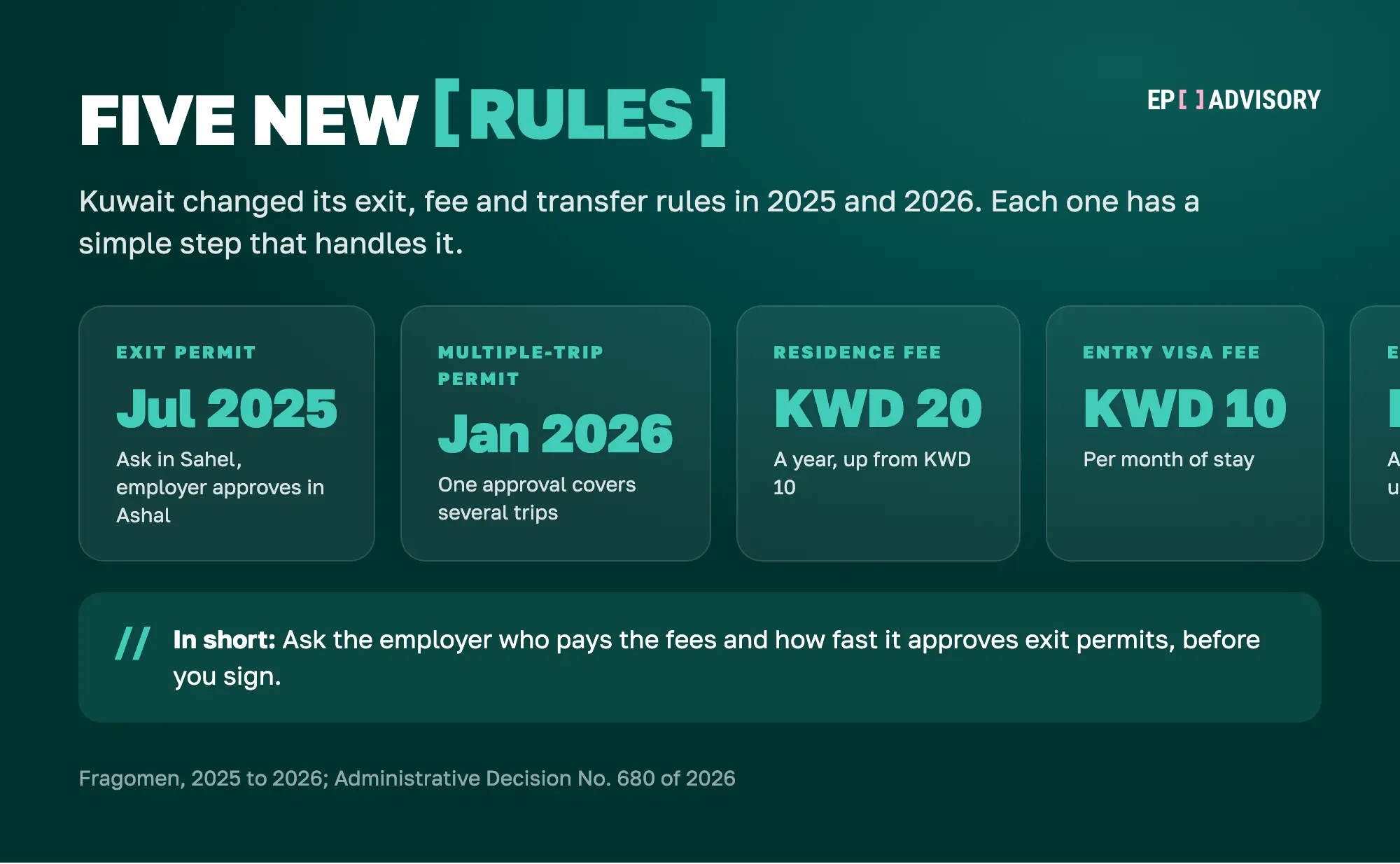
Kuwait updated its residence and labour rules in 2025 and 2026. Older guides miss these changes. Here is what is different now and what to do about each one.
- Exit permit since 1 July 2025. Private-sector foreign workers need an exit permit to leave Kuwait, for a holiday or for good. You request it in the Sahel government app, and your employer approves it on the Ashal portal (Fragomen, June 2025). The rule still applied in November 2026 (Fragomen, Middle East update). Ask before you sign how fast the company approves requests.
- Multiple-trip exit permit since January 2026. One approval can now cover several trips (Fragomen, January 2026). If your job involves travel, ask for this permit as part of your onboarding.
- Higher fees. According to Fragomen and press reports, the residence fee rose to KWD 20 a year (about $65 or £48), up from KWD 10. Entry visas, including work visas, cost KWD 10 per month of stay (Fragomen, January 2026). Ask the employer to confirm in writing that it pays them.
- Shorter passport validity. A new residence now needs a passport valid for 6 months, down from 2 years (same source). Renew early anyway if your passport runs out within a year.
- Early transfer in set cases. Administrative Decision No. 680 of 2026, published in the official gazette Kuwait Al-Youm on 24 May 2026, lets PAM approve a move to a new employer before your first year ends. That applies if, for example, your wages are unpaid (Arab Times, May 2026). Keep your payslips and bank statements, because they are your proof.
Score your CV in 30 seconds, then fix its biggest problems one by one. Both free.
Free, no card. A free account unlocks every fix.

You can change employer after a year, and sooner if the employer breaks the rules
Your work permit is tied to your employer. Since 2021, PAM lets you transfer to a new private employer after 1 year from the date your work permit was issued, down from 3 years. Your current employer still has to approve the move (Business & Human Rights Resource Centre, May 2021).
The 2026 rules add exceptions where you can move before the first year without waiting. They apply when (Fragomen, June 2026):
- your wages have not been paid
- the employer did not complete your work permit or residence steps
- you have the right under the labour law to end the contract without notice
- the employer’s file with PAM is suspended
- the employer filed a false absconding report against you
A further rule from March 2025 lets workers on government contracts move to a private employer when the contract ends, with both employers’ consent (Fragomen, March 2025). Family members on Article 22 residence can also transfer to Article 18 work residence once they find a job (MOI residence services).
So plan your first year as a whole. Pick an employer you would stay with for 12 months. Ask in the interview how the company handles transfers and exit permits, and listen for a clear answer.
Pay is tax-free, and the package matters more than the average
Kuwait has no personal income tax, so gross pay is your take-home pay (PwC Worldwide Tax Summaries). The legal minimum wage in the private and oil sectors is KWD 75 a month, about $244 or £181. It was set by a ministerial decision in June 2017 (Kuwait Times, June 2017). The figure is a legal floor, far below what skilled roles pay.
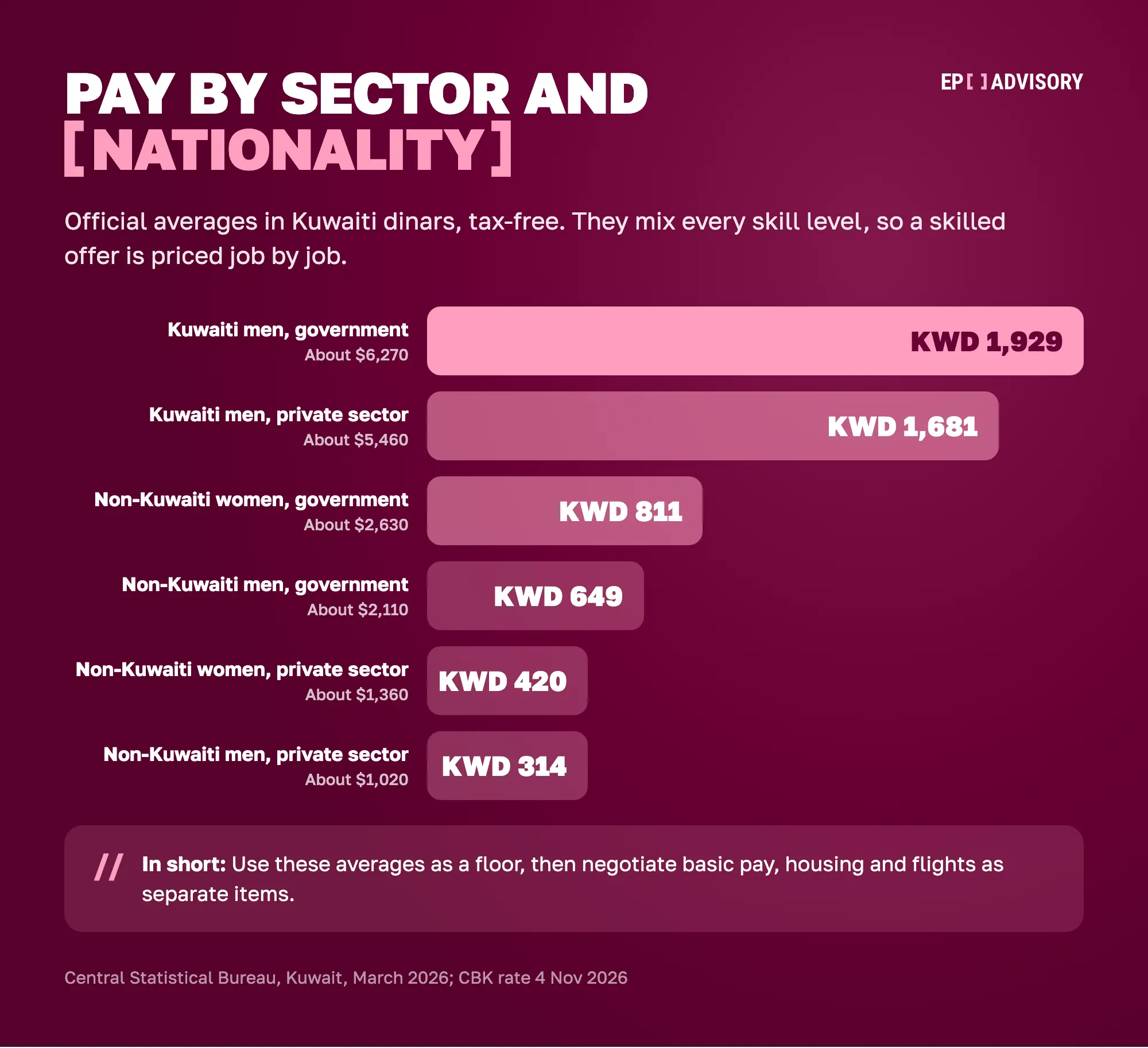
The official averages for March 2026 show how pay differs by sector and nationality. Non-Kuwaiti men in the private sector averaged KWD 314 a month (about $1,020). Non-Kuwaiti men in government averaged KWD 649 (about $2,110). Kuwaiti men in government averaged KWD 1,929 (CSB dashboard). Rates use the Central Bank of Kuwait’s rate of 4 November 2026, where KWD 1 is about $3.25 or £2.41 (Central Bank of Kuwait).
These averages mix every skill level, from cleaners to finance directors. So they say little about a skilled offer, which is priced job by job. Use them as a floor for your expectations, not as your target.
When you compare offers, split the package into parts:
- basic salary
- housing, or a housing allowance
- transport and annual flights home
- health insurance, which the residence requires
- who pays the residence and visa fees
Next: compare Gulf pay by sector in our salaries in Qatar and salaries in Dubai guides, then read our salary negotiation guide before you answer an offer.
Kuwait next to Qatar and the UAE: the rules side by side
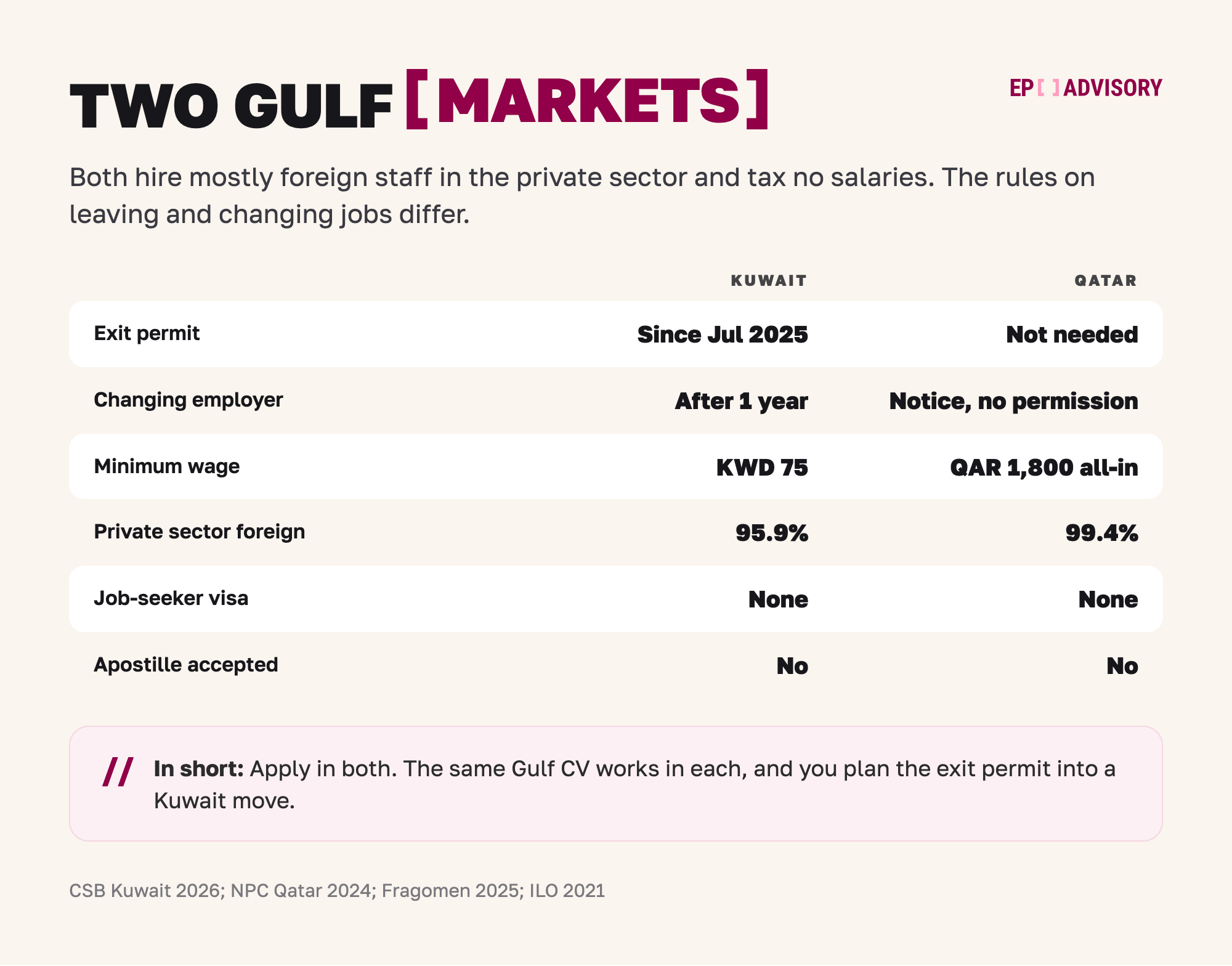
Most people looking at Kuwait also apply in Qatar and the UAE. The three countries share tax-free pay and employer sponsorship, but they differ on job-seeker visas, leaving the country and changing jobs.
| Rule | Kuwait | Qatar | UAE |
|---|---|---|---|
| Job-seeker visa | None. Visit visas are family, medical, commercial and tourist | None | Job seeker visit visa for 60, 90 or 120 days |
| Minimum wage for foreigners | KWD 75 a month, private and oil sectors | QAR 1,000 basic, plus QAR 300 food and QAR 500 housing if not provided | No minimum wage for expats |
| Changing employer | After 1 year with approval, earlier in set cases | No employer permission needed; notice applies | During probation, 1 month’s notice to join another UAE employer |
| Leaving the country | Exit permit via Sahel, approved by the employer | No exit permit | 14 days’ notice if you leave during probation |
| Income tax on salary | None | None | None |
| Apostille accepted | No, consular legalisation | No, consular legalisation | No, consular legalisation |
The ILO explains Qatar’s minimum wage. Our guides to jobs in Dubai and jobs in Qatar cover the other two columns in detail. For Saudi Arabia, read our guide to working in Saudi Arabia.
The table is a reason to apply in all three, not to pick one. Kuwait’s private sector is as open to foreigners as Qatar’s, so a strong CV works in every Gulf market. The practical difference is planning: in Kuwait you build the exit permit and the first-year transfer rule into your plans from day one.
Apply to employers directly, then use the Gulf job boards
Kuwait’s larger employers post roles on their own careers pages. Start with the ones that match your field:
- Banking: National Bank of Kuwait careers.
- Logistics: Agility careers, a Kuwaiti logistics group with offices worldwide.
- Oil and gas: Kuwait Petroleum Corporation and Kuwait Oil Company. Check the service firms that work for them too.
- Healthcare and teaching: private hospital groups and international schools hire on their own sites. Ministries hire foreign doctors, nurses and specialist teachers through their own channels.
Then cover the job boards. Bayt, GulfTalent and NaukriGulf carry many Kuwait roles, and LinkedIn Jobs is strong for professional and management roles. Set Kuwait as your location and save alerts, so new roles reach you on the first day.
Keep your CV ready, so you can answer a new role on the day it appears. Show your licences, your Gulf or international experience and your notice period in the first lines. Write a short cover letter for each role; our guide to a cover letter for a job abroad shows the shape. For the first video interview, our guide on passing a job interview helps. Getting ready to apply for jobs in Kuwait? Check your CV for free: see it the way a recruiter does, then fix each problem.
Legalise your degree early, because Kuwait does not accept an apostille
Kuwait is not a party to the Apostille Convention. Neither are Qatar and the UAE. Saudi Arabia, Bahrain and Oman are (HCCH status table). An apostille stamp alone does not make your degree valid in Kuwait. You need consular legalisation instead.
The usual chain has three stops:
- the issuing authority or a notary in your home country
- your country’s foreign ministry
- the Kuwaiti embassy or consulate in your country
Do this for your degree, your police certificate and any marriage or birth certificates you will need for family residence later. Start as soon as you begin applying, because each stop takes time. Ask the employer whether a final stamp in Kuwait is also needed. Engineers, doctors and nurses should also ask the employer which professional body checks their qualifications, and whether it needs the original or a certified copy.
Keep translated copies in Arabic ready. The Interior Ministry asks for the police certificate in translation, so ask the employer which other papers need one.
Urgent jobs and visa fees: how to spot a Kuwait job scam
Searches for “urgent jobs in Kuwait” bring up many posts that promise a visa within days. A real job still needs a PAM work permit and an Interior Ministry visa, so check every offer against these signs:
- A fee for the job or the visa. A real employer pays its own hiring costs. Treat any request for money as a warning sign and stop.
- A visit visa for a work job. Your visa should be a work entry visa, leading to Article 18 residence. A tourist or commercial visa is not a work visa.
- No company name. Look up the employer, its website and its staff on LinkedIn before you send your passport.
- Pay far above the market. Compare the offer with the official averages above. A clerk’s job at a manager’s salary is a red flag.
- Pressure to decide today. A real offer can wait a day while you check it.
Ask for the work permit details once the employer says it has been issued. A real employer can tell you the job title on the permit. Never hand over your original passport to anyone except the employer’s PRO at the residence step.
Key takeaways
- Aim at private employers. They are 95.9% foreign-staffed, while government jobs are 75.0% Kuwaiti and mostly closed.
- Get the offer first. There is no job-seeker visa, and your employer files the work permit and visa.
- Order your police certificate and legalise your degree early, because Kuwait does not accept an apostille.
- Plan for the exit permit. Ask how fast the employer approves requests, and ask for a multiple-trip permit if you travel.
- Pick an employer you would stay with for a year. You can transfer after 12 months, or earlier if your wages go unpaid.
- Judge an offer by the full package, and never pay anyone for a job or a visa.
See what a recruiter sees, then fix it before you apply. An instant score, then the fix for every problem.
Free, no card. A free account unlocks every fix.
Frequently asked questions
Can foreigners get jobs in Kuwait in 2026?
Yes. Foreigners hold 95.9% of private-sector jobs, according to the Central Statistical Bureau’s March 2026 figures. Government jobs are mostly reserved for Kuwaitis, apart from some medical and teaching roles. You need a job offer from an employer who sponsors your work permit and residence.
Can I go to Kuwait on a visit visa to look for work?
Kuwait has no job-seeker visa. The Interior Ministry’s visit visas are for family, medical, commercial and tourist trips. Search and interview from home, and enter Kuwait on a work entry visa once you have an offer.
What is the minimum salary in Kuwait for foreigners?
The legal minimum wage in the private and oil sectors is KWD 75 a month, about $244 or £181. Skilled roles pay far more. Non-Kuwaiti men in the private sector averaged KWD 314 a month in March 2026, and that average includes every skill level.
Do I need permission to leave Kuwait?
Yes, if you work in the private sector. Since 1 July 2025 you need an exit permit for every departure. You request it in the Sahel app and your employer approves it on the Ashal portal. A multiple-trip permit has been available since January 2026.
Can I change jobs in Kuwait?
Yes. You can transfer to a new private employer after 1 year from the date your work permit was issued, with your current employer’s approval. Since 2026 you can move earlier in set cases, such as unpaid wages or an employer that did not complete your papers.
Can I work remotely for a Kuwaiti company?
A job based in Kuwait needs a work permit and residence through the employer. If you work for a Kuwaiti company from your own country, you do not live in Kuwait, so your home country’s work and tax rules apply. You would need a Kuwait visa for any business trips there.
Is there income tax in Kuwait?
No. PwC’s tax summary states that Kuwait does not tax individuals’ income, so your gross salary is your take-home pay. Check your home country’s rules too, because some countries tax citizens or residents on income earned abroad.