 By Andre Atallah, CEO of EP Advisory

Short answer: yes, foreigners can get jobs in South Korea, and the degree question decides your route. With a bachelor’s degree and a passport from one of seven English-speaking countries, you can teach on an E-2 visa. Professionals of any nationality can use the E-7 visa with a degree, or with 5 years of related experience and no degree. The EPS factory and farm route (E-9) is open to 17 partner countries only.
South Korea has a visa for each kind of job, each with its own rules on degrees, passports and pay. The E-2 visa is for language teachers. The E-7 visa covers 94 listed occupations, from software developers and engineers to hotel staff and welders. The E-9 visa, through the Employment Permit System (EPS), brings in workers for small factories, farms and building sites from 17 partner countries.
This guide starts with the question most foreigners ask first: do you need a degree? Then it covers each route, the Korean you need, where to look and what jobs pay in 2026. All rules here come from the Ministry of Justice visa manual of October 2026 and other official sources. Immigration rules change often, so check the current rules with the official authority before you act.
For nearly 10 years, we’ve helped more than 5,000 professionals find jobs abroad. Want to know if your CV will pass screening in South Korea? Check your CV for free: a score in 30 seconds, then a fix for each problem.
Can foreigners work in South Korea? Routes by background
Every route needs an employer or a programme first. In each case the employer, school or programme sponsors you. With most routes, they apply in Korea for a visa issuance certificate. You then collect the visa at a Korean consulate and register as a foreign resident after you arrive.
Start with two questions: do you have a bachelor’s degree, and which passport do you hold?
- Degree and a passport from the US, UK, Canada, Ireland, Australia, New Zealand or South Africa: E-2 English teaching is open to you, and so is the E-7 professional route.
- Degree and any other passport: the E-7 route, and the D-10 job seeker visa to search from inside Korea. Indian citizens have a separate E-2 option as public school assistant teachers.
- No degree but 5 years of related experience: the E-7 route is still open. It accepts experience in place of a degree.
- No degree and a passport from an EPS partner country: the E-9 route into manufacturing, farming, fishing or construction.
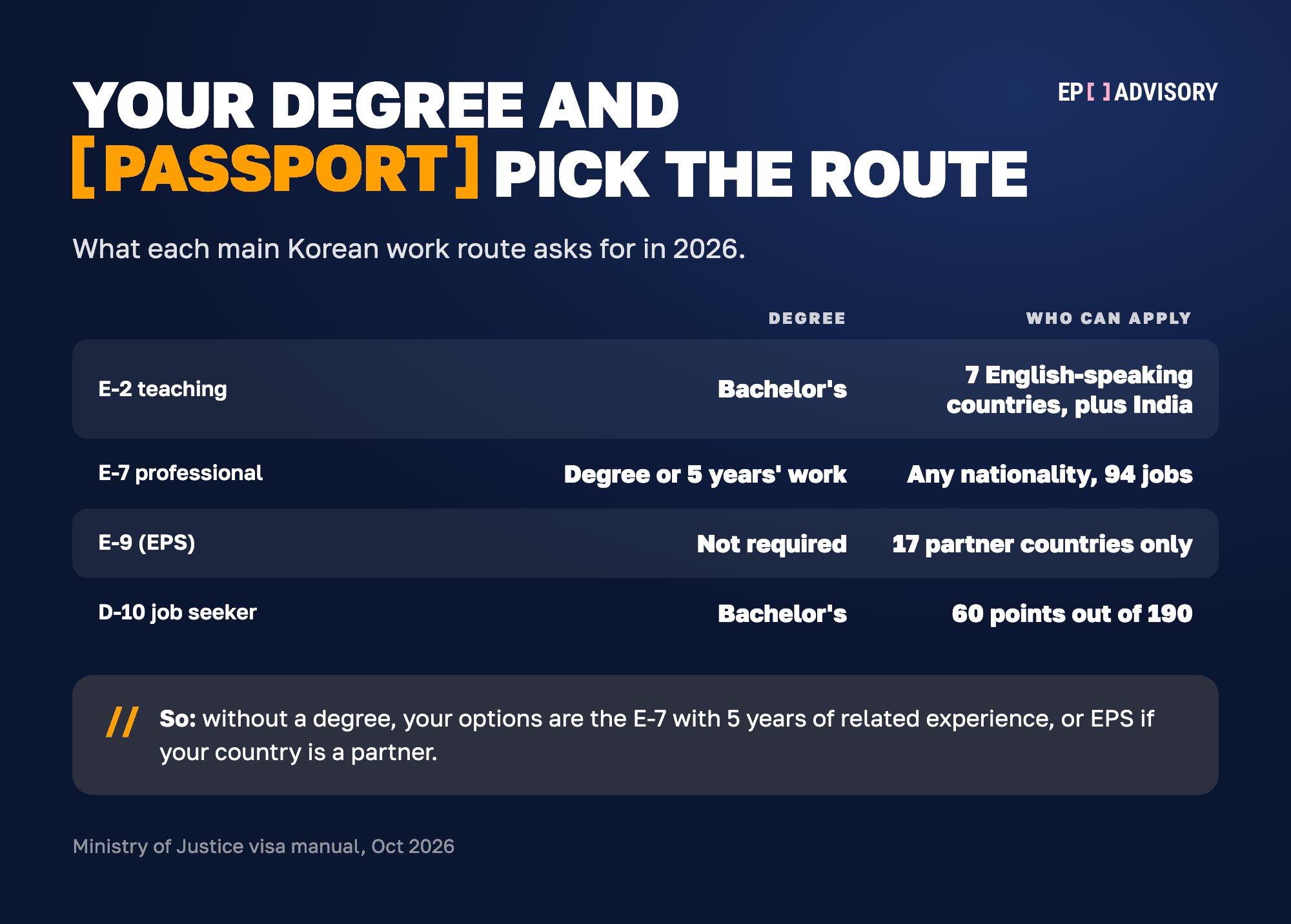
| Route | Who it fits | Degree | Pay rule in 2026 | Stay per grant |
|---|---|---|---|---|
| E-2 teaching | Native English speakers from 7 countries, plus Indian public school assistants | Bachelor’s, from your own country | At least the minimum wage | 2 years, extendable |
| E-7 professional | Any nationality, in one of 94 listed occupations | Degree, or 5 years of related experience | KRW 31,120,000 a year for professionals | 3 years, extendable |
| E-9 (EPS) | Citizens of 17 partner countries | Not required | At least the minimum wage | Up to 3 years, 4 years 10 months in total |
| D-10 job seeker | Graduates who score 60 points | Bachelor’s | No job yet: you show savings | 6 months to 1 year |
Teaching English on an E-2 visa
The E-2 visa has a passport rule and a degree rule, and both must be met. The visa manual lists seven countries whose mother tongue is English: the US, the UK, Canada, South Africa, New Zealand, Australia and Ireland. You must be a citizen of one of them and hold a bachelor’s degree or higher from a university in that country. A degree from Korea also works if you finished school in your own country first.
The manual allows some exceptions for other languages, but not for English. A fluent English speaker from the Philippines, Nigeria or Germany cannot get an E-2 visa to teach English. The one exception is India: under the Korea-India trade agreement, Indian graduates with a teacher certificate in English can work as assistant teachers in public schools.
There are two main ways to teach:
- Private academies (hagwons): the school sponsors your E-2-1 visa. The certificate covers your contract plus one month, up to 2 years.
- Public programmes: EPIK places teachers in public schools. It asks for schooling in English from grade 7 and, if your degree is not in education, a TEFL, TESOL or CELTA certificate of at least 100 hours. The TaLK programme places students and graduates in rural schools. It needs at least 2 years of university, or 1 year for UK citizens.
Start the paperwork early. For an academy job you need:
- your degree with an apostille
- a nationwide criminal record check with an apostille, issued within the last 6 months
- a second criminal record check from the country of your degree, if it differs from your passport country
- a health self-declaration
- a contract that pays at least the minimum wage
Korea has been part of the Apostille Convention since 2007, so a UK, US or Irish apostille is accepted. EPIK says the visa itself takes at least 14 business days after the school sends your papers.
E-7 visa: jobs for professionals of any nationality
The E-7 is the main route for professionals, and it is open to every passport. The employer must hire you for one of 94 occupations on the Ministry of Justice list. The list has four groups:
- E-7-1, professionals (67 jobs): managers, software and web developers, data and security specialists, engineers, nurses, international school teachers, overseas sales, translators and designers.
- E-7-2, semi-professionals (10 jobs): such as duty-free sales, airline ticketing, hotel reception, medical coordinators, customer service, tour guides, chefs and care workers.
- E-7-3, general skilled workers (14 jobs): such as shipbuilding welders, ship painters and aircraft mechanics.
- E-7-4, skilled workers (3 groups): a points route mostly used by workers already in Korea.
The education rule is where the E-7 differs from many countries. You need any one of these: a related master’s degree, a related bachelor’s degree plus 1 year of experience after graduating, or 5 years of related experience with no degree at all. So a software developer or a chef without a degree still has a route, if they can show five years in the field.
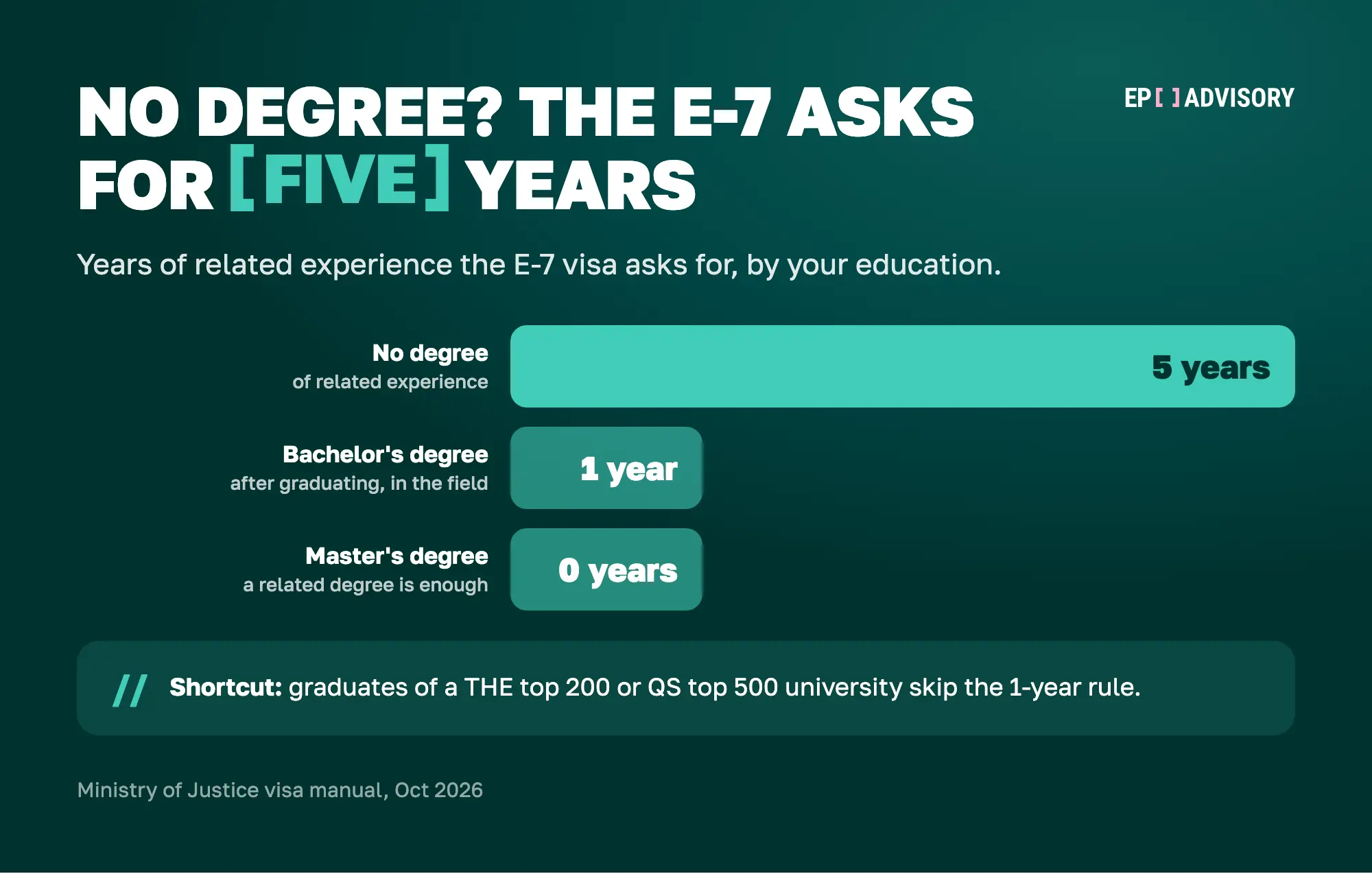
Two shortcuts help graduates. If your university is in the Times Higher Education top 200 or the QS top 500, you skip the 1-year experience rule. A year or more at a Fortune Global 500 company can waive the education and experience rules.
Two limits apply to the employer. In protected occupations, foreign hires are capped at 20% of the company’s Korean staff. The job must also pay the 2026 E-7 pay bar, set out in the pay section below. The E-7 gives a stay of up to 3 years, which can be extended. Our guide to countries with talent visas compares other options.
Score your CV in 30 seconds, then fix its biggest problems one by one. Both free.
Free, no card. A free account unlocks every fix.

EPS and the E-9 visa: who can use it
EPS is a government-to-government scheme, not an open visa. Korea’s Employment Permit System has run since August 2004. It recruits workers only from countries that signed an agreement with Korea. In 2026 there are 17: Thailand, the Philippines, Sri Lanka, Vietnam, Indonesia, Mongolia, Pakistan, Uzbekistan, Cambodia, China, Bangladesh, Nepal, Myanmar, Kyrgyzstan, Timor-Leste, Laos and Tajikistan.
If your passport is not on that list, EPS is not a route for you, and no agent can change that. That includes the UK, the US, India and Nigeria. If it is on the list, you register through your own government’s public employment agency and sit the EPS-TOPIK Korean test. Details are on the official EPS site.
- Employers: small and medium firms with fewer than 300 staff or capital of KRW 8 billion or less.
- Sectors: manufacturing, construction, farming, fishing and some services.
- Hiring: the job centre refers 3 candidates for each vacancy, and new workers do a 16-hour induction.
- Length: up to 3 years per grant and 4 years 10 months of work in total.
The D-10 job seeker visa: search from inside Korea
The D-10-1 visa gives graduates time in Korea to find a professional job. It covers searching and short paid internships for jobs under the E-1 to E-7 visas. You cannot use it from abroad to look for E-7 semi-professional or skilled jobs. You need a bachelor’s degree or higher and at least 60 points out of 190, with at least 20 from the basic items.
| Item | Points |
|---|---|
| Age | 20-24: 10; 25-29: 15; 30-34: 20; 35-39: 15; 40-49: 5 |
| Education | Bachelor’s: 15; master’s: 20; PhD: 30 |
| Work experience abroad | 3-4 years: 5; 5-6 years: 10; 7 years or more: 15 |
| Korean (TOPIK) | Level 2: 5; level 3: 10; level 4: 15; level 5 or 6: 20 |
| Bonus items | THE top 200 or QS top 500 university: 20; Fortune Global 500 experience: 20; STEM bachelor’s: 5; recommendation from a ministry or consulate: 20 |
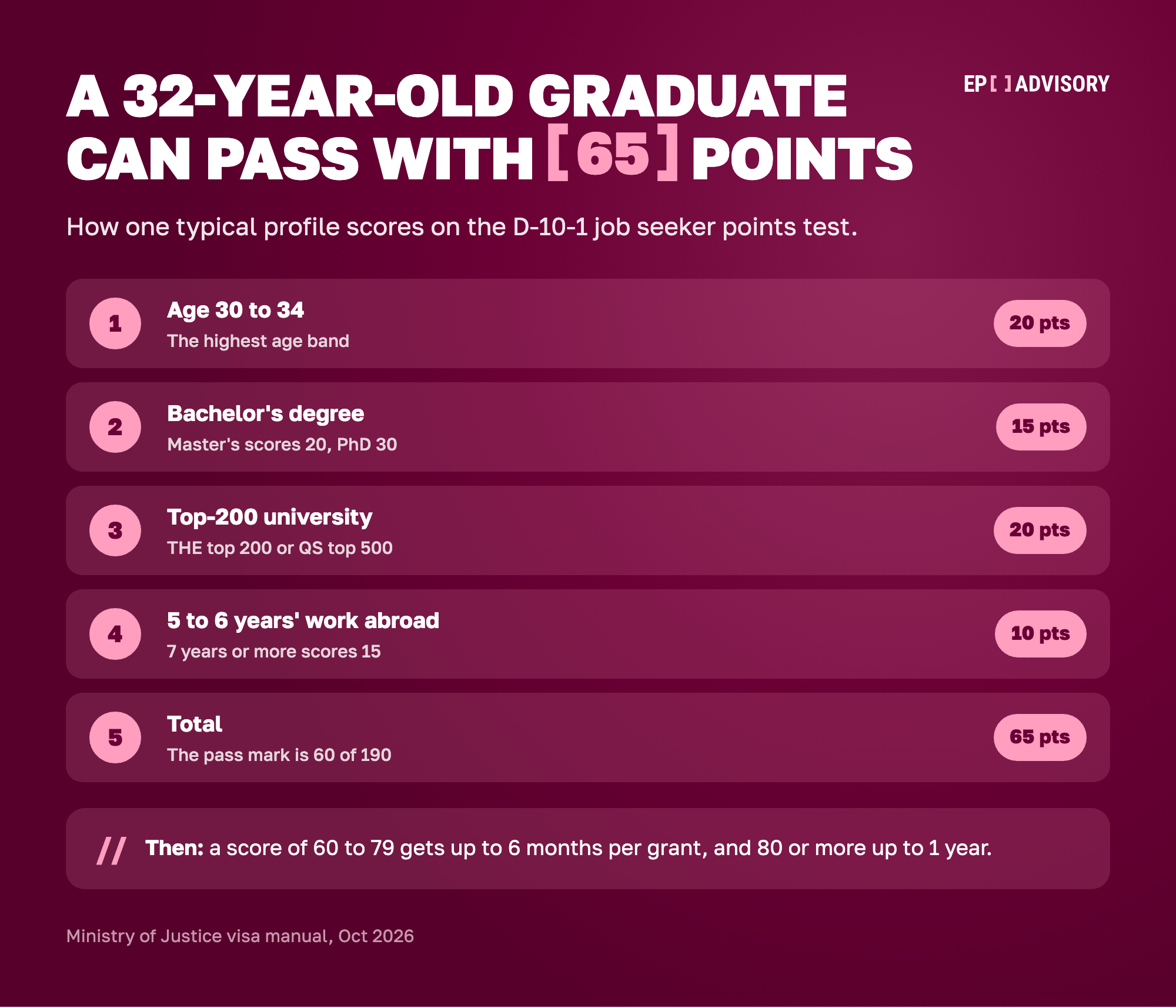
The consulate issues a single-entry visa. Scores of 60 to 79 get up to 6 months per grant, and 80 or more can get up to 1 year. You also show savings to cover your stay. Internships can last up to a year in total, and up to 6 months with one company.
Do you need Korean? TOPIK and language rules
For most teaching and professional jobs, the employer sets the Korean level. Many Korean firms work in Korean every day, so ask early. A few visa rules do set a level. Korean counts in three places:
- E-7-2 customer service jobs need TOPIK level 2, level 2 of the government integration course (KIIP), or a TOEIC score of 730.
- The D-10 points test gives 5 to 20 points for TOPIK level 2 and above.
- EPS candidates sit the EPS-TOPIK Korean test in their home country.
If you plan to stay beyond one contract, start Korean before you arrive.
English-speaking jobs in South Korea
Most English-only jobs are in teaching, international firms and tech. On the E-7 list, the roles where English often comes first are:
- software and data roles at start-ups and global firms
- overseas sales and marketing for exporters
- translators and interpreters
- international school teachers
- hotel and airline roles that serve foreign guests
Elsewhere, expect Korean. If you can work fully remote, our guide to remote jobs in Europe shows how that market hires. For another nearby option, see our guide to jobs in Japan for foreigners.
International employers in Korea read English CVs the way global firms do. They look for results with numbers, not a list of duties. Put your visa route near the top, for example “Eligible for E-7: BSc Computer Science plus 4 years in software”. Our CV achievement examples show how to turn duties into results. Check your English CV against what international employers expect before you send it. Getting ready to apply for jobs in South Korea? Check your CV for free: see it the way a recruiter does, then fix each problem.
Where to find jobs in South Korea
Use a Korean job board and an English route at the same time. The big Korean boards are mostly in Korean. Public programmes and global firms post in English.
| Where | Best for | Language |
|---|---|---|
| Work24 | Government job portal, all sectors | Korean |
| Saramin | One of the largest private boards | Korean |
| JobKorea | Large private board, corporate jobs | Korean |
| Wanted | Tech and start-up jobs | Mostly Korean |
| EPIK | Public school teaching | English |
| Seoul Global Center | Free help and information for foreign residents | English and other languages |
For global firms, go straight to their career pages and to recruiters who hire for their Seoul offices. Write a short cover letter that names the visa you qualify for, using our guide to a cover letter for a job abroad. Then prepare for video interviews with our guide on how to pass a job interview.
What jobs pay: the minimum wage and visa pay bars
Korea’s 2026 minimum wage is KRW 10,320 an hour, or KRW 2,156,880 a month for a full-time job. That is about USD 1,611 or GBP 1,194 a month, at ECB rates of 4 November 2026. It rises to KRW 10,700 an hour in 2027 (Minimum Wage Commission).
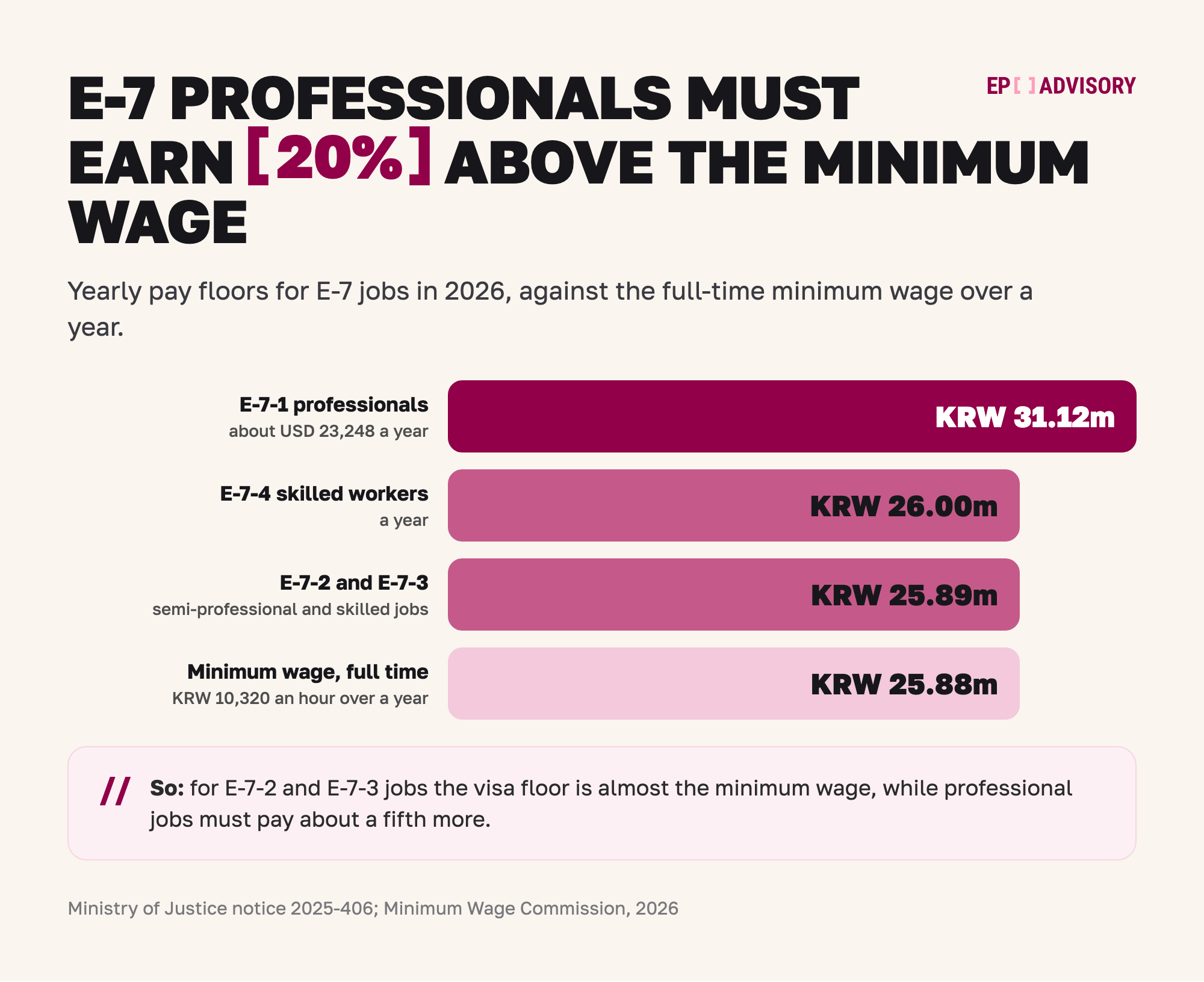
The E-7 visa adds its own pay bars, which apply from 1 February to 31 December 2026 (Ministry of Justice notice 2025-406). The contract must pay at least:
- E-7-1 professionals: KRW 31,120,000 a year, about USD 23,248 or GBP 17,221.
- E-7-4 skilled workers: KRW 26,000,000 a year.
- E-7-2 and E-7-3: KRW 25,890,000 a year, about USD 19,341. That is almost exactly the minimum wage over a year.
EPIK teachers outside Seoul earn KRW 2.1 million to 2.8 million a month by pay level, about USD 1,569 to 2,092, with housing provided. Offices of education are not hiring at level 3, so new teachers start at level 2 or above. Level 2 pays KRW 2.2 million to 2.35 million. EPIK also pays a settlement allowance of KRW 300,000, an entrance allowance of KRW 1,800,000 and a KRW 1,300,000 bonus when you finish the contract (EPIK pay scale, Fall 2026). Seoul’s office of education uses its own scale.
Next: before you discuss an offer, read our guide on how to negotiate salary, so you can ask above the visa floor with confidence.
Scams and illegal work on visa-free entry
You cannot work in Korea on visa-free entry or a K-ETA. Many English-speaking visitors enter without a visa. In 2026, the US, the UK, Germany and Japan are among 22 countries that do not need a K-ETA until 31 December 2026 (Ministry of Foreign Affairs). Others pay KRW 10,000 for a K-ETA, usually approved within 72 hours. Either way, the K-ETA rules allow no paid work.
Enforcement is active. On 30 October 2026 the Ministry of Justice announced a joint crackdown with the police and other ministries on illegal hiring. Students caught working illegally in restricted fields face deportation in principle. People who stay or work illegally normally face fines and entry bans. A special voluntary departure scheme waived these only for those who left between December 2025 and February 2026.
Four checks keep you safe:
- Never start work before your visa is issued. A real employer sponsors the visa first.
- Never pay for a job offer. A request for a “visa fee” to hold a place is a warning sign.
- Apply for a K-ETA only on the official site or app. The K-ETA site warns about fake copies.
- Check any rule you are unsure of with the HiKorea immigration contact centre on 1345, or +82-2-1345 from abroad (HiKorea).
Key takeaways
- Your degree and your passport decide your route, so check both before you apply anywhere.
- E-2 English teaching needs a bachelor’s degree and citizenship of one of seven English-speaking countries, with a separate route for Indian public school assistants.
- The E-7 visa is open to every passport in 94 occupations, and 5 years of related experience can replace a degree.
- EPS factory and farm jobs are open only to citizens of 17 partner countries, through their own government.
- Graduates who score 60 points can use the D-10 visa to search for a professional job from inside Korea.
- In 2026, E-7 professional jobs must pay at least KRW 31,120,000 a year, and every job must pay at least KRW 10,320 an hour.
- Never work on visa-free entry or a K-ETA, and never pay for a job offer.
See what a recruiter sees, then fix it before you apply. An instant score, then the fix for every problem.
Free, no card. A free account unlocks every fix.
Frequently asked questions
Can foreigners get a job in South Korea in 2026?
Yes. Most foreigners need an employer or programme to sponsor a work visa. Teachers use the E-2 visa, professionals of any nationality use the E-7 visa in 94 listed occupations, and workers from 17 partner countries can use the EPS E-9 route. Graduates can also search from inside Korea on a D-10 job seeker visa.
Can I work in South Korea without a degree?
Yes, on two routes. The E-7 professional visa accepts 5 years of related experience in place of a degree. The EPS E-9 route for factories, farms and building sites needs no degree, but it is only open to citizens of 17 partner countries. E-2 teaching and the D-10 job seeker visa both need a bachelor’s degree.
Which countries can teach English in South Korea on an E-2 visa?
Citizens of the US, the UK, Canada, South Africa, New Zealand, Australia and Ireland, with a bachelor’s degree from a university in that country. Indian citizens can teach as assistant teachers in public schools under the Korea-India trade agreement, with a bachelor’s degree and a teacher certificate in English.
Do companies in South Korea sponsor visas for foreigners?
Yes. Every Korean work visa needs a sponsor. For the E-7 visa, the employer applies for your visa issuance certificate, must hire you in one of 94 listed occupations and must pay at least the 2026 pay bar. For professionals that bar is KRW 31,120,000 a year.
Can I find English-speaking jobs in South Korea?
Yes, mainly in English teaching, international firms, tech start-ups, overseas sales, translation and international schools. Most other jobs expect Korean. Search the Korean job boards and global firms’ career pages at the same time, and send an English CV that states which visa you qualify for.
What is the minimum wage in South Korea in 2026?
KRW 10,320 an hour, or KRW 2,156,880 a month for a full-time job, about USD 1,611 or GBP 1,194 at ECB rates of 4 November 2026. It rises to KRW 10,700 an hour in 2027.
Can I work in South Korea on visa-free entry or a K-ETA?
No. Visa-free entry and the K-ETA allow no paid work. You need a work visa issued before you start. Illegal work can lead to fines, deportation and an entry ban, and the Ministry of Justice announced a new crackdown on illegal hiring on 30 October 2026.