 By Andre Atallah, CEO of EP Advisory

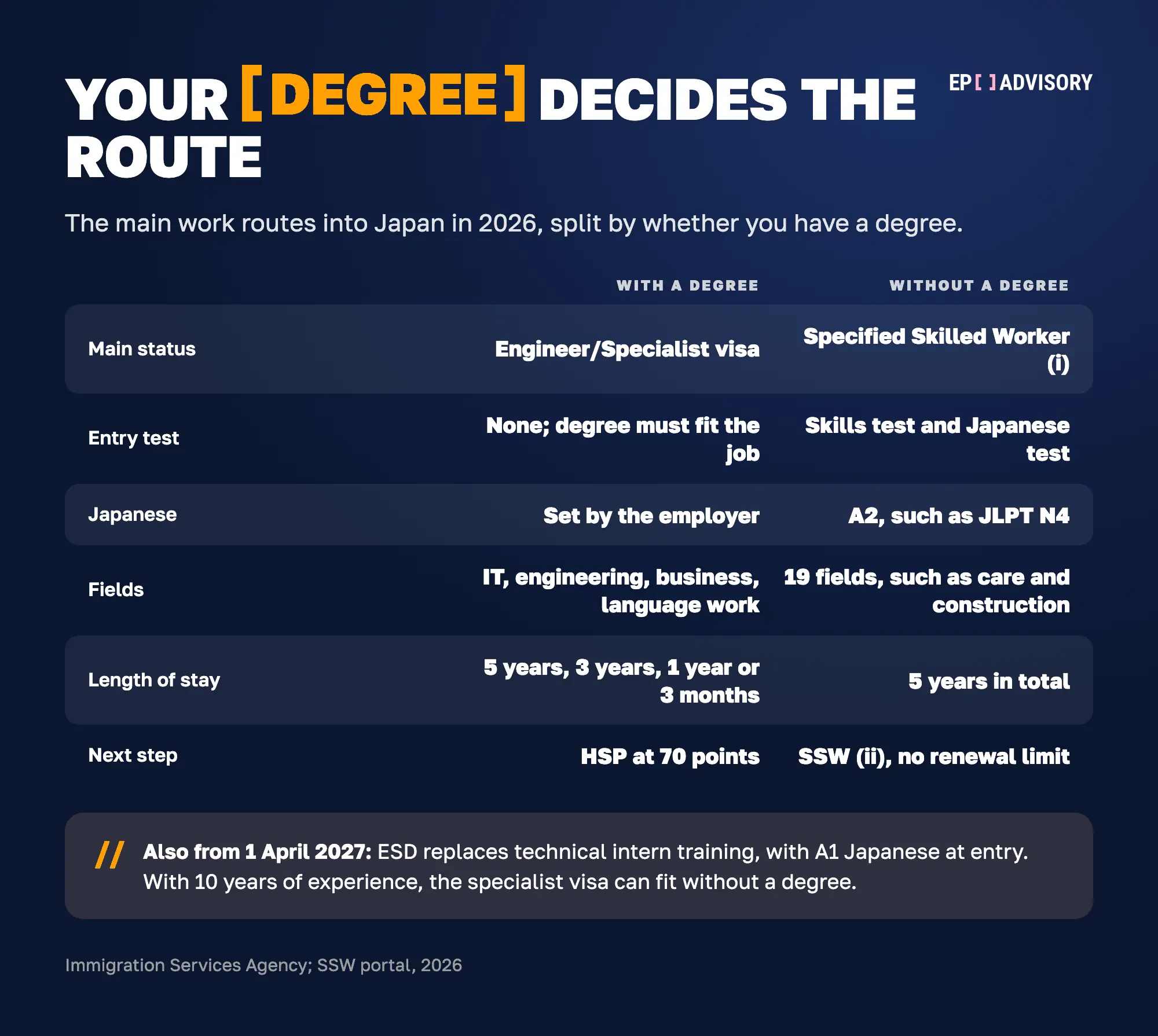
Short answer: yes. Japan hires foreigners in record numbers, and your route depends first on whether you have a degree. Graduates usually work on the Engineer/Specialist in Humanities/International Services visa or on Highly Skilled Professional points. Without a degree, Specified Skilled Worker (SSW) jobs need a skills test and basic Japanese, and a new system called ESD starts on 1 April 2027. In every case, your employer starts the process.
Japan has never employed more foreign workers. At the end of October 2025 there were 2,571,037, 11.7% more than a year earlier. Professionals on specialist visas grew fastest, up 20.4% to 865,588 (Ministry of Health, Labour and Welfare). Unemployment was 2.4% in September 2026 (Statistics Bureau of Japan), so many employers are short of staff.
This guide sorts the routes by your background, not by job title. Start with one question: do you have a degree? Then check your Japanese level, because it decides more offers than any visa rule.
For nearly 10 years, we’ve helped more than 5,000 professionals find jobs abroad. Want to know if your CV will pass screening in Japan? Check your CV for free: a score in 30 seconds, then a fix for each problem.
Can foreigners work in Japan? Start with the degree question
Every foreign worker in Japan needs a status of residence that matches the job. The status (zairyu shikaku) decides which work you may do. A visa-free short visit never allows paid work, whatever your passport.
For a work status, a Japanese employer applies first. It files for a Certificate of Eligibility (CoE), a document from the Immigration Services Agency that confirms you meet the rules. With the CoE, you get your visa at a Japanese embassy or consulate. These are the main routes in 2026:
| Route | Who it fits | Degree | Japanese | Length of stay |
|---|---|---|---|---|
| Engineer/Specialist in Humanities/International Services | Engineers, IT staff, marketing, interpreters, designers, language teachers | A related degree, or 10 years of experience | No fixed level; B2 proof for some customer-facing jobs | 5 years, 3 years, 1 year or 3 months |
| Highly Skilled Professional (HSP) | The same jobs, with higher pay or qualifications | Scores points, not required | Scores points (N1 15, N2 10) | Permanent residence after 3 years, or 1 year with 80 points |
| J-Find | Recent graduates of top-100 universities | Yes, from the last 5 years | None | Up to 2 years to find a job |
| Specified Skilled Worker (i) | 19 fields, such as care, construction and manufacturing | No | A2 (JFT-Basic or JLPT N4) | 5 years in total |
| Specified Skilled Worker (ii) | 11 fields, for experienced workers | No | B1 (JLPT N3) for Certificate of Eligibility applications from April 2027 | No upper limit |
| ESD, from 1 April 2027 | Entry-level workers trained up to SSW level | No | A1 (JLPT N5) at entry | 3 years, then SSW |
Some countries also have a working holiday agreement with Japan. It is a separate status for young people that allows short-term work alongside travel (Immigration Services Agency list of designated activities). Ask the Japanese embassy in your country whether yours takes part and what the age limits are.
With a degree: the specialist visa and Highly Skilled points
Most foreign graduates work in Japan on the Engineer/Specialist in Humanities/International Services status. People in Japan shorten it to gijinkoku. It covers engineers and IT staff, interpreters, designers, marketing staff and language teachers at private companies (Immigration Services Agency). The rules are set in the landing criteria ordinance:
- A degree in a related subject. Your subject must fit the job. A computer science graduate fits a developer role. A history graduate applying for an engineering role does not.
- Or 10 years of experience in the field. Years you spent studying the subject count towards the 10.
- International services work, such as translation, PR, overseas trade or design, needs 3 years of experience. Graduates who translate, interpret or teach languages are exempt from this rule.
- Equal pay. You must earn at least what a Japanese employee would earn for the same job. There is no fixed yen floor.
A new rule applies to applications from 15 April 2026. If your employer is a smaller company (category 3 or 4 in the immigration rules) and your job mainly uses language with people, such as interpreting or a hotel front desk, you must prove CEFR B2 level in the language you use at work. For Japanese, JLPT N2 or a degree from a Japanese university counts as proof. Listed companies and public bodies are category 1, so the rule does not apply to their hires.
Highly Skilled Professional (HSP) status rewards the same profile with faster permanent residence. You need 70 points on the official points table and pay of at least ¥3,000,000 a year. That is about $18,957 or £14,043 at the European Central Bank (ECB) rate on 4 November 2026. Points come from your degree, experience, salary and age. Here is how a 31-year-old engineer reaches the bar:
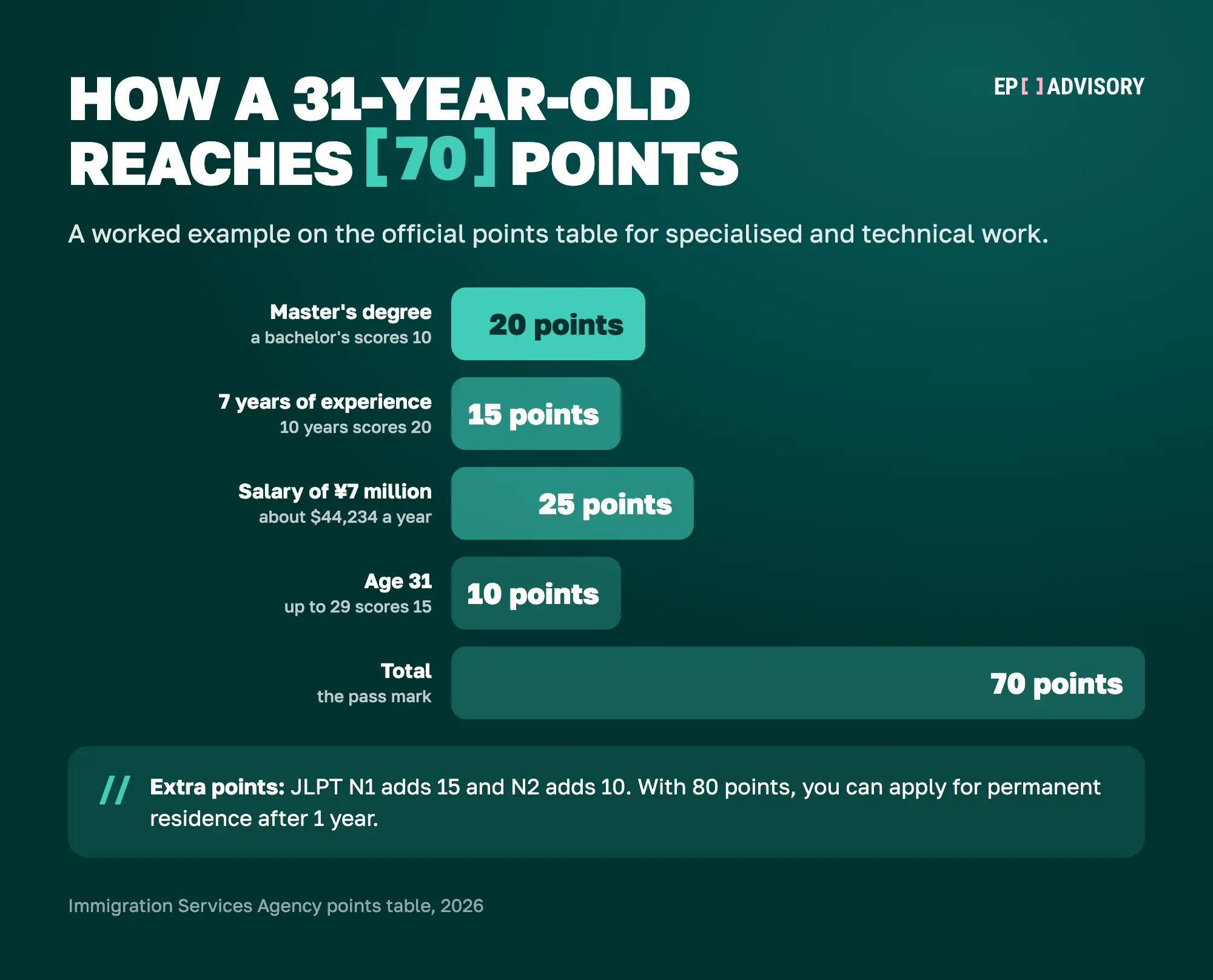
With HSP, you can apply for permanent residence after 3 years, or after 1 year with 80 points. The usual wait is 10 years, and your spouse may work too (Immigration Services Agency). Two more routes have existed since April 2023:
- J-Skip, for very high earners: a master’s degree or 10 years of experience, plus at least ¥20 million a year (about $126,400). Permanent residence is possible after 1 year (J-Skip rules).
- J-Find, for recent graduates: a degree from the last 5 years, from a university in the top 100 of at least two of the QS, THE and Shanghai (ARWU) rankings, plus savings of at least ¥200,000 (about $1,264). You get up to 2 years to look for a job or prepare a business (J-Find rules).
To compare these with talent visas elsewhere, see our guide to the best countries for talent visas.
Score your CV in 30 seconds, then fix its biggest problems one by one. Both free.
Free, no card. A free account unlocks every fix.

Without a degree: Specified Skilled Worker and the new ESD system
You can work in Japan without a degree. The main route is Specified Skilled Worker (SSW), a status for fields with staff shortages. It asks for no degree. Instead, you pass two tests: a skills test for your field and a Japanese test (SSW portal). People who completed technical intern training (ii) in the same field skip both tests.
- SSW (i) covers 19 fields, including nursing care, construction, building cleaning, manufacturing, car maintenance, aviation, hotels, farming, fishing, food manufacturing, railways and logistics warehouses. You can stay 5 years in total, without your family. The Japanese test is at A2 level, such as JFT-Basic or JLPT N4 (SSW fields).
- SSW (ii) covers 11 fields for experienced workers. There is no limit on renewals, and your family can join you. From 1 April 2027, Certificate of Eligibility applications need B1 Japanese, such as JLPT N3 (Immigration Services Agency). The date for changes of status and renewals inside Japan is still to be announced.
Demand is strong. At the end of July 2026, 432,016 people held SSW (i) status, against a government cap of 805,700 to March 2029 (SSW statistics). The largest fields were food and beverage manufacturing (101,922), nursing care (81,436) and industrial products (63,032).
One field is paused. Food service had 49,290 workers against its cap of 50,000, so no new Certificates of Eligibility are issued for restaurant jobs from 13 April 2026 (notice). If you are starting now, aim at care, construction, manufacturing or hotels instead.
Japan has signed SSW cooperation agreements with 17 countries, including the Philippines, India, Pakistan, Sri Lanka, Nepal, Bangladesh, Indonesia, Vietnam and Thailand (list of agreements). They set out the sending procedure in your home country, so read yours before you sign with an employer.
From 1 April 2027, ESD replaces the Technical Intern Training Program. ESD stands for Employment for Skill Development (ikusei shuro). It is a 3-year system that trains entry-level workers up to SSW (i) level in 17 fields (Immigration Services Agency, ESD overview). What it means for you:
- Entry with basic Japanese: A1 level, such as JFT-Basic or JLPT N5, or equivalent classes. You aim for A2 (N4) by the end.
- You can change employer after 1 to 2 years, depending on the field. Hello Work, the public employment service, supports the move.
- Lower recruitment fees: the fees sending organisations charge are limited under agreements between governments.
- A clear next step: ESD leads into SSW, and SSW (ii) has no limit on renewals.
Have 10 years of experience in a skilled field? Then the specialist visa above may fit you without a degree. Whatever the route, ask the employer which costs it covers.
Japanese level and the JLPT: the main filter
Japanese decides more job offers in Japan than any visa rule. The law sets a level only for SSW, ESD and some customer-facing specialist jobs. Employers set it for everything else. The common yardstick is the JLPT, the Japanese-Language Proficiency Test. It has five levels, from N5 (basic) to N1 (advanced), and it runs twice a year. The next test is on 6 December 2026.
| Level | CEFR level | What it counts for in 2026 and 2027 |
|---|---|---|
| N5 | A1 | Entry to ESD from 1 April 2027 |
| N4 | A2 | The Japanese test for SSW (i), or JFT-Basic |
| N3 | B1 | SSW (ii) Certificate of Eligibility applications from 1 April 2027 |
| N2 | B2 | Proof of B2 for customer-facing specialist jobs; 10 HSP points |
| N1 | C1 and above | 15 HSP points |
Put your JLPT level, or the level you are studying for, on your CV. While you build towards N2, aim at the jobs that run in English.
Jobs in English: IT, teaching and foreign firms
English-language jobs in Japan cluster in three areas. There is no official count. In our experience, these are where foreigners without fluent Japanese get hired most often:
- IT and software. Many tech firms in Tokyo work in English. On Japan Dev, a curated tech job board, 18 of the 24 newest jobs on 5 November 2026 were open to applicants abroad, and 6 required Japanese.
- English teaching. Private language schools hire on the specialist visa. The government’s JET Programme places assistant language teachers in public schools. It needs a bachelor’s degree in any subject (for the US 2027 intake, by 25 June 2027), and you apply through the Japanese embassy or consulate in your country (JET Program USA).
- Global firms and Japanese companies that recruit abroad. JETRO, Japan’s trade agency, keeps a list of Japanese companies that want global talent on its Open for Professionals portal.
A teacher at a small private school may need proof of B2 English under the April 2026 rule, so keep a test result ready. Even in English-language jobs, basic Japanese helps, and it adds HSP points later.
Where to find jobs in Japan
Use one public service, one or two job boards, and direct applications. Japan’s public job services for foreigners are free.
| Where | Best for | Language |
|---|---|---|
| Hello Work | The public employment service, with jobs at every level, including SSW roles | Japanese |
| Foreigner Employment Service Centers | Free job help for foreign nationals and international students, in Tokyo, Osaka, Nagoya and Fukuoka | Japanese, English, Chinese |
| JETRO Open for Professionals | Japanese companies open to global talent | English |
| SSW portal | SSW fields, test dates and job-matching events | English and other languages |
| Japan Dev | Tech jobs, many open to applicants abroad | English |
| Global firms and senior roles | English and Japanese |
On the first call, ask whether the company has filed a Certificate of Eligibility before. If you are weighing Asia more widely, compare our guide to jobs in South Korea for foreigners.
Your CV for Japan: show what the visa checks
A Japanese employer reads your CV with the immigration rules in mind. Make the facts the CoE needs easy to find:
- Degree subject and level. The specialist visa needs a degree related to the job, so name the subject, not only the university.
- Years in the field. They count for the 10-year and 3-year rules, and for HSP points.
- Japanese level. State your JLPT level, or the test you will sit and when.
- Where you live and your status. Say that you are applying from abroad and will need a CoE.
- Results, not duties. Numbers show your level fast. Our CV achievement examples show how.
If your CV was written for another market, make these points clear in English before you apply. Getting ready to apply for jobs in Japan? Check your CV for free: see it the way a recruiter does, then fix each problem.
Pair the CV with a short letter. Our guide to the cover letter for a job abroad covers it. In interviews, expect questions about your Japanese and when you could move. Our guides on how to pass a job interview and the toughest interview questions help you prepare.
Pay and the minimum wage by prefecture
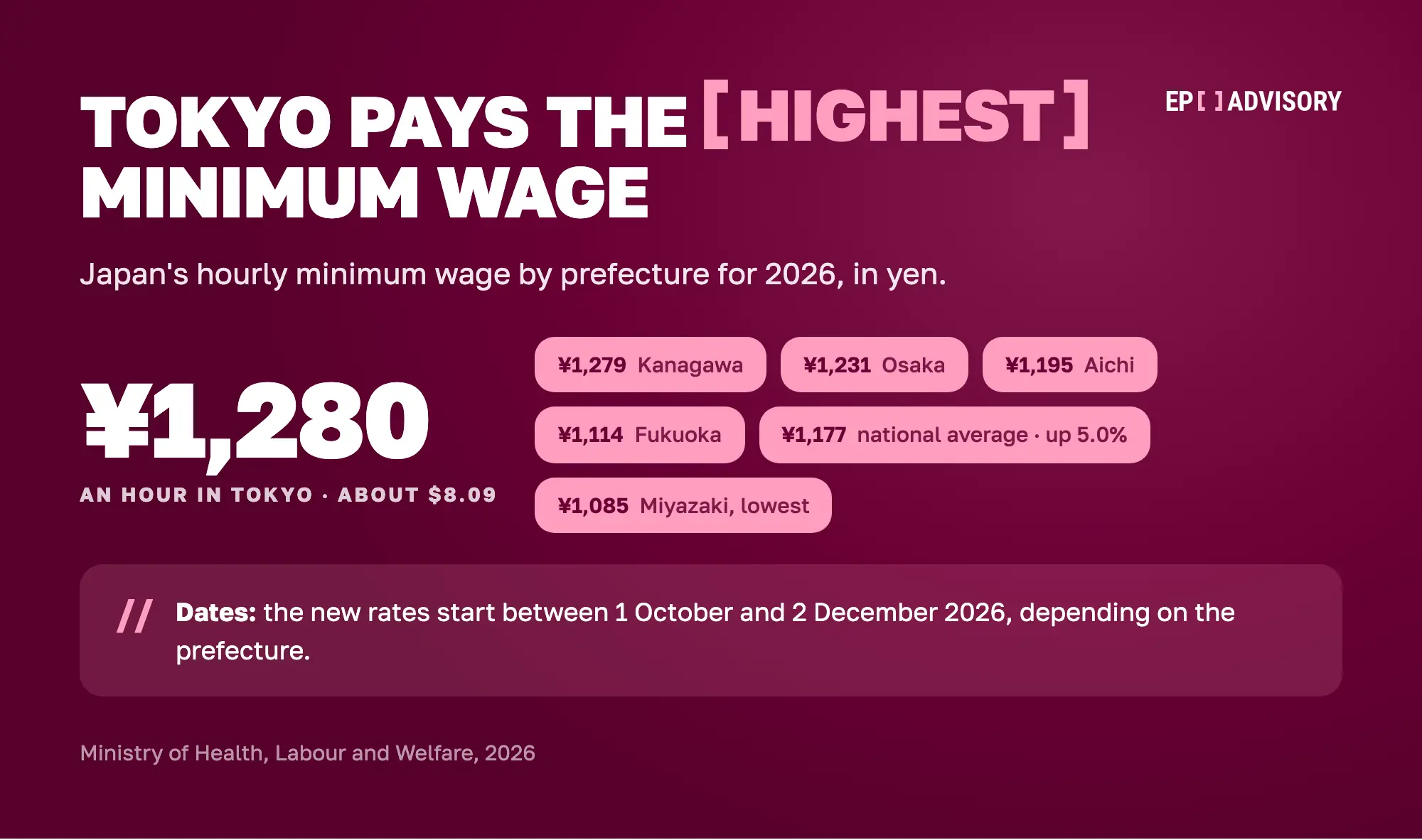
Japan sets its minimum wage by prefecture, and the national average for 2026 is ¥1,177 an hour, up ¥56 or 5.0% (Ministry of Health, Labour and Welfare). Tokyo is the highest at ¥1,280, about $8.09 or £5.99 at the ECB rate on 4 November 2026. Miyazaki is the lowest at ¥1,085. The new rates start between 1 October and 2 December 2026, depending on the prefecture.
Your visa status changes typical pay more than your city does. These are scheduled gross monthly earnings in June 2025, before overtime and bonuses (Basic Survey on Wage Structure 2025):
- ¥340,600 for all employees in Japan (about $2,152), and ¥418,300 in Tokyo.
- ¥313,200 for foreigners on professional and technical statuses (about $1,979).
- ¥221,400 for SSW workers (about $1,399).
- ¥190,300 for technical intern trainees, the group ESD replaces.
Bonuses are left out, so ask whether an offer includes them.
Next: before you accept an offer, read our tips on how to negotiate salary.
From offer to landing: the Certificate of Eligibility
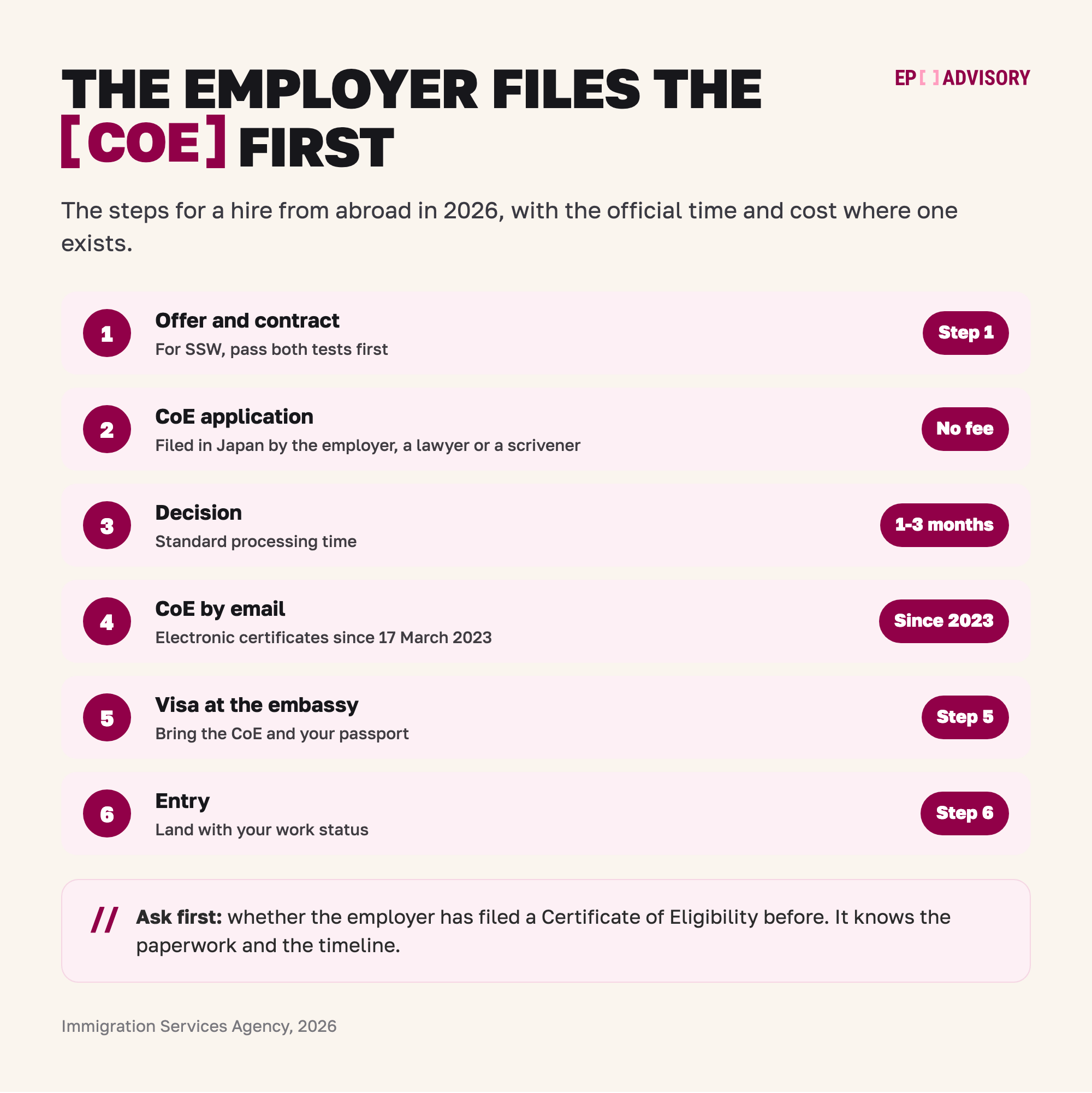
The Certificate of Eligibility comes first, and the visa follows. These are the steps for a hire from abroad in 2026 (Immigration Services Agency):
- Offer and contract. You agree the job, pay and start date. For SSW, you pass the interview and both tests first.
- CoE application. The employer’s staff, a registered lawyer or an administrative scrivener (gyoseishoshi, a licensed paperwork specialist) files it with the regional immigration bureau in Japan. It can be filed online, and there is no fee.
- Decision. The standard processing time is 1 to 3 months.
- CoE by email. Since 17 March 2023, the CoE can be sent electronically, so you do not wait for paper by post.
- Visa. You apply at the Japanese embassy or consulate in your country with the CoE and your passport.
- Entry. You land with your work status and start the job.
Nationals of the Philippines, Nepal and Vietnam also need a pre-entry tuberculosis screening, a scheme introduced in the 2025 financial year. For Indonesians it becomes mandatory from 4 January 2027 (JPETS, Ministry of Health). Once you are in Japan, the government’s Foreign Residents Support Center (FRESC) in Tokyo is a public help desk for foreign residents.
Key takeaways
- Graduates usually work on the Engineer/Specialist in Humanities/International Services visa, which needs a degree related to the job or 10 years of experience.
- Highly Skilled Professional status needs 70 points and at least ¥3,000,000 a year, and it can lead to permanent residence in 1 to 3 years.
- Without a degree, SSW (i) needs a skills test and A2 Japanese (JLPT N4), and covers 19 fields.
- ESD replaces technical intern training on 1 April 2027, with A1 Japanese at entry and the right to change employer after 1 to 2 years.
- JLPT N2 counts as business-level Japanese in the immigration rules and adds 10 HSP points.
- The minimum wage averages ¥1,177 an hour from autumn 2026, and Tokyo pays the most at ¥1,280.
- The employer files for the Certificate of Eligibility in Japan, with no fee and a standard decision time of 1 to 3 months.
See what a recruiter sees, then fix it before you apply. An instant score, then the fix for every problem.
Free, no card. A free account unlocks every fix.
Frequently asked questions
Can foreigners get a job in Japan in 2026?
Yes. Japan had a record 2,571,037 foreign workers in October 2025. You need a status of residence that matches the job, and the employer starts the process by applying for a Certificate of Eligibility. Graduates usually use the specialist visa, and people without a degree usually use Specified Skilled Worker.
Can I get a job in Japan without a degree?
Yes. Specified Skilled Worker (i) needs no degree. You pass a skills test for one of 19 fields and a Japanese test at A2 level, such as JLPT N4. From 1 April 2027, the new ESD system also trains entry-level workers with A1 Japanese. With 10 years of experience in a skilled field, the specialist visa can fit too.
Which jobs in Japan offer visa sponsorship?
Any job that matches a work status. The employer sponsors you by applying for your Certificate of Eligibility. Common examples are IT, engineering and English teaching for graduates, and care, construction and manufacturing under SSW. Food service is closed to new SSW applications from 13 April 2026.
Do I need to speak Japanese to work in Japan?
Not for every job. The specialist visa has no fixed Japanese level, and many IT, teaching and global firm jobs run in English. SSW needs A2 Japanese and ESD needs A1. Most other jobs at Japanese companies expect strong Japanese, and JLPT N2 counts as business level in the immigration rules.
What is ESD and when does it start?
ESD means Employment for Skill Development, or ikusei shuro. It starts on 1 April 2027 and replaces the Technical Intern Training Program. It trains workers for 3 years up to Specified Skilled Worker (i) level in 17 fields, with A1 Japanese at entry and the right to change employer after 1 to 2 years.
What is the minimum wage in Japan in 2026?
It depends on the prefecture. The national weighted average is ¥1,177 an hour from autumn 2026. Tokyo is the highest at ¥1,280, Kanagawa ¥1,279 and Osaka ¥1,231. Miyazaki is the lowest at ¥1,085. New rates start between 1 October and 2 December 2026.
How long does a Japanese work visa take?
The Certificate of Eligibility has a standard processing time of 1 to 3 months, and there is no fee. The CoE can be sent by email. You then apply for the visa at the Japanese embassy or consulate in your country.