
The short answer: the average salary in Poland was 9,509.02 zł gross a month in July 2026 in the enterprise sector (GUS, published 20 August 2026). Take-home from that figure on an umowa o pracę employment contract is about 6,812 zł. The median sits well below the average: 7,690.82 zł in the salary distribution study for February 2026. The minimum wage is fixed for the whole of 2026 at 4,806 zł a month.
| Poland, 2026 | Figure |
|---|---|
| Average, enterprise sector (July 2026) | 9,509.02 zł / month gross |
| Average, national economy (Q2 2026) | 9,233.13 zł / month gross |
| Median, distribution study (February 2026) | 7,690.82 zł / month gross |
| Take-home from 9,509 zł (umowa o pracę) | ≈ 6,812 zł / month |
| Minimum wage 2026 | 4,806 zł / month, 31.40 zł / hour |
Poland is one of the most accessible entry points into the EU labour market for professionals from outside the Union. Salaries here are also rising faster than in most of the older EU states: in July 2026 the enterprise-sector average was up 6.8% year on year. At the same time, Polish salary figures generate more confusion than those of almost any other European market, and the reason is simple: Poland publishes not one average salary, but three different ones.
The rest of this page is the arithmetic of those figures. We break down which of the three averages you actually need, how far below them the median sits, what each sector pays, and what genuinely lands in your account after tax and contributions.
Over 7 years, we’ve helped more than 5,000 professionals find jobs abroad. Want to know what your profile is realistically worth in Poland? Find your career consultant.
A warning about the figures. The most common error on pages about Polish salaries: they take a number from one GUS report, a date from a second, and a median comparison from a third. All three indicators exist, all three are official, but they are different measures built on different samples. Below, every figure comes with its own series name and its own period, so you can verify it at the source.
What Is the Average Salary in Poland Per Month? (2026)
The average salary in Poland in 2026 is 9,509.02 zł gross a month. That is the GUS figure for the enterprise sector for July 2026, published on 20 August 2026. At the NBP average rate for 28 August 2026 (1 EUR = 4.3274 zł) it comes to roughly €2,197. Growth on July 2025 was 6.8%.
The median describes the typical worker more honestly, and it sits noticeably lower. According to the salary distribution study for February 2026 (ZUS data covering roughly 10 million insured workers), the median was 7,690.82 zł, which is 22.8% below the average in the same study.
| Salary in Poland (2026) | Gross per month | Period and GUS series |
| Average, enterprise sector | 9,509.02 zł | July 2026 |
| Average, national economy | 9,233.13 zł | Q2 2026 |
| Average, distribution study | 9,966.32 zł | February 2026 |
| Median, distribution study | 7,690.82 zł | February 2026 |
| Minimum wage | 4,806.00 zł | all of 2026 |
The differences between the rows are not errors, and they are not different years. They are three separate statistical series, each with its own sample. What exactly each one counts is set out in the next section.
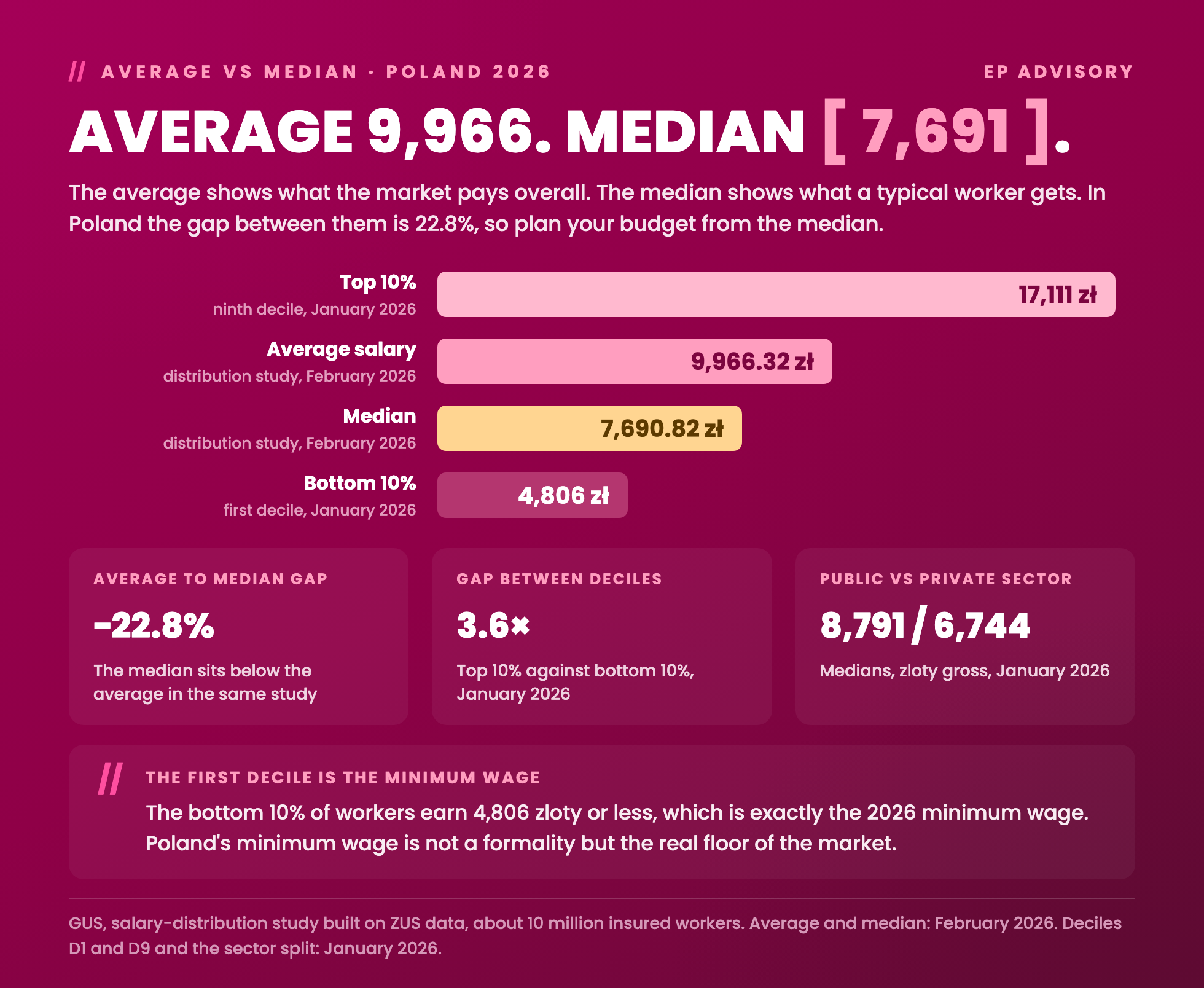
What counts as a good salary in Poland? Anything above the median of 7,691 zł gross puts you ahead of half the market. A comfortable benchmark for a single person in Warsaw or Kraków sits closer to the upper deciles of the distribution. The top 10% of workers earn more than 17,111 zł a month (the ninth decile, January 2026).
If the numbers work for you, the next step is practical: the European work-visa salary thresholds show what an offer must pay before a permit is possible, and jobs in Poland for foreigners walks through the entry routes, permits and paperwork passport by passport.
Why Poland Has Three Different Average Salaries
This is the key to all Polish salary statistics, and very few overviews explain it. Główny Urząd Statystyczny (GUS), the national statistics office, publishes three independent measures of the average salary. They are computed on different samples, released on different schedules, and always produce different numbers.
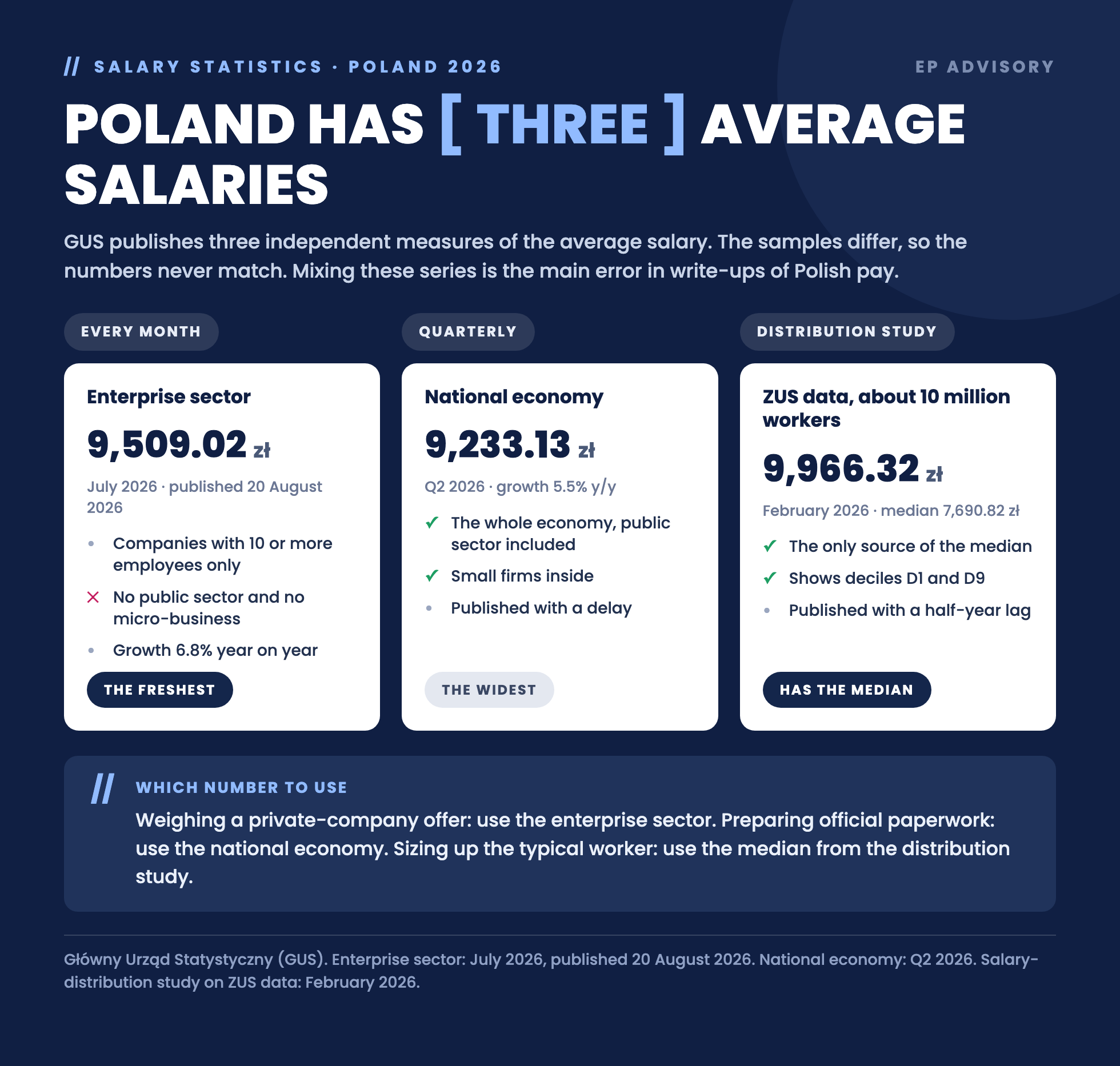
1. The enterprise sector (sektor przedsiębiorstw)
9,509.02 zł gross, July 2026. Published monthly, roughly three weeks after the month ends, so it is always the freshest figure. The sample is limited: only companies with 10 or more employees. The public sector, micro-businesses and the self-employed are not in it. This is the indicator that reaches the news whenever a headline reports that Polish average pay has risen.
2. The national economy (gospodarka narodowa)
9,233.13 zł gross, Q2 2026, up 5.5% year on year. Published quarterly and covering the whole economy, including public-sector workers and small firms. It is the broader measure, but it arrives with a longer delay. Part of the social-security arithmetic is pegged to it, so official documents usually cite this one.
3. The salary distribution study
Average 9,966.32 zł, median 7,690.82 zł, February 2026. Here GUS works with ZUS records covering roughly 10 million insured workers, and it reports not only the average but also the median and the deciles. It is the only source from which a Polish median can correctly be taken. For January 2026 the same study gives an average of 9,352.97 zł and a median of 7,447.16 zł.
Which figure you should use. If you want the freshest market benchmark, or you are weighing an offer from a private company, use the enterprise sector. If you are assessing the economy as a whole, or preparing documents that require the average salary in the national economy, use the quarterly figure. If you want to know what a typical worker actually earns, rather than what the arithmetic produces across everyone, use the median from the distribution study. Mixing them is exactly the error that makes one article promise 9,966 zł while another says 9,233.
Polish Salaries at a Glance: The Essentials
- Average salary: 9,509.02 zł/month gross, enterprise sector, July 2026, up 6.8% y/y (GUS, published 20 August 2026)
- National-economy average: 9,233.13 zł/month gross for Q2 2026, up 5.5% y/y
- Median: 7,690.82 zł/month gross, February 2026, which is 22.8% below the average in the same study
- The lowest-paid 10% earn under 4,806 zł (first decile, January 2026), which is exactly the minimum wage
- The top 10% earn over 17,111 zł/month (ninth decile, January 2026), a gap of roughly 3.6 times between the deciles
- The public sector pays more than the private sector: median 8,790.54 zł against 6,744.14 zł, January 2026
- Minimum wage: 4,806.00 zł/month and 31.40 zł/hour, set in a single step for the whole of 2026
- Take-home from 9,509 zł gross: about 6,812 zł, roughly 71.6% of gross on an umowa o pracę contract
- Workers under 26: zero PIT income tax on income up to 85,528 zł a year, with ZUS contributions still deducted
- Conversion rate: 1 EUR = 4.3274 zł, the NBP average rate for 28 August 2026
A caveat on the average and the median. The average is pulled up by IT, mining, finance and the large corporations in Warsaw. The median describes what a typical worker actually receives. Budget from the median, and use the average only to compare countries with each other.
A first job abroad, a career change or a step up. Tell us where you are now, and we will match you with the right consultant and the right service.

Salaries in Poland by Sector
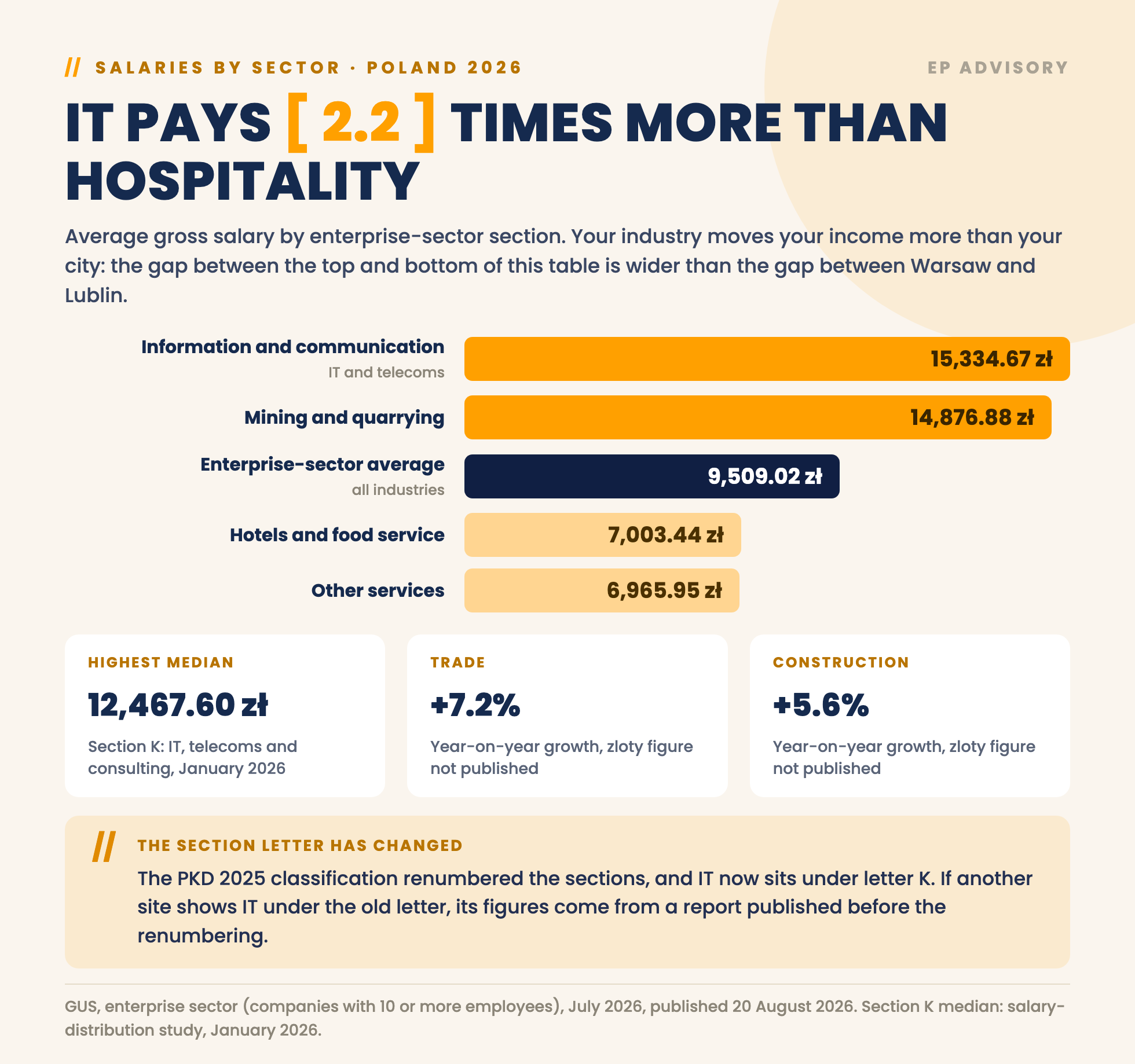
Your sector moves your income more than your city does. Below are the average gross salaries by section of the enterprise sector for July 2026, from the same GUS series as the overall 9,509.02 zł average.
| Sector (enterprise sector) | Gross per month, July 2026 |
| Information and communication (IT and telecoms) | 15,334.67 zł |
| Mining and quarrying | 14,876.88 zł |
| Enterprise-sector average | 9,509.02 zł |
| Hotels and catering | 7,003.44 zł |
| Other services | 6,965.95 zł |
IT and telecoms pay 2.2 times more than hotels and catering, and 1.6 times the enterprise-sector average. For two large industries this GUS release gives only the growth rate, without absolute figures: trade rose 7.2% year on year and construction 5.6%.
The median by sector. In the salary distribution study for January 2026 the highest median belongs to section K, which covers IT, telecoms and consulting: 12,467.60 zł. Watch the section letter. The PKD 2025 classification renumbered the sections, and IT now sits under the letter K. If another site quotes a different letter, its figures come from a report that predates the renumbering.
What this changes in practice. The gap between sectors in Poland is wider than the gap between cities. Moving from catering into IT support or logistics changes your income more than moving from Lublin to Warsaw. When you weigh an offer, compare it with the average for your section, not with the national average.
The Minimum Wage in Poland in 2026: 4,806 Zloty
The minimum wage in Poland in 2026 is 4,806.00 zł gross a month for full-time employment and 31.40 zł an hour for civil-law contracts. The rate took effect on 1 January 2026 and holds for the whole year: the government dropped its earlier practice of two increases and approved a single step. The legal basis is the Rozporządzenie Rady Ministrów of 11 September 2025, Dz.U. 2025 poz. 1242.
At the NBP rate for 28 August 2026 that is roughly €1,111 gross. One detail matters for reading the market: the first decile of salaries in January 2026 was exactly 4,806 zł. In other words, a tenth of workers in Poland earn the minimum or close to it, and the minimum wage acts as a real floor of the market rather than a formality.
Why this matters when you relocate. The minimum wage sets the lower bar for employment contracts, and therefore for many work permits. A full-time offer below 4,806 zł gross cannot be legal under an umowa o pracę. If someone offers you less and points to a probation period as the reason, that is a signal to check the terms.
Where to Look for Work: Official Resources
How the job market works, which entry routes fit your passport and how the permit is processed are covered in our separate guide to jobs in Poland for foreigners.
- praca.gov.pl: the state employment-services portal. Your employer also files your employment paperwork through it, so the name is worth remembering
- Pracuj.pl: Poland’s largest private job board, the main channel for office and IT roles
- EURES: the European job-mobility network, useful because it surfaces employers willing to hire from abroad
- LinkedIn Jobs: English-language and international roles, especially in Warsaw’s business-services centres
- No Fluff Jobs: IT vacancies with a mandatory salary range, useful for checking the market rate
How Polish ads quote pay. In our August 2026 sample of 74 Polish job listings, every advertised figure was gross (brutto) and labelled as such: 57% quoted a monthly rate and 41% an hourly one, with hourly quoting dominating hospitality and service roles. A net figure never appeared in a structured salary field. Read every advertised number as gross, and run the net arithmetic yourself before you compare offers.
Official sources for verifying the figures:
- GUS: all three average-salary series, the median and the deciles
- ZUS: social-contribution rates
- NBP: the official average exchange rate of the zloty
The Take-Home Arithmetic: What Actually Lands in Your Account
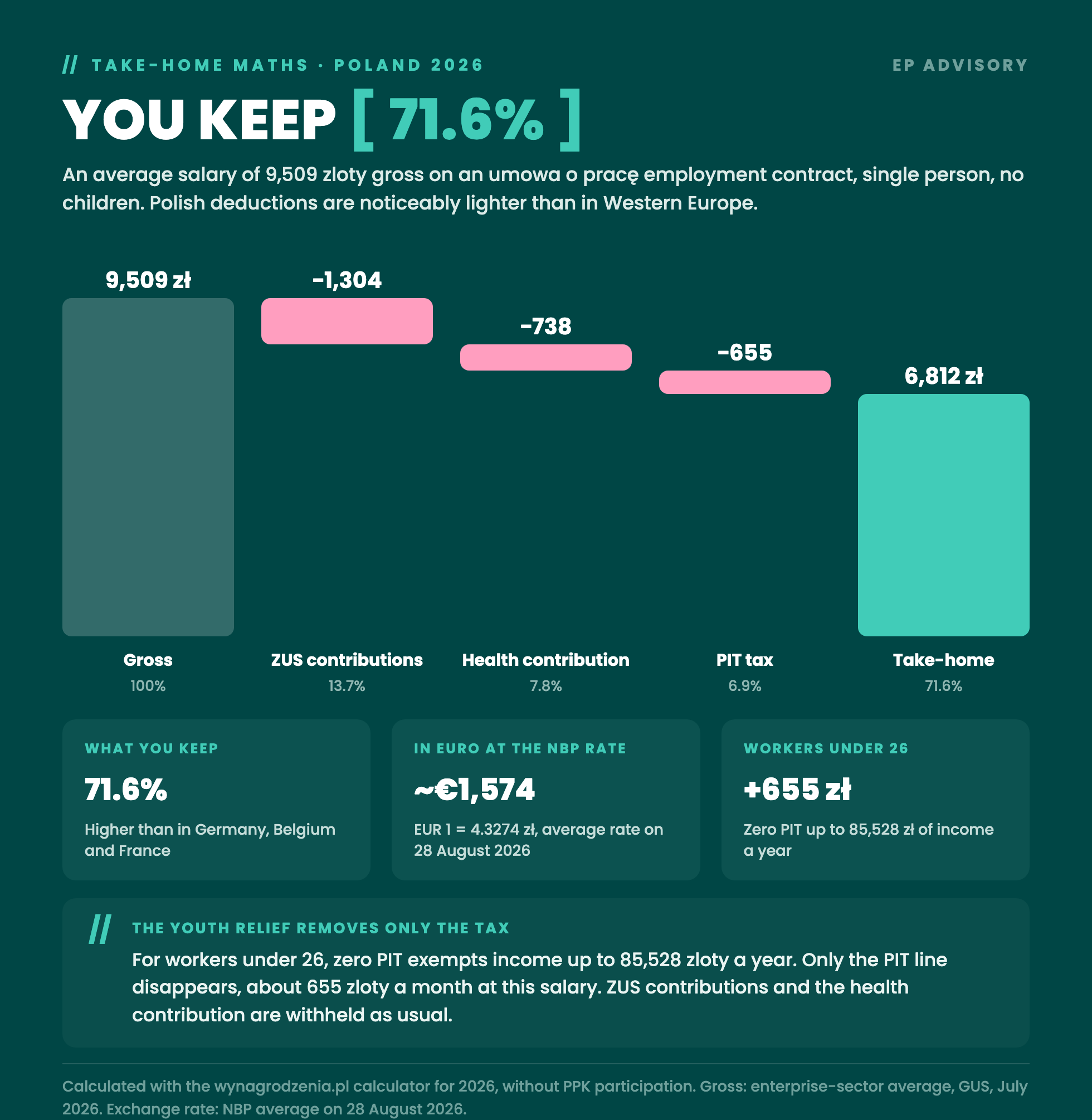
Now the arithmetic. Take the enterprise-sector average, 9,509 zł gross a month on an umowa o pracę employment contract, for a single person with no children and no PPK pension participation.
| Item | zł per month |
| Gross | 9,509 |
| − Employee social contributions (ZUS) | −1,304 |
| − Health insurance contribution | −738 |
| − PIT income tax | −655 |
| = Take-home | ~6,812 |
The calculation follows the wynagrodzenia.pl calculator for 2026, without PPK. Take-home is about 71.6% of gross, roughly €1,574 at the NBP rate for 28 August 2026. That share is noticeably higher than in Belgium, where OECD Taxing Wages 2026 puts take-home at about 60% of gross, and roughly at Germany’s level. In France, deductions on a comparable salary are lower than Poland’s. For the German arithmetic, see our breakdown of salaries in Germany.
The break for the young: ulga dla młodych. Workers under 26 are exempt from income tax on income up to 85,528 zł a year. The relief removes only the PIT line, about 655 zł a month at this salary. ZUS contributions and the health contribution are deducted as usual. So from 9,509 zł gross a worker under 26 keeps roughly 655 zł a month more, not a salary free of all deductions, as some pages claim.
What moves the figure. The contract type shifts your net more than any tax nuance. An umowa o pracę carries the full social package and the full deductions. An umowa zlecenie or a B2B arrangement through your own business is calculated differently, and often leaves more in hand at the cost of less protection. When you assess an offer, establish the contract type before you discuss the amount.
The national average will not tell you whether your number is good. Your section’s average, the contract type and the net arithmetic will. Bring us your target role or your offer, and we will tell you what it realistically pays and how to position your CV for the Polish market.
Work Permits: Your Route Into Poland
Citizens of the EU, the EEA and Switzerland work in Poland without a permit. For everyone else the route depends on the passport, and the differences between groups are large.
- Citizens of Ukraine: work without a permit under UKR status, extended until 4 March 2027. The employer files an employment notification through praca.gov.pl within 7 days
- Citizens of Belarus: the main route runs through the D21 humanitarian national visa, followed by a three-year residence permit with the right to work without a separate permit
- Most other non-EU citizens: a type A work permit issued through the voivodeship office, then a national D visa tied to the specific employer. Under the act of 20 March 2025 the permit can run for up to three years
- Citizens of Russia: the permit follows the standard procedure, but the bottleneck sits in the visa rather than in the permit
All the routes, with dates, legal references and procedures, are in our guide to jobs in Poland for foreigners. For how Polish pay compares with the salary bars of work visas across 16 countries, see the work visa salary thresholds in Europe.
Related reading: Jobs in Poland for Foreigners · Salaries in Germany · Salaries in Italy
Key Takeaways
- Poland has three official average salaries, and they are always different. Always check which GUS series and which period a source is quoting.
- The freshest figure: 9,509.02 zł gross, enterprise sector, July 2026, up 6.8% year on year.
- The median of 7,690.82 zł for February 2026 is 22.8% below the average. Budget from the median.
- The minimum wage of 4,806 zł is fixed for the whole of 2026 in a single step, and it coincides with the market’s first decile.
- Take-home is about 71.6% of gross, roughly 6,812 zł from the average salary. That share is higher than in Belgium and about the level of Germany.
- Sector decides more than city: IT and telecoms pay 2.2 times more than hotels and catering.
- For workers under 26, zero PIT adds about 655 zł a month, but it does not remove ZUS contributions.
Frequently Asked Questions
What is the average salary in Poland in 2026?
9,509.02 zł gross a month in the enterprise sector for July 2026, GUS data published on 20 August 2026, up 6.8% year on year. The national-economy average for the second quarter of 2026 was 9,233.13 zł. These are different statistical series, not different years.
Why do different articles give different average salaries for Poland?
Because GUS publishes three indicators: the enterprise sector (companies with 10 or more employees, monthly), the national economy (the whole economy, quarterly) and the salary distribution study built on ZUS data (with both an average and a median). For 2026 they give 9,509.02, 9,233.13 and 9,966.32 zł respectively. They cannot be mixed.
What is the median salary in Poland?
7,690.82 zł gross a month, according to the salary distribution study for February 2026. That is 22.8% below the average in the same study. For January 2026 the median was 7,447.16 zł, with 8,790.54 zł in the public sector and 6,744.14 zł in the private sector.
How much of a Polish salary is left after deductions?
From the average salary of 9,509 zł gross on an umowa o pracę employment contract, about 6,812 zł is left in hand, roughly 71.6% of gross. The deductions are the employee’s social contributions, the health insurance contribution and PIT income tax. Calculated with the wynagrodzenia.pl calculator for 2026, without PPK participation.
What is the minimum wage in Poland in 2026?
4,806.00 zł gross a month for full-time employment and 31.40 zł an hour. The rate took effect on 1 January 2026 in a single step for the whole year, with no second mid-year increase. The legal basis is the Rozporządzenie Rady Ministrów of 11 September 2025, Dz.U. 2025 poz. 1242.
Want a personal assessment of your chances in Poland, help with your CV and preparation for interviews? Find your career consultant.