 By Andre Atallah, CEO of EP Advisory
Short answer: It takes work, and with the right approach it is very achievable. UK employers know and value American experience. Fewer than 1 in 100 US Skilled Worker visa applications are refused. Most missed replies come down to four details you can fix: apply to licensed sponsors, quote salary in pounds, pick roles that meet the skill and pay rules, and send a UK-format CV. Do that and your applications reach a person.
American professionals start from a strong position in the UK. UK employers know US companies, US job titles and US ways of working, and in tech, finance, consulting and research, American experience is often a selling point. So when a UK search goes quiet, the fix is usually in how the application reaches the employer. That part is in your hands.
Below are the 10 reasons we see most often in our work with American clients, in the order an application meets them: the online form, the visa rules, the CV screen, the interview and the offer. Each one comes with the fix we use. It works whether you need a visa or already have the right to work through a partner, the Graduate visa or the High Potential Individual visa. For nearly 10 years, we’ve helped more than 5,000 professionals find jobs abroad. Want to know if your CV will pass screening in the UK? Check your CV for free: a score in 30 seconds, then a fix for each problem.
How good American candidates start getting replies
Aim at employers that already budget for sponsorship, and your applications start getting read. Fewer than 1 in 100 US Skilled Worker visa applications were refused in the year to June 2026 (Home Office statistics). For the full plan from target list to visa, read our guide on how to get a job in the UK as an American.
Americans who move to the UK are a smaller group, mainly because US pay is high. Some come by transferring within their own employer. So the number of American hires says little about your chances. A strong American candidate usually does well here.
Sponsorship is a planned cost, and employers that sponsor already expect it. A sponsored hire needs a sponsor licence (the Home Office permission a company holds to hire visa workers) and a certificate of sponsorship (the digital record that ties you to one job). The employer also pays the Immigration Skills Charge, a government levy on each sponsored worker. The employer must pay these sponsorship costs itself and cannot pass them on to you. For a medium or large company, the charge is £1,320 for the first 12 months and £660 for each extra 6 months. So a 5-year hire costs £6,600 in charges plus £525 for the certificate. That is £7,125, about $9,400 at the Bank of England rate of $1.3251 per £1 (28 September 2026).
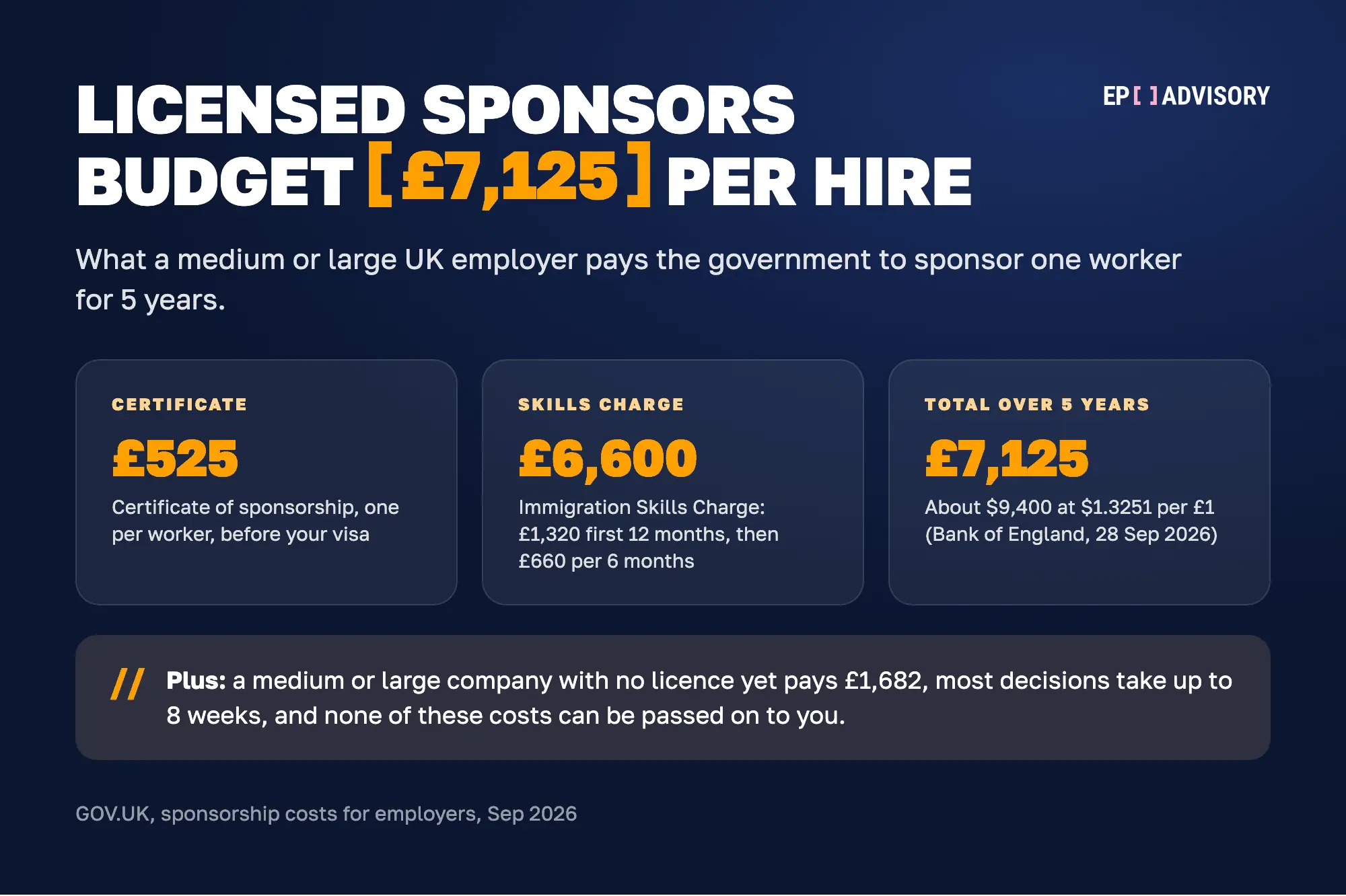
That is why licensed sponsors are your best targets. For them, this cost is routine. If you already have full right to work, none of this cost applies to you. Focus on reasons 1, 5 and 6.
The 10 reasons, and the fix for each
Fix the first four and far more of your applications reach a recruiter. They sit at the form and the visa rules, so you can fix them before anyone judges your experience.
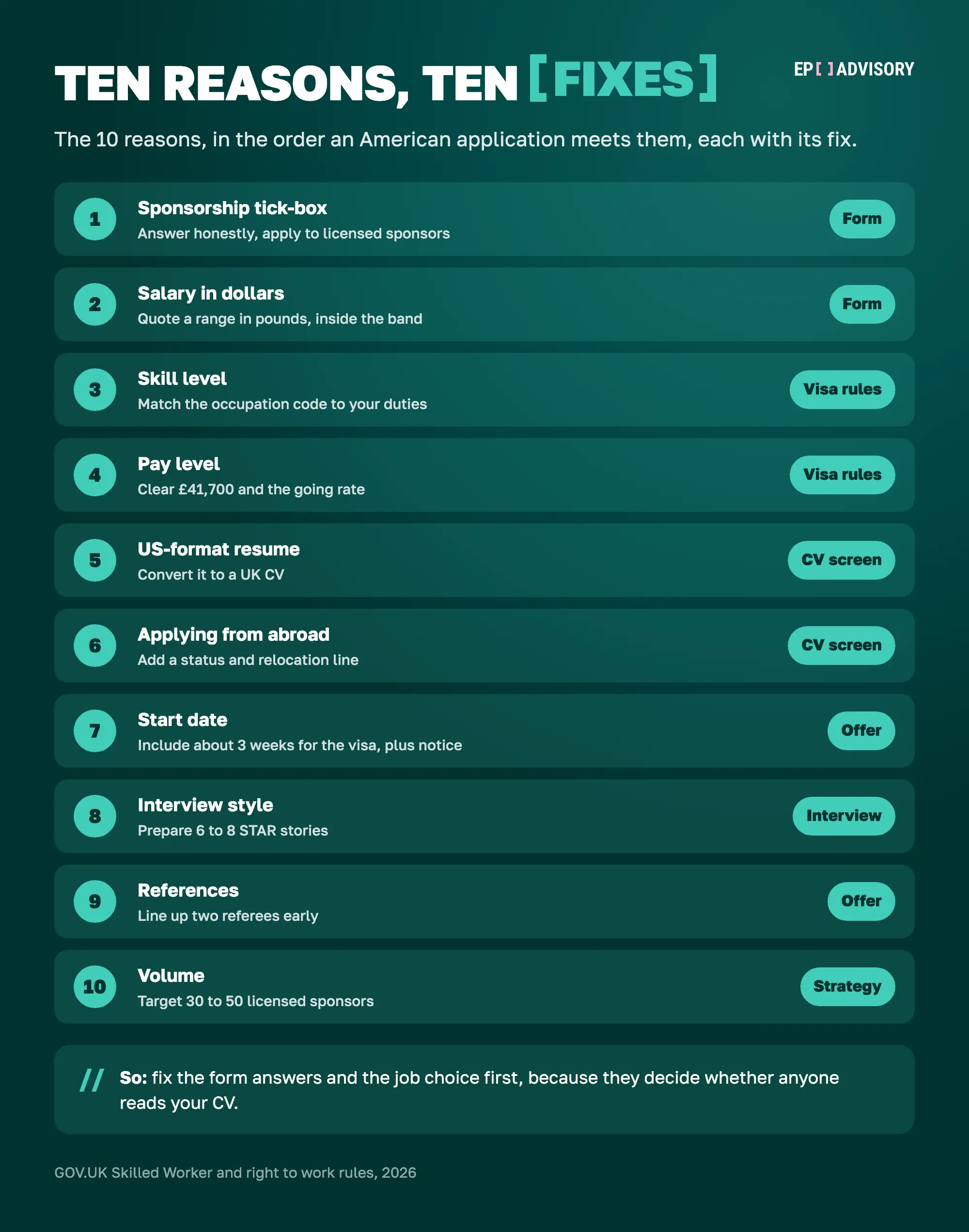
- The sponsorship tick-box. Answer honestly, and apply to licensed sponsors.
- Salary in dollars. Give a range in pounds, inside the UK band.
- Skill level. Pick roles in a “higher skilled” occupation code.
- Pay level. Check the pay clears £41,700 and the going rate.
- A US-format resume. Convert it to a UK CV.
- Applying from abroad. Add one line on your status and relocation plan.
- Start date. Quote one that includes notice and visa time.
- Interview style. Prepare STAR answers for a UK panel.
- References. Line them up before the offer depends on them.
- Volume. Swap one-click applications for a target list.
Score your CV in 30 seconds, then fix its biggest problems one by one. Both free.
Free, no card. A free account unlocks every fix.

Reasons 1 and 2: get past the online form
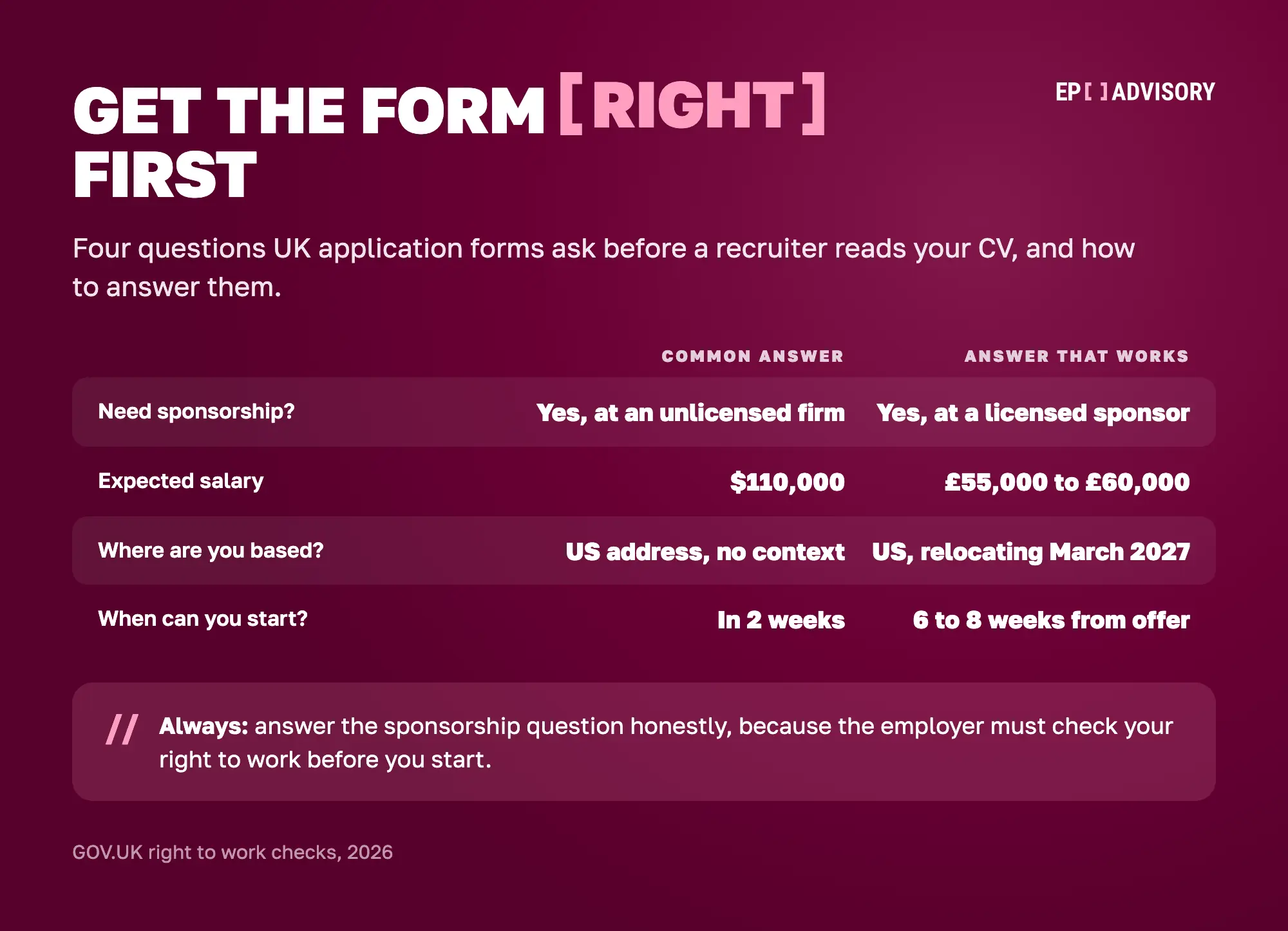
Answer the screening questions for the software first, then for the recruiter. Online application forms often ask these questions before anyone sees your CV, so the right answer keeps you in the running.
1. The sponsorship question
Many UK forms ask some version of “Do you now, or will you in the future, require sponsorship to work in the UK?” If the company has no sponsor licence, or the role is not one it will sponsor, a “yes” ends the application there. So the thing to change is not your answer. It is where you apply.
The fix: answer honestly, always, and change where you apply. Employers must check your right to work before you start (GOV.UK right to work checks), so an honest answer is the one that holds up. Check each company on the register of licensed sponsors before you fill in the form. It lists over 120,000 organisations on the Skilled Worker route. Look for ads that mention sponsorship. Our guide to UK companies that sponsor visas shows the method step by step.
If you already have the right to work, say so in plain words: “Full right to work in the UK, no sponsorship required.” Put it in the free-text box, at the top of your CV and in the cover letter. It is the first line we add to an American client’s CV when they already have the right to work.
2. Salary in pounds, inside the band
Many UK forms ask for your current and expected salary on page one. If you type “$110,000”, a UK screener sees about £83,000. The London median for full-time workers is £49,692 gross a year, and the UK median is £39,039 (ONS, April 2025). A figure far above the band can read as too expensive.
The fix: give a range in pounds, based on the advertised band and the going rate for your occupation. Check it against the UK salary figures by role and region. If you must give your current pay, write it in pounds with the dollar figure after it, and add “open to UK market rates”. Negotiate the full package later, once they want you.
Reasons 3 and 4: choose jobs that can be sponsored
Check the skill level and the pay before you apply, because those are the jobs a licensed sponsor can say yes to.
3. Check the skill level of the role
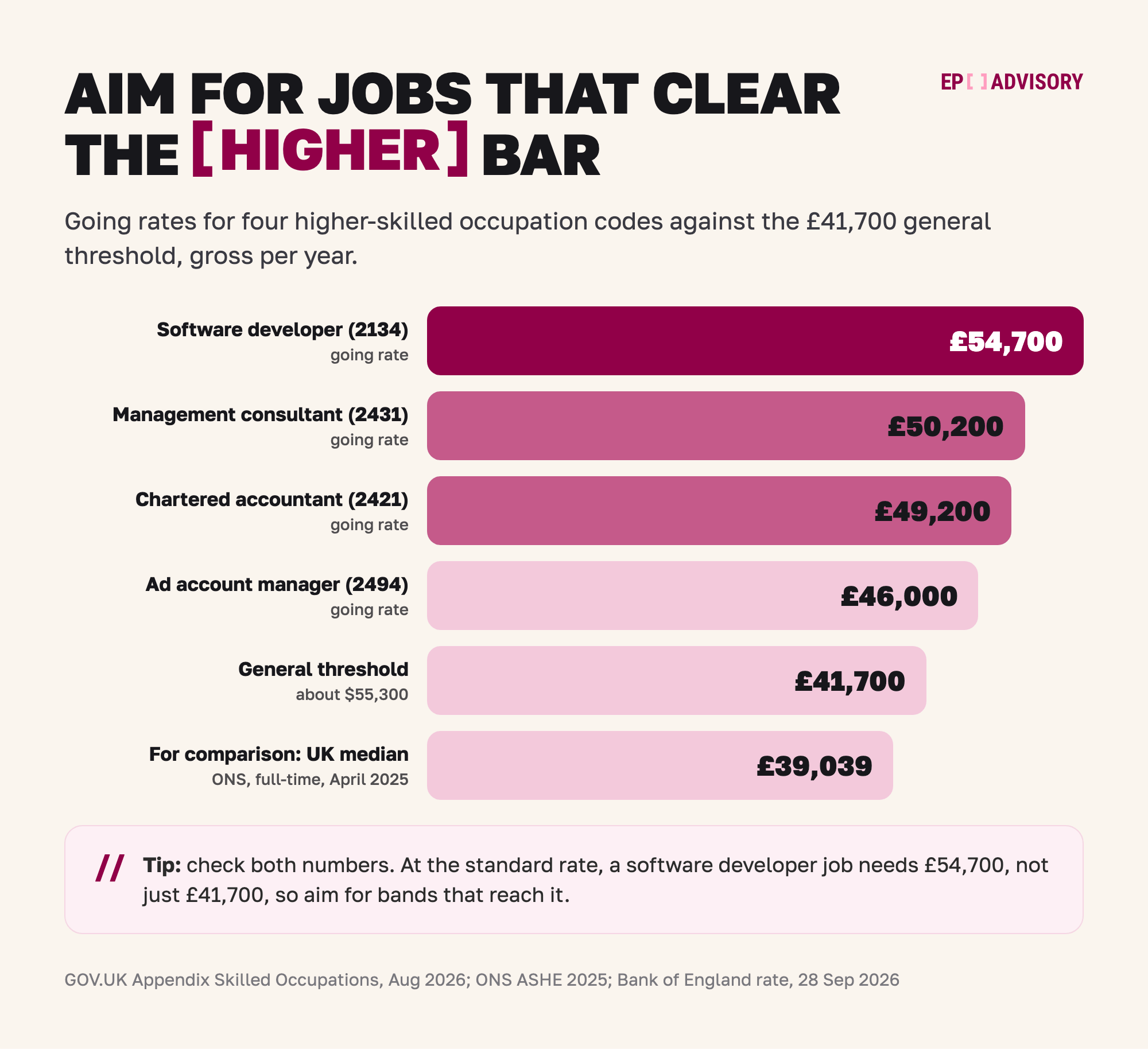
Every sponsored job must be matched to a 4-digit occupation code in the Appendix Skilled Occupations. Job titles can mislead. An “advertising account manager” (code 2494) is higher skilled. A “marketing executive” (code 3554) is medium skilled. New applicants can only be sponsored in medium-skilled codes in narrow cases, such as a job on the Immigration Salary List or the Temporary Shortage List.
The fix: match the code to the duties, not the title. A role one level down may fall out of sponsorship range, so apply at the level your experience supports.
4. Check the pay against both numbers
For most new Skilled Worker applicants, the salary must be at least £41,700 a year gross (about $55,300 at the same Bank of England rate), or the going rate for the occupation code, whichever is higher (GOV.UK, Skilled Worker job rules). A software developer’s going rate is £54,700. So at the standard rate, a developer job advertised at £45,000 cannot be sponsored.
New entrants, such as people under 26 or recent graduates, can be paid 70% of the going rate, never below £33,400. Our Skilled Worker salary threshold guide has the full table. Check the current rules on GOV.UK or with a regulated adviser before you rely on a lower rate.
The fix: check every ad against both numbers before you apply, and focus on roles whose band reaches your going rate.
Next: to find your occupation code and going rate, and the employers that can pay it, use our guide to UK companies that sponsor visas.
Reasons 5 and 6: make the CV and contact details read as UK-ready
Your experience travels well. The format has to travel with it. UK recruiters often give a CV a short first read, so a UK-format document gets your experience seen.
5. From US resume to UK CV
A CV is the UK word for a resume. UK recruiters usually expect up to two pages for experienced candidates, a short personal statement at the top, British spelling (“organisation”, “programme”, “analysed”), and A4 paper size. They do not expect a GPA, a list of every duty, or US terms such as “401(k) plan” or “Series 7” without an explanation.
The fix: convert the document, do not just re-save it. Our UK CV vs US resume guide has a side-by-side table and a before-and-after example. Lead each bullet with a result and a number, not a duty.
6. Applying from abroad
A US address, a +1 phone number and no word about relocation leave three questions unanswered. When can this person start? Will they really move? Can we even hire them?
The fix: answer the questions before they are asked. Add one line under your name: “Based in Chicago. Relocating to London in March 2027. Will require Skilled Worker sponsorship.” Or, if it applies: “Full right to work in the UK.” Keep your real address. Skip a relative’s UK address, because it unravels at the first call. List a number with WhatsApp, and say you can take calls in UK working hours.
Reason 7: give a start date the employer can plan around
A clear start date with the visa steps in it reads as a safe hire. UK hiring managers plan around notice periods. A notice period is the time you must keep working after you resign. The legal minimum, once you have been in a job for more than a month, is one week (GOV.UK, handing in your notice), but your contract often sets a longer one. So UK employers are used to waiting. What they need from you is a date that already includes the visa.
A sponsored start has fixed steps. The employer assigns the certificate of sponsorship. You can apply for the visa up to 3 months before the start date. A decision usually takes 3 weeks from outside the UK (GOV.UK, Skilled Worker visa).
The fix: give a realistic date with the steps in it. For example: “Available 6 to 8 weeks from offer: 3 weeks for the visa decision, then 2 weeks’ notice to my US employer.” A clear plan reads better than a fast promise.
Reasons 8 and 9: win the interview and have references ready
Once you reach the interview, your experience has done its job. Style and references carry you to the offer.
8. Interview answers for a UK panel
Many UK interviews are competency-based. The panel asks “Tell me about a time when…” and scores each answer against a list of skills from the job description. The standard structure is STAR: the Situation, the Task, the Action you took and the Result. Specific actions and measured results score well. Big claims, broad visions and “we crushed it” language score lower. UK panels also tend to be more reserved, so a quiet room is normal.
The fix: prepare 6 to 8 STAR stories, each tied to a skill in the ad. Say “I” for what you did. Give the number, then stop. This is the drill we run with American clients before a UK panel. See our guides on how to pass a job interview and the toughest interview questions.
9. Have references ready
References are statements from past employers that confirm your work. Acas, the UK’s official workplace advice service, says it is best to ask for references at the final stage, when making a job offer. Before contacting your current employer, the new employer should have made a conditional offer and have your permission (Acas, job references). A former employer’s reference policy can also limit what it says and who can give the reference. If your referees take weeks to reply, or only confirm dates, the offer can stall.
The fix: line up two referees before you start applying, including your latest manager. Warn them that a UK company may email them. Give them the role and the dates you want confirmed. Keep their details off the CV. A UK CV does not need them.
Reason 10: replace volume with a target list
Thirty well-chosen employers beat three hundred one-click applications. One-click applications all meet the same form questions, and many go to companies that cannot sponsor the role. It is the pattern we fix most often for Americans who come to us, including those with full right to work.
The fix: build a target list of 30 to 50 employers that hold a sponsor licence and hire for your occupation code at or above the going rate. US companies with UK offices are a strong place to start, because they know American resumes and may have intra-company routes. Then apply with a tailored CV, and message a recruiter or hiring manager at each one. Our route guide on jobs in the UK for foreigners covers the sectors that sponsor most often.
Before you send the next batch, test the document first. Getting ready to apply for jobs in the UK? Check your CV for free: see it the way a recruiter does, then fix each problem.
Key takeaways
- American experience is valued in the UK, and fewer than 1 in 100 US Skilled Worker visa applications are refused.
- Sponsoring a 5-year hire costs a medium or large employer £7,125 in government charges and fees, so target licensed sponsors that already budget for it.
- Pick jobs that are higher skilled and pay £41,700 or the going rate, whichever is higher, or a lower rate you qualify for.
- Give salary expectations in pounds, in the advertised band.
- State your status in one line, and quote a start date that includes about 3 weeks for the visa decision and your notice period.
- Replace volume with a target list of 30 to 50 sponsors and a UK-format CV.
See what a recruiter sees, then fix it before you apply. An instant score, then the fix for every problem.
Free, no card. A free account unlocks every fix.
Frequently asked questions
Does it help to say I have the right to work in the UK?
Yes, if you have it. Write “Full right to work in the UK, no sponsorship required” at the top of your CV, in the cover letter and in any free-text box. Without that line, a UK employer may assume that an applicant with a US address needs a visa.
Why do I get no replies to my UK job applications?
Usually it is one of four fixable details: the sponsorship question at a firm that cannot sponsor, a salary in dollars, a role that cannot be sponsored, or a US-style resume. Apply to licensed sponsors, quote pounds, check the role and convert the CV. Then work on your start date and interview answers.
Should I say I need sponsorship on a UK job application?
Yes. Always answer honestly, because employers must check your right to work before you start. Then make that answer work for you by applying to employers that hold a sponsor licence and to roles that meet the salary rules.
What salary should I put on a UK application as an American?
Give a range in pounds that fits the advertised band and the going rate for your occupation code. UK pay is often lower than US pay for the same role, so a converted US salary can read as too expensive. A range inside the band keeps you in the running.
Do UK employers hire Americans from abroad?
Yes, and US experience is valued by UK employers. A sponsored job must be higher skilled and usually pay at least £41,700 or the going rate. US companies with UK offices and firms already on the register of licensed sponsors are a strong place to start.