 By Andre Atallah, CEO of EP Advisory

Short answer: the Germany Opportunity Card (Chancenkarte) is a residence permit that gives you up to 12 months in Germany to look for a job. You qualify with a qualification fully recognised in Germany, or with 6 points plus a degree or 2-year vocational qualification and English B2 or basic German. You must show money to live on, €1,091 a month at the German missions in India, and you may work up to 20 hours a week while you search.
The Opportunity Card is one of the few ways in Europe to move first and find the job second. You do not need an offer, a sponsor or German at a high level. You need a qualification, a few points and enough money to live on for the months you search.
The card gives you time, not a job. The German missions in India say it plainly: people who arrive without having researched employers rarely find work. So this guide covers both halves. First the rules: the two ways in, the points, the money and the documents for applicants in India and Pakistan. Then a month-by-month plan to turn 12 months into an offer and a work permit.
For nearly 10 years, we’ve helped more than 5,000 professionals find jobs abroad. Want to know if your CV will pass screening in Germany? Check your CV for free: a score in 30 seconds, then a fix for each problem.
Germany Opportunity Card in one minute: what it gives you
The card came in with Germany’s skilled immigration reform and is set out in section 20a of the Residence Act. Every rule below comes from the law itself or from a German mission’s own page, checked on 5 November 2026.
| Question | The rule in 2026 |
| How long | Up to 1 year for the first card |
| Who qualifies | A skilled worker whose qualification is fully recognised in Germany, or anyone with 6 points, a recognised degree or 2-year vocational qualification, and German A1 or English B2 |
| Work while searching | Up to 20 hours a week on average, plus trial work of up to 2 weeks per employer |
| Money to show | At least €1,091 a month at the missions in India. Karachi lists €1,027 a month plus €500 for a return ticket |
| Visa fee | €75 for adults (INR 8,300 in India) |
| Where you apply | Online through the Consular Services Portal, then at the German mission for the place you live |
| What comes next | A work permit, such as the EU Blue Card, which you can apply for from inside Germany |
Two things make this card stronger than a plain job seeker visa. You can earn money while you look. And you can try out a job for up to 2 weeks before either side commits. Both help you get hired faster, if you plan for them.
If you are still choosing a country, our overview of every way to move to Germany puts this card next to the study, work and family routes.
Two ways in: full recognition or 6 points
The law gives you two separate routes. Check the first one before you count any points, because it is simpler.
Route 1: you count as a skilled worker
You qualify directly if Germany already treats your qualification as equal to a German one. In law you are then a “Fachkraft”, a skilled worker (section 18 of the Residence Act). For a university degree, that usually means one of two things:
- The anabin database lists your degree and university. The German missions in India ask for a degree rated “entspricht” or “gleichwertig” (equivalent) and a university rated “H+” in anabin, the German database of foreign qualifications. A university rated “H+/-” only counts if your programme is named in its notes.
- You hold a Statement of Comparability. The Central Office for Foreign Education (ZAB) issues it for a fee of €208. It confirms that your degree matches a German bachelor’s or master’s level.
For a vocational qualification, you need a recognition decision from the German body for your trade. The official Recognition Finder tells you which body that is.
One detail most guides miss: the law sets the language minimum only for the points route. On route 1, the Residence Act does not ask for German A1 or English B2. Some German still helps you in every interview.
Route 2: you collect at least 6 points
If your qualification is not fully recognised, you can still qualify on points. You need all three of these first:
- A qualification recognised where you earned it. A university degree, or a vocational qualification that took at least 2 years, recognised by the state that issued it. A German body must confirm this. In practice that is an anabin printout or a ZAB statement.
- Language: German at A1 (basic) or English at B2.
- At least 6 points from the table in the next section.
The Consular Services Portal asks you a short questionnaire at the start, called “your score counter”. It sorts you into route 1 or route 2 and tells you whether you reach 6 points. Do the count yourself first, so you know which documents to collect.
The Opportunity Card points table, with three worked scores
The points come from the annex to the Residence Act, read with section 20b. The pass mark is 6. The highest possible score is 16.
| Criterion | Points | What counts |
| Partial recognition in Germany | 4 | A German recognition body has said you need extra training, an exam or more qualifications for full recognition |
| German B2 / B1 / A2 | 3 / 2 / 1 | Only your highest level counts |
| English C1 | 1 | B2 is the entry minimum and earns no points |
| Work experience | 3 or 2 | 3 for 5 years in the last 7, or 2 for 2 years in the last 5, in work related to your qualification and gained after it |
| Shortage occupation | 1 | Your qualification is in a listed group: managers in production, ICT or professional services; science and engineering; doctors; nurses and midwives; vets; other health professionals; teachers; ICT professionals |
| Age | 2 or 1 | 2 if you are 35 or under when you apply, 1 if you are over 35 and up to 40 |
| Past stay in Germany | 1 | At least 6 months of lawful, continuous stay in the last 5 years |
| Partner applies too | 1 | Your spouse or registered partner also qualifies, applies at the same mission and comes with you |
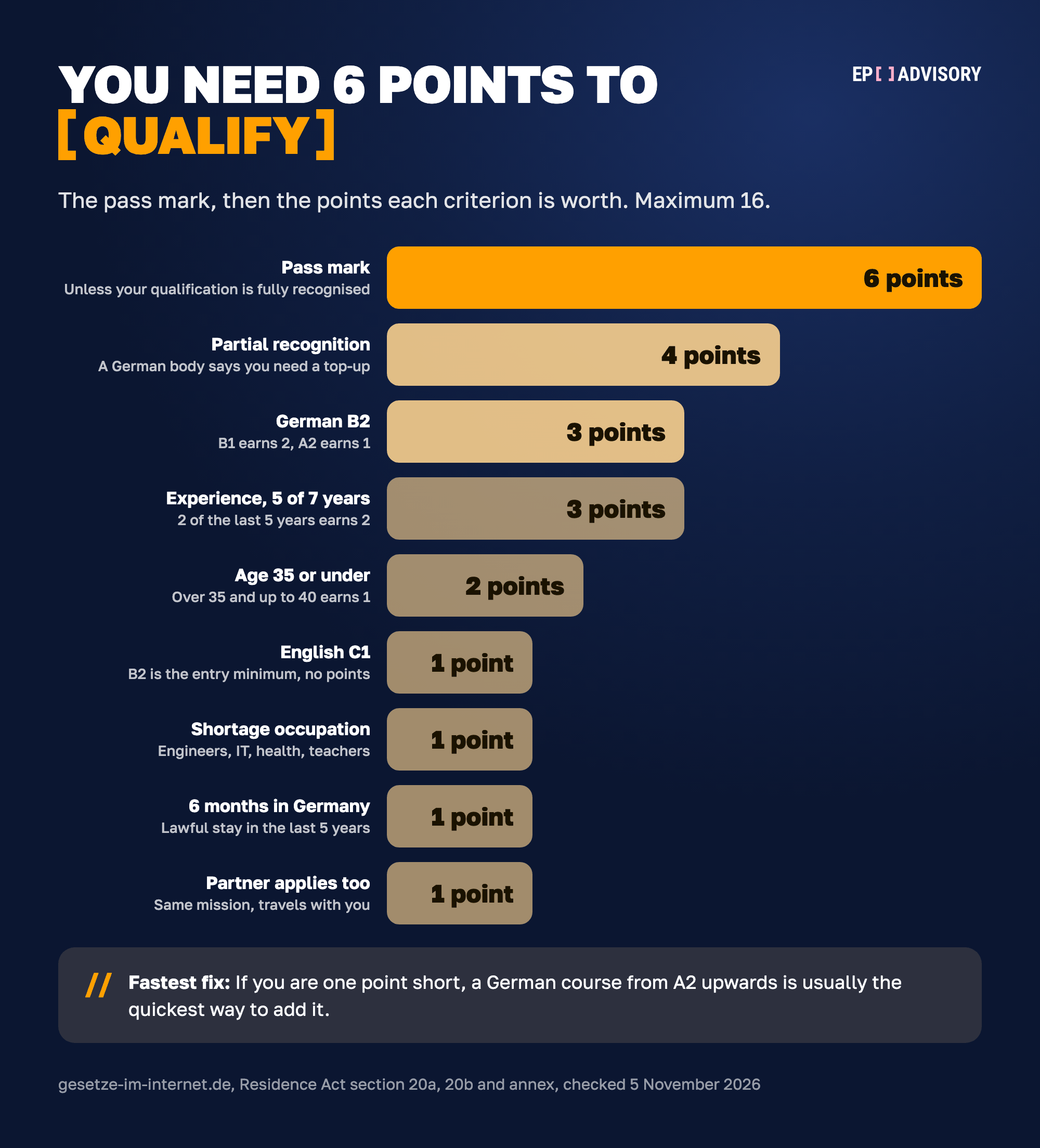
There is no upper age limit. After 40 you simply get no age points. The shortage groups come from the EU Blue Card section of the law, so the same list later lowers your Blue Card salary floor too.
Here is how the count works for three composite profiles. They are not real clients. They show how the table behaves, not which permit you should choose.
Ananya, 29, software engineer from Bengaluru. Her B.Tech was full-time and on campus, and anabin rates her university H+ and her degree as equivalent. That makes her a skilled worker on route 1, so she needs no points. If she used route 2, she would score 3 for 6 years of experience, 2 for her age, 1 for English C1 and 1 because software engineering is an ICT profession. That is 7.
Bilal, 37, civil engineer from Lahore. His degree is recognised in Pakistan, but it is not fully recognised in Germany, so he takes route 2. He scores 3 for 8 years of experience, 1 for his age and 1 because engineering is a shortage group. That is 5. His English is B2, which lets him in but earns no points. German at A2 adds 1 point and takes him to 6. A few months of evening classes decide his application.
Reshma, 32, nurse from Kochi. She applied for recognition as a nurse in Germany. The recognition body told her she needs an adaptation course first. That decision alone is worth 4 points, and it also replaces the usual qualification rule. Add 2 for her age, 1 for nursing as a shortage group and 2 for German B1. That is 9. She can also use the card to look for the adaptation course itself, because the law covers recognition measures as well as jobs.
The lesson from all three: experience and age do most of the work, and German is the lever you control. Every level from A2 to B2 adds a point. If you are one point short, a language course is usually the fastest fix.
Proof of funds: about €1,091 a month, and how to show it
The law says only that your living costs must be covered. The German missions publish the amount they accept, and the figures differ. On 5 November 2026 the German missions in India ask for at least €1,091 a month. The Consulate General in Karachi lists €1,027 a month plus €500 for a return ticket to Pakistan. Use the figure on your own mission’s page on the day you apply.
The pages give a monthly figure but do not say how many months you must cover. Ask your mission, or plan for the full card. At €1,091 a month, 12 months is €13,092.
You can usually show the money in one of two ways:
- A blocked account (Sperrkonto). You pay the money into a blocked German account before you travel.
- A formal declaration of commitment (Verpflichtungserklärung). Someone who lives in Germany signs it at their local authority and promises to cover your costs.
You also need health insurance, statutory or private, that starts on the day you enter Germany. The India missions ask for the certificate with your application.
Treat the funds figure as a floor, not a budget. Rent in the big hiring cities often takes most of it. A part-time job of up to 20 hours a week can close the gap, but plan your search so that it does not depend on finding one. Our guide to salaries in Germany shows what jobs pay once you switch.
How to apply from India or Pakistan, document by document
You apply in your country of residence, not your country of citizenship. An Indian citizen living in Dubai applies in the UAE. Most Opportunity Card applications now start online, in the Consular Services Portal. Where it is available, using it is obligatory.
- Check your route. Look up your degree and university in anabin. If they are not listed as required, apply to ZAB for a Statement of Comparability early, because ZAB gives 3 months as the processing time for a regular application.
- Book your language test. German from a recognised provider such as the Goethe-Institut (Max Mueller Bhavan in India), ÖSD or telc. English from an ALTE-standard provider or TOEFL.
- Arrange funds and health insurance. Open the blocked account or get the declaration of commitment signed. Buy insurance that starts on your arrival date.
- Collect proof of experience. Letters from employers or work contracts that show exact start and end dates and what you did. Add a CV in English or German.
- Apply in the portal. Answer the questionnaire, choose the mission for the place you live, and upload the documents on your personal list. You can save and come back.
- Book the appointment. You get the booking link only after the portal pre-check. The €75 fee is not refunded if you are refused.
- Register when you arrive. Register your address within 2 weeks of moving in (section 17 of the Federal Registration Act). Then apply at the local foreigners office for a residence permit if your visa does not cover the full stay.
If you live in India
- Mark sheets for every semester, not only the final degree certificate.
- Proof of regular mode. Your university must confirm that you studied on-site, not by distance learning. For a distance degree, add proof that the programme was approved when you graduated, or a ZAB certificate.
- The right English test. PTE, Duolingo and TOEFL online are not accepted as proof in India.
- Passport issued within the last 10 years, with at least 2 empty pages.
- The fee is INR 8,300 for adults. The external service provider adds its own service fee. The missions state that you do not need an agent, and that all forms and information are free (national visa page).
- If you are refused, there is no remonstration in India since 1 January 2024. The refusal letter explains how to challenge it at the administrative court in Berlin.
If you live in Pakistan
- The Embassy in Islamabad handles Islamabad Capital Territory, Punjab, Khyber Pakhtunkhwa, Gilgit-Baltistan and Azad Jammu and Kashmir. The Consulate General in Karachi handles Sindh and Balochistan. Both take Opportunity Card applications through the portal (German missions in Pakistan).
- HEC attestation. Karachi’s checklist asks for your degrees and final transcripts, both attested by the Higher Education Commission.
- Two anabin printouts, one for the degree and one for the university, or a ZAB Statement of Comparability.
- Funds through a blocked account or a declaration of commitment from a sponsor in Germany.
- The fee is €75, paid in rupees.
Check the current rules with the official site or a regulated adviser before you pay for anything. The missions in India say they may ask for certificates to be verified, at an extra fee. Ask your mission in Pakistan whether it does the same.
What you may do while you search
The card lets you do two kinds of work. Both have limits, and both are worth using.
- A part-time job of up to 20 hours a week on average. The law sets no condition on the type of job. A role in your own field is still the best choice, because it gives you a German reference and a German line on your CV.
- Trial work of up to 2 weeks with each employer. This must be a qualified role, a step towards training, or part of a recognition measure. It lets an employer see you work before they sign a contract.
- No full-time job on the card. Once you have a full-time offer, you move to a work permit.
Use the trial work on purpose. When an interview goes well, offer a short paid trial. A hiring manager who is unsure about a candidate from abroad often just needs to see the first week. Mention in your cover letter that the card allows it. Our guide to the cover letter for a job abroad shows how to say that in one sentence.
Score your CV in 30 seconds, then fix its biggest problems one by one. Both free.
Free, no card. A free account unlocks every fix.

A 12-month job search plan that uses every month
Most of the work happens before you land. What we have seen in the market in 2026 is that 200 applications is a safe number to work from to get an offer. 10 high-quality applications a week is a realistic long-term pace. At that pace, 200 applications take about 5 months. So the plan below aims for an offer by month 6, with time left for the permit.
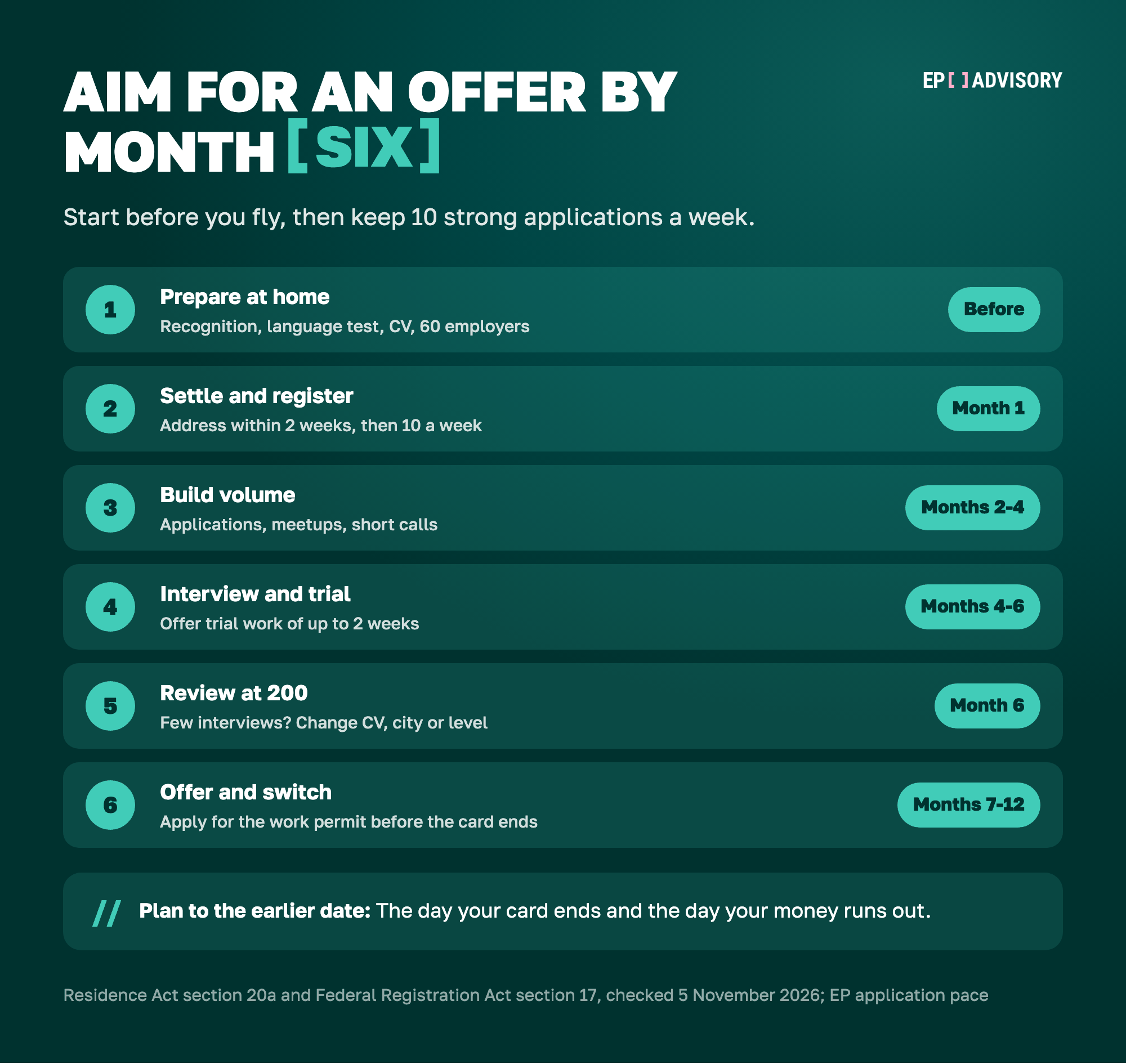
Before you go (2 to 3 months). Finish your recognition check and language test. Rewrite your CV in the German format: a clear profile, dated roles, and your permit status in one line. Our European CV format guide shows what changes. List 60 employers in your field and city. Start with the official Federal Employment Agency job search. Start applying 6 to 8 weeks before you fly, and aim to have first calls booked for your first month.
Month 1: settle fast. Register your address, open your account and confirm your insurance in the first 2 weeks. Then go straight to 10 applications a week. Apply for a part-time job in your field at the same time.
Months 2 to 4: build volume. Keep the 10 a week. Go to meetups and industry events in your city, and ask for short calls with people in the teams you target. Track every application in one sheet: date, role, contact, reply.
Months 4 to 6: interview and trial. Expect most interviews in this window. Prepare for the German style: punctual, structured and fact-based. Our guide on how to pass a job interview covers the method. Offer trial work where it helps the employer decide.
Month 6: review honestly. If you have applied 200 times and have few interviews, change something. Rewrite the CV around results, widen the cities, add a German level, or aim one step lower in seniority. Our CV achievements examples help with the first fix.
Months 7 to 10: offer and switch. Check the offer against the salary floor of the permit you need, then apply for the work permit from inside Germany.
Months 11 and 12: protect your status. Apply for the new permit before the card ends. If there is no offer, plan your exit. A new search card is only possible after you have spent as long outside Germany, or in Germany on another permit, as you spent on the last one.
Your CV does the first round of every one of those 200 applications, often before you have even landed. A free check shows you what a German recruiter will notice first. Getting ready to apply for jobs in Germany? Check your CV for free: see it the way a recruiter does, then fix each problem.
For where the hiring is strongest by sector and city, read our guide to jobs in Germany for foreigners. For the search method itself, see how to find a job in Europe from abroad.
Switching to a work permit: Blue Card, skilled worker or IT specialist
The card is a residence permit, so you can apply for your work permit without leaving Germany (section 39 of the Residence Ordinance). Which permit depends on your qualification and your offer. The 2026 floors follow from the pension contribution ceiling of €101,400 a year. All figures are gross per year.
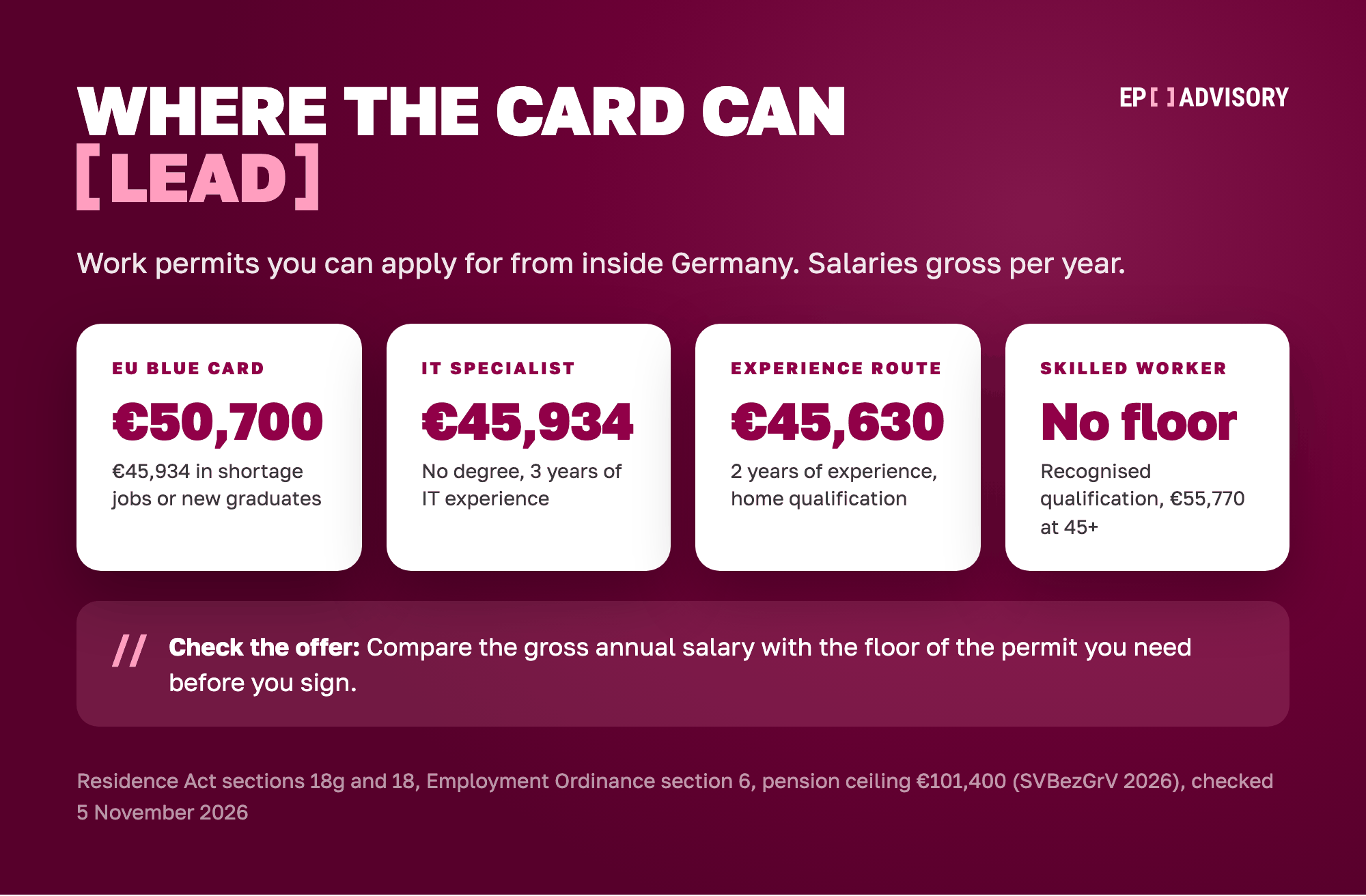
| Route | Who it fits | 2026 salary floor | Worth knowing |
| EU Blue Card | Recognised or comparable degree, offer of at least 6 months | €50,700. €45,934 in shortage groups or with a degree from the last 3 years | Permanent residence after 27 months with German A1, or 21 months with B1 |
| Blue Card for IT specialists | No degree, but 3 years of IT experience in the last 7 | €45,934 | Experience replaces the degree |
| Skilled worker permit | Recognised degree or vocational qualification, any qualified job | No general floor. €55,770 if you are 45 or over at the first permit, unless you show adequate pension provision | Permanent residence after 3 years with B1 German |
| Experience route | 2 years of experience in the last 5, qualification recognised at home | €45,630, or the collective agreement rate | In IT jobs, no formal qualification is needed. From age 45, the agency asks for at least €55,770. |
| Follow-on Opportunity Card | An offer for qualified work that fits none of the routes above | Approval by the Federal Employment Agency | Up to 2 more years, no further extension |
The rules come from sections 18g and 18c of the Residence Act and section 6 of the Employment Ordinance.
For most Opportunity Card holders with a degree, the Blue Card is the target. Its floor is the number to keep in mind when you choose roles and negotiate. If you are a nurse, engineer, teacher or developer, the lower €45,934 floor applies, so more offers will qualify.
Next: compare these floors with other countries in our work visa salary thresholds guide, so you know which offers to say yes to.
Six mistakes that waste an Opportunity Card
- Entering on a tourist visa and planning to switch. The law only gives the card inside Germany to people who already hold a study, training or work residence permit. Everyone else applies at a mission abroad.
- Sending the wrong English test. In India, PTE, Duolingo and TOEFL online are not accepted. Check your mission’s list before you book.
- Counting B2 English as points. B2 gets you in on route 2. Only C1 earns a point.
- Leaving out proof of how you studied. Indian applicants need semester mark sheets and proof of regular mode. Pakistani applicants in Karachi need HEC attestation. Missing papers delay the whole year.
- Treating the part-time job as the plan. The 20 hours pay the rent. They do not get you a work permit. Keep the 10 applications a week going.
- Waiting for the follow-on card. It needs an offer and Federal Employment Agency approval, and it only applies when no other work permit fits. Aim for a Blue Card or skilled worker permit instead.
Key takeaways
- The Germany Opportunity Card gives up to 12 months in Germany to look for work, with no job offer needed.
- You qualify with a qualification fully recognised in Germany, or with 6 of 16 possible points plus a recognised qualification and German A1 or English B2.
- Partial recognition is worth 4 points, and each German level from A2 to B2 adds one more.
- The missions in India ask for at least €1,091 a month in funds, and the visa fee is €75.
- You may work up to 20 hours a week and do trial work of up to 2 weeks per employer.
- Aim for an offer by month 6. At 10 strong applications a week, 200 applications take about 5 months.
- Switch from inside Germany. The Blue Card floor in 2026 is €50,700 a year gross, or €45,934 in shortage jobs.
See what a recruiter sees, then fix it before you apply. An instant score, then the fix for every problem.
Free, no card. A free account unlocks every fix.
Frequently asked questions
How many points do I need for the Germany Opportunity Card?
You need at least 6 points out of a possible 16, unless your qualification is fully recognised in Germany, in which case you need no points. Points come from partial recognition, German or English skills, work experience, age, a shortage occupation, a past stay in Germany and a partner who applies with you.
How much money do I need for the Opportunity Card?
The German missions in India ask for at least €1,091 a month to cover living costs. The Consulate General in Karachi lists €1,027 a month plus €500 for a return ticket. You can show it with a blocked account or a declaration of commitment from someone in Germany. Check your own mission’s page, because the figure changes.
Can I work full time on the Opportunity Card?
No. You may work up to 20 hours a week on average and do trial work of up to 2 weeks with each employer. Once you have a full-time offer, you apply for a work permit such as the EU Blue Card, and you can do that from inside Germany.
Can I apply for the Opportunity Card from inside Germany?
Only if you already hold a German residence permit for study, training or work. If you are in Germany as a visitor, you must apply at a German mission in the country where you live.
What happens if I do not find a job within 12 months?
The card ends and cannot be extended for further searching. A follow-on card is only possible with a job offer and approval from the Federal Employment Agency. You can apply for a new search card only after spending as long outside Germany, or in Germany on another permit, as you spent on the last one.