 By Andre Atallah, CEO of EP Advisory
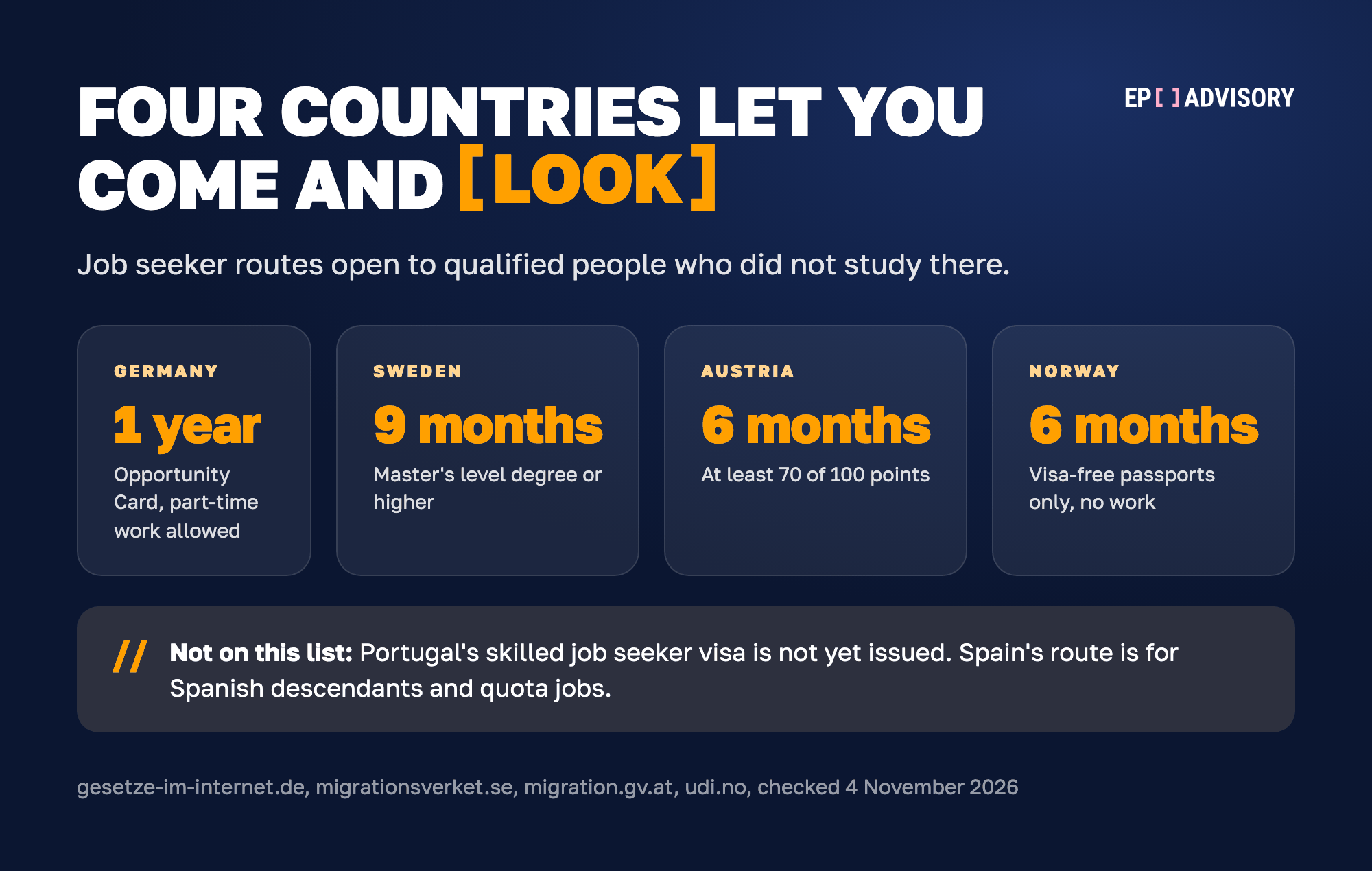
Short answer: four European countries let a qualified non-EU professional come and look for work without a job offer in 2026: Germany (up to 1 year), Sweden (up to 9 months), Austria (6 months) and Norway (6 months, visa-free passports only). Spain’s route is limited to Spanish descendants and set occupations. Portugal’s new skilled job seeker visa is not yet issued. Most other “job seeker visas” are for graduates of that country’s universities.
A job seeker visa in Europe is a permit that lets you enter a country, stay for a set time and look for work before you have an offer. In 2026 only a handful of countries offer one to people who did not study there. Most lists online mix those few open routes with permits that only local graduates can get, and some still describe visas that no longer exist.
This guide separates the two. The first table covers the routes open to any qualified professional, with the time you get, whether you may work while you search, the money you must show and where you apply. The second table covers the graduate-only permits. Every rule is from the government source, checked on 4 November 2026.
For nearly 10 years, we’ve helped more than 5,000 professionals find jobs abroad. Want to know if your CV will pass screening in Europe? Check your CV for free: a score in 30 seconds, then a fix for each problem.
Start here: which job seeker visa in Europe fits you?
Your profile decides your list more than any ranking does. Find the line that describes you, then go to the table.
- You have a master’s degree or a PhD from anywhere. Sweden’s permit to look for work is open to you if your degree is at second-cycle level. Germany and Austria are open too if you meet their points rules.
- You have a bachelor’s degree or a 2-year vocational qualification, but no master’s. Germany’s Opportunity Card is the main open route. You need English at B2 or basic German, and at least 6 points.
- You hold a passport that does not need a visa for Norway, such as a US, Canadian, Australian or UK passport. Norway’s skilled job seeker permit is also open to you, if you count as a skilled worker.
- Your parent or grandparent is Spanish by origin. Spain has a 12-month job search residence for you.
- You studied, or are studying, in Europe. Look first at the graduate table. Those permits are often longer and let you work while you search.
- You were planning on Portugal’s job seeker visa. Read the Portugal block first. The skilled job seeker visa is not yet available at Portuguese consulates.
If none of these fit, you can still move. You apply from home for jobs that come with a work permit. Our guide to finding a job in Europe from abroad covers that plan.
Every open job seeker visa in Europe, compared
These are the routes open to qualified people who did not study in that country. All figures were checked on the official site on 4 November 2026.
| Country and permit | Who can apply | Time to search | Work while searching | Money to show | Where you apply |
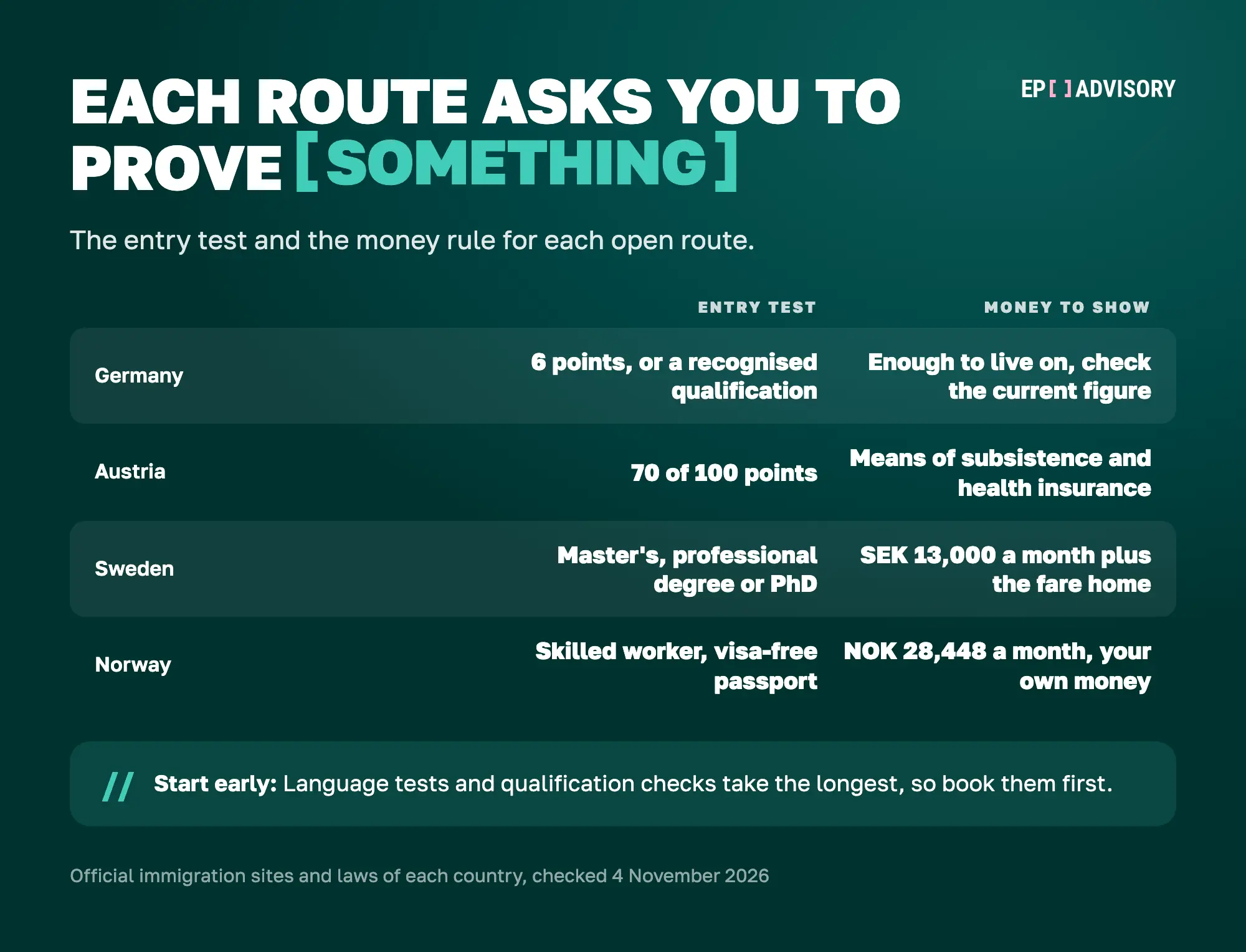
| Germany, Opportunity Card (Chancenkarte) | A recognised skilled worker, or 6+ points with a degree or 2-year vocational qualification and English B2 or German A1 | Up to 1 year | Yes, up to 20 hours a week on average, plus trial work of up to 2 weeks per employer | Enough to live on (check the current figure) | German embassy or consulate. Not from a visa-free visit |
| Austria, Job Seeker Visa | Very highly qualified people with at least 70 of 100 points | 6 months | Not stated on the official page | Means of subsistence, accommodation and full health insurance | Austrian embassy or consulate. Visa-free nationals do not need it |
| Sweden, residence permit to look for work | People with a master’s, a professional degree of 60 to 330 credits, or a PhD | Up to 9 months | Only after you apply for a work permit | SEK 13,000 a month, plus the return fare | From outside Sweden |
| Norway, skilled job seeker permit | Skilled workers from visa-free countries only | Up to 6 months | No | NOK 28,448 a month, your own money | UDI online application portal |
| Spain, job search residence (limited) | Children or grandchildren of Spaniards by origin, or set occupations in the yearly quota order | 12 months | The employer applies for your work permit once you find a job | Check with the consulate | Spanish consulate |
| Portugal, skilled job seeker visa | Not yet available | Not yet available | Not yet available | Not yet available | Consulates are waiting for the new regulation |
Fees we could confirm: Austria’s Job Seeker Visa costs €195, then €218 for the Red-White-Red Card application. Sweden’s permit costs SEK 2,200. The country blocks below give the rest, with links to each official page.
The time on the permit is only half the picture. Each route asks you to prove something different before you arrive. Plan for that proof now, because it decides how fast you can apply.
Graduate-only routes: if you studied in Europe
These permits are for people who graduated in that country. They are usually longer and more flexible than the open routes. If you are still studying, this table matters more than the one above. The Netherlands is the one exception: it also accepts master’s and PhD graduates of top-ranked universities worldwide.
| Country and permit | Who can apply | Time to search | Good to know |
| Denmark, job-search permit after studies | Graduates of a Danish professional bachelor’s, bachelor’s, master’s or PhD | Up to 3 years (6 months for other programmes) | The old establishment card scheme has closed to new applicants |
| Finland, permit to look for work after studies | People who finished a degree or research in Finland | Up to 2 years | Apply up to 5 years after your student permit ends |
| Spain, job search after studies | Graduates of a Spanish degree at EQF level 6 or above (bachelor’s level and up) | Up to 24 months, not renewable | Apply in the 60 days before or 90 days after your study stay ends |
| Ireland, Third Level Graduate Programme (Stamp 1G) | Non-EEA graduates of Irish institutions | 12 months at level 8; up to 24 months at level 9 and above | Fee €300. Time limits apply to total years spent in Ireland as a student |
| Netherlands, orientation year | Dutch graduates, or master’s and PhD graduates of top-200 universities in at least 2 world rankings | 1 year, not renewable | You may work freely. Fee €254. Diploma must be from the last 3 years |
| Belgium, search year | Graduates of Belgian higher education | Up to 12 months | Apply at your town hall at least 15 days before your residence card (A card) expires |
| France, job search or business creation permit | Graduates of a French master’s or equivalent, licence professionnelle, Mastère Spécialisé or MSc | 1 year | From abroad, you can apply within 4 years of your degree |
| Austria, job search after studies | Graduates of Austrian universities | 12 months | Your student permit is extended. No points test for the graduate Red-White-Red Card |
| Norway, job seeker after studies | Graduates and researchers of Norwegian institutions | Up to 1 year | You may work full or part-time. Funds NOK 28,448 a month |
| Switzerland, job search after studies | Graduates of Swiss higher education | 6 months | There is no job seeker permit for anyone else |
Sweden also has a separate permit to look for work after studies in Sweden. Its terms differ from the open permit above, so check Migrationsverket’s page for graduates if you studied there.
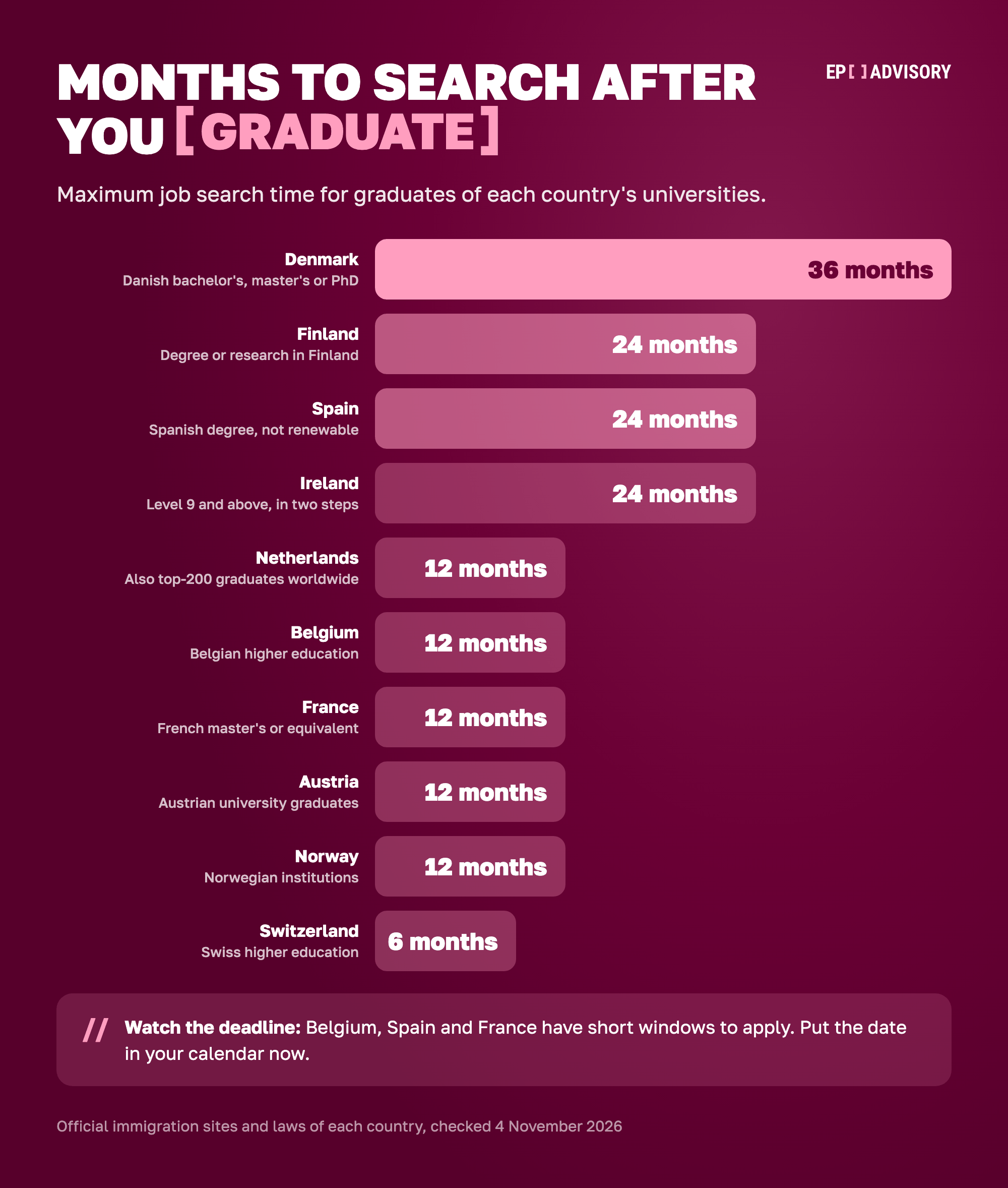
A graduate permit is worth planning for while you are still studying. Note your deadline in your calendar now. Belgium, Spain and France all have short application windows, and missing one usually means losing the permit.
Score your CV in 30 seconds, then fix its biggest problems one by one. Both free.
Free, no card. A free account unlocks every fix.

Four worked examples
These are composite profiles, not real clients. They show how the rules play out. They are not advice on which permit to choose.
Priya, 31, software engineer from India. She has a master’s in computer science, 6 years of work since graduating, English at C1 and no German.
- Germany: her degree and English B2 or above meet the basic rule. Points: 3 for 5 years of experience in the last 7, 2 for being 35 or under, 1 for English C1 and 1 because software engineering is a shortage group. That is 7, one more than the minimum.
- Sweden: her master’s qualifies. For 9 months she would need SEK 117,000 in her bank (9 x SEK 13,000), plus the return fare.
- Austria: her master’s is a MINT subject and she is under 35, so she starts with a strong score. She should run Austria’s official points calculator before counting on 70.
- Norway: not open to her, because Indian citizens need a visa for Norway.
Daniel, 28, marketing manager from the US. He has a bachelor’s degree, 3 years of experience and no German.
- Germany: 2 points for experience, 2 for age and 1 if he reaches English C1. That is 5, one short. German at A2 adds 1 point, so a few months of classes would take him to 6.
- Sweden: not open yet, because a bachelor’s alone is not a second-cycle degree.
- Norway: open, because US citizens are visa-free and a degree makes him a skilled worker. He would need NOK 28,448 a month of his own money and may not work while searching.
Amara, 26, finishing a master’s in the Netherlands. Her degree is Dutch, so the orientation year is open to her. She gets 1 year and may work in any job while she looks. If she then takes a skilled role, the employer’s salary floor for her is the reduced highly skilled migrant rate of €3,122 a month, not the €4,357 that applies to other people under 30. The details are in our Netherlands work visa guide.
Lucas, 34, engineer from Brazil. His grandfather was Spanish by origin. He had planned on Portugal’s job seeker visa, which is not issued today. Spain’s job search residence for grandchildren of Spaniards by origin gives him 12 months instead. Our guide to jobs in Spain for foreigners covers where he would start.
The pattern is the same in all four cases. Each person has two or three real options, not twenty. Write yours down before you research any further.
What changed in 2026, and the traps in old advice
Many of the top results for this query are out of date. These are the changes and mix-ups that matter most.
- Portugal’s job seeker visa is not open. Portugal’s consular site says the skilled job seeker visa is not yet available. It is waiting for the regulation of Article 57-A of the Foreigners’ Law. Guides that promise a 120-day visa with a 60-day extension describe a route you cannot use today.
- Sweden raised its work permit bar. New work permit rules started on 1 June 2026. The salary requirement has been SEK 34,470 a month since 16 June 2026. So your Swedish offer needs to clear that figure before you switch.
- Spain has a new immigration regulation. Real Decreto 1155/2024 took effect on 20 May 2025 and was amended in April 2026. The general job search residence stays limited to Spanish descendants and quota occupations.
- Denmark’s establishment card is gone. It closed to new applicants in 2023. Danish graduates got a longer job-search permit of up to 3 years instead.
- Austria’s job seeker visa is not the Red-White-Red Card. The visa gives you 6 months to find a job. The card is the work permit you apply for once you have one.
- Germany’s Opportunity Card lasts up to 1 year. Some guides say 18 months. The law says up to 1 year, with a follow-on card of up to 2 years only if you have a job offer and the Federal Employment Agency approves it.
Immigration rules in Europe change every year. Before you book anything, check the current rules with the official site or a regulated adviser.
Country by country: how each open route works
Germany: Opportunity Card (Chancenkarte)
Germany’s Opportunity Card is the most flexible open route in Europe. It also lets you work while you search.
- Who: anyone whose foreign qualification is fully recognised in Germany. Or anyone with at least 6 points who has a degree or a vocational qualification of at least 2 years, recognised by the state where they earned it.
- Language (points route only): German at A1 or English at B2, as a minimum. People with full recognition need no language proof.
- Points: the points table gives 4 for partial recognition of your qualification, 1 to 3 for German (A2 to B2), 1 for English C1, 2 or 3 for experience, 1 or 2 for age up to 40, 1 for a shortage occupation and 1 for a past stay in Germany.
- Work: up to 20 hours a week on average, plus trial work of up to 2 weeks with each employer.
- Time: up to 1 year. You need to show you can support yourself. The amount changes, so check the current figure with the German mission.
- Where: at a German embassy or consulate. You cannot get it in Germany after entering on a visa-free visit.
Use the 20 hours well. A part-time job in your field is a stronger story for a recruiter than any other job. Our guide to jobs in Germany for foreigners covers which work permit you move to once you have an offer.
Austria: Job Seeker Visa for very highly qualified people
Austria’s Job Seeker Visa gives you 6 months to find a job. It is for people who score at least 70 of 100 points.
- Points: a 4-year degree gives 20, a MINT subject (maths, IT, science or technology) gives 30 and a PhD gives 40. Being under 35 gives 20. German or English at A1 gives 5, at A2 gives 10.
- Proof: accommodation, full health insurance and enough money to live on. The Public Employment Service (AMS) checks your points.
- Fee: €195 for the visa, then €218 for the Red-White-Red Card.
- Visa-free passports: you do not need the visa. You can apply for the Red-White-Red Card during your visa-free stay once you have a matching offer.
If your offer matches your profile, you can apply for the Red-White-Red Card, in some cases from inside Austria. Run the official points calculator before you apply, since a few points decide the outcome.
Sweden: residence permit to look for work
Sweden’s permit to look for work or start a business is for people with an advanced degree.
- Who: people with a master’s of 60 or 120 credits, a professional degree of 60 to 330 credits, or a PhD. Equivalent foreign degrees count.
- Money: at least SEK 13,000 for each month you apply for, plus the cost of your trip home. You also need full health insurance.
- Time: up to 9 months, and never longer than your passport is valid.
- Where: you must apply from outside Sweden. The fee is SEK 2,200.
- Switching: once you have an offer, you apply for a work permit from inside Sweden.
Renew your passport first if it expires within a year. A short passport means a short permit.
Norway: skilled job seeker permit
Norway’s job seeker permit is open only to citizens of countries that do not need a visa for Norway.
- Who: skilled workers. That means a degree or at least 3 years of vocational training. Without formal training, it usually means 6 years or more of experience.
- Money: at least NOK 28,448 a month of your own money, usually in a Norwegian bank account.
- Work: not allowed while you search.
- Time: up to 6 months from the day you enter. Your family cannot join you on it. You must spend a year outside Norway before another job seeker permit.
Because you cannot work, build your savings before you go. Book interviews for your first weeks so the 6 months count.
Spain: job search residence
Spain’s 2024 immigration regulation gives 12 months of residence to look for work. It is open to two groups only:
- children or grandchildren of Spaniards by origin;
- people in occupations and regions named in the yearly collective hiring order, which also sets the numbers.
When you find a job, the employer applies for your work permit. If you studied in Spain, the graduate route gives you up to 24 months instead.
Portugal: skilled job seeker visa, not yet available
Portugal’s consular site now shows a clear banner on its job seeker visa page. It says the skilled job seeker visa is not yet available at Portuguese consular offices. The consulates are waiting for the regulation of Article 57-A of the Foreigners’ Law.
So do not pay for an appointment or a package based on the 120-day visa, which consulates do not issue yet. Apply from home for jobs that come with a work visa instead. Check the consulate page again before you plan. Our guide to jobs in Portugal for foreigners covers the employers and work visas that are open now.
How to use your months: a plan for the search
A job seeker visa gives you time, not a job. Most of the work happens before you arrive. These steps are the ones that make the months count.
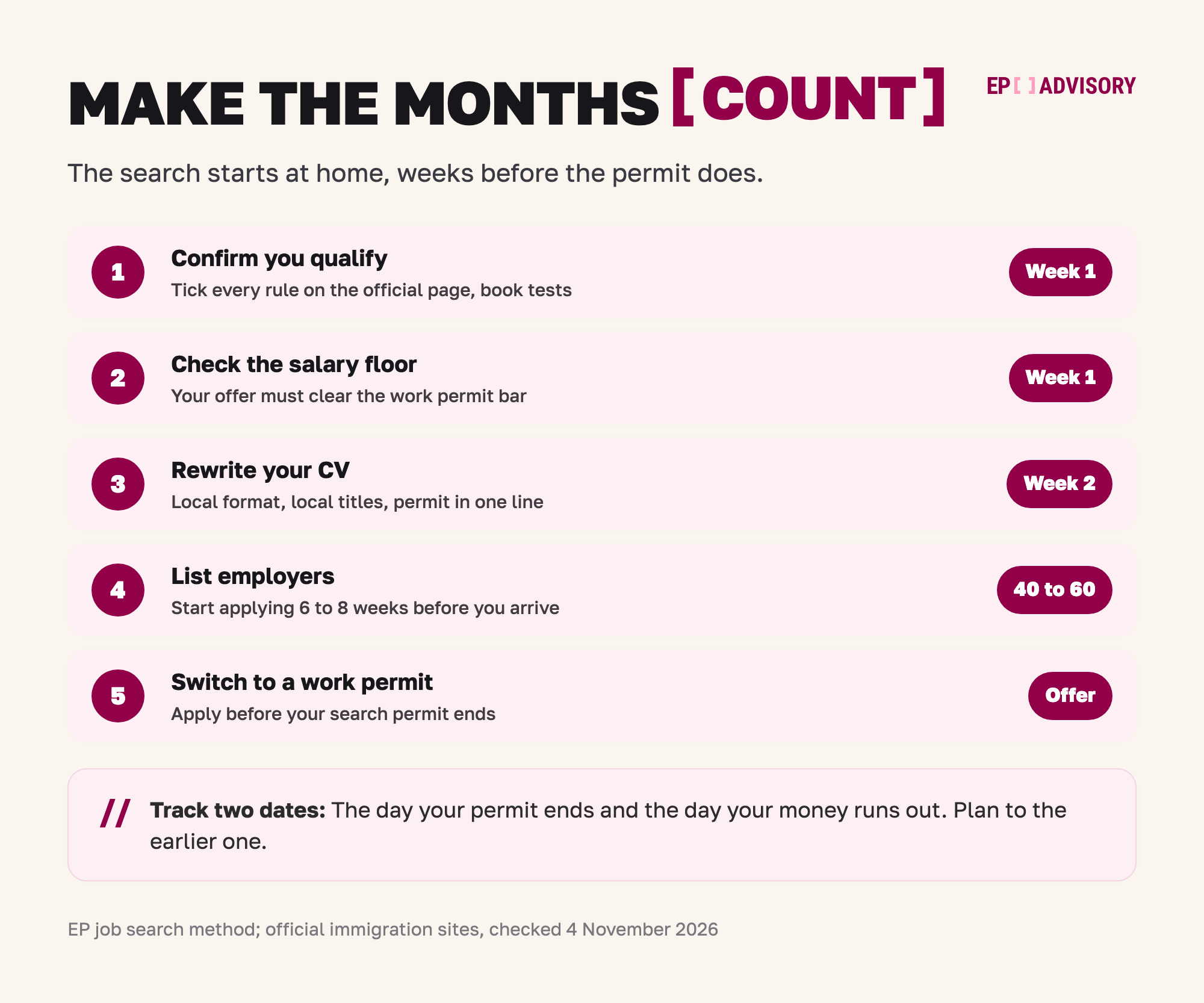
- Confirm you qualify, on the official page. Print the requirements and tick each one. Book the language test or the recognition check first, because those take the longest.
- Know the salary floor for your work permit. The offer you find must clear it. For example, Germany’s Blue Card needs €50,700 a year in 2026, or €45,934 in shortage jobs. Our work visa salary thresholds guide has every country.
- Rewrite your CV for that country. Use the local format, local job titles and a clear line on your permit. Our European CV format guide shows what changes by country.
- List 40 to 60 employers before you travel. Start applying 6 to 8 weeks before you arrive. Aim to have interviews booked for your first month.
- Write one letter you can adapt. Say in one sentence that you hold a job seeker permit and can start quickly. Our cover letter guide for jobs abroad shows how.
- Track your time and your money. Note the date your permit ends and the switch steps for a work permit. Keep enough funds for the full period, not only the minimum.
Next: write down the two or three routes open to you and the end date each would give you. Then work back from that date to the day you start applying.
Your CV is the first thing an employer sees, often before you have even landed. A free check shows you what a recruiter in your target country will notice. Getting ready to apply for jobs in Europe? Check your CV for free: see it the way a recruiter does, then fix each problem.
Other countries: quick reference
- Netherlands, Belgium, Ireland, Denmark, Finland, France and Switzerland: graduate routes only (see the graduate table). If you did not study there, you need a job offer and a work permit first.
- Italy, Czechia, Lithuania, Luxembourg and Estonia: we could not confirm an open job seeker route on their official sites, so they are not in the tables. Check their immigration sites directly.
- UK: it has no job seeker visa. You need an offer from a licensed sponsor first. Our UK Skilled Worker salary threshold guide covers the bar.
How we checked: methodology
We counted a permit as a job seeker visa if its main purpose is to let you stay and look for work without an offer. Permits that only follow a job offer are left out. Permits that only local graduates can get are in a separate table.
Every rule, figure and fee comes from the government source for that country: the law itself, or the immigration authority’s own page. All were checked on 4 November 2026. Where an official page does not state something, such as work rights or the current funds figure, we say so rather than guess. Salary floors match our 2026 thresholds guide.
Key takeaways
- Only four countries offer an open job seeker route in 2026: Germany, Austria, Sweden and Norway. Norway’s is for visa-free passports only.
- Germany’s Opportunity Card lets you work while you search, up to 20 hours a week. Norway does not allow it, and Sweden only once you apply for a work permit.
- Portugal’s skilled job seeker visa is not yet available. Ignore guides that say the 120-day visa is open now.
- Most other job seeker permits are for local graduates, and they are often longer: up to 3 years in Denmark and 2 years in Finland.
- The Netherlands also accepts master’s and PhD graduates of top-200 universities worldwide.
- Your offer still has to clear a work permit salary floor, so check it before you start.
- Most of the search happens before you land: CV, employer list and interviews.
See what a recruiter sees, then fix it before you apply. An instant score, then the fix for every problem.
Free, no card. A free account unlocks every fix.
Frequently asked questions
Which European countries have a job seeker visa in 2026?
Germany, Austria, Sweden and Norway offer job seeker routes to qualified people who did not study there. Norway’s is only for visa-free passports. Spain has a limited route for Spanish descendants and quota occupations. The Netherlands, Belgium, Ireland, Denmark, Finland, France and Switzerland offer job search permits to graduates of their own universities.
Does Portugal still have a job seeker visa?
Not at the moment. Portugal’s consular site says the skilled job seeker visa is not yet available at its consulates, while it waits for the regulation of Article 57-A of the Foreigners’ Law. Check the consulate page before you plan, and apply for jobs with a work visa in the meantime.
Can I work on Germany’s Opportunity Card?
Yes, part-time. You may work up to 20 hours a week on average, and you may do trial work of up to 2 weeks with each employer. Once you have a qualifying offer, you apply for a work-based residence permit.
Which job seeker visa can I get if I did not study in Europe?
Germany’s Opportunity Card, Austria’s Job Seeker Visa and Sweden’s permit to look for work are open to people with qualifications from anywhere, if they meet the rules. Norway’s skilled job seeker permit is open too if your passport does not need a visa for Norway. The Netherlands’ orientation year also accepts master’s and PhD graduates of top-200 universities worldwide.
What happens when I find a job on a job seeker visa?
You apply for a work permit before you start the job. In Sweden you apply from inside the country. In Austria you apply for the Red-White-Red Card. In Germany you move to a work-based permit, and in Spain the employer applies for you. The offer must meet that permit’s salary floor.