 By Andre Atallah, CEO of EP Advisory

Short answer: yes, foreigners can work in Cyprus, and professionals have a faster route than most people expect. A company of foreign interests can hire non-EU staff on at least €2,500 gross a month with no labour market test, and the Migration Department decides in about one month. The EU Blue Card covers ICT, maritime and pharmacy research from €43,632 gross a year. Other non-EU hires need a labour market test. EU citizens need no permit.
Cyprus is a small labour market with an unusually international business base. Shipping managers, trading and investment firms and tech companies run regional offices here, and many of them work in English. Unemployment was 4.0% in September 2026, against 6.2% for the EU as a whole, according to Eurostat.
This guide covers the Republic of Cyprus. Northern Cyprus has different rules for work and residence, and it is not covered here. Immigration rules change often, so check the current rules with the Civil Registry and Migration Department before you act.
For nearly 10 years, we’ve helped more than 5,000 professionals find jobs abroad. Want to know if your CV will pass screening in Cyprus? Check your CV for free: a score in 30 seconds, then a fix for each problem.
Who can work in Cyprus: four routes
Your route depends on your passport and on who your employer is. EU, EEA and Swiss citizens have had free movement in Cyprus since 1 May 2004. They can start work straight away. To stay longer than 3 months, they apply for a Registration Certificate, often called the yellow slip, as the Department of Labour explains.
Non-EU citizens need an entry permit and a residence and work permit before they start. The employer applies in Cyprus, and the route depends on the company. Cyprus splits employers into two groups. Companies inside the government’s business facilitation scheme use a fast track. Every other employer uses the general route with a labour market test.
| Route | Who it fits | Pay rule | Labour market test | Decision time |
|---|---|---|---|---|
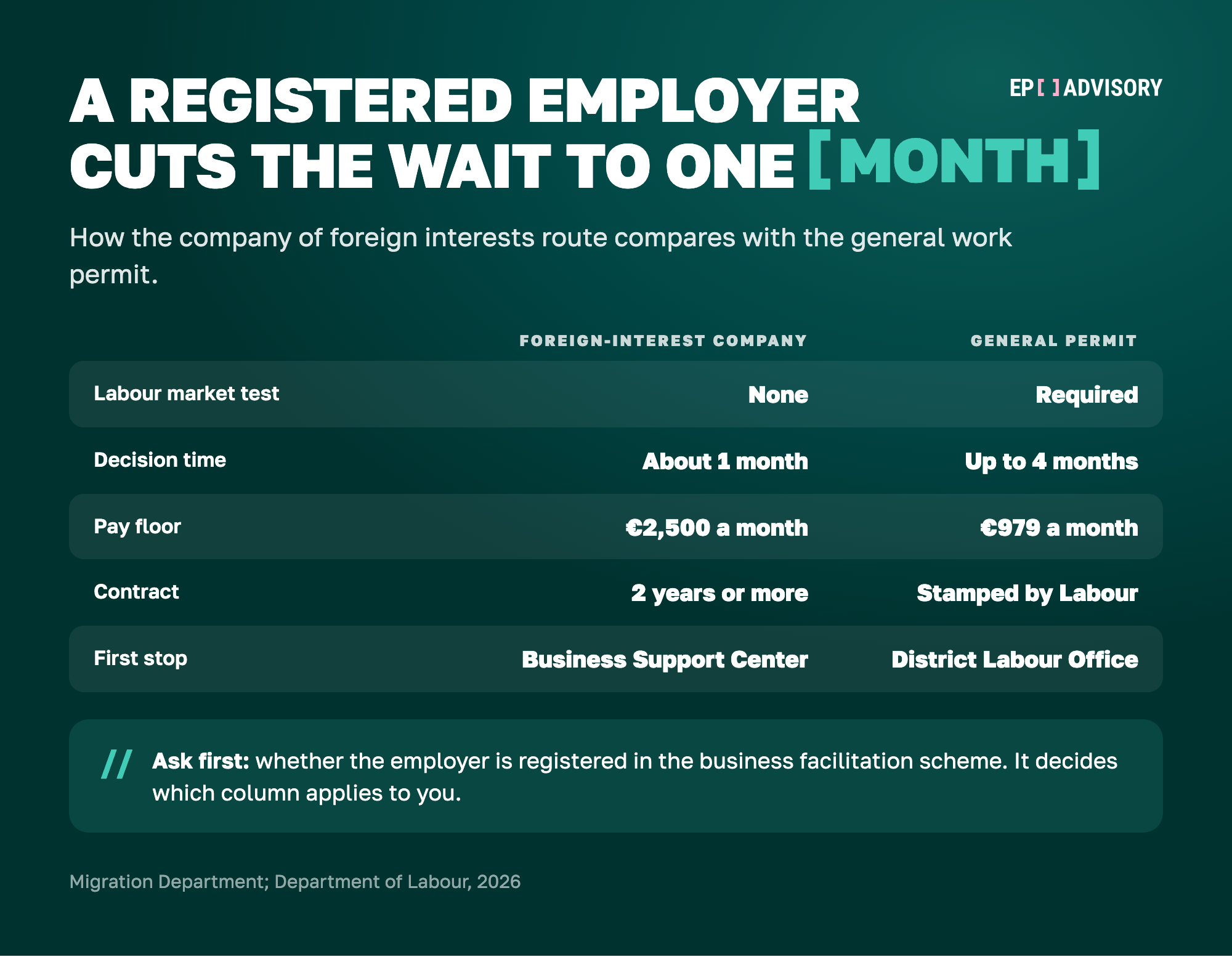
| Company of foreign interests | Directors, key staff and specialists at a company registered in the scheme | At least €2,500 gross a month | No | About 1 month |
| EU Blue Card | Graduates in ICT, maritime or pharmacy research | At least €43,632 gross a year | No | Up to 90 days |
| General work permit | Any non-EU hire by any other employer | At least the minimum wage and local terms | Yes | Up to 4 months |
| EU, EEA or Swiss citizen | Any job | Same as locals | No | No permit needed |
One point surprises people. Cyprus is in the EU but not in the Schengen area. A Cypriot permit lets you live and work in Cyprus. It does not give you the Schengen travel rights that a German or Italian permit would.
Companies of foreign interests: the fast route for professionals
For most non-EU professionals, this is the route that makes a Cyprus job realistic. Since 2 January 2022, Cyprus has run a business facilitation strategy for companies of foreign interests. A company joins once, and then hires non-EU staff without quotas or a labour market test. The rules are set out by the Migration Department.
According to the updated strategy, these companies can join:
- Foreign-owned companies, where third-country nationals hold most of the shares, with their own offices in Cyprus away from any home.
- Cypriot shipping companies.
- Cypriot high-tech and innovation companies.
- Cypriot pharmaceutical, biogenetics and biotechnology companies.
Since November 2022, a company must also prove an initial investment in Cyprus of at least €200,000. It registers first with the Business Support Center, run by the Ministry of Energy, Commerce and Industry. That is why this route mostly means established international employers, not start-ups run from a flat.
To be hired as highly paid staff, you need three things:
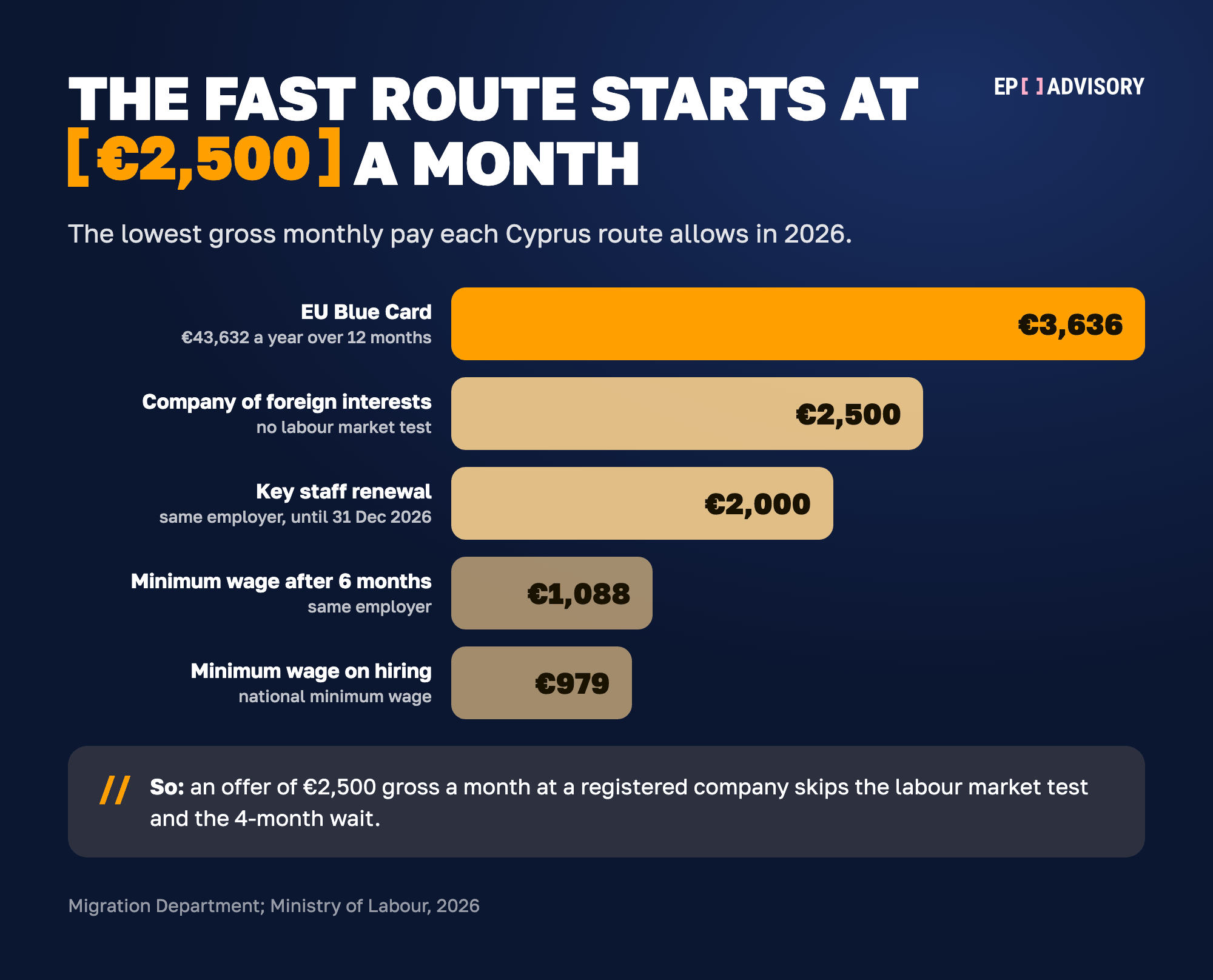
- Pay of at least €2,500 gross a month.
- A relevant degree, or at least 2 years of relevant experience.
- A contract of at least 2 years.
The specialist category is not limited to a list of jobs. Permits run for up to 3 years. Key staff already on €2,000 gross a month or more can renew with the same employer until 31 December 2026, so check the rule if your renewal falls after that date.
The scheme also helps families. Family reunification does not need a stamped job contract. A spouse of someone on €2,500 or more gets free access to the labour market straight away. Long-term, highly paid staff of these companies can apply for citizenship after 5 years of residence and work, or after 4 years with a certificate of very good Greek.
Companies do accept one limit. Over 5 years, at least 30% of their staff must be Cypriot or EU citizens. Support staff on under €2,500 go through the labour market test like any other hire.
So ask early in the process whether the company is registered in the business facilitation scheme. If it is, a €2,500 offer can turn into a permit in weeks, not months. If it is not, expect the general route below.
Score your CV in 30 seconds, then fix its biggest problems one by one. Both free.
Free, no card. A free account unlocks every fix.

The EU Blue Card in Cyprus covers three sectors only
The Cypriot Blue Card is narrower than in most EU countries. The Migration Department accepts it only for highly qualified jobs in three sectors:
- Information and communication technology (ICT).
- Pharmacy, for research purposes.
- Maritime jobs, except captains and ship’s crew.
The salary floor is €43,632 gross a year, which is about €3,636 gross a month over 12 months. You need a higher education qualification of at least 3 years. ICT managers and specialists can qualify with 3 years of relevant experience in the last 7 years instead. There is no quota.
The application goes to the Migration Department headquarters in Nicosia. The legal decision time is 90 days. In the first 12 months, a change of employer triggers a 30-day pause while the new job is checked. Time spent abroad does not cancel the card.
When does the Blue Card beat the faster company route? Mainly when your employer is not in the business facilitation scheme, or when you want EU long-term mobility later. If your employer is in the scheme, the €2,500 route is usually quicker. Compare the Cypriot floor with other countries in our guide to work visa salary thresholds in Europe.
The general work permit and its labour market test
Every other non-EU hire starts with proof that no local or EU worker was available. The Department of Labour describes these permits as meeting pressing, short-term needs in certain fields. Pay and terms must match those of Cypriot staff.
The steps run like this, according to the Department of Labour and the Migration Department:
- The employer advertises the job in daily newspapers through the public employment service.
- The District Labour Office checks whether a local or EU worker is available. Labour headquarters makes the final call.
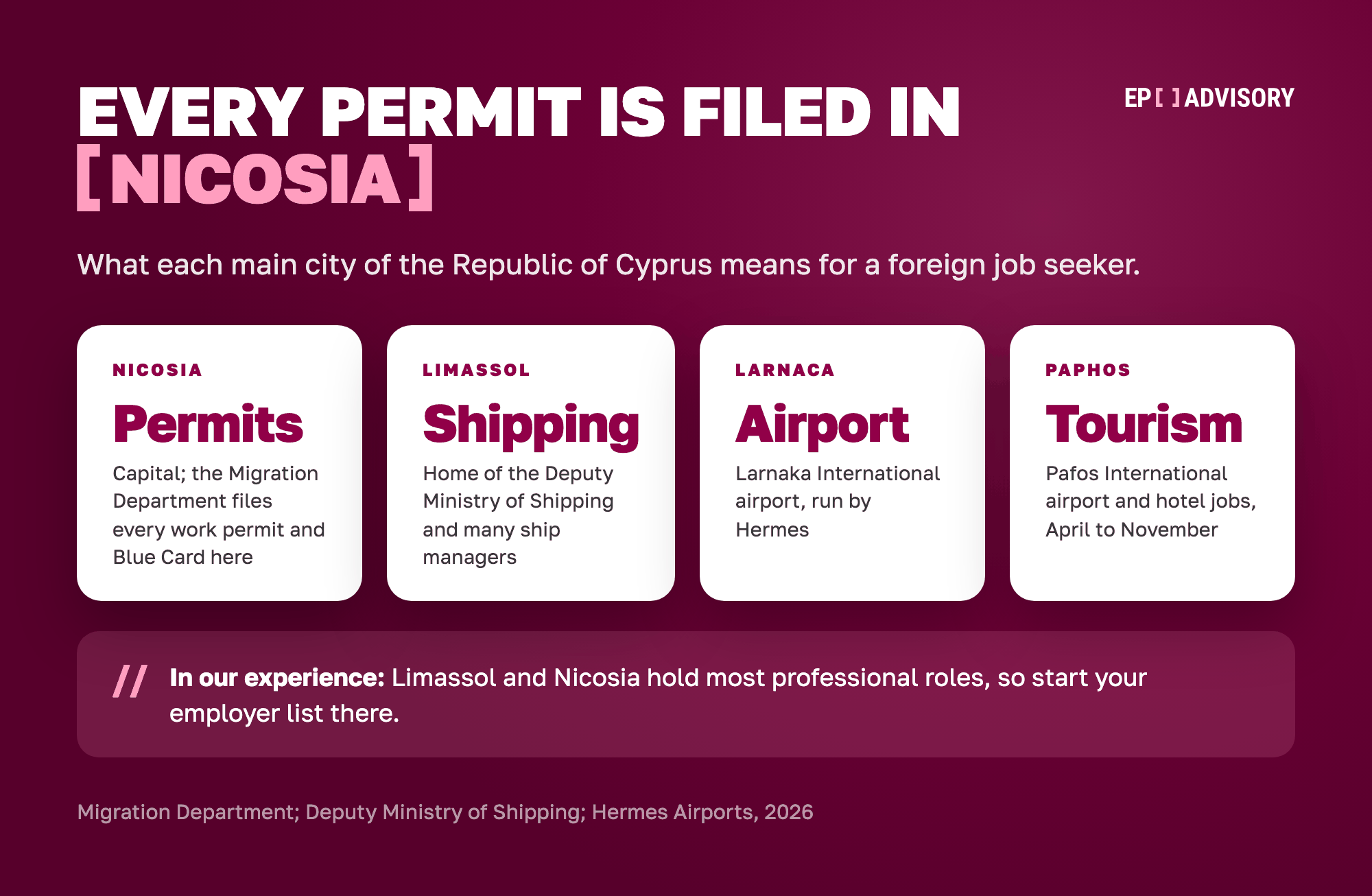
- The employer files the permit application at the Migration Department in Nicosia, with the stamped contract and the labour recommendation.
- You enter Cyprus and register in the Aliens Register. You give biometrics at the District Immigration Unit of the Police.
The Migration Department aims to decide within 4 months of a complete file. A permit lasts up to 3 years. Most general-route workers can stay in employment for up to 4 years in total, with exceptions such as athletes, farm workers and specialised cooks.
If the job ends by agreement, a mutual release document gives you 30 days to find a new employer. From 1 January 2027, renewals with the same employer move fully online, through the gov.cy portal with a verified CY Login account, as the Deputy Ministry of Migration announced. You file 60 to 30 days before the permit expires.
People searching for unskilled or urgent jobs in Cyprus mostly land on this route. The labour market test and the 4-month decision time mean there is no such thing as a legal non-EU job that starts next week.
Shipping, finance, tech and tourism lead foreign hiring
Four sectors account for most of the jobs that foreigners land in Cyprus. In our experience, Limassol and Nicosia are where most professional roles sit.
- Shipping. Cyprus has over 200 shipping and shipping-related companies and the third largest merchant fleet in Europe. Firms based here manage more than 20% of the world’s third-party ship management fleet, according to Invest Cyprus. The Deputy Ministry of Shipping sits in Limassol. Roles include crewing, chartering, technical superintendents, insurance and ship finance.
- Finance, trading and investment firms. Brokerages, payment companies and fund administrators hire compliance, risk, accounting, client support and back-office staff. The foreign-owned ones may fit the company route above.
- Tech. Software, gaming and fintech companies hire developers, QA engineers, product managers and data staff. ICT is also one of the three Blue Card sectors.
- Tourism and hospitality. Tourism contributes close to 15% of GDP, according to Invest Cyprus. Seasonal contracts usually run from April to November. Hotel jobs for non-EU workers go through the general permit.
If you work remotely for a company abroad, see our guide to remote jobs in Europe, since that is a different set of rules.
English is the working language of many Cyprus offices
Many professional jobs in Cyprus run in English. The official languages are Greek and Turkish. But most people speak another language, usually English, and interviews for non-Greek speakers are usually held in English, according to EURES, the EU’s job mobility network.
In our experience, that holds for shipping offices, international finance firms and tech companies. Greek is usually needed in the public sector, local retail, health care and law firms serving Cypriot clients.
Greek still pays off if you plan to stay. It widens the jobs you can apply for. It also cuts the wait for citizenship from 5 years to 4 for highly paid staff of companies in the business facilitation scheme.
Where to search for jobs in Cyprus
Mix one international site, one Cypriot board and direct approaches to employers. Cypriot boards carry most local roles. International firms tend to post on LinkedIn and their own careers pages.
| Where | Best for | Language of most ads |
|---|---|---|
| Shipping, finance and tech roles at international firms | English | |
| Ergodotisi | A broad Cypriot board, from office jobs to hotels | English and Greek |
| Kariera.com.cy | Professional and corporate roles | English and Greek |
| CyprusJobs | Local listings across sectors | English and Greek |
| Carierista and Bazaraki | Carierista for office roles; Bazaraki is a classifieds site with many local job ads | English and Greek |
| Public employment service and EURES | Vacancies employers must post before a non-EU hire, and EU-wide listings | Greek and English |
| Cyprus Mail | The English-language daily, for company news that hints at hiring | English |
The labour market test helps you here. Before most general-route hires, the employer must advertise through the public employment service. Those ads show which employers are actively looking abroad.
For international firms, go direct. Make a list of 20 to 30 shipping managers, brokers or tech companies in Limassol or Nicosia, and ask whether they hire through the business facilitation scheme. Our guide on how to find a job in Europe shows how to build that list. If you are also weighing Malta or Greece, our guides to jobs in Malta and jobs in Greece compare their routes.
CVs, interviews and the 26-week trial period
Cypriot employers expect a short, clear CV and a cover letter for each job. EURES notes that Cyprus has no standard CV format and that the Europass CV is widely known. For tips on layout, see our guide to the European CV format.
- Quote the job. Name the role and any vacancy number in your cover letter. Our guide to a cover letter for a job abroad shows how.
- Show results. Shipping and finance recruiters scan for tonnage, deal sizes, regulators and systems. Use numbers, as in our CV achievement examples.
- Expect two or three interviews. Written tests and assessment centres are common, according to EURES. Prepare with our guide on how to pass a job interview.
- Say your permit position clearly. State your citizenship and whether you need a permit. Name the route that fits, so a recruiter does not have to guess.
Once hired, the first 26 weeks are usually a trial period. A full-time week is typically 38 to 40 hours, with a legal maximum of 48.
A CV built for one country often hides what a Cypriot recruiter looks for first. Getting ready to apply for jobs in Cyprus? Check your CV for free: see it the way a recruiter does, then fix each problem.
What jobs in Cyprus pay, and a short note on tax
Cyprus has a national minimum wage. From 1 January 2026 it is €979 gross a month when you are hired, rising to €1,088 gross a month after 6 months with the same employer, according to the Ministry of Labour. Domestic workers, farm workers and seafarers are outside this decree, and hotel staff have their own decree.
For a single worker on the average wage, Eurostat puts 2025 pay at €34,692 gross a year, or about €28,340 net a year. Professional jobs in shipping, finance and tech often pay above that, which is how many of them clear the €2,500 a month bar for the company route.
On tax, the first €22,000 a year of income is tax-free from 2026, and higher bands run from 20% to 35%, according to PwC. Employees also pay 8.8% social insurance and 2.65% for the national health system. New arrivals may qualify for a partial income tax exemption, with strict conditions. Ask a tax adviser before you sign.
Next: before you accept an offer, prepare your number with our guide on how to negotiate salary.
How to avoid job scams in Cyprus
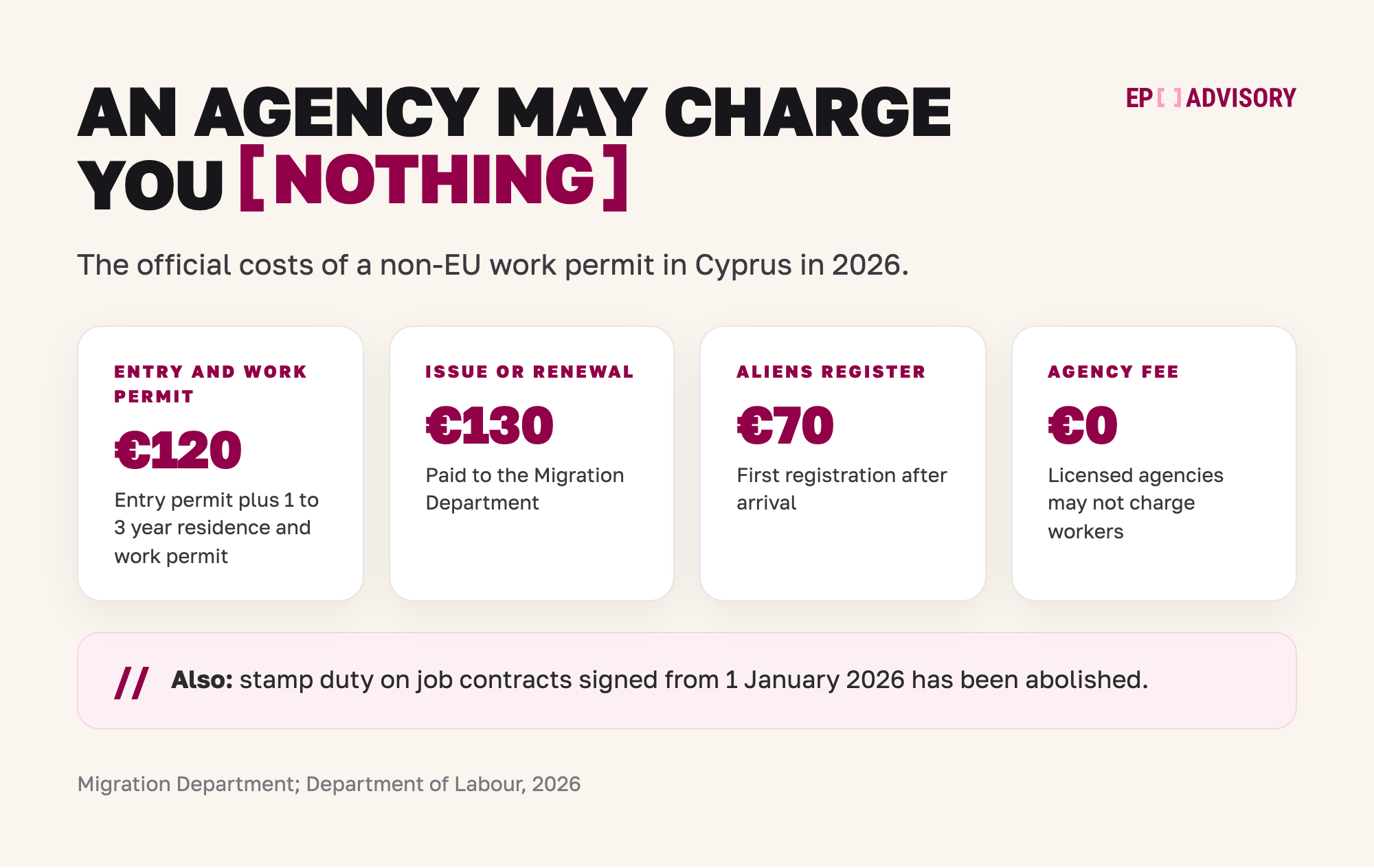
A real employer never makes you pay to be hired. Private employment agencies in Cyprus must hold a licence from the Director of the Department of Labour. By law they may not charge the worker any direct or indirect fee for finding, placing or keeping a job, and they may not take your pay, as the Department of Labour explains.
The official costs are small and paid to the state. An entry permit plus a 1 to 3 year residence and work permit costs €120. Issue or renewal costs €130, and first entry in the Aliens Register costs €70, according to the Migration Department. Stamp duty on job contracts signed from 1 January 2026 is gone.
Watch for these warning signs:
- A business visa offered for a job. The Type C business visa allows stays of up to 90 days with no right to work.
- An urgent start for a non-EU worker. The general permit takes up to 4 months to examine, so a start next week is not possible.
- Fees for placement, a contract or a work visa. These are illegal for agencies, and the state fees go to the state.
- Work in Northern Cyprus sold as a Cyprus job. It runs under different rules, and a permit from one side does not cover the other.
If an agency contacts you, ask for its Department of Labour licence number. Check it with the Department before you send documents.
Key takeaways
- Ask every employer whether it is registered in the business facilitation scheme for companies of foreign interests.
- That route needs at least €2,500 gross a month, a 2-year contract, and a degree or 2 years’ experience. It has no labour market test.
- The Cypriot Blue Card covers only ICT, maritime and pharmacy research, from €43,632 gross a year.
- All other non-EU hires need a labour market test, and the decision can take up to 4 months.
- Limassol and Nicosia hold most professional roles. Many of them work in English.
- Licensed agencies may not charge you, and state fees start at €70.
See what a recruiter sees, then fix it before you apply. An instant score, then the fix for every problem.
Free, no card. A free account unlocks every fix.
Frequently asked questions
Can foreigners get a job in Cyprus in 2026?
Yes. EU, EEA and Swiss citizens work like locals and register after 3 months. Non-EU professionals are most often hired by companies of foreign interests, which can sponsor staff on €2,500 gross a month or more with no labour market test. Other employers need a labour market test first.
Which companies in Cyprus sponsor work permits?
Companies registered in the government’s business facilitation scheme sponsor most professional permits. They include foreign-owned firms with their own offices, shipping companies, high-tech companies and pharmaceutical and biotech companies that have invested at least €200,000 in Cyprus. Ask the employer whether it is registered.
What salary do I need for a work permit in Cyprus?
For the company of foreign interests route, at least €2,500 gross a month with a contract of at least 2 years. For the EU Blue Card, at least €43,632 gross a year. General permits must pay at least the same as Cypriot staff, and, in jobs covered by the national minimum wage, not below €979 gross a month.
Can I work in Cyprus without speaking Greek?
Yes, in many professional roles. Shipping, international finance and tech firms often work in English, and interviews for non-Greek speakers are usually held in English. Public-sector, health care and local client-facing jobs usually need Greek.
How long does a Cyprus work permit take?
Staff of companies in the business facilitation scheme get a decision in about 1 month. The Blue Card has a 90-day legal limit. The general permit can take up to 4 months after the labour market test, so plan your start date around it.
Do I have to pay an agency to get a job in Cyprus?
No. Licensed private employment agencies may not charge the worker any fee for finding, placing or keeping a job. You pay only the state fees, such as €120 for the entry and work permit and €70 for the Aliens Register.