 By Tatiana Terekhina, Career Consultant at EP Advisory
Working in Norway in 2026 means a median salary of NOK 55,800 a month (about €5,170), an exceptional work-life balance, and easy travel across the Schengen area. Unemployment stands at 4.4%, and NAV estimates a shortage of about 33,750 workers. In this article, we cover the most in-demand industries, salaries, the visa process, and everything you need to know about finding a job in Norway as a foreign professional.
High salaries, breathtaking nature, outstanding work-life balance, and visa-free travel across the Schengen area with a Norwegian residence permit. That’s Norway in a nutshell. In nearly 10 years, we have helped more than 5,000 clients find jobs abroad. The first step to a job in Norway is a CV that passes screening. Check your CV for free: a score in 30 seconds, then a fix for each problem.
Norway at a Glance: The Essentials
Before diving into the details, here’s everything you need at a glance:
- Average salary: NOK 62,070/month before tax (about €5,750); median NOK 55,800 (about €5,170), SSB, November 2025
- Take-home pay: about NOK 41,800 (median salary) to NOK 45,800 (average salary) a month after tax
- Minimum salary for Skilled Worker visa: NOK 545,400/year (bachelor’s) or NOK 624,700/year (master’s)
- Visa processing time: no fixed time; check the current waiting times on udi.no
- Unemployment rate: 4.4% (SSB, June–August 2026)
- Labour shortage: about 33,750 workers (NAV, spring 2026)
- Rent (one-bedroom flat, Oslo and Bærum): NOK 15,260/month on average (SSB, 2025); more for new leases in the centre
- Rent (one-bedroom flat, Bergen): NOK 11,870/month on average (SSB, 2025)
- Coffee (cappuccino, Oslo): about NOK 57 (€5)
- Monthly transport pass (Oslo): NOK 655 (Ruter 30-day adult ticket, zone 1)
- Permanent residency: possible after 3 years on a skilled worker permit, with A2 spoken Norwegian and a passed social studies test
Want the full picture? Keep reading for a detailed breakdown of each topic.
How to Move to Norway: Everything About Working in the Land of Fjords
Who Is Norway Right For?
Norway is ideal for people who prefer a slower pace of life, love nature and value mindful living. If you’re someone who finishes work at 3pm and heads straight to a forest trail or a fjord kayak trip, this is your place. Norway may disappoint those who thrive on big-city energy and can’t live without urban hustle.
Here’s the honest reality: a cappuccino in Oslo costs about NOK 57 (about €5), and your local café may have a short menu built around local ingredients. That’s Norway in a nutshell. Quality over quantity, in everything.

I’ve been living in Europe for 7 years. Previously I lived in Moscow, Malmö, Bucharest, and London, and worked at companies like Nike and Google. I came to Denmark for my studies, then got a job at Carlsberg in Copenhagen, and now I work at Pandora. Scandinavia appeals to me for its balance: between work and personal life, nature and urbanisation, friendliness and respect for personal space.Norway is a country where everything moves slowly, but efficiently. In big cities, people often equate efficiency with instant service, order a pizza and expect it at 2am. But in Norway, efficiency means you’ll get that pizza made from the finest organic ingredients, just the next day. And the menu will probably have just 3–4 options.
George PayCareer consultant | Careers in Scandinavia
What You Can Actually Do in Norway: Beyond the Postcard
Forget the generic “beautiful nature” pitch. Here’s what your actual week in Norway could look like:
In the cities (Oslo, Bergen, Trondheim):
- After-work sessions at the floating saunas in Oslo harbour, a popular Norwegian ritual
- Friday bar culture: many workplaces have “fredagspils” (Friday beers), when colleagues meet for a drink after work
- Food halls and markets such as Mathallen in Oslo and the Fish Market in Bergen
- Cross-country skiing close to home (the metro runs from Oslo city centre to the edge of Nordmarka forest)
In nature (weekend trips anyone can do):
- Fjord kayaking in the Nærøyfjord, part of the West Norwegian Fjords UNESCO World Heritage site
- Cabin culture (“hytte”): Norwegians rent simple mountain cabins for weekends, no Wi-Fi, wood stove, card games. DNT (the Norwegian Trekking Association) has about 600 cabins
- Northern Lights viewing from Tromsø (late August to late March), a regular sight on clear, dark nights if you live up north
- Midnight sun hiking in the north (in Tromsø, about 20 May to 22 July): 24 hours of daylight means you can hike at 11pm
Norway has a legal concept called “allemannsretten” (the right to roam): you can walk, ski, cycle and camp on uncultivated land, even when it is privately owned. Pitch your tent at least 150 metres from the nearest house or cabin, and ask the landowner if you stay more than two nights in one place (except in the mountains or remote areas). This isn’t just a nice idea, it’s how people actually live here.

From a career perspective, Norway is best suited for professionals in the country’s most in-demand industries. Only about 4,070 of Norway’s 656,492 businesses (under 1%) have 100 or more employees (SSB, 1 January 2026). Small business thrives in this country, so we recommend Norway especially if you want to work in startups or small-to-medium enterprises. Norway also offers good conditions for PhD candidates: a PhD research fellow (stipendiat) is a salaried university employee. University of Oslo adverts in September 2026 offer NOK 551,000–625,000 a year, and the fellow applies for a skilled worker permit. PhD candidates pay no tuition.
I’m currently doing research in entrepreneurship and teaching. Norway offers excellent conditions for an academic career: if you’re accepted for a PhD, you’re considered a university employee, you get a work visa, and you’re paid the national average salary. By comparison, in England you typically only receive a student stipend, while the cost of living is very high.
Katerina ShewljugaLecturer, PhD graduate and former consulting professional
Editor’s note (September 2026): PhD research fellows at the University of Oslo are currently offered NOK 551,000–625,000 a year, about NOK 45,900–52,100 a month. That is below the national average salary (NOK 62,070 a month, SSB). Researchers with a Norwegian employer apply for a skilled worker permit.
Industries, Salaries, and Where the Jobs Are
Norway faces a significant labour shortage. According to NAV (the Norwegian Labour and Welfare Administration), employers were short about 33,750 workers in spring 2026, down from 39,000 in 2025. Health and care jobs lead with about 9,200, followed by industrial work (5,750) and building and construction (4,750).
Here’s what each industry pays, according to Statistics Norway (SSB, November 2025, gross monthly pay):
| Industry | Average (NOK/month) | Median (NOK/month) |
| Oil and gas extraction, incl. services | 96,350 | 87,080 |
| Finance and insurance | 88,570 | 73,580 |
| IT services | 82,710 | 76,360 |
| Architecture and engineering services | 80,340 | 74,950 |
| Electricity, water and waste | 71,370 | 63,670 |
| Aquaculture | 67,770 | 62,980 |
| Hospitals | 66,560 | 60,280 |
| Construction | 58,840 | 53,860 |
| All industries | 62,070 | 55,800 |
By occupation, the median monthly pay is NOK 87,200 for mechanical engineers, NOK 77,420 for software developers, NOK 75,990 for civil engineers, NOK 57,830 for nurses, NOK 54,930 for electricians and NOK 47,900 for carpenters (SSB, November 2025). NAV sees the biggest 2026 shortages among healthcare workers (about 3,650), nurses (1,850), carpenters (1,150) and electricians (1,100).
Wages grew 5.3% in 2024 and 4.5% in 2025. For 2026, SSB forecasts wage growth of 4.3% with prices up nearly 3%, a third year in a row of real wage growth.
A real example: Equinor, Norway’s largest energy company, is headquartered in Stavanger and had about 24,600 employees in 2025. Alongside oil and gas, its projects include offshore wind farms such as Hywind Tampen and Dogger Bank, so its jobs span both. Check its careers page for current openings and pay.
The most important thing is to keep applying and to recognise that the labour shortage in Norway is very real. That should give you confidence. At the same time, patience is key, Norwegians tend to take their time with everything.
George PayCareer consultant | Careers in Scandinavia
How to Immigrate to Norway in 2026
There are three main pathways, each with its own timeline and requirements:
1. Skilled Worker visa (the most common route)
This is how most international professionals move to Norway. You need a job offer from a Norwegian employer, and your salary must meet the current thresholds, in force in 2026: NOK 545,400/year for bachelor’s-level roles, or NOK 624,700/year for master’s-level roles. If a collective agreement covers the job, the pay must be at least the agreed rate. UDI sets no fixed processing time, so check the current waiting times on udi.no. Jobs at vocational level, such as cooks, mechanics and carpenters, often take longer. After 3 years on the permit, you can apply for permanent residency if you meet the conditions: A2 spoken Norwegian, a passed social studies test and an income of at least 2.5 G (about NOK 341,000) over the last 12 months. There is no shortage occupation list, so you can apply across all sectors with the same document package. Weighing Norway against an EU alternative? Our 2026 salary thresholds comparison for work visas in 16 European countries shows every bar, and our Netherlands work visa guide covers the graduate-friendly Dutch route.
The main challenge? EEA citizens can work in Norway without a permit, so in practice many employers find them easier to hire. To stand out, you need a carefully tailored CV and genuine enthusiasm. Norwegians want colleagues who are both competent and approachable.
Requirements:
- Job offer from a Norwegian employer
- Full-time (or 80%+) employment
- The role must require relevant qualifications
- Salary at or above Norwegian standards for the role
2. Studying at a Norwegian university
Public universities are free only for students from the EU/EEA and Switzerland. Since autumn 2023, students from other countries pay tuition. At NTNU, for example, fees for 2026/27 range from NOK 176,300 to NOK 528,650 a year, depending on the programme. For a student permit you also need to show NOK 170,368 a year for living costs (2026/27), on top of any tuition. PhD candidates and exchange students pay no tuition. Studying locally is a powerful way to build your network, which matters a lot in the Norwegian job search.
3. Starting a business
If you have an innovative business idea, you can apply for a self-employed visa. You’ll need a business plan, market analysis, proof of relevant experience, and supporting documents. You need a skilled worker qualification (a vocational certificate or a degree), and the business must be expected to make a profit of at least 2.5 G (about NOK 341,000 a year before tax). It is usually a sole proprietorship, and you may not take other work, including remote work. The permit runs one year at a time. The rules name no priority sectors.
Score your CV in 30 seconds, then fix its biggest problems one by one. Both free.
Free, no card. A free account unlocks every fix.

The Real Cost of Living: What Your Money Actually Buys
Norway is expensive, let’s not sugarcoat it. But with Norwegian salaries, the maths works out. Here’s what daily life actually costs:
- A cappuccino at a café: about NOK 57 (€5) in Oslo
- A beer at a bar: about NOK 112 (€10) for 0.5 litres in Oslo. In a supermarket: about NOK 33
- Food and drink (one adult aged 25 to 50): NOK 4,280–4,760 a month (€400–440), according to the SIFO reference budget for 2026. REMA 1000 and Kiwi are the main discount chains
- Lunch at an inexpensive restaurant: about NOK 200 (€19) in Oslo. Many Norwegians bring a packed lunch (“matpakke”) instead
- Rent (one-bedroom flat): NOK 15,260/month on average in Oslo and Bærum, NOK 11,870 in Bergen and NOK 11,850 in Trondheim (SSB, 2025). New leases in the centre cost more
- Monthly transport pass (Oslo): NOK 655 for a 30-day adult ticket in zone 1, covering metro, tram, bus and some ferries
For a single person in Oslo, the three biggest costs add up to about NOK 20,000–21,000 a month: rent of about NOK 15,260, food and drink of NOK 4,280–4,760, and NOK 655 for transport. Utilities, a phone, insurance and leisure come on top.
The hidden upside: public healthcare with low co-payments (capped at NOK 3,278 a year in 2026), free public universities for EU/EEA students, parental benefit of 49 weeks at full pay or 61 weeks at 80% (shared between the parents), and sick pay of 100% of salary up to NOK 819,294 a year for up to 52 weeks.
Work-Life Balance: What It Actually Looks Like
This isn’t a buzzword in Norway, it’s the operating system. Here’s what a typical day looks like for a Norwegian professional:
- 8:00 AM: Arrive at work. Nobody checks. You’re trusted by default.
- 11:30 AM: Lunch break. Most people eat their packed “matpakke”, open sandwiches. Yes, this is a cultural institution.
- 3:00–4:00 PM: Leave work. This is normal, not early. Staying late every day is unusual.
- 4:30 PM: Forest run, fjord swim, or picking up kids from barnehage (kindergarten). Or working from a café with a fjord view.
- Friday afternoon: “Fredagspils”, Friday beers with colleagues at the office or a local bar, a common ritual in many workplaces.
Personal time is deeply respected. Employers actively want you to have interests beyond work. A candidate who plans to “live at the office” will make employers uncomfortable, it signals inefficiency, not dedication.
Leave and benefits: The Holiday Act gives at least 25 working days of paid holiday a year, and collective agreements give many employees a fifth week. If a doctor signs you off sick, including for stress or burnout, sick pay is 100% of your salary up to NOK 819,294 a year. The employer pays the first 16 days, then NAV, for up to 52 weeks. Hybrid work is common in office jobs, but the rules depend on your employer. A normal working week is at most 40 hours by law, and 37.5 hours under many collective agreements.
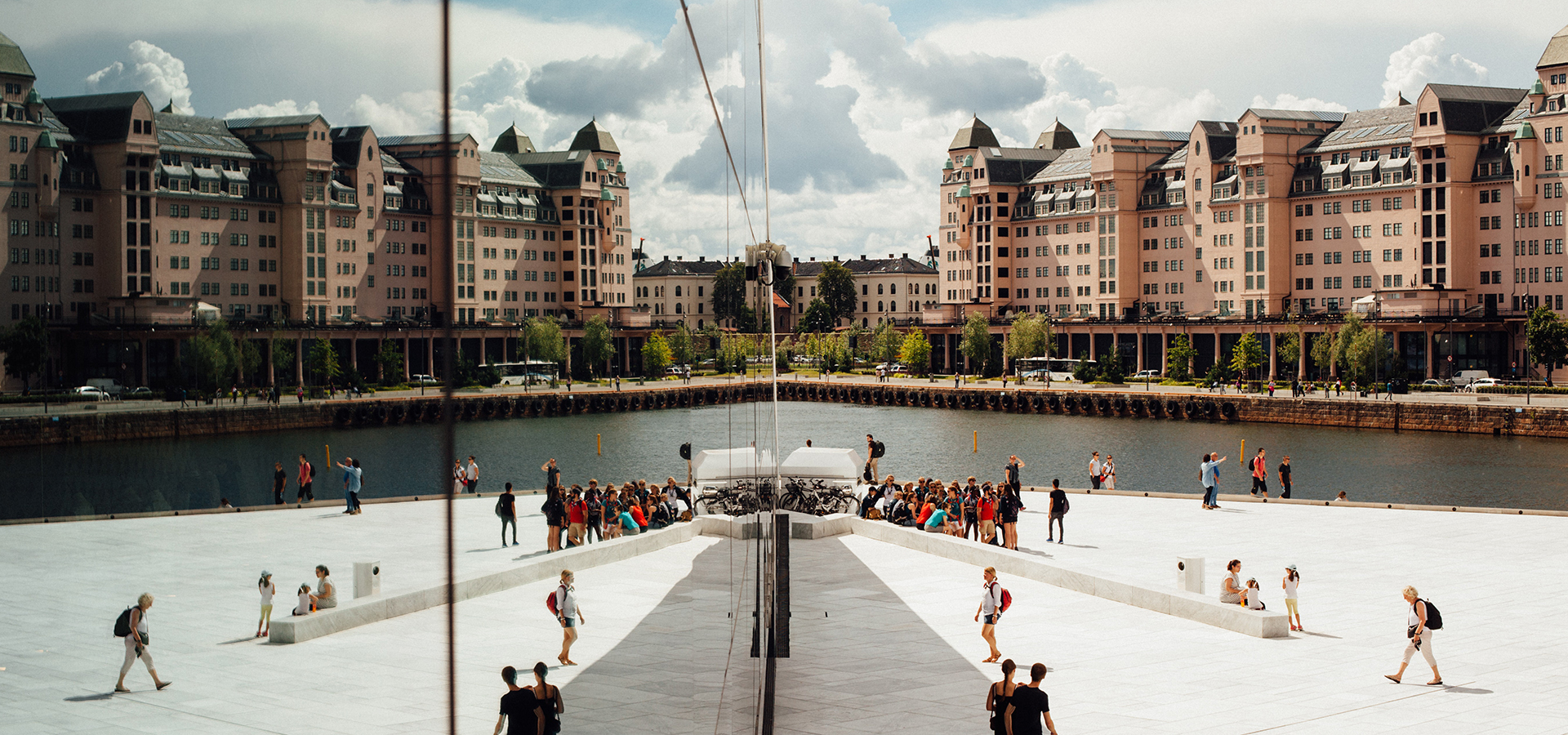
Norway is attractive not only for its high salaries but also for its exceptional working conditions.
How to Search for a Job in Norway
The most popular platforms are:
- Finn: a large classifieds site with a big jobs section
- Arbeidsplassen: the public job board run by NAV, the Norwegian Labour and Welfare Administration
- LinkedIn: widely used, especially for corporate and tech roles
- Indeed: a major international job board with Norwegian listings
- Jobs in Oslo: specifically for jobs in Oslo
- Randstad and Adecco: staffing agencies covering various specialisations
LinkedIn is a key tool in Norway. Without a profile, employers have less to go on. Focus on growing your network and building genuine connections.
I’ve lived in Britain, Germany, Norway, and Italy, and worked at companies like KPMG and Bloomberg. In Norway, networking is the most effective job search strategy. If you don’t know anyone yet, I’d recommend adding people from your industry on LinkedIn, engaging with them, and learning from their experience.
Katerina ShewljugaLecturer, PhD graduate and former consulting professional
CV and Interview Tips for Norway
A strong CV for Norway is similar to a CV for the UK or other European countries, but with local nuances:
Include a photo, Norwegian employers want to see a person, not just a document. Smile, keep it professional.
Add a personal touch, mention your hobbies and interests. The more unique, the more memorable you become.
Tailor every application, sending the same CV to multiple jobs will almost certainly fail. Norwegian employers expect careful preparation.
In interviews, expect questions about your management style and whether you enjoy after-work drinks. Employers may not ask about your political views or union membership unless the job itself requires it (Working Environment Act, section 13-4). They want to know you as a person, not just a professional.
Here’s a simple hack to check if you’ve tailored your CV well. Imagine showing it to a teenager. If they can compare your document with the job description and see a clear match, you’ve done it right.
George PayCareer consultant | Careers in Scandinavia
Norwegian Culture: What to Expect
Here are a few things to know about Norwegian culture before making the move.
- Norwegians are reserved, many have established their social circles since childhood and only expand them when there’s a strong reason. Don’t rush it. Give them time.
- Kind but “cold”, they won’t make small talk at coffee breaks, but if you need help with a work issue, they’ll absolutely step in.
- Equality is fundamental, hierarchy is flat in Norwegian companies. Calling your CEO by first name is standard. Nobody pulls rank.
- “Janteloven” matters, the cultural code that says “don’t think you’re better than anyone else.” Bragging is frowned upon. Show competence quietly.
See what a recruiter sees, then fix it before you apply. An instant score, then the fix for every problem.
Free, no card. A free account unlocks every fix.
Key Takeaways About Working in Norway
Working in Norway is a real opportunity for international professionals: NAV estimates employers are short about 33,750 workers in 2026. The average salary is NOK 62,070 a month and the median NOK 55,800 (SSB, November 2025), the visa process is transparent, and working conditions are among the best in the world. Want to know if your CV will pass screening in Norway? Check your CV for free: a score in 30 seconds, then a fix for each problem.