 By Andre Atallah, CEO of EP Advisory
The short answer: the average full-time salary in Australia is about $108,400 a year in 2026, or roughly $9,000 a month before tax. That is the average, lifted by high earners. The typical full-time worker earns closer to $90,500.
| Average full-time salary (ABS, May 2026, annualised) | ~$108,400 / year (~$9,000/mo) |
| Median full-time wage (ABS, Aug 2025) | ~$90,500 / year |
| Take-home on the median, after tax | ~$71,000 / year (~$5,920/mo) |
| National minimum wage (from 1 July 2026) | $26.44 / hour |
| The average, in US dollars | about US$76,000 |
Australia keeps topping the lists of where skilled workers want to move, and pay is a big reason why. Full-time wages are high by global standards, the currency is stable, and employers add superannuation on top of salary. The headline average is one number though, and most people earn less than it.
In nearly 10 years, we have helped more than 5,000 professionals find jobs abroad. Want to know if your CV will pass screening in Australia? Check your CV for free: a score in 30 seconds, then a fix for each problem.
What Is the Average Salary in Australia in 2026?
The average full-time salary in Australia is about $108,400 a year, or roughly $9,000 a month before tax. That figure comes from the Australian Bureau of Statistics, which measured average weekly ordinary-time earnings for full-time adults at $2,084 in May 2026. Annualised, that is close to $108,400.
The more useful number is the median. Half of full-time workers earn more than about $90,500 a year, and half earn less. That is roughly $7,540 a month. All figures here are in Australian dollars. One Australian dollar is worth about US$0.70 in September 2026, so the average is around US$76,000.
The Average Is Not the Typical Wage
The average and the median tell different stories. The average is the mean, and a small number of very high salaries pull it upward. The median sits in the middle, so it describes the typical worker far better. When you plan a move, plan around the median, not the headline.
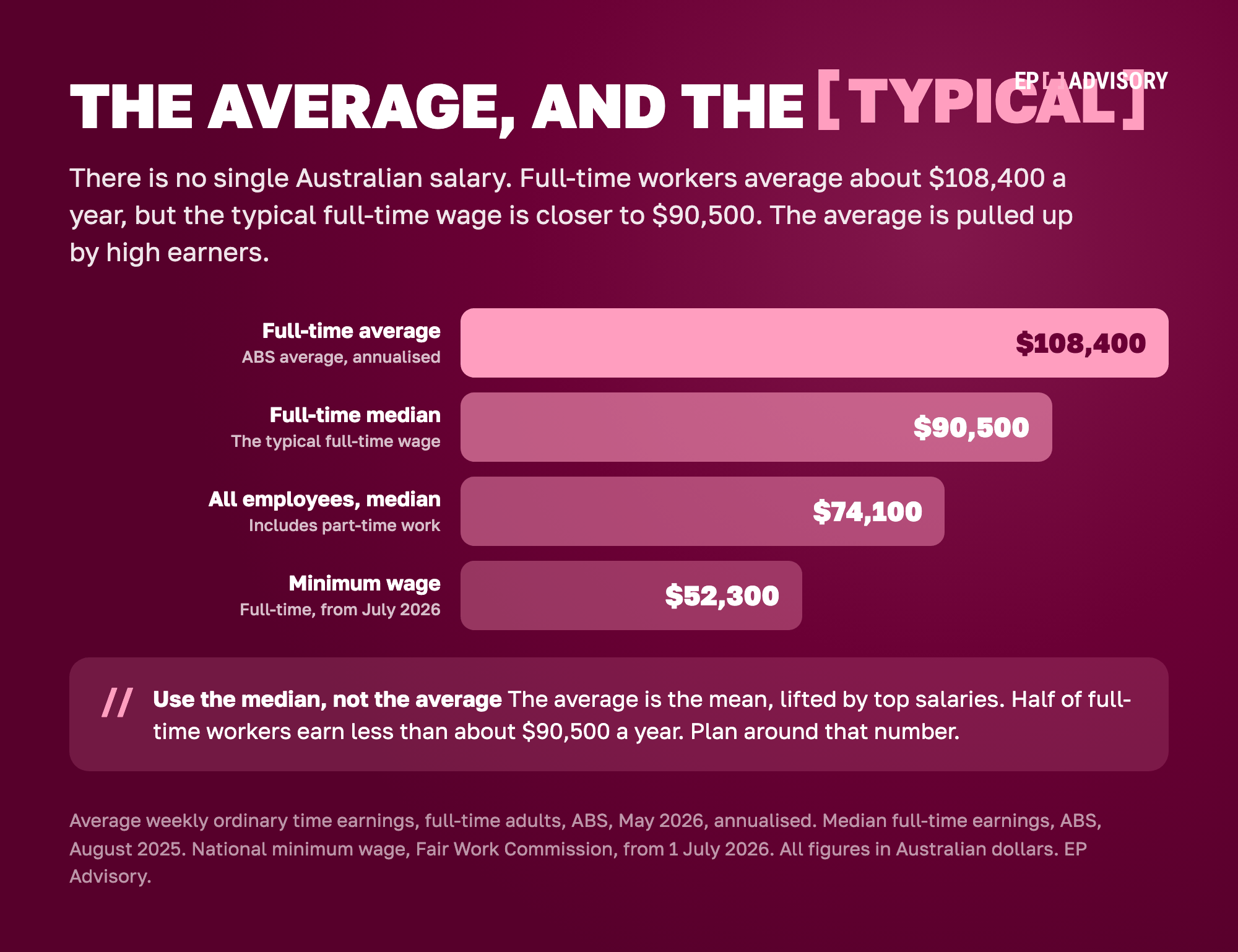
Include part-time workers and the median across all employees drops to about $74,100 a year. That gap is why a single average can mislead. Your own number depends far more on your job, your industry and your city than on the national figure.
Salaries by Job in Australia
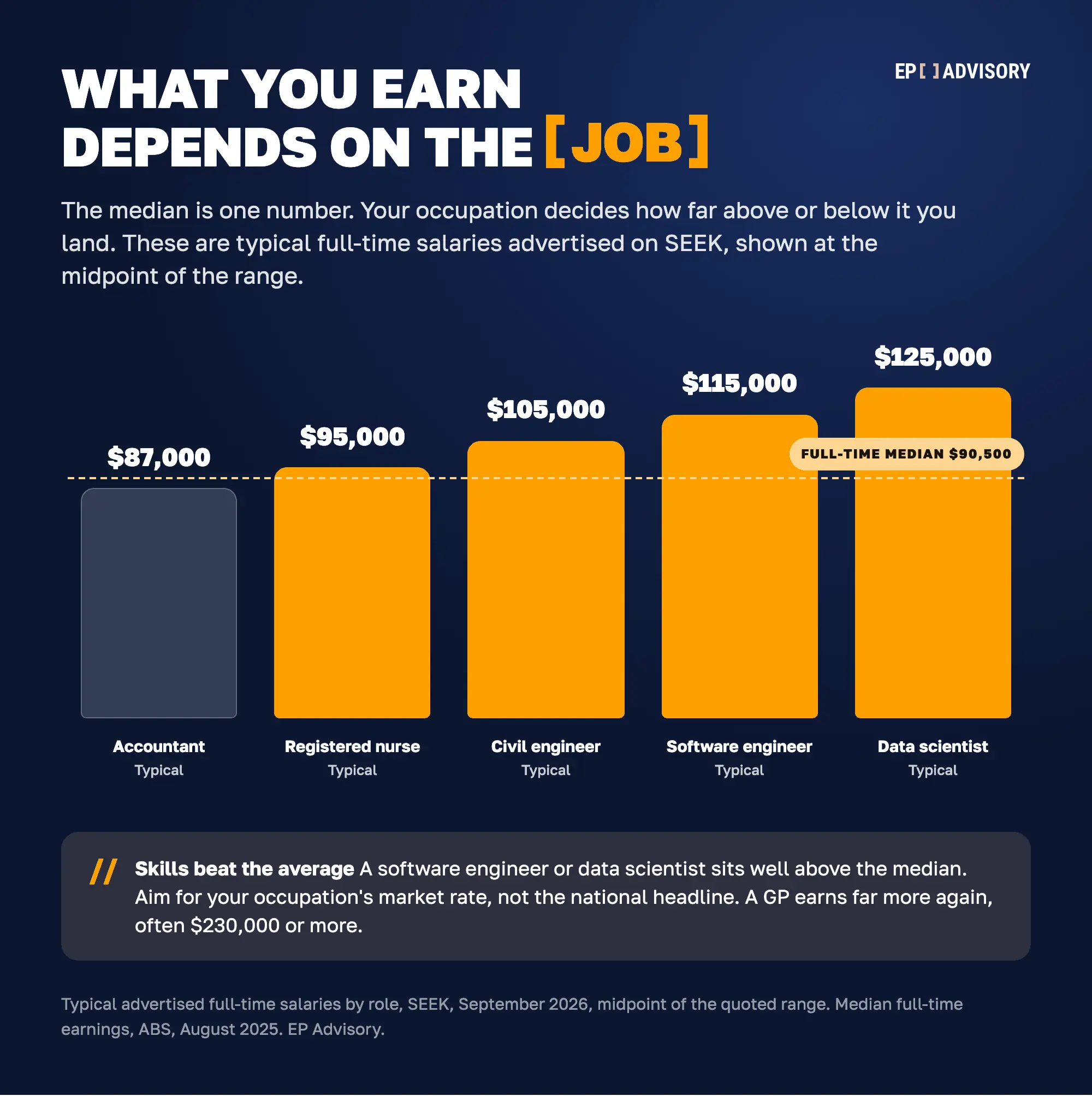
Your occupation decides where you land. The figures below are typical full-time salaries advertised on SEEK, Australia’s largest job board, shown at the midpoint of the quoted range. They are a guide to market rates, not official statistics.
| Role | Typical full-time salary |
| Accountant | $80,000 to $95,000 |
| Registered nurse | $90,000 to $100,000 |
| Mechanical engineer | $90,000 to $110,000 |
| Civil engineer | $95,000 to $115,000 |
| Software engineer | $105,000 to $125,000 |
| Data scientist | $115,000 to $135,000 |
| General practitioner (doctor) | $230,000 to $250,000+ |
Salaries in Sydney and Melbourne usually run above these national ranges, and Sydney tends to pay the most. A senior technology or engineering role in either city can reach $180,000 or more.
Weighing your options? Compare these numbers with the average salary in Canada and the average salary in the UK, the other big destinations for skilled migrants. If the United States is on your list, see our US work-visa guide.
Minimum Wage in Australia 2026
The national minimum wage is $26.44 an hour from 1 July 2026, set by the Fair Work Commission. For a standard 38-hour week that is about $1,005, or roughly $52,300 over a full-time year. Most award rates sit above the national minimum, so few skilled workers are paid the floor. It matters mainly as the bottom of the market, and it rises every July.
What Actually Lands in Your Account
Australia taxes residents on a sliding scale, and a 2% Medicare levy sits on top. On the median full-time salary, about $71,000 a year reaches your account, roughly $5,920 a month. That is just over a fifth of the gross.
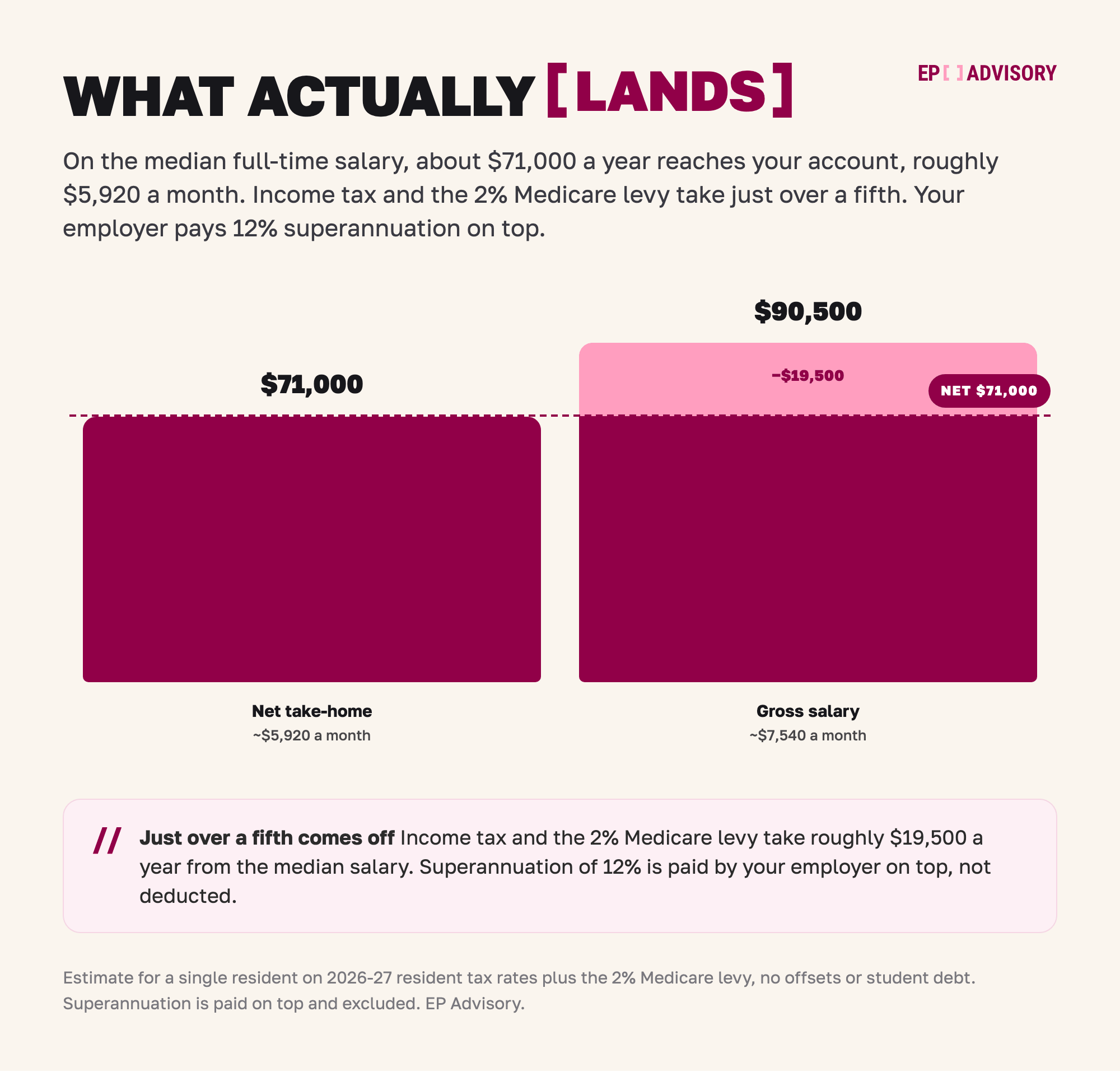
The 2026-27 resident tax rates are: nothing on the first $18,200, then 15% to $45,000, 30% to $135,000, 37% to $190,000 and 45% above that. There is good news that many newcomers miss. Your employer pays superannuation of 12% of your ordinary earnings straight into a retirement fund, on top of your salary. It is not deducted from your pay.
Salary and an Australian Skilled Visa
Australia’s main employer-sponsored route is the Skills in Demand visa (subclass 482), which replaced the older Temporary Skill Shortage visa in December 2024. Pay is central to it. Your salary must be at least a set income threshold and at least the market rate for the same role in the same location, whichever is higher. The threshold is a floor, not the salary on offer.
There are three streams. The Core Skills stream is the main one, for occupations on the Core Skills Occupation List, with a Core Skills Income Threshold of $79,423 for nominations lodged from 1 July 2026. The Specialist Skills stream is for higher earners at or above $146,576 a year and skips the occupation list. The third is the Labour Agreement stream, for workers under a negotiated agreement. Both thresholds are indexed every July.
For permanent residence, the Employer Nomination Scheme (subclass 186) is the sponsored route, while the points-tested subclasses 189 and 190 need no employer. You need 65 points to submit an expression of interest, but invitations need more. In the 4 June 2026 round, most occupations needed 75 to 85 points for the subclass 189 visa. Salary itself no longer scores points, but a higher-paying skilled career usually lifts the other factors that do.
Where to Look for Work
SEEK and LinkedIn carry the most professional roles, and many employers who sponsor visas advertise there directly. Before you apply, check the Core Skills Occupation List to confirm your job is eligible, then target the fields that are short of workers. Healthcare, technology, engineering and skilled trades dominate the list, driven by an ageing population and a long construction pipeline.
Key Takeaways
- The average full-time salary is about $108,400 a year, but the typical full-time wage is closer to $90,500.
- Your job matters more than the average. Technology, engineering and medicine pay well above it.
- About 22% comes off the median salary in tax and the Medicare levy, and 12% super is added on top.
- The Skills in Demand visa needs pay at or above the Core Skills threshold of $79,423, and at least the market rate.
- Sydney and Melbourne pay more than the national figures, and their living costs are higher too.
Score your CV in 30 seconds, then fix its biggest problems one by one. Both free.
Free, no card.

See what a recruiter sees, then fix it before you apply. An instant score, then the fix for every problem.
Free, no card. A free account unlocks every fix.
Frequently Asked Questions
What is the average salary in Australia in 2026?
The average full-time salary is about $108,400 a year, based on the Australian Bureau of Statistics figure for average weekly ordinary-time earnings in May 2026. The typical full-time wage, the median, is closer to $90,500.
Is $90,000 a good salary in Australia?
Yes. About $90,500 is the median full-time wage, so it puts you right in the middle of full-time workers. It stretches further in cities other than Sydney, where rent is the biggest single cost.
How much tax will I pay on an Australian salary?
On the median salary of about $90,500, income tax and the 2% Medicare levy take just over a fifth, leaving about $71,000 a year. Your employer also pays 12% superannuation on top of your wage.
What salary do I need for a skilled visa in Australia?
For the Skills in Demand visa Core Skills stream, you must be paid at least the Core Skills Income Threshold of $79,423 from July 2026, and at least the market rate for the role, whichever is higher. The Specialist stream starts at $146,576.
Which Australian city pays the most?
By state, the Australian Capital Territory, around Canberra, has the highest average full-time earnings. Western Australia, around Perth, is next, then New South Wales, around Sydney. Victoria, around Melbourne, sits about 2% below the national average (ABS, May 2026). Pay for your own job can rank differently.
Related reading: the average salary in Canada, the average salary in the UK, and our US work-visa guide.