 By Andre Atallah, CEO of EP Advisory

Short answer: yes, foreigners can work in Hungary, but the route depends on your passport and your qualification. Since 6 June 2026, no country qualifies for a new guest-worker permit. Citizens of Georgia, Armenia and the Philippines can still get an employment permit, within a 2026 cap of 35,000. Graduates of any nationality can use the EU Blue Card if the job pays at least HUF 1,001,048 gross a month. EU citizens apply like locals.
Hungary’s permit rules changed twice in two years. Act XC of 2023 created a guest-worker permit that only approved employers and qualified agencies could use, for citizens of a government list of countries. In June 2026 the government emptied that list. So most online advice on guest-worker jobs, including agency adverts, describes a permit no new applicant can get.
The skilled routes are still open, and none of them uses the 35,000 cap. This guide sets out who can apply for what, what each permit pays and allows, and where to look for work. Immigration rules in Hungary change by decree, sometimes with a few days’ notice, so check the current rules with the official authority before you act.
For nearly 10 years, we’ve helped more than 5,000 professionals find jobs abroad. Want to know if your CV will pass screening in Hungary? Check your CV for free: a score in 30 seconds, then a fix for each problem.
Can foreigners work in Hungary? Who can apply for what
EU, EEA and Swiss citizens can work in Hungary without a permit. You apply like a Hungarian candidate. Everything below is for citizens of other countries, which Hungarian law calls third-country nationals.
For everyone else, the permit decides the job. OIF, the immigration authority, groups the work routes by education: three for jobs without a degree and three for graduates (OIF).
| Route | Who can apply | Education needed | Longest first permit | Counts toward the 35,000 cap |
|---|---|---|---|---|
| EU Blue Card | Any nationality | Degree, or 3 years of ICT experience in the last 7 | 4 years | No |
| Hungarian Card (Magyar Kártya) | Any nationality | Degree in IT, engineering, natural sciences or listed music fields | 3 years | No |
| National Card (Nemzeti Kártya) | Citizens of Bosnia and Herzegovina, North Macedonia, Belarus, Moldova, Montenegro, Russia, Serbia and Ukraine | Any level | 2 years | No |
| Employment-purpose permit | Citizens of Georgia, Armenia and the Philippines | Any level | 2 years, 3 at most | Yes |
| Guest-worker permit | No new applicants since 6 June 2026 | Any level | 2 years, 3 at most | Yes |
| EU, EEA or Swiss citizen | Any job | None | No permit needed | No |
A third route without a degree is tied to named investment projects. It needs an employer with a signed deal with the foreign economic affairs minister and a prior approval for a set number of workers (OIF). The employer tells you if a job uses it.
The guest-worker permit: how Act XC of 2023 works, and why it is closed
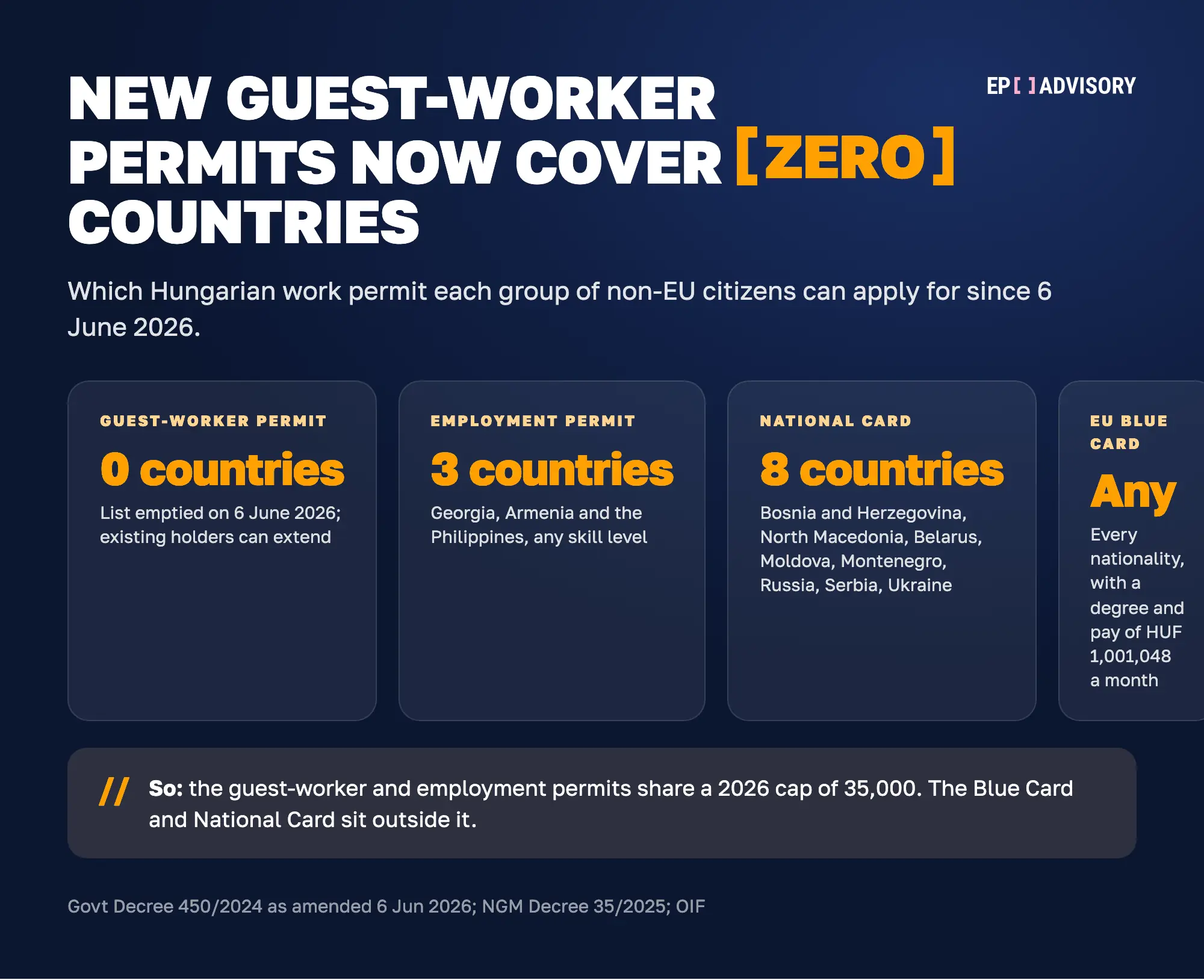
The guest-worker permit is still in the law, but no country is on its list. Act XC of 2023 on the general rules for the entry and residence of third-country nationals set it up from 2024 (Act XC of 2023, sections 30 to 32). It works only for citizens of countries the government names in a decree. Since 6 June 2026, that decree names none (Government Decree 450/2024, section 1).
Existing permits stay valid, and people who held one on 5 June 2026 can extend under the old lists. Here is how the permit works:
- Only two kinds of employer can hire. A “preferred employer” or a qualified temporary-work agency (minősített kölcsönbeadó). Preferred employers are government strategic partners, firms running a nationally priority investment, or members of the Kiemelt Exportőr export partnership programme. Both kinds must register with the Budapest Government Office and pay a fee (OIF employer notice).
- Three years is the hard limit. The permit lasts up to 2 years. It can be extended once, by up to 1 year, and never beyond 3 years from the first issue.
- No switching inside Hungary. You cannot apply for any other permit in Hungary while you hold it, or after it ends.
- No family. No family member can get a residence permit based on your stay. The one exception is a child born in Hungary.
- No long-term residence. Time on the permit does not lead to a national residence card.
- The employer carries the risk. It must report a job change within 5 days. When the job ends, it must make sure you leave Hungary within 6 days, or pay a fine of HUF 5 million. It also pays any expulsion costs.
An employer that misses its reporting duties for 30% of the guest workers it brought in during a year loses the right to hire guest workers for 2 years.
The employment permit: Georgia, Armenia and the Philippines
For jobs without a degree, the employment-purpose permit is now the main route outside the National Card. It is called the foglalkoztatási célú tartózkodási engedély, and only citizens of Georgia, Armenia and the Philippines can get it (Decree 450/2024, Annex 1).
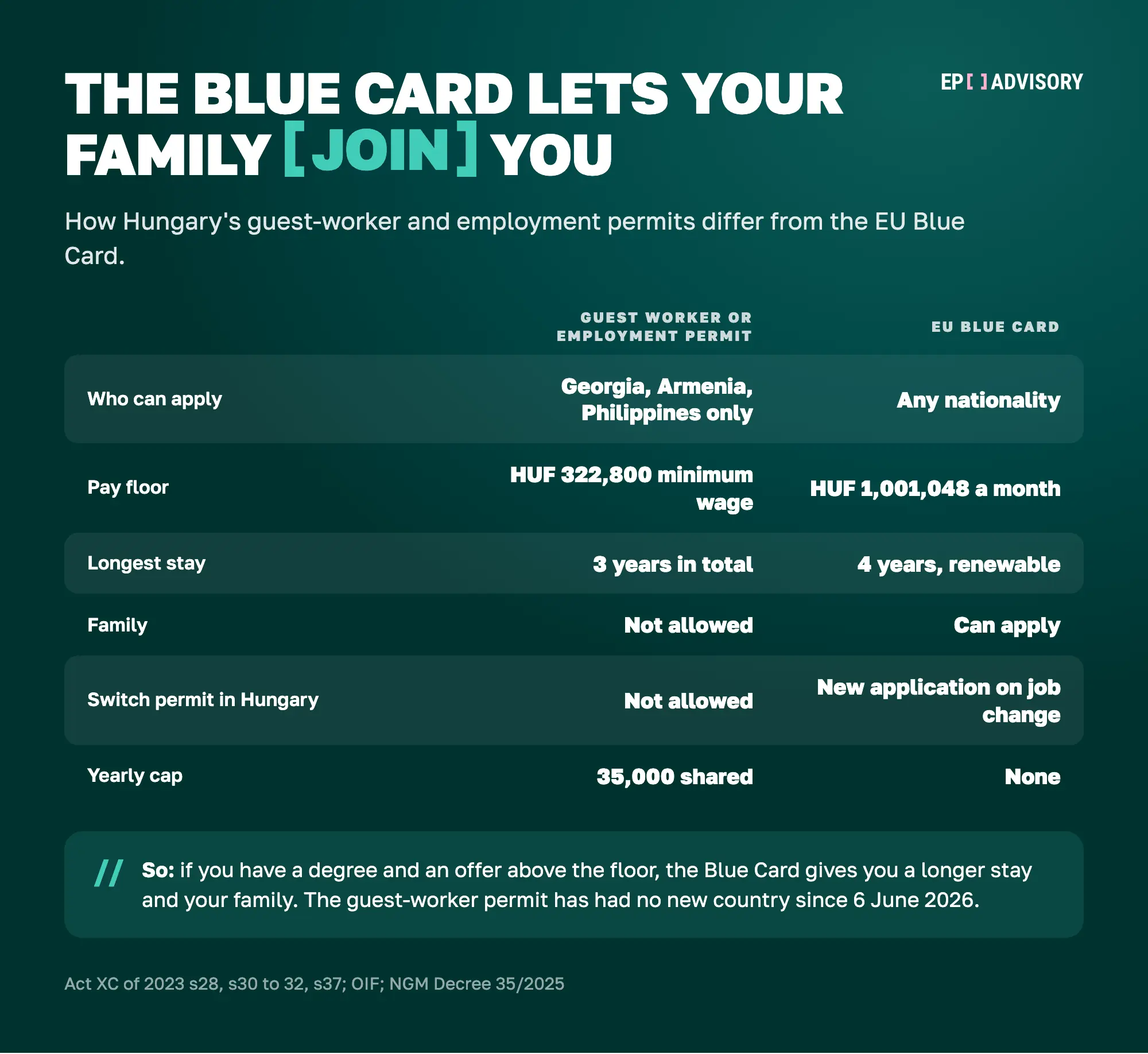
The limits are close to those of the guest-worker permit. The permit lasts up to 2 years, plus 1 year, so 3 years in total. It gives no right to bring family, no national residence card and no switch to another permit (OIF). If you want to stay longer, you can make a fresh application in Hungary, at most 40 days before the permit expires. A new permit is not guaranteed.
Both permits share one yearly number. For 2026 the economy minister set it at 35,000 permits in total (NGM Decree 35/2025). Investment-project permits count toward it too. Before an offer, the employer normally files a labour demand notice (munkaerőigény) with the employment office.
Score your CV in 30 seconds, then fix its biggest problems one by one. Both free.
Free, no card. A free account unlocks every fix.

The EU Blue Card and the other skilled routes
For graduates, the EU Blue Card is the widest route, because it is open to every nationality and has no cap. You need a job offer or contract for work that needs a higher qualification. A degree counts. For ICT managers and specialists, 3 years of relevant experience in the last 7 years also counts (OIF Blue Card page).
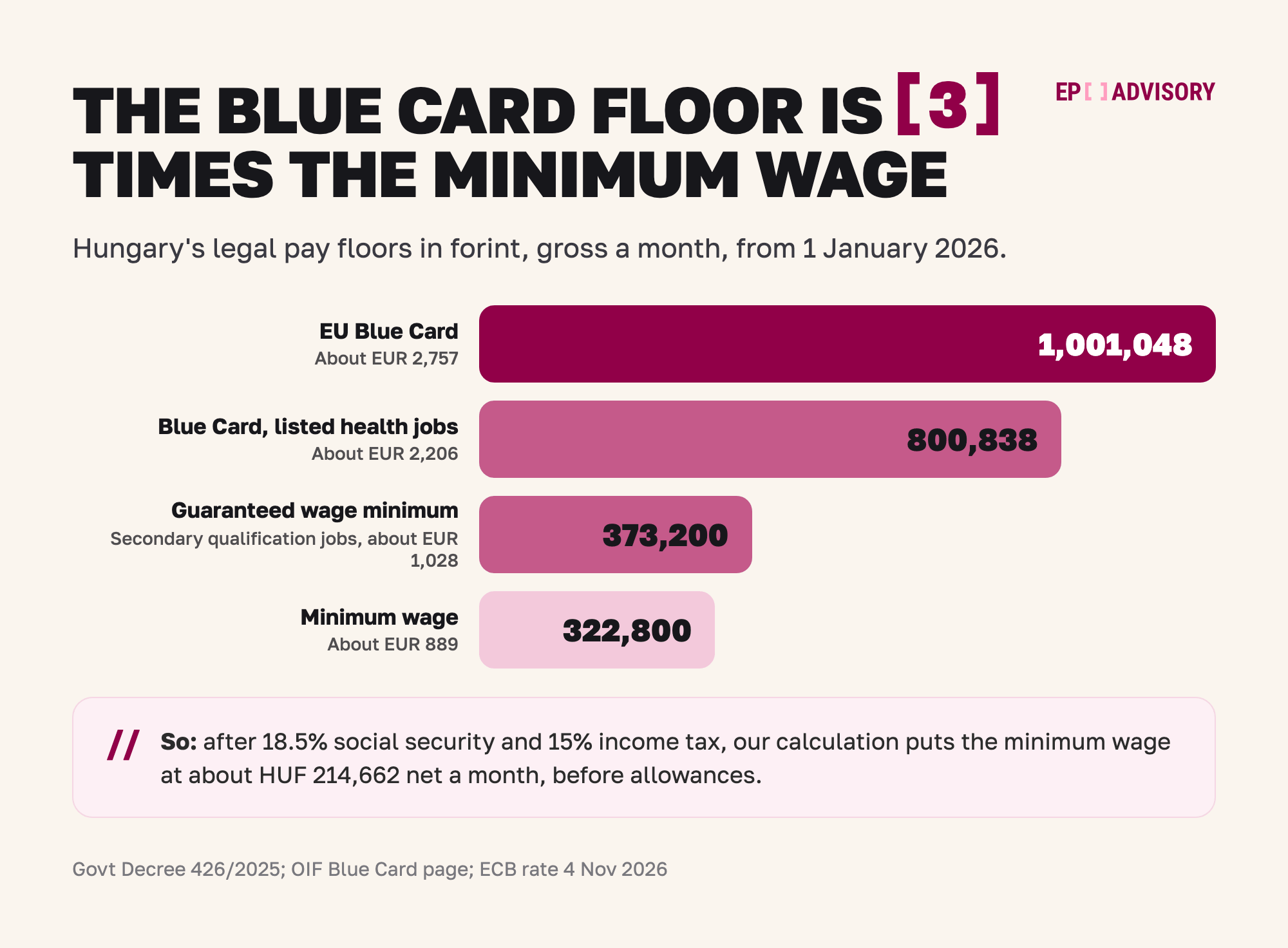
The pay floor is high for Hungary. In 2026 the job must pay at least HUF 1,001,048 gross a month, about €2,757, or €33,090 a year, at the ECB rate on 4 November 2026. The floor is 1.5 times the national average gross monthly earnings measured by KSH, the statistics office, two years earlier. For general practitioners, pharmacists, optometrists, dietitians, physiotherapists, health visitors, paramedic officers and degree-level nurses and midwives, the floor is lower: HUF 800,838 gross a month, about €2,206.
The new floor also applies to renewals decided in 2026. So if your Blue Card salary is below HUF 1,001,048, raise it with your employer before you renew.
- Length. Up to 4 years, renewable by 4 years at a time (Act XC, section 37).
- Family. Family members can apply for residence based on your Blue Card.
- Changing job. A new employer or a new job code means a new application on Enter Hungary, the online immigration portal.
- Decision time. 21 days of processing time, with a final decision within 70 days.
The Hungarian Card is a national route for graduates in fields Hungary wants. It covers degrees in IT, engineering, natural sciences and some music fields. It lasts up to 3 years and renews by 3 years at a time (OIF).
The National Card is for citizens of eight neighbouring and nearby countries, at any skill level. It lasts up to 2 years and extends by up to 3 years at a time. Agency work is allowed. A new employer means an extension application, decided in 21 days (OIF).
A national residence card, Hungary’s long-term status, needs at least 3 years of lawful, unbroken stay (OIF). Pay floors vary a lot across Europe, and our guide to work visa salary thresholds in Europe compares them.
Which sectors hire foreigners, and where English works
The permit rules show where the government wants workers. The Hungarian Card names IT, engineering and natural sciences. The guest-worker system was built around strategic partners, priority investments and big exporters. In practice, that means manufacturing, export and investment projects, and the logistics firms that serve them. Outside Budapest, most of these jobs need Hungarian on the shop floor.
In Budapest, the business services sector is the largest employer of English speakers. These are shared service centres for finance, HR, IT and customer support for international groups, and the sector’s industry body is ABSL Hungary. Many centres hire for a second language as well as English, such as German, French, Dutch or a Nordic language. In our experience, that second language often matters more than the degree subject.
So where can you work in English?
- Shared service centres in finance, accounting, procurement, HR and IT support.
- Software and IT at international firms and start-ups, mostly in Budapest.
- Engineering roles at foreign-owned plants, where team languages are often English or German.
Unskilled and warehouse jobs now have a route only for National Card and employment-permit nationals. If you are comparing markets for this kind of work, read our guides to jobs in Poland for foreigners and jobs in Romania for foreigners, which run different permit systems.
Where to find jobs in Hungary
Search in English and Hungarian, because many ads exist only in Hungarian. According to EURES Hungary, the EU job mobility network, public vacancies sit on the Virtual Labour Market Portal. Private agencies must be registered with the employment office.
| Where | Best for | Language of most ads |
|---|---|---|
| Shared service centres, IT and international firms | English | |
| Profession.hu | The broad Hungarian private market | Hungarian, some English |
| CVonline.hu | Office, sales and service centre roles | Hungarian and English |
| Jobline | Blue-collar, logistics and regional jobs | Hungarian |
| Virtual Labour Market Portal (VMP) | Public employment service vacancies across the country | Hungarian |
| EURES Hungary | Employers open to hiring from other countries | Hungarian and English |
| Euraxess | University and research posts | English |
Hungary has no public list of employers that sponsor foreign staff. So on the first call, ask which permit the role uses and whether the firm has hired on it before. If the answer is a guest-worker permit for a new hire, the offer cannot work today. Our guide on how to find a job in Europe covers the wider search method. If you are also weighing a neighbour, see jobs in Austria for foreigners or jobs in Croatia for foreigners.
Hungarian CVs, interviews and contracts
Hungarian employers expect a short CV and copies of your certificates. EURES lists these norms:
- Language. Hungarian and, depending on the post, English.
- Length. One or two pages, with education and jobs in reverse order.
- Proof. Attach copies of your qualifications and any language certificates.
- Cover letter. One page that says where you saw the job and why you fit it. See our cover letter for a job abroad guide.
Add one line with your nationality and the permit you would use, such as “EU Blue Card eligible”. If your CV follows another country’s style, our guide to the European CV format helps you adapt it. Getting ready to apply for jobs in Hungary? Check your CV for free: see it the way a recruiter does, then fix each problem.
In our experience, interviews at service centres often include a language test in each language on your CV. Our guide on how to pass a job interview covers preparation.
Your written contract must name the job, the place of work and the basic salary. Within 15 days of your start, the employer must tell you your hours, pay date, leave rules and notice rules. Probation is up to 3 months, or 6 months under a collective agreement. Before you sign, check that the gross monthly pay clears the floor for your permit, and read our tips on how to negotiate salary.
From offer to permit: steps and deadlines
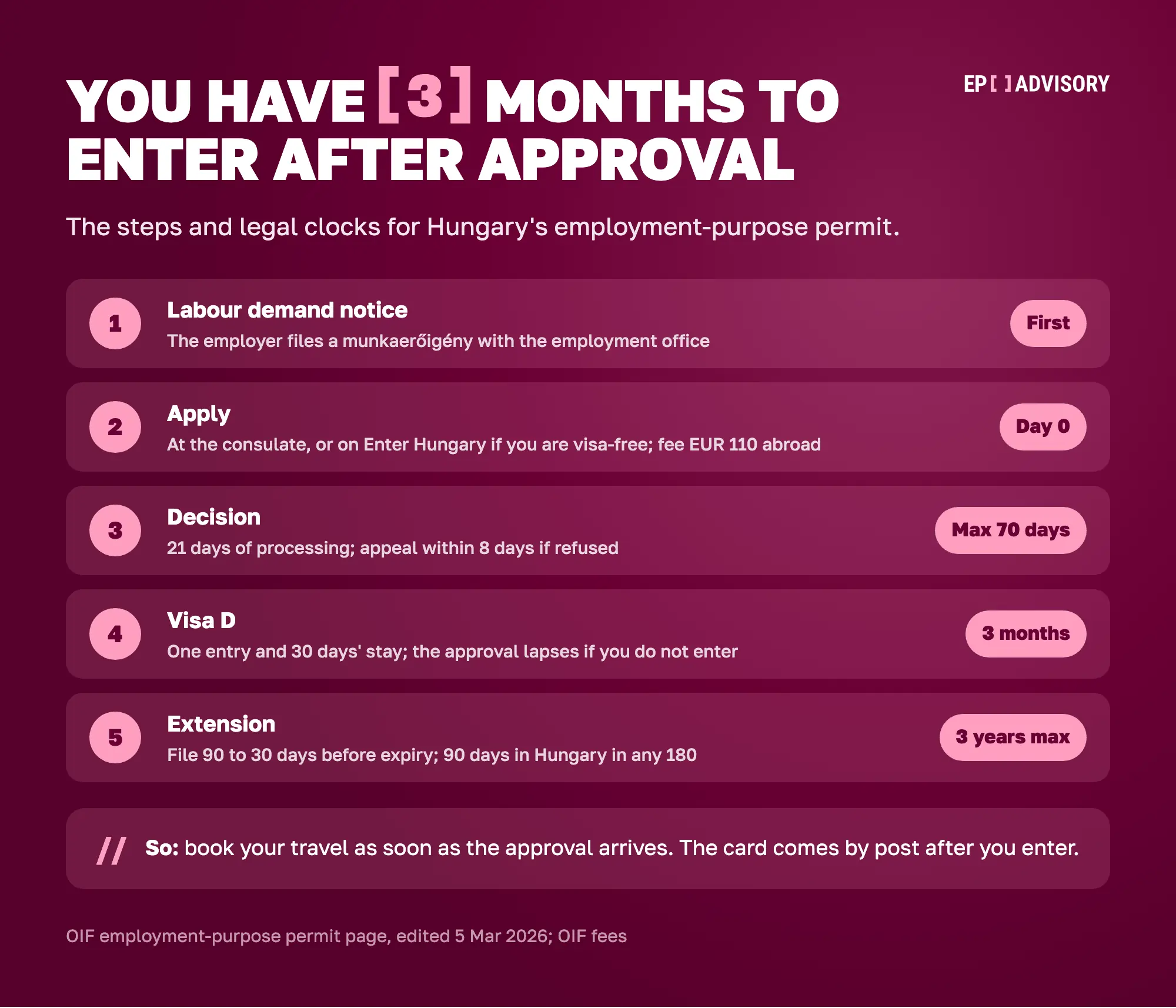
Most permit steps have a legal clock. This is the order for the employment-purpose permit. Other permits follow a similar order, so check each one’s OIF page.
- Labour demand notice. The employer files a munkaerőigény with the employment office.
- Application. You apply at the Hungarian consulate in your country. If you can enter Hungary visa-free, you can apply in Hungary on Enter Hungary or at an OIF office. The fee is €110 abroad, or HUF 26,000 on Enter Hungary (OIF fees).
- Biometrics. Your photo and fingerprints are taken. On Enter Hungary, this must happen within 15 days of the confirmation.
- Decision. The processing time is 21 days, and the final decision is due within 70 days. If refused, you can appeal within 8 days.
- Visa D. After approval, you get a visa D valid for 3 months, for one entry and 30 days’ stay. Enter within the 3 months, or the approval lapses.
- Card. Your residence card is sent by post.
- Extension. File 90 to 30 days before expiry. You must have spent at least 90 days in Hungary in any 180-day period.
Minimum wage, the guaranteed wage minimum and real pay
Hungary has two legal pay floors, and your education decides which one applies. From 1 January 2026, the minimum wage (minimálbér) is HUF 322,800 gross a month, about €889. The guaranteed wage minimum (garantált bérminimum) is HUF 373,200 gross a month, about €1,028. It applies to any job that needs at least a secondary school education or a secondary vocational qualification (Government Decree 426/2025).
The hourly rates are HUF 1,856 and HUF 2,145 gross. Employees pay 18.5% social security and a flat 15% income tax, according to EURES. Under-25s pay no income tax. So before family or age allowances, our own calculation puts the minimum wage at about HUF 214,662 net a month, about €591.
A Blue Card job pays at least three times the minimum wage. So in Hungary it mostly fits senior specialist, engineering and IT roles.
Next: see how Hungary’s HUF 1,001,048 Blue Card floor compares with other countries in our guide to work visa salary thresholds in Europe, then compare pay next door in salaries in the Czech Republic.
How to spot a Hungary job scam
The 2026 rule change created a gap that scammers fill. Some adverts still sell guest-worker places to people who are no longer eligible. Use these checks:
- You should never pay to be placed. EURES states that jobseekers cannot be charged a fee for employment agency services in Hungary.
- Check the permit name. An offer of a new guest-worker permit is impossible since 6 June 2026. An employment-purpose permit is possible only for citizens of Georgia, Armenia and the Philippines.
- Know the real fees. The permit fee is €110 if you apply abroad, paid to the state. A quote of hundreds or thousands of euros for “visa processing” is a warning sign.
- Check the agency. Private agencies must be registered with the employment office. Ask for the registration number and check it with the public employment service, NFSZ.
- Check the pay. No legal offer pays less than HUF 322,800 gross a month for full-time work.
Key takeaways
- No country qualifies for a new guest-worker permit since 6 June 2026, though existing holders can extend.
- Citizens of Georgia, Armenia and the Philippines can get an employment-purpose permit, within a combined 2026 cap of 35,000.
- The guest-worker and employment permits last 3 years at most, with no family and no switch to another permit.
- The EU Blue Card is open to every nationality, needs HUF 1,001,048 gross a month in 2026 and has no cap.
- The minimum wage is HUF 322,800 gross a month, and the guaranteed wage minimum for skilled jobs is HUF 373,200.
- English-speaking jobs are mostly in Budapest shared service centres, IT and engineering.
- You never pay an agency to be placed in Hungary.
See what a recruiter sees, then fix it before you apply. An instant score, then the fix for every problem.
Free, no card. A free account unlocks every fix.
Frequently asked questions
Can foreigners get a job in Hungary in 2026?
Yes. EU citizens apply like locals. Others need a permit that fits their passport and education. Graduates of any nationality can use the EU Blue Card or, in some fields, the Hungarian Card. Citizens of eight countries can use the National Card, and citizens of Georgia, Armenia and the Philippines can get an employment permit.
Is the Hungary guest worker visa still open?
Not for new applicants. Since 6 June 2026, the government decree lists no country whose citizens can get a guest-worker permit. Permits issued before then stay valid, and holders on 5 June 2026 can extend them, up to 3 years in total.
Which jobs in Hungary offer visa sponsorship?
Hungary has no sponsor licence list. Instead, the employer supports or files your permit papers. Blue Card roles in IT, engineering and shared service centres are the most common for graduates. For jobs without a degree, only National Card and employment-permit nationals have a route.
What is the minimum wage in Hungary in 2026?
From 1 January 2026 it is HUF 322,800 gross a month, about €889. Jobs that need at least a secondary qualification must pay the guaranteed wage minimum of HUF 373,200 gross a month, about €1,028.
How much do you need to earn for a Hungarian Blue Card?
In 2026 the job must pay at least HUF 1,001,048 gross a month, about €2,757. Listed health jobs, such as GPs, pharmacists and degree-level nurses, need HUF 800,838. The floor also applies to Blue Card renewals decided in 2026.
Can I find unskilled or warehouse jobs in Hungary as a foreigner?
Only if your passport fits a route. Citizens of the eight National Card countries can take any job. Citizens of Georgia, Armenia and the Philippines can use the employment permit. For other nationalities, there is no route for unskilled work since June 2026.
Do I need to speak Hungarian to work in Hungary?
Not for every job. Shared service centres, IT firms and research posts often work in English. Most factory, warehouse, retail and public sector jobs expect Hungarian.