 By Andre Atallah, CEO of EP Advisory
The short answer: the average salary in Canada is about $69,500 a year in 2026, roughly $5,800 a month gross. That is the average. The typical wage earner makes less, about $47,650 a year, because high earners pull the average up. In Ontario, the average salary leaves roughly $4,450 a month after tax. Pay swings hard by province, from about $62,000 in Prince Edward Island to $96,800 in Nunavut. The federal minimum wage is $18.15 an hour. All figures are in Canadian dollars.
| Average salary (Statistics Canada, May 2026, annualised) | ~$69,500 / year (~$5,800/mo) |
| Median wage earner (2023 tax data) | ~$47,650 / year |
| Take-home on the average, Ontario | ~$4,450 / month net |
| Federal minimum wage (from 1 April 2026) | $18.15 / hour |
| The average, in US dollars | about US$49,300 |
The salary in a Canadian job ad can mislead you on its own. The average sounds healthy. It hides two things, though. Most people earn well below it, and where you live changes it by tens of thousands of dollars. For anyone moving to Canada, the number that matters is the pay for your job, in your province, after tax.
So here is the whole picture, in plain figures. We break down the average, the typical wage that sits below it, the huge gap between provinces, what different jobs pay, the minimum wage, and what actually lands in your account after tax. We also cover the salary rules that touch your visa.
In nearly 10 years, we’ve helped more than 5,000 professionals find jobs abroad. Want to know if your CV will pass screening in Canada? Check your CV for free: a score in 30 seconds, then a fix for each problem.
What Is the Average Salary in Canada in 2026?
The average salary in Canada is about $69,500 a year in 2026, or roughly $5,800 a month gross. That comes from Statistics Canada average weekly earnings of $1,336 in May 2026, over a full year.
This is a gross figure, before tax. It is an average across all employees and all industries. One point catches out anyone comparing from abroad. This is in Canadian dollars, not US dollars. At the exchange rate in September 2026, that $69,500 average is only about US$49,300. US readers routinely overestimate Canadian pay by forgetting the currency gap. The exchange rate moves daily, so treat the US figure as a guide, not a fixed number.
The Average Is Not the Typical Wage
Most Canadians earn less than the average. The median wage was about $47,650 a year in the most recent tax data, well below the $69,500 average, because a group of high earners lifts the average.
The average and the median answer different questions. The average adds everyone’s pay and divides by the number of people, so a small group of very high earners lifts it. The median is the person in the middle, with half above and half below. For a realistic sense of a normal wage, the median is the better guide. Both numbers come from Statistics Canada, though from different surveys, so read the gap as a guide rather than an exact subtraction.
One Country, Many Salaries: The Provincial Gap
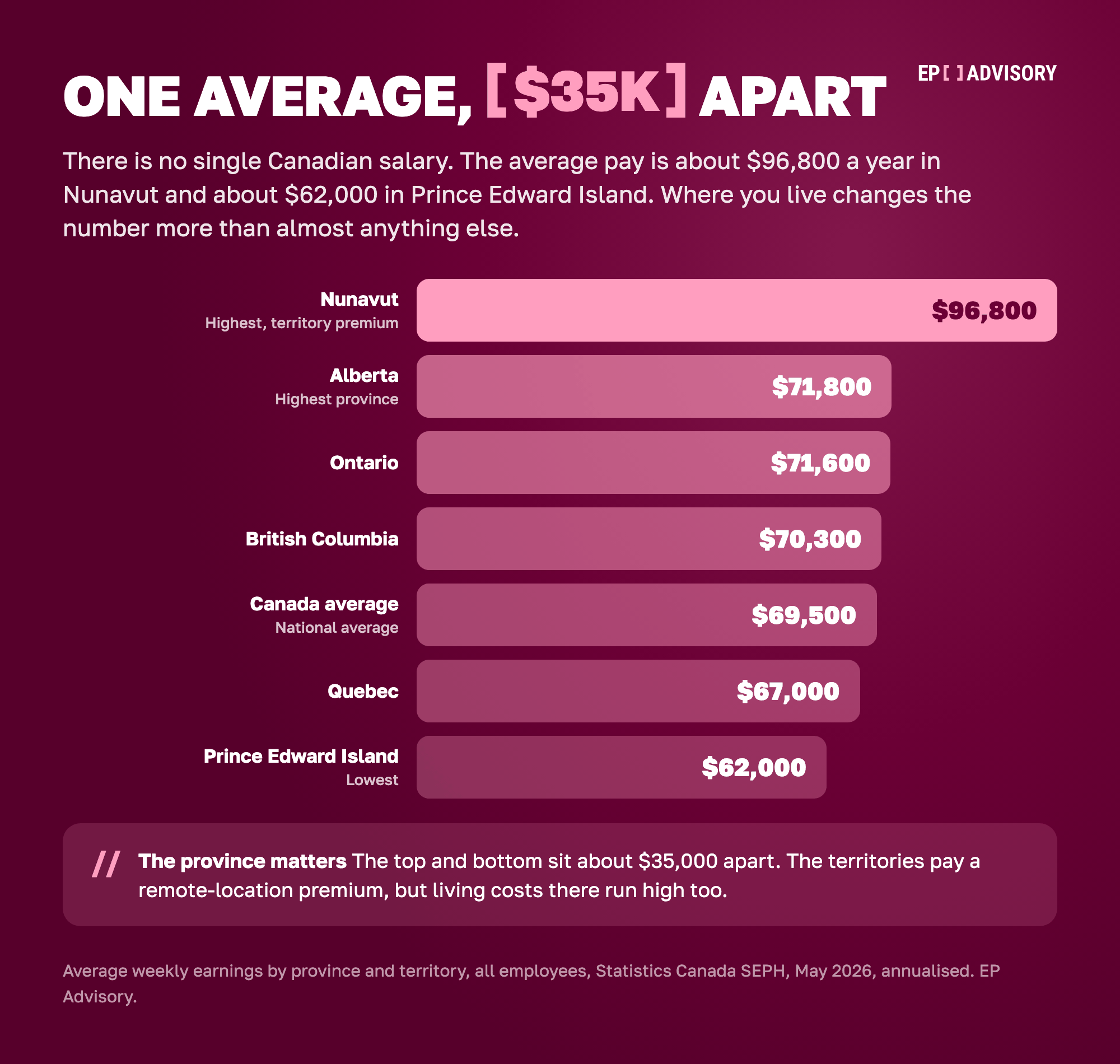
Pay varies enormously across Canada. The average is about $96,800 a year in Nunavut but around $62,000 in Prince Edward Island. Among the big provinces, Alberta and Ontario lead and Quebec trails.
The territories pay most, driven by remote-location premiums and resource jobs, but living costs there are high too. Among the provinces where most newcomers settle, Alberta and Ontario sit at the top, British Columbia close behind, and Quebec below the national average. Your province can change your pay by tens of thousands of dollars for the same role.
| Province or territory | Average weekly earnings | Approx. per year |
| Nunavut (highest) | $1,861 | ~$96,800 |
| Alberta | $1,381 | ~$71,800 |
| Ontario | $1,377 | ~$71,600 |
| British Columbia | $1,351 | ~$70,300 |
| Canada (average) | $1,336 | ~$69,500 |
| Quebec | $1,288 | ~$67,000 |
| Prince Edward Island (lowest) | $1,193 | ~$62,000 |
Average weekly earnings, all employees, May 2026 (Statistics Canada, SEPH). Annual figures are weekly pay over 52 weeks, so treat them as approximate.
Salaries by Job in Canada
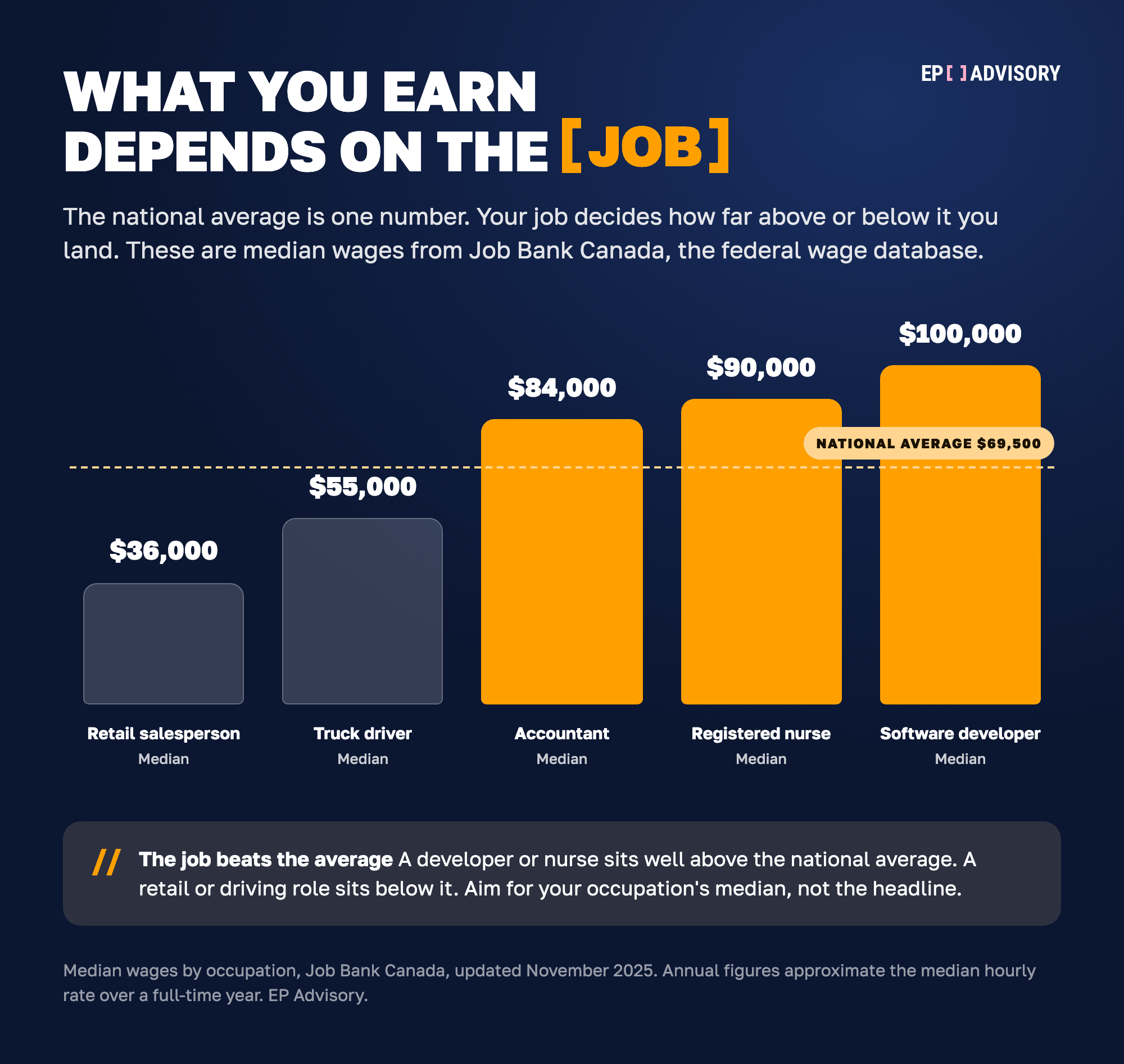
What you earn depends far more on your job than on the national average. A software developer or civil engineer sits near $100,000, a nurse near $90,000, a truck driver near $55,000, and a retail worker near $36,000.
These are median wages by occupation from Job Bank Canada, the federal wage database. The median is the middle of the pay range for that job, so half earn more and half earn less. Here is how a range of common roles compares.
| Job (NOC 2021 code) | Median wage | Approx. per year |
| Family doctor / GP (31102) | $232,227 / year | ~$232,000 (billings, not salary) |
| Civil engineer (21300) | $48.56 / hour | ~$101,000 |
| Software developer (21232) | $48.08 / hour | ~$100,000 |
| Secondary school teacher (41220) | $45.67 / hour | ~$95,000 |
| Registered nurse (31301) | $43.27 / hour | ~$90,000 |
| Accountant (11100) | $40.36 / hour | ~$84,000 |
| Long-haul truck driver (73300) | $26.42 / hour | ~$55,000 |
| Material handler (75101) | $22.00 / hour | ~$45,800 |
| Retail salesperson (64100) | $17.31 / hour | ~$36,000 |
Median hourly wages from Job Bank Canada, updated November 2025. Annual figures apply the median hourly rate over a full-time year, so treat them as approximate. Family-doctor pay is published as annual billings under a fee-for-service model, not a salary, so it sits apart from the rest.
Weighing your options? Compare these numbers with the average salary in the UK, another major destination for skilled migrants. If the United States is also on your list, see our US work-visa guide for the routes in.
Minimum Wage in Canada 2026
The federal minimum wage is $18.15 an hour from 1 April 2026. It applies only to federally regulated jobs. Most workers fall under a provincial rate, which ranges from $15.00 in Alberta to $20.17 in Nunavut.
Canada has no single minimum wage. The federal rate covers banks, airlines, interprovincial transport and telecoms. Everyone else is set by their province or territory. Alberta has held the lowest rate since 2018. British Columbia leads the provinces, and the territories pay more again.
| Jurisdiction | Minimum wage | Effective |
| Nunavut (highest) | $20.17 / hour | 1 Sep 2026 |
| British Columbia (highest province) | $18.25 / hour | 1 Jun 2026 |
| Federal (federally regulated jobs) | $18.15 / hour | 1 Apr 2026 |
| Ontario | $17.60, rising to $17.95 | 1 Oct 2026 |
| Alberta (lowest) | $15.00 / hour | unchanged since 2018 |
Rates as of September 2026. Minimum wages change often and on different dates in each province, so check your province’s current rate before you rely on it.
What Actually Lands in Your Account
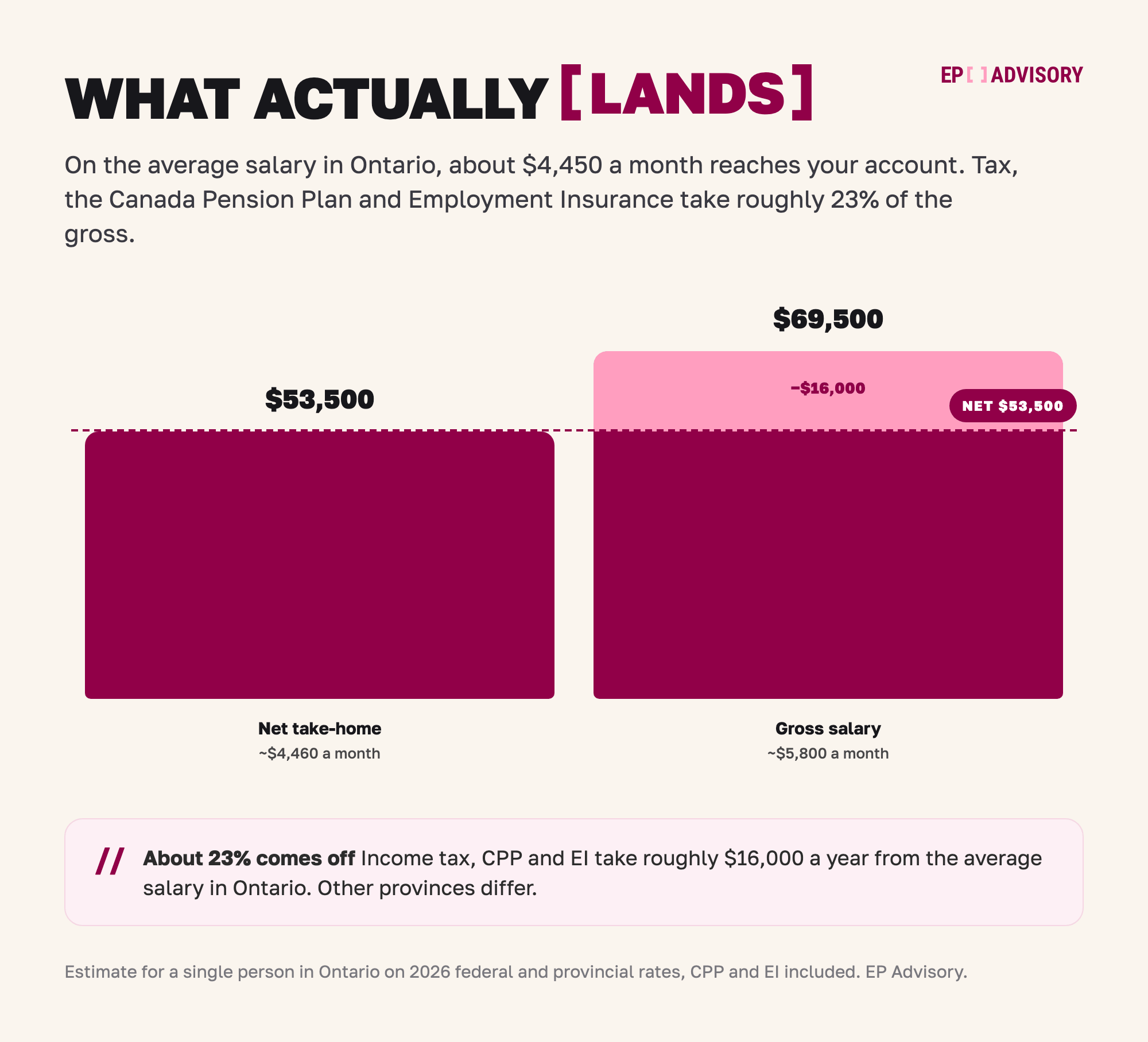
On the average salary in Ontario, about $4,450 a month lands in your account after tax. Deductions take roughly 23% of gross pay, through income tax, the Canada Pension Plan and Employment Insurance.
Your take-home depends on your province, because each sets its own income tax on top of the federal tax. Here is the arithmetic for a single person on the average salary in Ontario, on 2026 rates.
| On the average salary, in Ontario | Amount per year |
| Gross salary | ~$69,500 |
| Canada Pension Plan (CPP) | about -$3,900 |
| Employment Insurance (EI) | about -$1,120 |
| Federal income tax | about -$7,200 |
| Ontario income tax and health premium | about -$3,800 |
| Net take-home | ~$53,500 / year (~$4,460 / month) |
An estimate for a single person in Ontario, on 2026 rates, with no extra credits or deductions. Other provinces differ. Quebec has its own provincial tax and a lower EI rate, so the split there is not the same.
Salary and Canadian Immigration
Canada’s main skilled-migration route, Express Entry, has no minimum-salary requirement. A job offer no longer adds points to your ranking either, after a rule change in March 2025. Where salary bites is the work permit and the money you must show.
This is the section most applicants get wrong, because older guides are out of date. Three points matter.
- No salary threshold for Express Entry. Your ranking score rewards age, education, language and experience, not pay. There is no set salary you must earn to qualify.
- A job offer no longer adds ranking points. Canada removed the bonus points for arranged employment on 25 March 2025. A job offer can still help with eligibility and with some provincial streams, but it does not lift your core score any more.
- Employer-sponsored permits must pay the going rate. If an employer hires you through a Labour Market Impact Assessment, they generally must pay at least the median wage for that job, the same Job Bank figure shown above. That is where a real salary floor appears.
There is also proof of funds. Most Express Entry applicants must show they have enough savings to settle. The amounts rise with family size.
| Family size | Funds required (CAD) |
| 1 person | $15,263 |
| 2 people | $19,001 |
| 3 people | $23,360 |
| 4 people | $28,362 |
| Each additional person | +$4,112 |
You are exempt from proof of funds if you have a valid job offer with work authorisation, or if you apply through the Canadian Experience Class. One more thing worth knowing. Recent immigrants earn less than Canadian-born workers at first, a gap of about 9% for men and 16% for women in 2023. The gap has roughly halved since 2015, so it narrows as you settle.
Where to Look for Work
Start with Job Bank, the federal government’s own job portal. It also holds the wage data used above, so you can check the going rate for your occupation and province in one place.
- Job Bank Canada, the main federal portal, with a stream for newcomers.
- Job Bank wage report, to look up any occupation’s pay by region.
- Provincial services such as WorkBC in British Columbia and alis in Alberta.
Key Takeaways
- The average salary in Canada is about $69,500 a year in 2026, roughly $5,800 a month gross.
- The typical wage is lower, about $47,650, because high earners lift the average.
- Pay swings from about $62,000 in PEI to $96,800 in Nunavut. Your province matters.
- On the average salary in Ontario, about $4,450 a month lands after tax.
- Express Entry has no salary threshold, and a job offer no longer adds ranking points.
Score your CV in 30 seconds, then fix its biggest problems one by one. Both free.
Free, no card.

See what a recruiter sees, then fix it before you apply. An instant score, then the fix for every problem.
Free, no card. A free account unlocks every fix.
Frequently Asked Questions
What is the average salary in Canada in 2026?
About $69,500 a year, or roughly $5,800 a month gross. The typical wage is lower, around $47,650 a year, because high earners raise the average.
Is $69,500 a good salary in Canada?
It is around the national average, so it is a solid middle income. It goes further in Alberta or the Atlantic provinces than in Toronto or Vancouver, where housing costs are high. After tax in Ontario it is about $4,450 a month.
Which province pays the most?
The territories pay most, with Nunavut averaging about $96,800 a year. Among the provinces, Alberta and Ontario lead, and Prince Edward Island is the lowest at about $62,000.
Do I need a job offer or a minimum salary for Express Entry?
No. Express Entry has no minimum-salary requirement, and since March 2025 a job offer no longer adds points to your ranking. Employer-sponsored work permits, though, must usually pay at least the median wage for the job.
How much money do I need to move to Canada under Express Entry?
A single applicant must show about $15,263 in savings, and more for a family. You are exempt if you have a valid job offer with work authorisation or apply through the Canadian Experience Class.
Related reading: the average salary in the UK, the average salary in Australia, the average salary in Saudi Arabia, and our US work-visa guide.