 By Alisa Schlosser, Career Consultant at EP Advisory
Qatar’s official average monthly wage for paid employees is QAR 12,303, about USD 3,380, and none of it goes to income tax. But 87% of paid workers sit in sectors averaging under QAR 7,800, while degree-holders average QAR 25,294. Latest published official figure: Q4 2025.
| The number | What it actually is |
| QAR 12,303 | Official average monthly wage of paid employees, latest published: Q4 2025 |
| QAR 25,294 | Average for workers with a university degree (2024) |
| QAR 7,786 | Private-sector average, where 79.2% of paid workers are (2024) |
| QAR 1,000 | Minimum basic wage, or QAR 1,800 all-in when the employer provides no food or housing, unchanged since 20 March 2021 |
| 0% | Income tax on your salary |
Here is the honest starting point, and it is the thing most Qatar salary pages hide: the newest official wage figure for Qatar covers the fourth quarter of 2025. No official 2026 wage data has been published yet. Anyone quoting a precise “2026 official average salary in Qatar” is either using an older number without saying so, or making it up.
That figure is QAR 12,303 a month, from the Qatar National Planning Council’s Labour Force Sample Survey. It is a real government number and the best one available. It is just not a 2026 number, and we will keep saying so. This guide uses that official series, adds the deeper 2024 annual tables almost no competitor opens, then does the part salary articles skip: subtracting Doha rent.
In nearly 10 years, we’ve helped more than 5,000 professionals find jobs abroad. Want to know if your CV will pass screening in Qatar? Check your CV for free: a score in 30 seconds, then a fix for each problem.
What Is the Average Salary in Qatar Per Month? (2026)
The average salary in Qatar is QAR 12,303 a month for paid employees, about USD 3,380, with no income tax deducted. That is the latest published official figure and it covers the fourth quarter of 2025.
The source is the Qatar National Planning Council, formerly the Planning and Statistics Authority, in its Labour Force Sample Survey for Q4 2025, Table 7. It is the average (mean) monthly wage of paid employees aged 15 and over, of every nationality and every sector. Men averaged QAR 11,922 and women QAR 13,278.
Currency conversion here is unusually safe. The riyal is pegged to the US dollar at a fixed USD 1 = QAR 3.64, so the dollar figures below will not decay the way euro or sterling conversions do.
| Period | Average monthly wage | In USD, at the fixed peg |
| Full-year 2022 | QAR 11,963 | USD 3,286 |
| Full-year 2023 | QAR 12,535 | USD 3,444 |
| Full-year 2024 | QAR 12,656 | USD 3,477 |
| Q4 2024 | QAR 12,416 | USD 3,411 |
| Q4 2025 (latest published) | QAR 12,303 | USD 3,380 |
The full-year average rose about 4.8% in 2023 and about 1.0% in 2024. The quarterly readings then slipped: Q4 2025 sits 0.9% below Q4 2024. Compare quarters with quarters and years with years, because the two come from different survey rounds.
A useful cross-check. Numbeo, which crowdsources pay and cost-of-living data from residents, reported an average net salary of QAR 11,841 a month for Doha on 28 September 2026, from 1,000 entries by 107 contributors. That lands within 4% of the official figure. Two independent methods landing in nearly the same place is about as much confidence as this data gives. We use Numbeo’s Doha city page, not its Qatar country page, because the two contradict each other, and crowdsourced data skews towards professionals.
There is no official median. The survey tables publish averages, not a median, and we will not invent one by guessing at the distribution. The next section shows the split a median would have revealed anyway.
Qatari Salaries at a Glance: The Essentials
- Official average: QAR 12,303/month (USD 3,380) for paid employees, Labour Force Sample Survey, latest published: Q4 2025 (Qatar National Planning Council)
- Recent trend: full-year QAR 12,535 in 2023 and QAR 12,656 in 2024; quarterly QAR 12,416 in Q4 2024 and QAR 12,303 in Q4 2025
- Crowdsourced net average: QAR 11,841/month for Doha, 28 September 2026, from 1,000 entries (Numbeo, city page)
- Degree-holders: QAR 25,294/month, double the national average, covering 29% of the labour force (2024)
- Government departments: QAR 31,774/month, but only 7.4% of paid workers (2024)
- Private sector: QAR 7,786/month, covering 79.2% of paid workers (2024)
- Income tax: 0% on salaries, and no expatriate social security, so gross equals net
- Minimum wage: QAR 1,000 basic plus allowances, up to QAR 1,800 all-in, unchanged since 20 March 2021
- Rent, one-bed city centre: QAR 7,138/month, which is 60% of the crowdsourced net average
- Family sponsorship: commonly reported at QAR 10,000/month, or QAR 6,000 with employer-provided family housing, for technical or specialised jobs
- Currency: fixed peg at USD 1 = QAR 3.64
The dating discipline. Wage data and legal data in Qatar move at different speeds. The wage figures here are the 2024 annual tables and Q4 2025, because those are the newest published; the labour-law figures are current to 2026. Mixing the two and calling all of it 2026 data is the most common error in this topic.
The Number the Average Hides: Government vs Private Pay
Qatar’s official statistics break pay down by sector of employer, and that is where the average stops being useful.
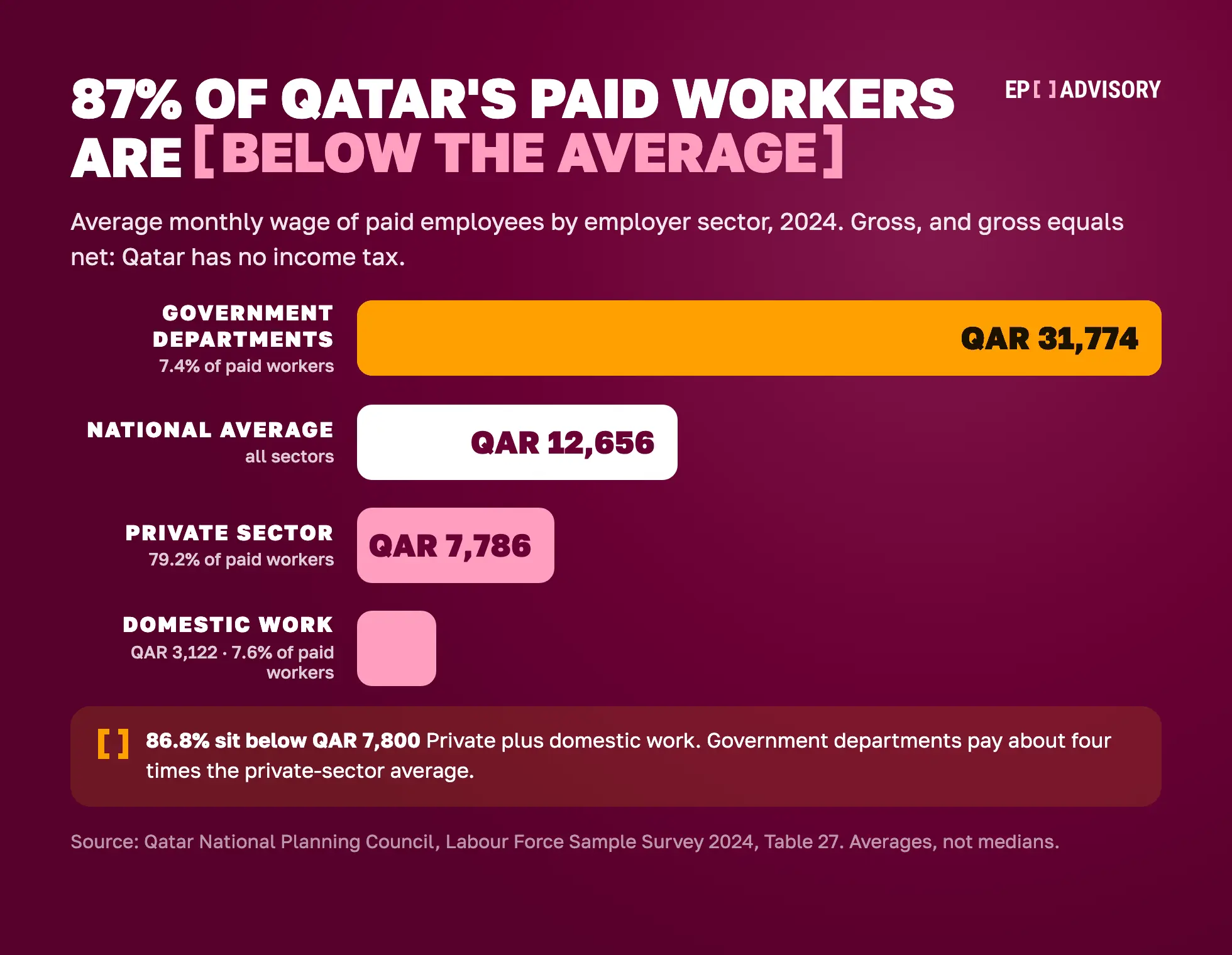
| Sector of employer | Average per month | Share of paid workers |
| Government departments | QAR 31,774 | 7.4% |
| National average, all sectors | QAR 12,656 | All paid workers |
| Private sector | QAR 7,786 | 79.2% |
| Domestic work | QAR 3,122 | 7.6% |
Figures from the Labour Force Sample Survey 2024, Table 27. All are average monthly wages of paid employees.
Do the arithmetic. The private sector employs 79.2% of paid workers and domestic work another 7.6%. Together that is 86.8% of everyone earning a wage in Qatar, in sectors averaging under QAR 7,800 a month. Government departments pay roughly four times private-sector rates and employ fewer than one worker in thirteen.
So the headline misleads in both directions at once. It sits far above what most workers earn, because a small, very well paid public sector drags it up. It also sits well below what a qualified professional should expect, because it includes the entire low-wage workforce.
Score your CV in 30 seconds, then fix its biggest problems one by one. Both free.
Free, no card.

Salaries by Sector and Occupation
The strongest single predictor of pay in Qatar is your qualification, and the official data says so directly.
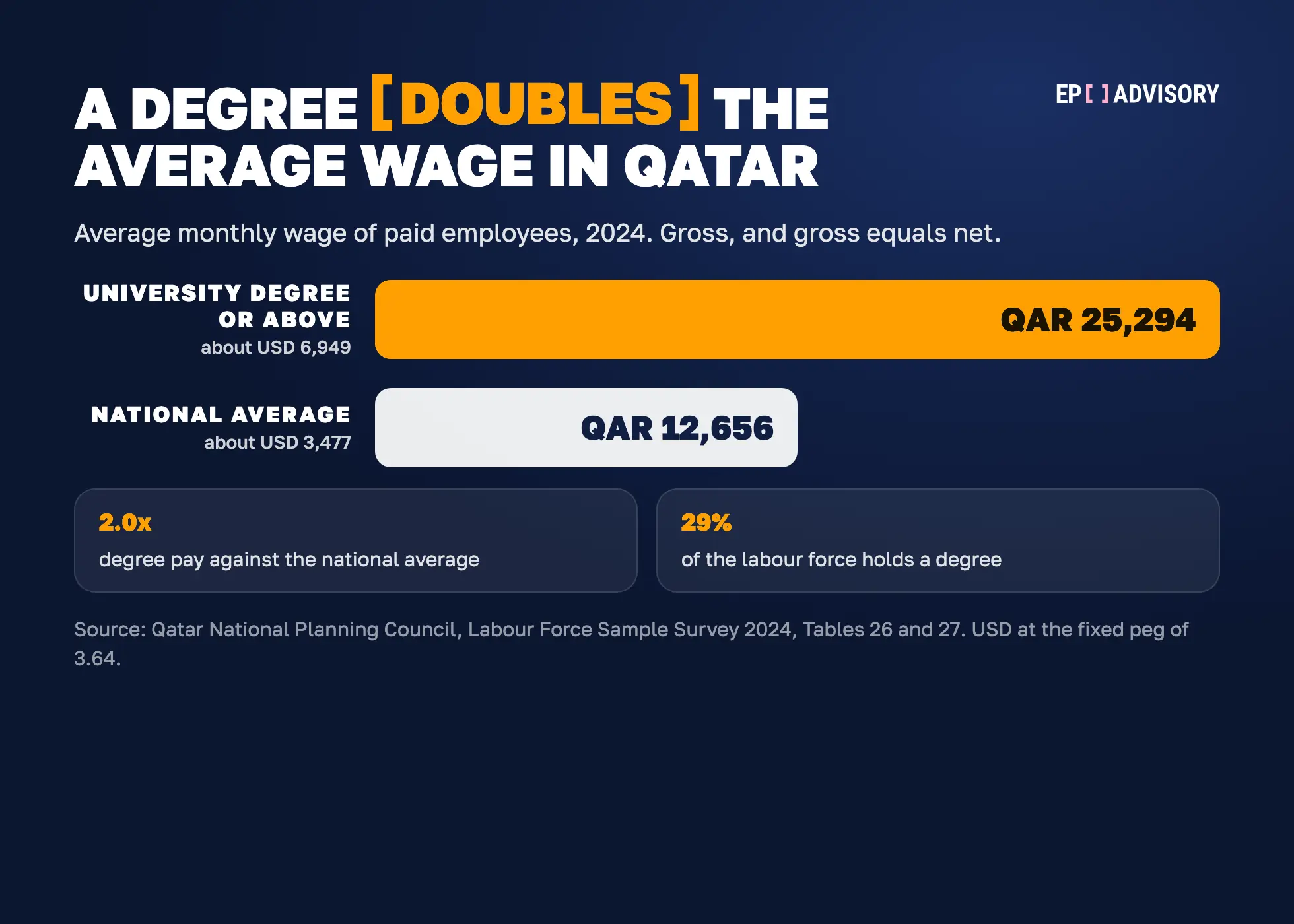
Workers with a university degree or above averaged QAR 25,294 a month in 2024, against a national average of QAR 12,656 in the same year. That is a factor of 2.0, and degree-holders are 29% of the labour force. If you hold a degree and you are being recruited into a professional role, this is your number.
| Sector | Average per month |
| Mining and energy | QAR 32,467 |
| Public administration | QAR 31,718 |
| Finance and insurance | QAR 29,195 |
| Information and communication | QAR 28,209 |
| Education | QAR 24,935 |
| Healthcare | QAR 21,006 |
| Transport and storage | QAR 12,306 |
| Hospitality | QAR 7,173 |
| Construction | QAR 5,709 |
And by occupation group: managers average QAR 43,975, professionals QAR 26,581, technicians and associate professionals QAR 19,114. All sector and occupation figures come from the Labour Force Sample Survey 2024, Tables 24 and 25, as average monthly wages.
What the ladder tells you. Mining and energy pays more than five times construction, in the same country and often on the same street. Qatar is an energy economy with a large service and construction workforce attached. Choosing the sector matters more than choosing the employer.
Qatar’s Minimum Wage: QAR 1,000 Plus Allowances
Qatar has a statutory minimum wage of QAR 1,000 a month in basic salary, plus QAR 300 for food and QAR 500 for housing where the employer provides neither. That is QAR 1,800 all-in, and it applies to workers of every nationality.
The instrument is Law No. 17 of 2020, in force since 20 March 2021. Its significance is not the amount. It is that Qatar became the first country in the Gulf to set a non-discriminatory minimum wage, applying identically to citizens and migrants and explicitly covering domestic workers.
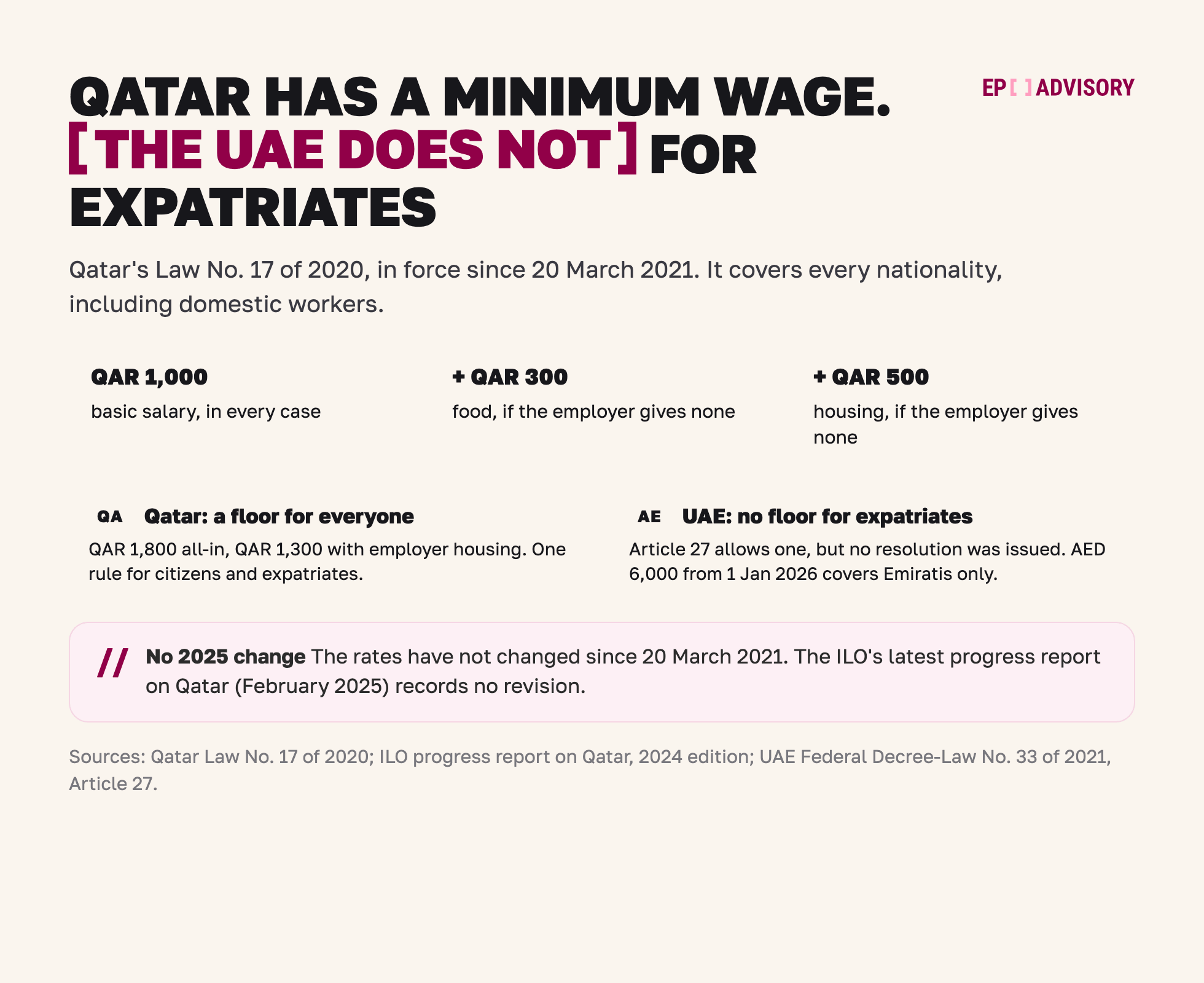
| What the employer provides | Legal monthly minimum |
| Nothing, neither food nor housing | QAR 1,800 all-in |
| Housing but not food | QAR 1,300 |
| Basic salary component in every case | QAR 1,000 |
A correction worth making gently. A number of sites list a change to “QAR 1,800 from 1 January 2025”. There was no such change. The rates have been unchanged since 20 March 2021, and the International Labour Organization’s latest progress report on Qatar, published in February 2025, records no revision. If a page dates the minimum wage to 2025, its other figures deserve checking too.
The Gulf contrast, and it is a sharp one. Qatar has a statutory minimum wage covering expatriates. The UAE does not: Article 27 of Federal Decree-Law No. 33 of 2021 allows the Cabinet to set one, but no implementing resolution has ever been issued, so a separate AED 6,000 floor reaches Emirati citizens only. Our guide to salaries in Dubai covers what that means for an expatriate offer there.
At about USD 495 a month, QAR 1,800 is a floor for the lowest-paid rather than a benchmark for any professional reader. Its relevance to you is that it exists at all.
No Income Tax: What Tax-Free Means in Doha
There is no personal income tax on salaries in Qatar. Not a low rate, not a generous allowance. Zero. There is also no social security contribution for expatriate employees, so the number written in your contract is the number that reaches your account. That position is recorded in PwC’s Worldwide Tax Summaries for Qatar, last reviewed on 17 September 2026.
Why this changes how you read offers. In most of Europe a headline salary shrinks before you see it. A QAR 20,000 monthly offer in Doha is QAR 20,000 in hand, roughly USD 5,495. Comparing a Gulf gross against a European gross misleads every time, so compare what lands in the account.
One caveat that is yours to check. Your home country may still have a claim under its own tax-residency rules, which differ sharply by nationality. Qatar not taxing you does not mean nobody does.
If the maths works, the next step is practical: our guide to working in Saudi Arabia covers the other big Gulf market on the same money-first basis, and the European work-visa salary thresholds show the opposite model: Europe fixes a legal salary floor per visa route, while in Qatar the bar you must clear is the market, not the law.
The Other Side: What Doha Rent Does to a Salary
Now the subtraction. Qatar does not tax your income. It prices your address instead.
Numbeo’s Doha data for 28 September 2026 puts a one-bedroom flat in the city centre at QAR 7,138 a month and the same flat outside the centre at QAR 4,392. Set those against the reported net average of QAR 11,841.
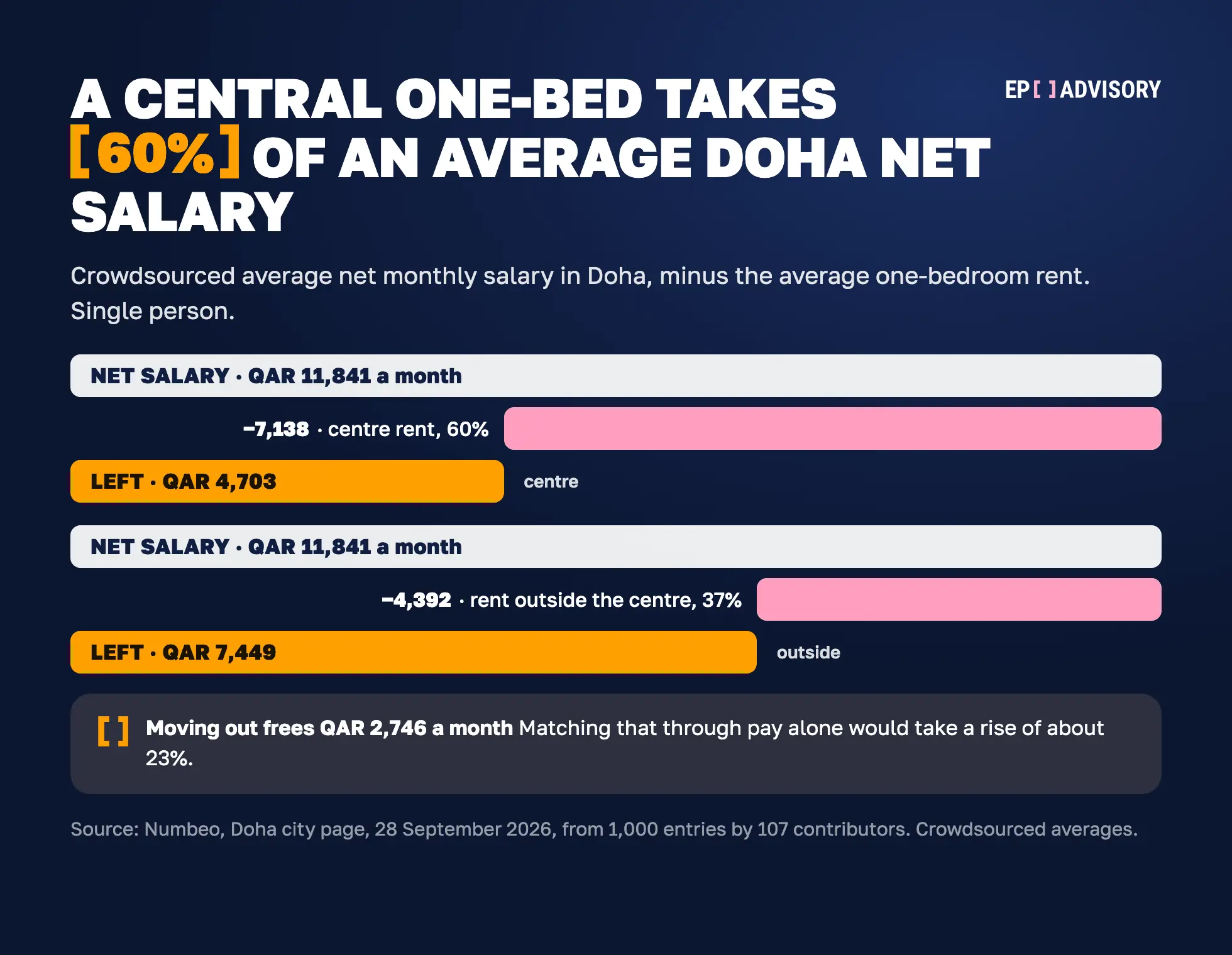
| Scenario (single person) | City centre | Outside centre |
| Net salary per month | QAR 11,841 | QAR 11,841 |
| Rent, one-bed | −QAR 7,138 | −QAR 4,392 |
| Share of salary gone | 60% | 37% |
| Left for everything else | QAR 4,703 | QAR 7,449 |
Sixty percent. A central one-bedroom flat takes well over half the reported net average before food, transport, insurance or savings. Doha’s zero-tax headline and its rent bill are two sides of one arrangement.
The lever you control. Moving out of the centre frees QAR 2,746 a month and lifts what is left from QAR 4,703 to QAR 7,449. Matching that through pay alone would take a rise of about 23%. Location beats negotiation here, which is unusual and worth acting on.
Settle one thing before you sign. Ask whether the offer includes a housing allowance or is a single all-in figure. That split is not cosmetic. End-of-service gratuity is calculated on your last basic salary (Labour Law No. 14 of 2004, Article 54), and the split may also matter for the family-sponsorship rules below.
Work Rules in 2026: Sponsorship, Job Changes and the New Labour Law
You can change jobs without your employer’s consent. The No Objection Certificate requirement was abolished in 2020. You give notice, file the change through the Ministry of Labour, and you move. That is the biggest practical difference between Qatar and the older Gulf model. Exit permits went in 2018 for Labour-Law workers, and the 2020 reforms extended that to most remaining categories, so you do not need permission to leave the country. The Wage Protection System is mandatory: salaries must run through the banking system, which makes non-payment visible to the Ministry of Labour.
Law No. 9 of 2026, promulgated on 25 June 2026, is the newest change, and its implementing regulations are still expected. Treat the detail as directional until they land.
- Part-time work and freelancing stay outside the Labour Law for now; the Council of Ministers may set rules for them later
- Non-compete clauses are capped at two years and need Ministry approval, so read restrictive covenants in a Qatari contract carefully
- Also covered: strikes, joint worker-employer committees at firms with 100 or more workers, and fines for recruitment agencies. Published summaries show no change to the minimum wage, the NOC abolition or the exit-permit abolition
Family sponsorship, and the number that decides it. As commonly reported, sponsoring a spouse and children requires a salary of QAR 10,000 a month, or QAR 6,000 where the employer provides family housing, and a technical or specialised job rather than a labour role. Sources differ on whether basic salary or total salary is assessed, so ask your employer which figure the Ministry of Interior will use. Criteria are applied administratively and vary by case, so confirm your own position before planning a family move.
Long-term residency exists, but it is narrow. Permanent residency under Law No. 10 of 2018 is reported to be capped at around 100 grants a year, so it is not a route to plan around. Property is the other route: according to Qatar’s Real Estate Regulatory Authority, property worth QAR 730,000 (USD 200,000) brings a renewable residence permit, and property worth QAR 3,650,000 (USD 1 million) adds permanent-residency benefits.
Where to Look for Work
For the work visa, the sectors that hire and how to apply, read our guide to jobs in Qatar for foreigners.
- LinkedIn: one of the main channels for professional and English-language roles in Qatar, and among the first places recruiters search
- Bayt: one of the biggest regional job boards in the Middle East, with strong Qatar coverage
- GulfTalent: Gulf-focused and weighted towards professional and managerial roles
- Michael Page covers Qatar from its Gulf offices and places into the sectors at the top of the ladder above, so registering directly is worth the time
Use the official tables as your script. Because Qatar publishes wage data by sector, occupation and education, you can negotiate against a named public source instead of a personal expectation. The 2024 Labour Force Survey putting professionals at QAR 26,581 is a far stronger opening than a number you picked. Just be accurate about the year.
Related reading: Salaries in Dubai: what you will really earn in 2026 · Working in Saudi Arabia in 2026 · Work visa and Blue Card salary thresholds in Europe 2026
Key Takeaways
- Qatar’s official average is QAR 12,303 a month for paid employees, about USD 3,380, and it is the Q4 2025 figure. No official 2026 wage data exists yet, so distrust any page that calls a figure the official 2026 average.
- Growth has slowed: the full-year average rose about 1.0% in 2024, to QAR 12,656, and Q4 2025 came in 0.9% below Q4 2024.
- The average hides a four-to-one split: government departments pay QAR 31,774 and employ 7.4% of paid workers, the private sector pays QAR 7,786 and employs 79.2% (2024).
- 86.8% of paid workers sit in sectors averaging under QAR 7,800 a month. That, not the headline, is what most people in Qatar earn.
- A degree roughly doubles the average, to QAR 25,294 (2024). If you hold one, plan against that number.
- You keep 100% of it. No income tax on salaries and no expatriate social security, so gross equals net.
- Rent is the real deduction: a central one-bed at QAR 7,138 takes 60% of the QAR 11,841 reported net average, and 37% outside the centre.
- Qatar has a statutory minimum wage covering all nationalities, unchanged since 20 March 2021, where the UAE has none for expatriates. The claimed 2025 change never happened.
- You can change jobs without employer consent and leave without an exit permit. The NOC requirement went in 2020; exit permits went in 2018 for Labour-Law workers.
- Family sponsorship is commonly set at QAR 10,000 a month, so ask how your package is split and which figure counts.
See what a recruiter sees, then fix it before you apply. An instant score, then the fix for every problem.
Free, no card. A free account unlocks every fix.
Frequently Asked Questions
What is the average salary in Qatar per month in 2026?
The latest published official figure is QAR 12,303 a month, about USD 3,380 at the fixed peg of USD 1 = QAR 3.64. It is the average monthly wage of paid employees in the fourth quarter of 2025, from the Qatar National Planning Council’s Labour Force Sample Survey. No official 2026 figure has been published yet. As a cross-check, Numbeo reported an average net salary of QAR 11,841 a month for Doha on 28 September 2026, within 4% of the official number.
What is a good salary in Qatar?
For a single professional, QAR 15,000 a month upwards is comfortable if you rent outside the centre, and QAR 25,000 upwards leaves real savings. The reason is rent: a one-bedroom flat in central Doha costs QAR 7,138 a month, which is 60% of the QAR 11,841 average net salary reported by Numbeo in September 2026. Workers with a university degree averaged QAR 25,294 a month in 2024, a realistic target for a qualified professional rather than an ambitious one.
What is the minimum wage in Qatar?
QAR 1,000 a month in basic salary, plus QAR 300 for food and QAR 500 for housing where the employer provides neither, giving QAR 1,800 all-in or QAR 1,300 if housing is provided. It was set by Law No. 17 of 2020 and came into force on 20 March 2021, and the rates have not changed since. It applies to all nationalities, including domestic workers, making it the first non-discriminatory minimum wage in the Gulf. Claims of a change on 1 January 2025 are incorrect.
Do you pay tax on salary in Qatar?
No. There is no personal income tax on salaries in Qatar and no social security contribution for expatriate employees, so your gross salary is your net salary. This is recorded in PwC’s Worldwide Tax Summaries for Qatar, last reviewed on 17 September 2026. Your home country may still tax you under its own residency rules, which vary by nationality, so check that separately.
What salary do you need to sponsor your family in Qatar?
As commonly reported, QAR 10,000 a month, or QAR 6,000 where the employer provides family housing, and the job must be a technical or specialised role rather than a labour role. Sources differ on whether basic salary or total salary is assessed, so ask your employer which figure the Ministry of Interior will use. Criteria are applied administratively and vary by case, so confirm your position before planning a family move.
Getting ready to apply for jobs in Qatar? Check your CV for free: see it the way a recruiter does, then fix each problem.