 By Andre Atallah, CEO of EP Advisory

Short answer: to move to Norway from the US, the UK or another non-EEA country, you need a residence permit from UDI, the Norwegian Directorate of Immigration. Most professionals use the skilled worker permit, which needs a job offer from a Norwegian employer. Family, study and self-employed permits also exist. After 3 years you can apply for permanent residence, and after 8 years for citizenship. EU and EEA citizens only register.
Norway is not in the EU, but it is in the European Economic Area (EEA). So EU and EEA citizens only register, while Americans, Britons and other non-EEA citizens need a residence permit from UDI before they start work. Norway also ties much of its system to one number, the basic amount G set by NAV, the Norwegian Labour and Welfare Administration. G was NOK 136,549 from 1 May 2026 (NAV). The bars for self-employment, family, permanent residence and faster citizenship are all multiples of G.
Immigration rules change often, so check the current rules with the official authority before you act.
For nearly 10 years, we’ve helped more than 5,000 professionals find jobs abroad. Want to know if your CV will pass screening in Norway? Check your CV for free: a score in 30 seconds, then a fix for each problem.
The five ways to move to Norway, and which one fits you
Your route depends on your passport first and your reason for moving second. EU and EEA citizens use the EEA rules. For everyone else, UDI decides on one of the permits below.
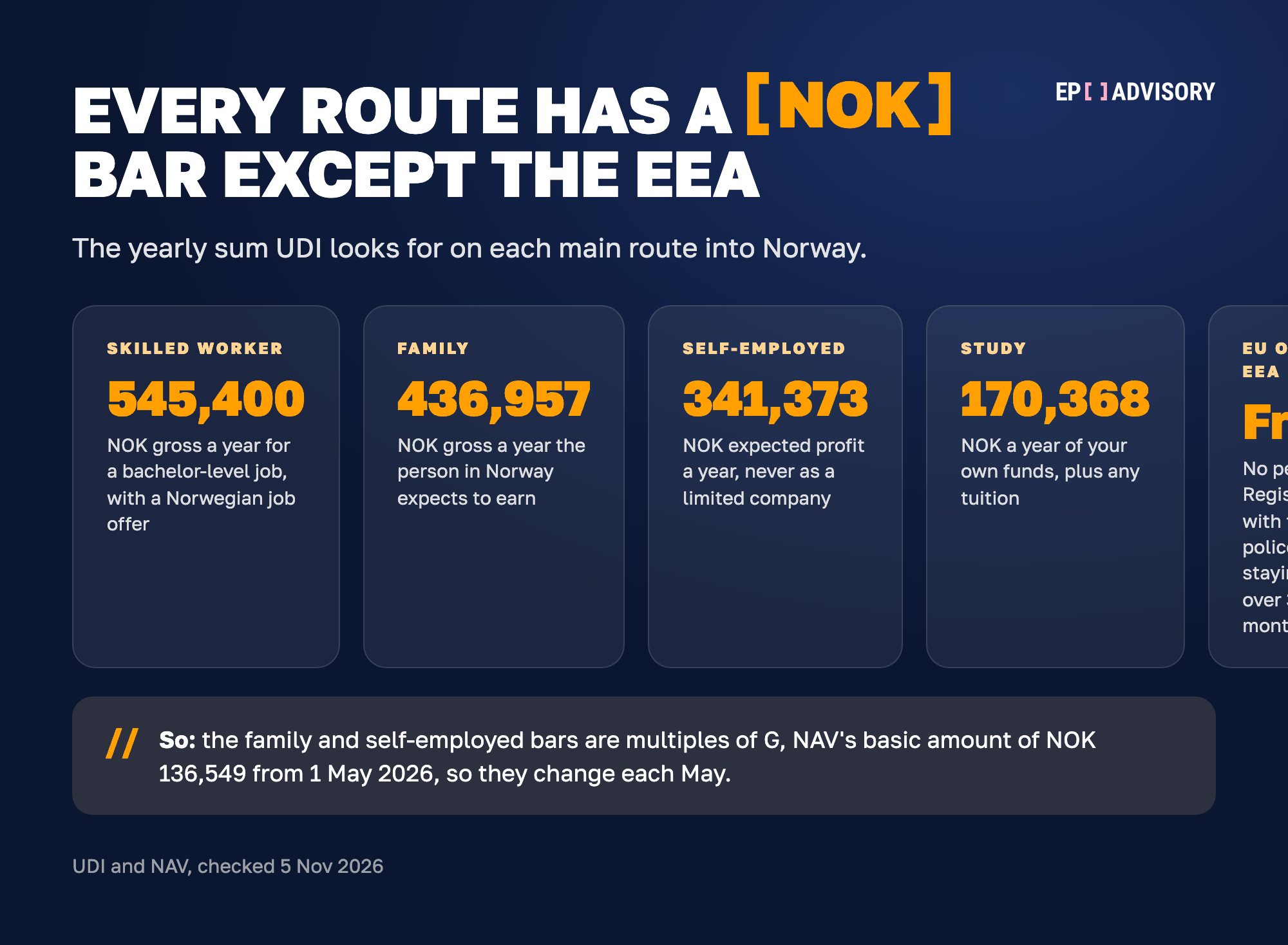
| Route | Who it fits | The bar to clear | Counts toward permanent residence |
|---|---|---|---|
| Skilled worker | Graduates and trained trades people with a Norwegian job offer | Pay no lower than normal in Norway, such as NOK 545,400 gross a year for a bachelor-level job | Yes, after 3 years |
| Family | Spouses, partners and children of someone living in Norway | The person in Norway expects NOK 436,957 gross a year | Ask UDI for your case |
| Study | Full-time students admitted to a Norwegian school | NOK 170,368 a year of your own funds, plus any tuition | Generally no |
| Self-employed | Skilled people running their own sole proprietorship | Expected profit of NOK 341,373 gross a year | Yes, after 3 years |
| EU or EEA citizen | Citizens of the EU, Iceland, Liechtenstein and Switzerland | Work, study, self-employment or your own funds. Register if staying over 3 months | Permanent right possible after 5 years |
If Norway’s bars do not fit your plans, compare our guides on how to move to Sweden and how to move to Denmark, then come back here.
EU and EEA citizens: register, no permit
If you hold an EU or EEA passport, Norway treats you almost like a local. You can stay up to 3 months without registering. You can stay longer if you work, are self-employed, provide services, study or have your own funds (UDI).
- Staying more than 3 months: register with the police. You get a registration certificate, and UDI charges no fee for it (UDI fees).
- Coming to look for work: you have 6 months to find a job, and you must register with the police as a job seeker within 3 months of arriving (UDI EU/EEA answers).
- Family from outside the EEA: they apply for a residence card if they will stay more than 3 months.
- After 5 years in a row: you may qualify for a permanent right of residence and can apply for a permanent residence card.
The registration certificate only confirms that the police have registered you. It is not proof of a right to stay, so keep your job contract or admission letter to hand.
Skilled worker permit: the main route for professionals
The skilled worker permit is how most non-EEA professionals move to Norway, and it starts with a job offer. You cannot apply on the hope of finding work. UDI needs a concrete offer from a specific Norwegian employer (UDI skilled workers). Our guide to jobs in Norway for foreigners covers where to look and who hires.
You qualify as a skilled worker if you have one of these:
- a university or college degree
- completed upper secondary vocational training of at least 3 years, such as a trade certificate
- special qualifications, which UDI normally links to long relevant experience
The job must be full-time or at least 80%, with pay and conditions no poorer than normal in Norway. Regulated professions, such as many health care jobs, need Norwegian authorisation first.
The pay bar
Where a collective agreement covers the job, its wage is the floor. For other jobs, UDI’s guide figures are NOK 545,400 gross a year for jobs that need a bachelor’s degree and NOK 624,700 gross a year for jobs that need a master’s degree (UDI pay and working conditions). Our overview of work visa salary thresholds in Europe shows how Norway’s bar compares with its neighbours.
How the application works
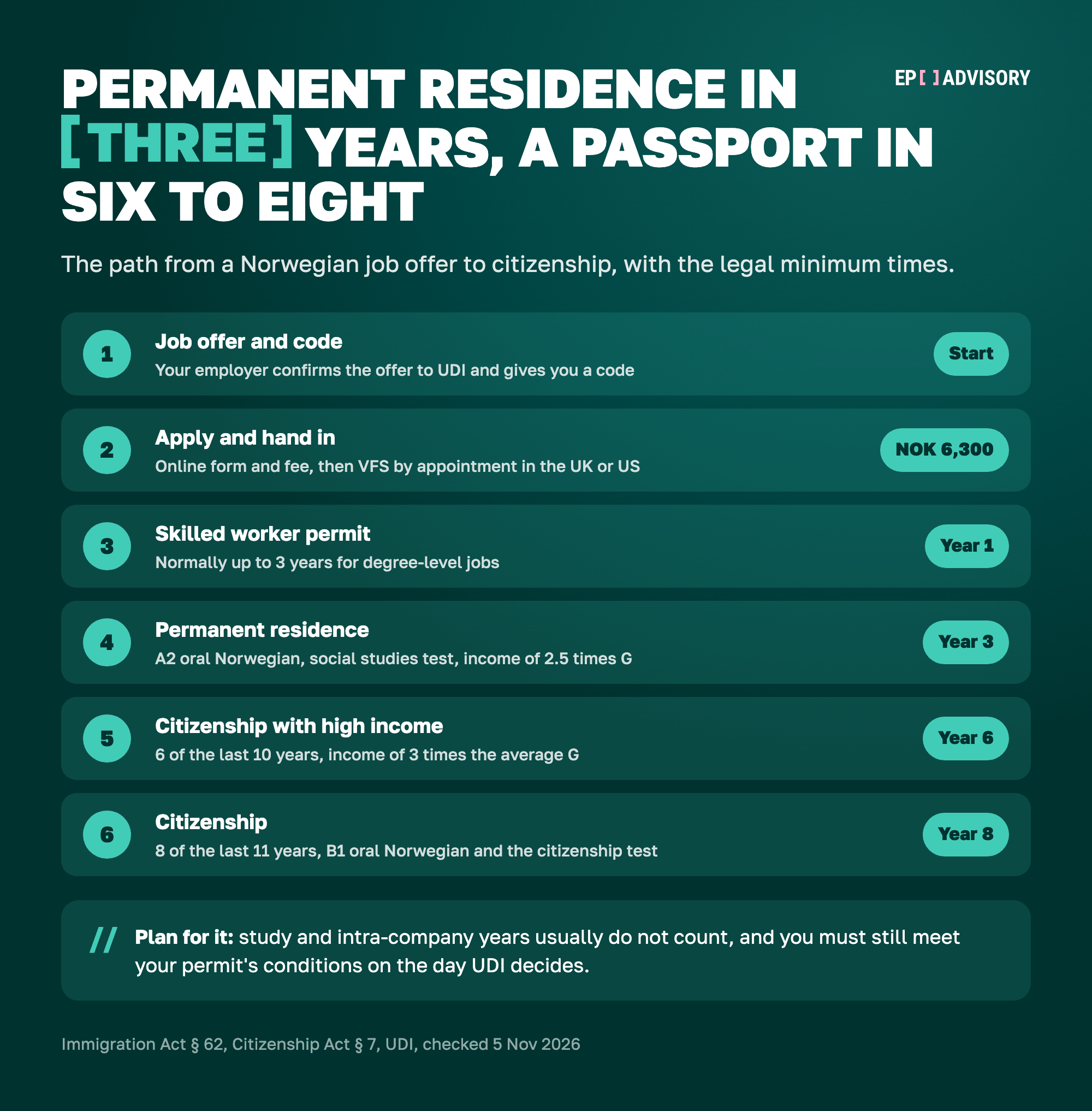
- Your employer confirms the job offer to UDI and gives you a code.
- You apply online with that code and pay the NOK 6,300 fee for adults.
- You hand in your documents. From the UK, that is at the VFS centre in London or Edinburgh, by appointment. From the US, it is at a VFS centre by appointment too.
- UDI decides. You can see current processing times on UDI’s waiting time page.
If you do not need a visa to visit Norway, you may travel there before the decision. You may not start work until the permit is granted, unless you get a confirmation of early employment start from the police. Plan your start date around that rule.
What the permit lets you do
A degree-level permit normally runs up to 3 years, and a vocational one up to 1 year at a time. Family who apply with you get their decision at the same time. If you move to the same type of job at a new employer, you do not need a new permit, but you must tell the police within 7 days. A different type of job needs a new permit. If you lose your job, you may stay up to 6 months to look for another one, and you must tell the police within 7 days.
If a global employer sends you, note that an intra-company assignment permit runs 2 years at a time, up to 6 years, and does not count toward permanent residence. If you want to settle, ask whether you can be hired by the Norwegian company directly.
Next: before you accept a figure, check what your role normally pays in our guide to salaries in Norway.
Score your CV in 30 seconds, then fix its biggest problems one by one. Both free.
Free, no card. A free account unlocks every fix.

Study permit: a way in, but not a clock toward residence
Studying is a real route in, but the years usually do not count toward permanent residence. You need admission to a full-time course. You must show NOK 170,368 a year of your own funds, which is NOK 15,488 a month, plus tuition where the school charges it (UDI study permit). The fee for the application is NOK 5,400.
While you study, you may work up to 20 hours a week, and full-time in the holidays. Family members can usually apply to join you.
The useful part comes at the end. Recent graduates in Norway can apply for a job seeker permit for up to 1 year (UDI job seekers). You need NOK 28,448 a month of your own funds, usually in a Norwegian bank account. You may work full-time or part-time while you look. Apply at least 1 month before your study permit runs out. A skilled job then moves you onto a skilled worker permit, and the 3-year clock starts.
Family immigration: the income bar is on the person in Norway
If your partner lives in Norway, they carry most of the burden of proof. The person in Norway must expect to earn at least NOK 436,957 gross a year, which is 3.2 times G. For cases UDI processes from 1 February 2026, their income last year must also reach 3.2 times the average G (UDI family income).
The first application costs NOK 11,900 for an adult. If you already work legally in Norway yourself, the regulations let your own income count too (Immigration Regulations § 10-8). So if your partner earns less than the bar, your own lawful job in Norway can change the picture. Check last year’s tax settlement first, because UDI looks back as well as forward.
Other routes: self-employed, job seekers, and the UK and US in practice
Self-employed with a sole proprietorship
You can move to run your own business, but normally as a sole proprietorship, and never as a limited company (UDI self-employed). You must have skilled qualifications. The business must be expected to make a profit of at least NOK 341,373 gross a year, which is 2.5 times G. You may only work in that business, so you cannot also take a job as someone’s employee. The permit runs 1 year at a time, and after 3 years you can apply for permanent residence.
Job seeker permit for skilled workers
Norway’s immigration regulations also provide a job seeker permit for skilled workers who do not need a visa to visit, such as US and UK citizens (Immigration Regulations § 6-29a). It gives up to 6 months to look for work. You apply within 3 months of arriving, and the time does not count toward permanent residence. UDI’s job seeker pages, in English and Norwegian, only describe the permit for recent graduates and researchers today, so confirm with UDI that this one is open before you rely on it.
Moving from the UK
Since Brexit, UK citizens are not EEA citizens in Norway. The Brexit residence rules only covered people who lived in Norway before the end of 2020. From 1 January 2022, new UK movers use the standard rules above (UDI Brexit). You can still visit for up to 90 days in any 180 without a visa. To apply, you register and pay online, then hand in documents at the VFS centre in London or Edinburgh by appointment (Norwegian Embassy in London).
Moving from the US
UDI lists no US-only route, so Americans use the same permits as everyone else. You hand in your application at a VFS centre by appointment. If you do not need a visa, you get your passport back right after registration. UDI decides, and the Consulate General in New York sends the result by email (Norway in the US). Our guide to getting a job in Europe as an American covers the job hunt side.
Permanent residence after 3 years, citizenship after 6 to 8
The path to settle in Norway is short and clear, if you plan the language early. Both steps test your Norwegian, so start lessons in your first year.
Permanent residence
You can apply after 3 years with a permit that counts, such as a skilled worker permit (Immigration Act § 62). You need all of these:
- no more than 7 months outside Norway in total over the 3 years. Skilled workers may be away up to 15 months if at least 8 months were trips for their employer (Immigration Regulations § 11-2)
- income of at least 2.5 times G over the last 12 months, which is NOK 341,373 gross with the May 2026 G, if you are 18 to 67 (§ 11-11)
- a passed oral Norwegian test at level A2 or higher, and a passed social studies test, which you can take in a language you understand. These rules apply from 1 September 2025 (UDI)
- you still meet the conditions of your current permit on the day UDI decides, for example you are still in full-time skilled work (UDI)
So avoid a job change or long break around year 3 until the decision arrives. The fee is NOK 4,000 for an adult.
Citizenship
You can apply after 8 years in Norway within the last 11, on permits of at least 1 year (Citizenship Act § 7). You must meet the conditions for permanent residence. If you are 18 to 67, you also need oral Norwegian at level B1 and a passed citizenship test (§ 8). The B1 level applies from 1 October 2022 (UDI).
A good income shortens the wait to 6 years in the last 10. Your income must be at least 3 times the average G. For the 2025 tax settlement, that means NOK 384,348 or more (UDI reduced residence). Any salary at the skilled worker pay bar clears it, so the real limit is often your Norwegian.
Norway has allowed dual citizenship since 1 January 2020 (UDI). Check your home country’s own rules too.
What the move costs in UDI fees
UDI fees are modest next to a Norwegian salary, but they add up for a family. These are UDI’s fees for first applications (UDI fees). The page shows no start date, so check it on the day you pay. VFS adds its own service fee on top when you hand in abroad.
| Application | Adult | Child |
|---|---|---|
| Skilled worker or other work permit (also renewals) | NOK 6,300 | NOK 3,150 (under 18) |
| Study permit | NOK 5,400 | NOK 2,700 (under 18) |
| Family immigration, first application | NOK 11,900 | NOK 5,950 |
| Permanent residence | NOK 4,000 | NOK 2,000 |
| Citizenship | NOK 6,500 | No fee |
| EU or EEA registration | No fee | No fee |
Our worked example: a skilled worker moving with a partner who applies for family immigration pays NOK 6,300 plus NOK 11,900 in UDI fees, so NOK 18,200 before VFS fees. Add NOK 5,950 for each child.
First steps after you land: ID number, tax card, BankID
In Norway, almost everything runs on your identification number, so get it first. Work through these in order.
- Tax deduction card. Everyone who works in Norway needs one from Skatteetaten, the Norwegian Tax Administration (Skatteetaten). Without it, your employer must withhold 50% of your pay (Skatteetaten).
- ID number. When you apply for the tax card, you get a D number or a national identity number. The D number is for temporary stays. The national identity number stays with you for life and needs a right of residence and a stay of 6 months or more (New in Norway).
- Report your move. If you will stay more than 6 months, you must report the move to Skatteetaten (Skatteetaten).
- Bank account. You need to live in Norway, have valid photo ID and have a Norwegian identification number.
- BankID. BankID and MinID are the two most common electronic IDs. You get BankID from your bank once you have an ID number (New in Norway). You use it for your tax return, online banking and signing contracts.
- Doctor. Everyone who lives in Norway has the right to a GP, called a fastlege, in their municipality.
- NAV and Norwegian. As an employee, you can get sick pay and unemployment benefits from NAV. Free Norwegian courses exist online, and your municipality can tell you about local classes. Start in month one.
On tax: you become tax resident if you stay more than 183 days in 12 months, or more than 270 days in 36 months (Skatteetaten). Some foreign workers can use the PAYE scheme, a flat 25% tax with no deductions, on income up to NOK 725,050 in 2026 (Skatteetaten PAYE). Ask Skatteetaten whether it suits you before you choose it, because you give up deductions.
If you are still applying for jobs, adapt your papers to Norwegian employers before you send them. Our guides to the European CV format and the cover letter for a job abroad help with that. Getting ready to apply for jobs in Norway? Check your CV for free: see it the way a recruiter does, then fix each problem. For the last step before the offer, read how to pass a job interview.
Key takeaways
- Norway is in the EEA but not the EU. EU and EEA citizens register with the police. Everyone else needs a permit from UDI.
- For most professionals, the route is the skilled worker permit. It needs a Norwegian job offer that pays at least the normal rate, such as NOK 545,400 gross a year for a bachelor-level job.
- Family, self-employed and permanent residence bars are all multiples of G, which was NOK 136,549 from 1 May 2026.
- Permanent residence takes 3 years, with A2 oral Norwegian and a social studies test. Study and intra-company years usually do not count.
- Citizenship takes 8 years, or 6 with an income of at least 3 times the average G. You need B1 oral Norwegian and the citizenship test.
- After you land, get your tax deduction card and ID number first. A bank account and BankID follow from them.
See what a recruiter sees, then fix it before you apply. An instant score, then the fix for every problem.
Free, no card. A free account unlocks every fix.
Frequently asked questions
Can I move to Norway without a job offer?
Yes, if you are an EU or EEA citizen, you study, you join family or you run your own sole proprietorship. For a skilled worker permit, you need a concrete offer from a Norwegian employer. Recent graduates of Norwegian schools can get up to 1 year to look for work.
How do I move to Norway from the USA?
Americans use the standard permits, most often the skilled worker permit after a job offer. You apply online, hand in documents at a VFS centre by appointment and wait for UDI’s decision, which the Consulate General in New York sends by email.
How do I move to Norway from the UK after Brexit?
Since 1 January 2022, new UK movers use the same rules as other non-EEA citizens. You apply to UDI for a permit, such as a skilled worker permit, and hand in documents at the VFS centre in London or Edinburgh by appointment.
How much do I need to earn to move to Norway?
For a skilled worker permit, pay must be normal for Norway. Where no collective agreement applies, UDI’s guide figures are NOK 545,400 gross a year for a bachelor-level job and NOK 624,700 for a master’s level job. Family sponsors need NOK 436,957 gross a year.
How long until I can get permanent residence or citizenship in Norway?
You can apply for permanent residence after 3 years, with A2 oral Norwegian, a social studies test and an income of at least 2.5 times G. Citizenship takes 8 of the last 11 years, or 6 of the last 10 with high income, plus B1 oral Norwegian and the citizenship test.