 By Andre Atallah, CEO of EP Advisory

Short answer: yes, foreigners can get jobs in Portugal, but non-EU citizens now need a job offer before they travel. The switch from visitor to worker closed in June 2024. The new job-seeker visa is in the law but not yet open at consulates. With an offer, the main routes are the standard work visa, the EU Blue Card, the highly qualified permit and the Tech Visa. EU citizens apply like locals.
Portugal’s job market is strong. Unemployment was 5.5% in the third quarter of 2026, up from 5.3% in the second (INE, 4 November 2026). Average gross monthly earnings reached €1,835 in the second quarter (INE, Q2 2026), up 5.1% on a year. Lisbon and Porto also have a large English-speaking market in tech, shared service centres and contact centres.
For non-EU candidates, the key is order. You need a contract or a written promise of a contract before a consulate will issue a work visa. This guide covers each route, the 2026 pay floors, where to search and how offers work. Immigration rules change often, so check the current rules with the official authority before you act.
For nearly 10 years, we’ve helped more than 5,000 professionals find jobs abroad. Want to know if your CV will pass screening in Portugal? Check your CV for free: a score in 30 seconds, then a fix for each problem.
Can foreigners work in Portugal? The main routes
EU, EEA and Swiss citizens can live and work in Portugal without a work permit. You apply like a local candidate. If you stay longer than 3 months, you register your residence with the local council. Everything below applies to non-EU citizens.
Immigration is run by AIMA (Agência para a Integração, Migrações e Asilo). It replaced the old border and immigration service, SEF, in October 2023. The usual order has three parts. You get the offer. You apply for a national visa at the Portuguese consulate in your country. Then you enter Portugal and AIMA issues your residence permit.
You can no longer arrive as a visitor and switch to a work permit. That option, called manifestação de interesse, was revoked by Decree-Law 37-A/2024 on 3 June 2024. Many older guides still describe it.
| Route | Who it fits | 2026 pay floor, gross per month | What you need |
|---|---|---|---|
| EU, EEA or Swiss citizen | Any job | Same as locals | No permit |
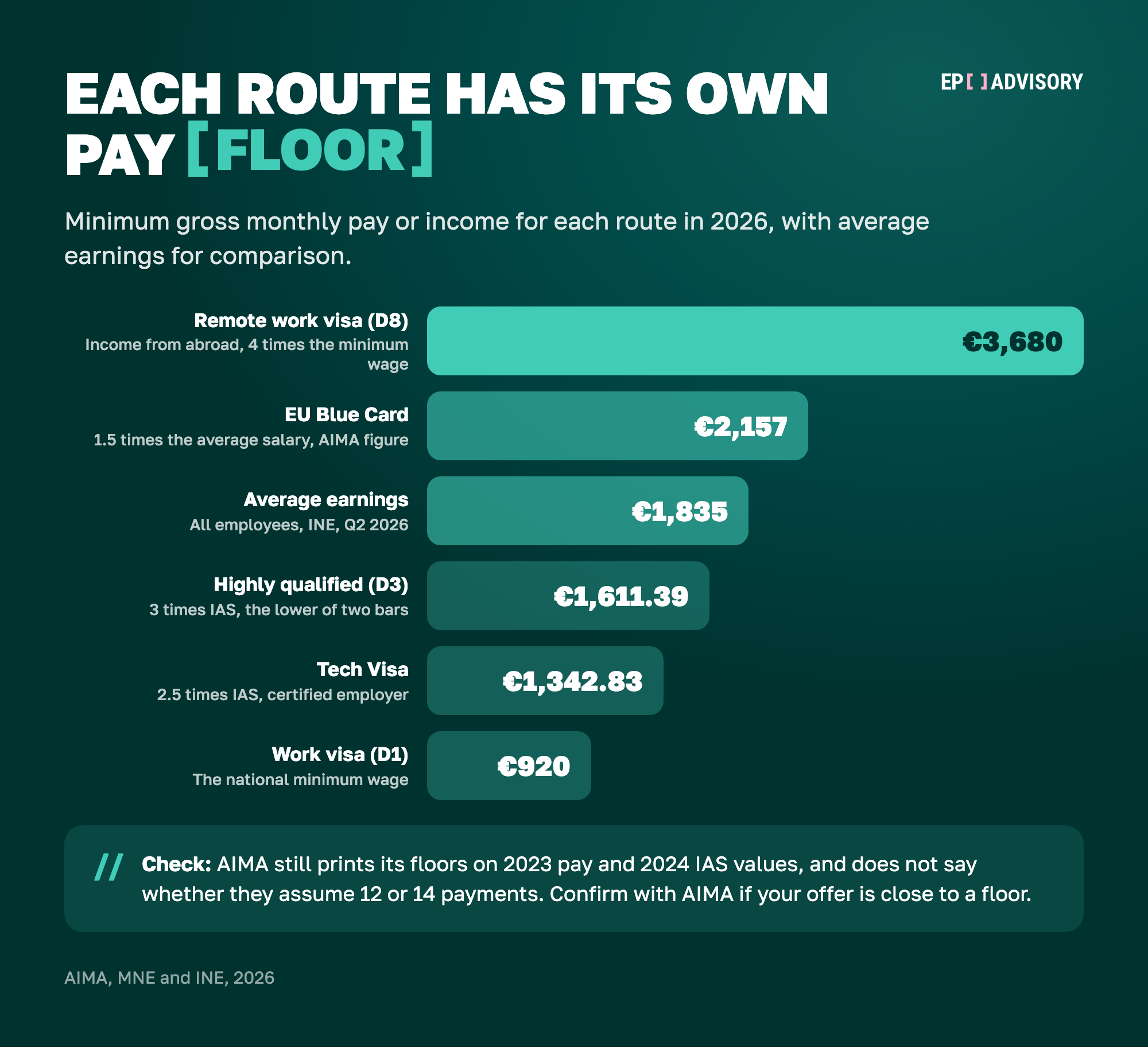
| Work visa (D1) | Any job with a Portuguese employer | €920, the minimum wage | A contract, a promise of contract or the employer’s formal statement of interest |
| Highly qualified permit (D3) | Degree-level roles | €1,611.39 (3 times IAS) or €2,157 | A contract of at least 6 months |
| EU Blue Card | Degree-level roles | €2,157 (€1,725.60 for shortage roles) | A contract of at least 6 months |
| Tech Visa | Qualified staff at an IAPMEI-certified company | €1,342.83 | A contract of at least 12 months |
| Remote work visa (D8) | Work for employers or clients outside Portugal | €3,680 of income | Proof of 3 months of income |
| Job-seeker visa | Specialised skills, no offer yet | Not open yet | Waiting for its regulation |
IAS is the indexante dos apoios sociais, an index the state uses to set many legal amounts. It is €537.13 in 2026. If you are weighing Portugal against its neighbour, our guide to jobs in Spain for foreigners covers the Spanish routes.
The job-seeker visa: in the law, not yet open
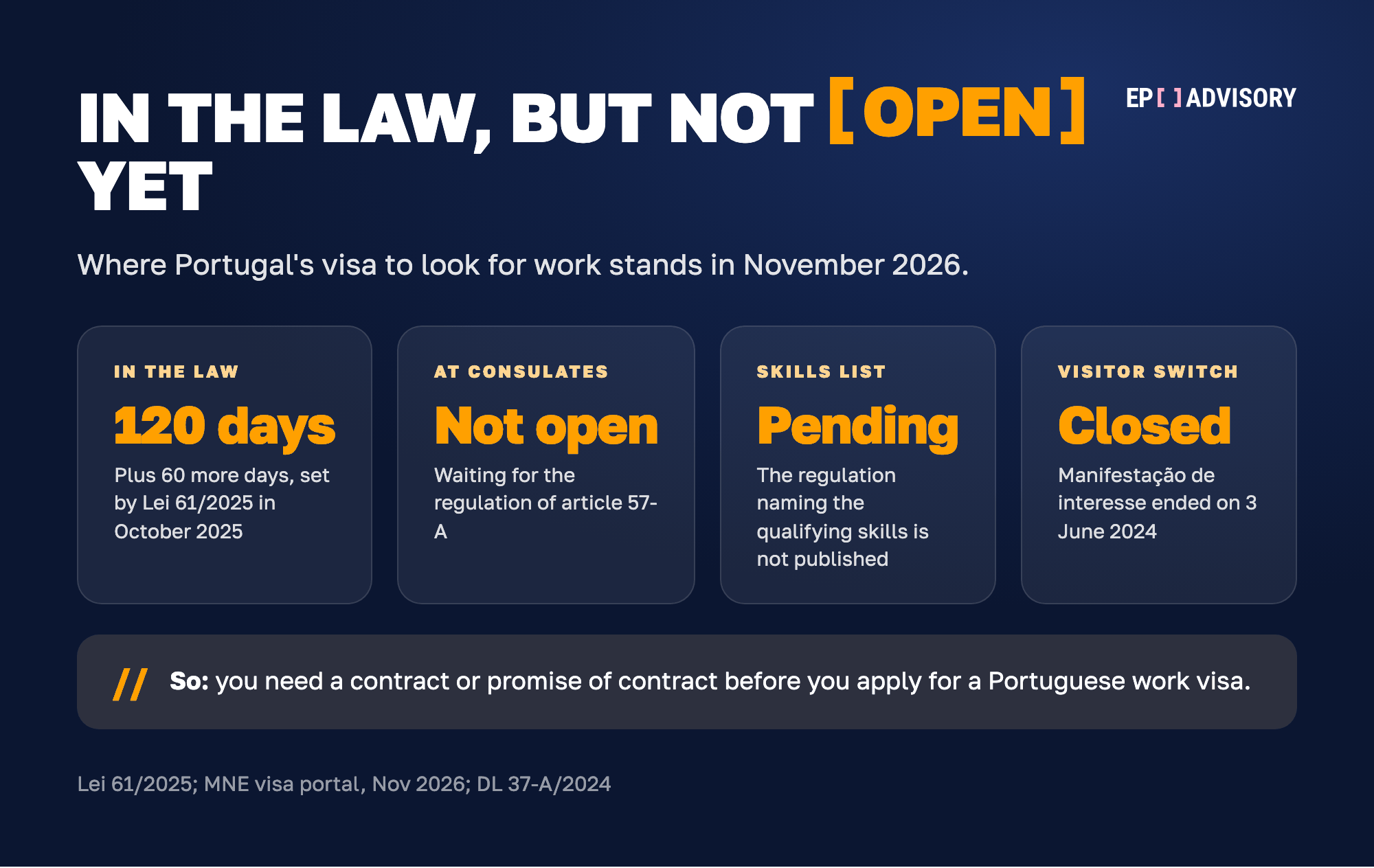
Portugal has no working job-seeker visa today. The October 2025 amendment to the immigration law (Lei 61/2025) replaced the old job-seeker visa with a visa for people with specialised technical skills. It allows 120 days in Portugal, plus 60 more, to look for highly qualified work. If you do not find a job, you must leave and wait a year before you apply again.
The skills that qualify must be set by a separate regulation, and it has not been published. Until it is, the Foreign Ministry’s visa portal says this visa is not yet available at Portuguese consulates. Some popular guides still say you can apply. You cannot.
So run your search from home and aim for a signed contract or promise before you travel. In our experience, a CV that states your start date and the permit you need is easier for employers to act on. For how job-seeker visas work in other countries, see our guide to job-seeker visas in Europe.
EU Blue Card, highly qualified permit and Tech Visa
Degree-level professionals have three routes, each with its own pay floor. All three need a job offer first. These are the 2026 rules:
- EU Blue Card. You need a highly qualified job and a contract of at least 6 months. The pay must be at least 1.5 times the national average gross salary. AIMA gives no amount on its Blue Card page. Its highly qualified permit page puts the same 1.5 times bar at €2,157 gross a month, based on 2023 pay data. For shortage roles the bar is 1.2 times, or €1,725.60. If you have held a Blue Card in another EU country for 18 months, you can move to Portugal with it.
- Highly qualified permit (D3). You need a contract of at least 6 months. The pay must reach one of two bars: 1.5 times the average salary (€2,157), or 3 times IAS. In 2026, 3 times IAS is €1,611.39 a month. For shortage roles in managerial and professional jobs, the bars drop to €1,725.60 or 2 times IAS (€1,074.26). AIMA’s page still prints 2023 and 2024 values, so confirm the figure it applies. The permit runs for 2 years, then renews for 3.
- Tech Visa. This is for jobs at companies certified by IAPMEI, the agency for business and innovation. The pay must be at least 2.5 times IAS, which is €1,342.83 a month in 2026. You need a contract of at least 12 months. You need a bachelor’s degree, or a shorter higher-education qualification plus 5 years of experience. The working language can be Portuguese, English, French or Spanish (AIMA).
The Tech Visa list of February 2025 holds about 570 companies. They include Accenture, Bosch, Critical Software, Farfetch, Feedzai, OutSystems, Revolut, Siemens and Talkdesk. Ask early whether your employer is on it.
Family rules favour these routes. Since October 2025, most permit holders wait 2 years before family can join them. Blue Card and highly qualified permit holders are exempt from that wait.
AIMA does not say whether its monthly figures assume 12 or 14 salary payments. So ask the employer to state the monthly gross pay in the contract. If your offer sits close to a floor, confirm with AIMA before you apply. To compare these bars with other countries, see our guide to work visa salary thresholds in Europe.
Score your CV in 30 seconds, then fix its biggest problems one by one. Both free.
Free, no card. A free account unlocks every fix.

Which jobs are in demand in Portugal
Health, skilled trades and IT are the main shortage areas. The EURES labour market report for Portugal lists shortages among health professionals, metal and machinery trades and ICT professionals. Named shortage jobs include nurses, doctors, bus drivers, toolmakers and civil engineers.
For the Lisbon region, EURES adds software analysts and programmers, construction trades, health workers, and staff with foreign languages for contact centres and shared service centres. Most international employers sit around Lisbon and Porto.
Regulated professions need recognition before you can practise. Doctors, nurses, engineers and similar roles must have their qualification recognised in Portugal first. Start that process as soon as you decide on Portugal. For other jobs, you may still need to prove your degree level for a Tech Visa or a highly qualified permit. DGES, the Directorate-General for Higher Education, handles degree recognition.
Do you need Portuguese? English-speaking jobs in Lisbon and Porto
The work visa does not test your Portuguese, but many employers do. There is no official count of English-only jobs. In our experience, they are most common in these areas:
- Tech companies and start-ups in Lisbon and Porto, including many Tech Visa firms.
- Shared service centres of international groups, in finance, HR, IT support and procurement.
- Contact centres that serve customers across Europe. A second European language besides English is often the key skill.
- Research, universities and international schools.
Health, construction, retail, the public sector and most small firms expect Portuguese. Start learning early. AIMA lists Portuguese courses from level A1 to B2, given by public schools and training centres. They are open to visa and permit holders and anyone with a social security number. Show your level on your CV with the European scale (A1 to C2).
Where to find jobs in Portugal
Use one or two job boards, then go direct to employers. These are the main places to look:
| Where | Best for | Language of most ads |
|---|---|---|
| Net-Empregos | The broad private-sector market | Portuguese |
| Sapo Emprego | General jobs across sectors | Portuguese |
| International companies and English-speaking roles | English and Portuguese | |
| Indeed Portugal | High volume across all sectors | Portuguese |
| Landing.jobs and ITJobs | Tech and IT jobs | English and Portuguese |
| IEFP international recruitment | Employers who want to hire non-EU citizens living outside Portugal | Portuguese |
| BEP | Public-sector jobs | Portuguese |
IEFP is Portugal’s public employment service. Every offer on its board for non-EU citizens comes from an employer that expects to hire from abroad. EU citizens can also search across Europe on EURES. On a first call, ask whether the company has hired non-EU staff before. For a wider search plan, see our guide on how to find a job in Europe.
Never pay for a job, a contract or a visa appointment. A real employer does not charge you for an offer. Temporary work agencies (empresas de trabalho temporário) need a licence. IEFP keeps the national register, so check any agency there before you sign. Book visa appointments only through the consulate or its official visa centre.
Portuguese CVs, interviews and offers
Portuguese recruiters expect a short, clear CV. The first four norms come from EURES. The last one is our own advice:
- Length and order. One or two pages, with your latest job first.
- Language. An English CV is fine if you do not speak Portuguese. For Portuguese-language roles, write it in Portuguese.
- Photo. A photo is often appreciated.
- Cover letter. One A4 page at most. The text of your email often replaces it. Our guide to a cover letter for a job abroad shows how to keep it short.
- Your status. State your nationality, where you live, which permit you would need and when you could start.
Our guide to the European CV format covers layout. If your CV was written for another market, rework it for Portugal before you apply. Getting ready to apply for jobs in Portugal? Check your CV for free: see it the way a recruiter does, then fix each problem.
Hiring usually takes one to two months. Large firms and agencies often use psychometric tests. Expect questions on your Portuguese, your notice period and your relocation date. Our guide on how to pass a job interview covers preparation.
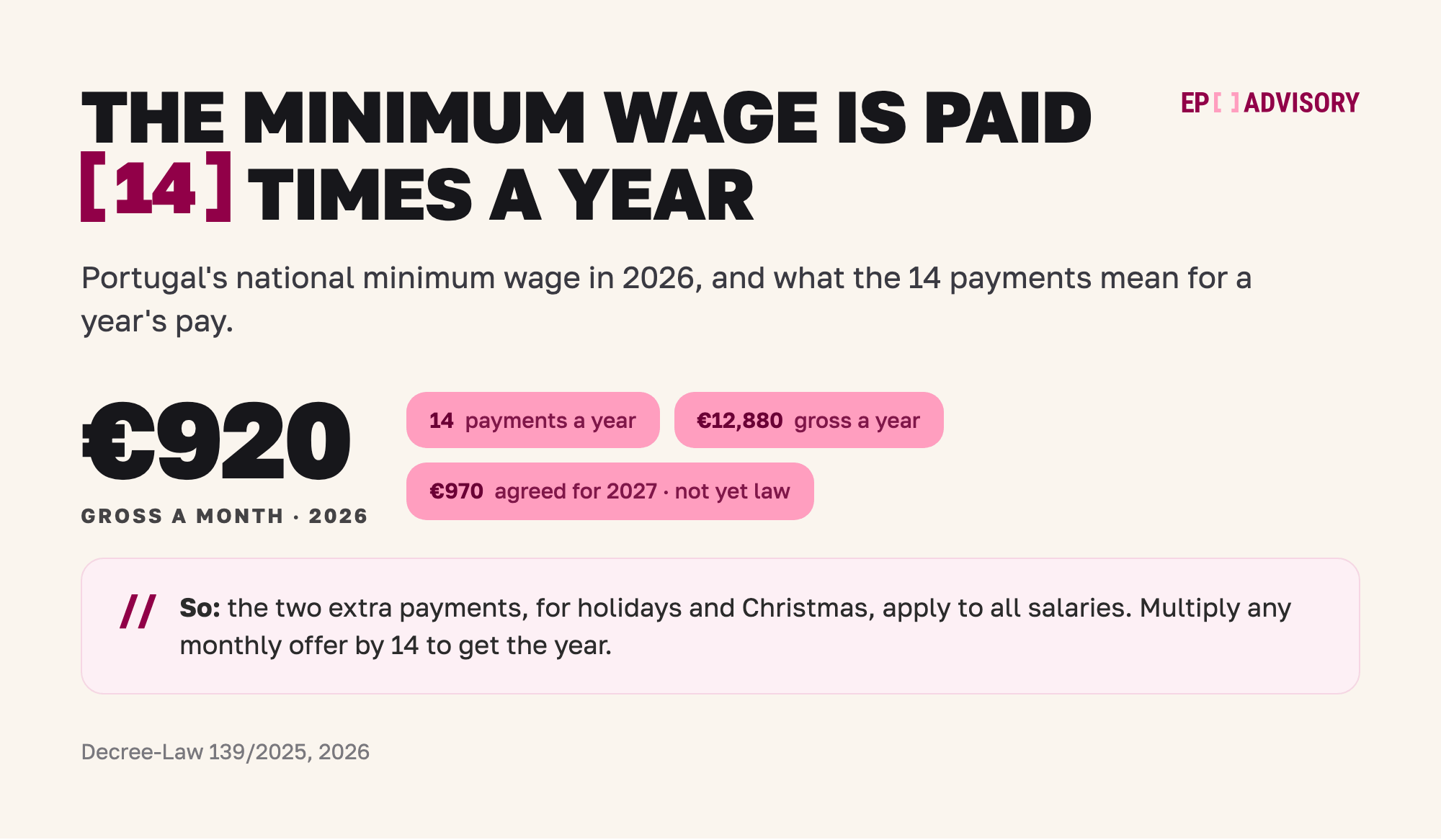
Salaries are often quoted per month and paid 14 times a year. The two extra payments are the holiday allowance and the Christmas allowance. So an offer of €2,000 gross a month is €28,000 gross a year. Multiply by 14, not 12, when you compare offers from other countries. Probation is usually 90 days, 180 days for complex roles and 240 days for directors. To resign, you give 30 days’ notice in your first 2 years, then 60 days. Our guide on how to negotiate salary helps with the offer.
From offer to first day: visa, NIF and NISS
Most steps from offer to permit have a set time limit. This is the usual order for a non-EU hire in 2026:
- Offer. Get a signed contract or promise of contract that states the job, the pay and the length.
- NIF. The número de identificação fiscal is your tax number. You need it for a contract, a bank account and a lease. It is issued by the tax authority. Ask your employer how they want you to get it, because many people get one before they arrive.
- Visa. Apply for the national visa at the Portuguese consulate in your country. The legal deadline for a decision on a residence visa is 60 days.
- Travel. A residence visa is valid for 4 months and allows 2 entries (MNE).
- AIMA. You apply for your residence permit within those 4 months. Some visas are now issued without an AIMA appointment. You then book one through AIMA’s online form.
- NISS. The número de identificação da segurança social is your social security number. You need it to be paid on the books and to use public services. Your employer can request it for you, or you can apply to Segurança Social yourself.
- Permit card. A first temporary residence permit usually runs for 2 years.
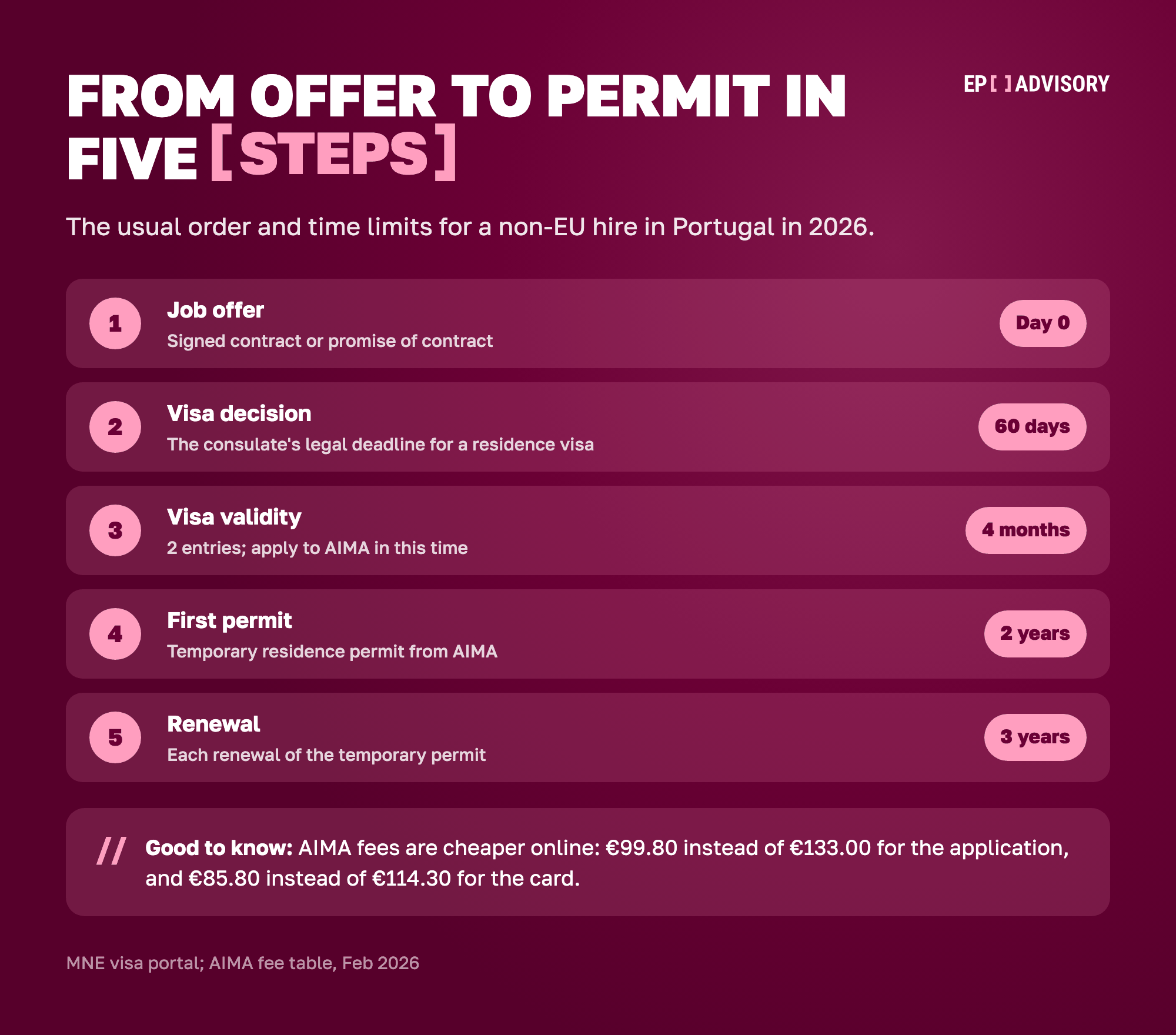
AIMA fees are cheaper online. On AIMA’s fee table of February 2026, the temporary residence application costs €133.00 in person or €99.80 through the digital channel. The card costs €114.30 or €85.80. Blue Card fees are higher. Large employers can also use AIMA’s employer protocol, a faster channel for firms that recruit abroad. Ask whether yours has signed it.
Working remotely for a foreign employer: the D8 visa
The D8 is for people who keep a job or clients outside Portugal. It is not a way into a Portuguese job. You need average income of at least 4 times the minimum wage over the last 3 months. That is €3,680 gross a month in 2026 (MNE), or about $4,146 at the ECB rate on 4 November 2026. A temporary-stay version covers stays under a year. Our guide to remote jobs in Europe covers how to find this kind of work.
What jobs in Portugal pay
The minimum wage is €920 gross a month in 2026 (Decree-Law 139/2025). It is paid 14 times, so it comes to €12,880 gross a year. A social partners’ agreement sets €970 for 2027, but it is not yet law.
Average gross monthly earnings were €1,835 in the second quarter of 2026 (INE). That is about $2,067 or £1,531 at the ECB rates on 4 November 2026. IT and telecoms averaged €3,061 a month and finance €2,970.
Two tax schemes can lower your income tax. IRS Jovem gives people up to age 35 a partial income tax exemption for up to 10 years. IFICI, often called NHR 2.0, applies a flat 20% rate for 10 years to some qualified jobs, if you were not tax resident in Portugal in the previous 5 years. You cannot combine the two. Talk to a tax adviser before you sign, as these schemes can change what an offer is worth.
Next: check what your role pays by sector and city in our guide to salaries in Portugal.
Key takeaways
- Non-EU citizens need a contract or promise of contract before they apply for a Portuguese work visa.
- The switch from visitor to worker ended in June 2024, and the new job-seeker visa is not yet open.
- The 2026 monthly floors run from €920 for the standard work visa to €2,157 for the EU Blue Card.
- Tech Visa jobs need a certified employer and pay of at least €1,342.83 a month.
- Salaries are paid 14 times a year, so multiply the monthly figure by 14.
- Check any temporary work agency on the IEFP register, and never pay for a job.
See what a recruiter sees, then fix it before you apply. An instant score, then the fix for every problem.
Free, no card. A free account unlocks every fix.
Frequently asked questions
Can foreigners get a job in Portugal in 2026?
Yes. EU citizens apply like locals. Non-EU citizens need a contract or promise of contract first, then a national visa from a Portuguese consulate. The main routes are the standard work visa, the EU Blue Card, the highly qualified permit and the Tech Visa.
Can I go to Portugal to look for work?
Not on a job-seeker visa yet. The law allows a 120-day visa for people with specialised skills, but consulates do not issue it until its regulation is published. You also can no longer enter as a visitor and switch to a work permit, as that option ended in June 2024.
What salary do I need for a work visa in Portugal?
The standard work visa needs at least the minimum wage, €920 gross a month in 2026. The Tech Visa needs €1,342.83. The highly qualified permit needs €1,611.39 or €2,157. The EU Blue Card needs €2,157, or €1,725.60 for shortage roles.
Can I work in Portugal without speaking Portuguese?
Yes, in some sectors. The work visa does not test Portuguese. English-only roles are most common in tech in Lisbon and Porto, shared service centres, contact centres and research. Most other jobs expect Portuguese.
Which jobs are in demand in Portugal?
Health, skilled trades and IT. EURES lists shortages of nurses, doctors, bus drivers, toolmakers, civil engineers and ICT professionals. The Lisbon region also needs programmers and staff with foreign languages for contact centres and shared service centres.
What are NIF and NISS in Portugal?
The NIF is your tax number, needed for a contract, a bank account and a lease. The NISS is your social security number, needed to be paid on the books. Your employer can request the NISS for you.