 By Andre Atallah, CEO of EP Advisory

Short answer: yes, if you hold a UK immigration status that lets you work, such as a Graduate, High Potential Individual or partner visa. A visitor, including an American on an ETA, may do some remote work for a US employer. That is allowed only when work is not the main purpose of the trip, and a visitor cannot make the UK their home. There is no UK digital nomad visa. Your employer may also need a UK payroll set-up.
You can work remotely in the UK for a US company while you live in London, Manchester or Edinburgh, if you hold the right UK status. It works when your UK status, your employer’s set-up and your tax position all line up.
This guide takes each one in turn, with the 2026 rules, what you keep on UK payroll and a clear test for when a UK employer is the better route.
For nearly 10 years, we’ve helped more than 5,000 professionals find jobs abroad. Want to know if your CV will pass screening in the UK? Check your CV for free: a score in 30 seconds, then a fix for each problem.
Can you work remotely in the UK for a US company? It depends on your status
Your immigration status decides the answer, not your employer’s location.
A US company paying you in dollars does not change what your UK status allows. A visitor can do some remote work but cannot live here. A visa that allows work in most jobs usually lets you keep a US job. A sponsored visa ties your main job to the UK sponsor.
The rules change often. Before you move, check the current rules on GOV.UK or with a regulated adviser.
Working remotely on a UK visit: allowed, within limits
A visitor can answer emails and join calls for a US employer. A visitor cannot base their working life here.
Americans do not need a visit visa for trips of up to 6 months. Instead, you need an Electronic Travel Authorisation (ETA). It costs £20 and lasts 2 years, or until your passport expires if that is sooner. It covers many trips. The GOV.UK ETA page is clear that an ETA does not let you do paid or unpaid work for a UK company, or work here as a self-employed person.
The visitor rules allow visitors to “undertake activities relating to their employment overseas remotely from within the UK, providing this is not the primary purpose of their visit”. You can read that line in the visitor permitted activities rules.
Two limits come with it:
- The trip must be about something else. A holiday, a family visit or a business meeting, with some work on the side, fits the rule. A trip whose main point is to work from a London flat does not.
- You cannot live here on visits. A genuine visitor “will not live in the UK for extended periods through frequent or successive visits, or make the UK their main home”. That test is in Appendix V of the visitor rules. Back-to-back 6-month stays can fail it.
Work for UK clients is not allowed. The GOV.UK visitor guide says visitors may do business activities only if they are not paid by a UK-based organisation or client. The narrow exception is a permitted paid engagement, such as an invited expert lecture.
There is no UK digital nomad visa. Nothing in the GOV.UK list of UK work visas lets you live here just to work remotely for a foreign employer. If you want to stay longer than a visit, you need one of the statuses below.
Which UK statuses let you keep your US job
Several common statuses let you work for any employer, including a US one.
| UK status | Can you work for a US employer? | Main limit |
| Visitor on an ETA | Only as a side activity | Work cannot be the main purpose. You cannot live here |
| Graduate visa | Yes, it allows work in most jobs | For people who finished a UK degree. 2 years if you apply by 31 December 2026, then 18 months. 3 years for a PhD |
| High Potential Individual visa | Yes, it allows work in most jobs | For graduates of the last 5 years from listed top universities. 2 years, or 3 for a PhD. It cannot be extended |
| Global Talent visa | Yes, as an employee, self-employed or a director | You need an endorsement first, unless you won an eligible prize |
| Partner of a Skilled Worker | Yes | Tied to your partner’s visa |
| Family visa as a spouse or partner | Yes | A fiancé visa does not allow work |
| Skilled Worker visa | Only on top of the sponsored job | Extra work of up to 20 hours a week, if it meets the rules |
| Youth Mobility Scheme | Not available | Americans are not eligible |
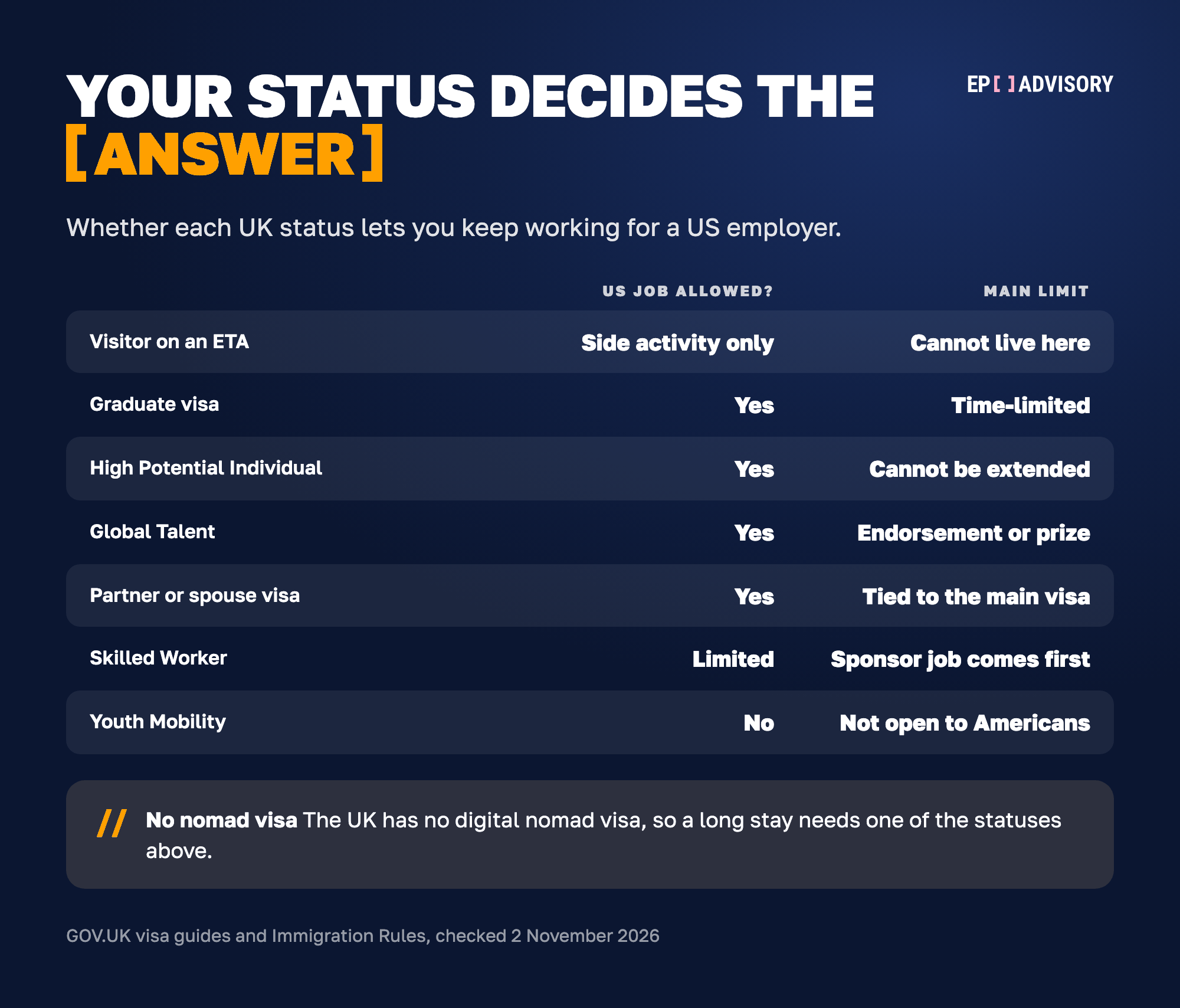
A Skilled Worker visa is the one that trips people up. It exists so you can “work for a UK employer that’s been approved by the Home Office”, the UK government department for immigration. Your sponsored UK job must stay your main job. Extra work is capped at 20 hours a week. The extra job must be in a higher-skilled occupation, on the Immigration Salary List, or in the same sector and at the same level as your main job. A full-time US job alongside it does not fit.
If you finished a UK degree, our guide on how to stay in the UK after studying walks through the options.
Score your CV in 30 seconds, then fix its biggest problems one by one. Both free.
Free, no card. A free account unlocks every fix.

What your US employer has to set up
Your status lets you work. Your employer still has to pay you the right way in the UK.
The UK runs income tax and National Insurance through PAYE (Pay As You Earn). It is the UK version of US payroll withholding. National Insurance is the UK payroll tax for state pension and benefits, like Social Security. The question for a US employer is whether it must run PAYE for you.
HM Revenue and Customs (HMRC), the UK tax authority, sets the line in its PAYE manual. An employer must run PAYE if it has a “tax presence” in the UK, such as a branch, agency or representative office. HMRC says it “would not regard an overseas employer as having a tax presence in the UK simply because there are employees in the UK”.
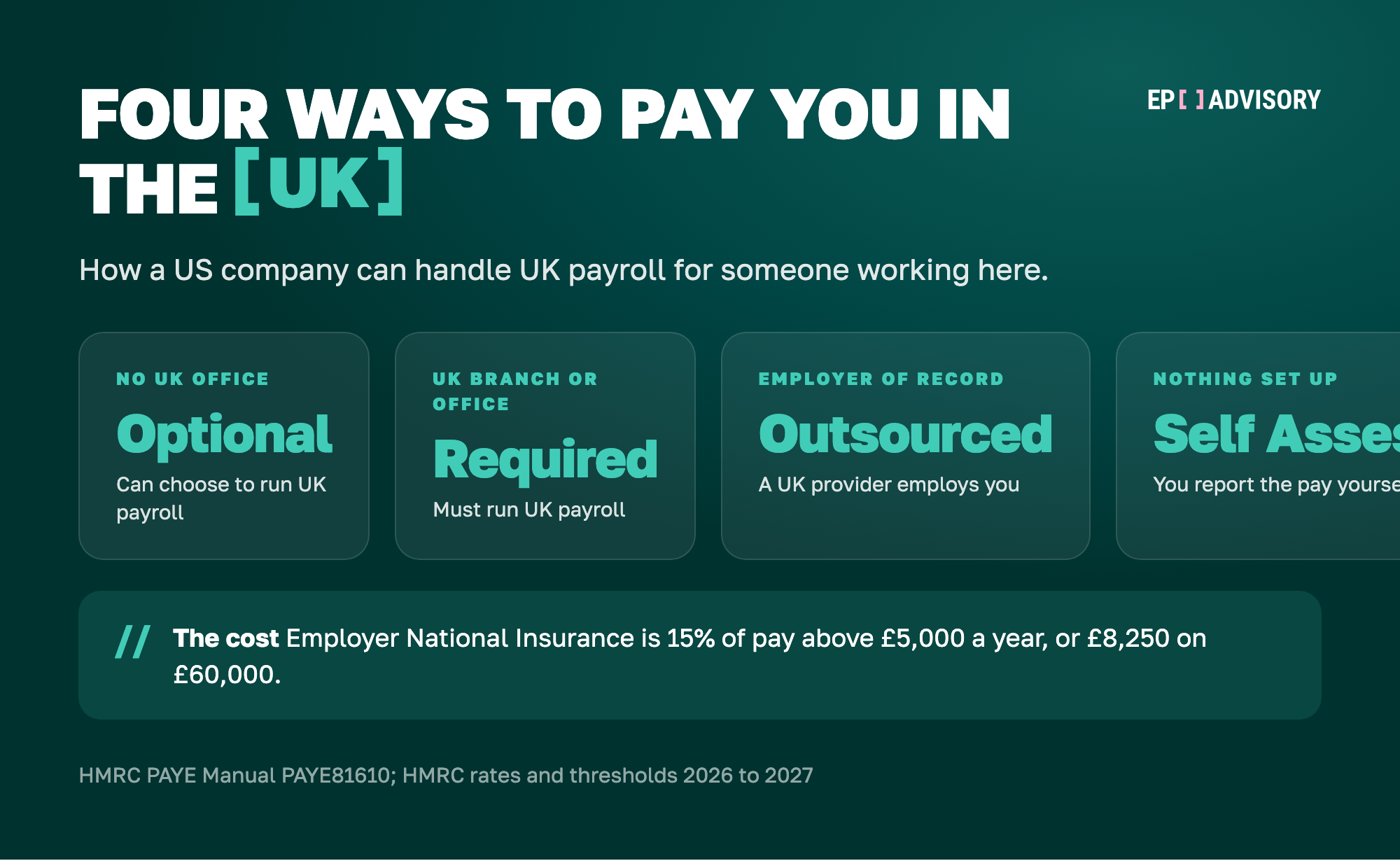
That leaves four common set-ups:
- Voluntary UK payroll. A US company with no UK office can choose to run PAYE for you. HMRC can confirm how such a company registers.
- A UK branch or office. PAYE is then required. If you work for a UK group company, that company normally has to run PAYE on your pay, even when the US company pays you.
- An employer of record. A UK provider becomes your legal employer and runs payroll for a fee. Your US company still directs your work.
- Nothing set up. No UK tax comes off your pay. You would then usually report it yourself through Self Assessment, the UK annual tax return. How National Insurance is paid in this case needs a specific answer, so check with HMRC or a cross-border tax adviser.
Three more points for your employer’s HR and legal team. UK employment rights can apply, such as at least 28 days’ paid holiday a year for a 5-day week, including bank holidays. Workplace pension rules can apply too, for workers aged 22 to State Pension age who earn at least £10,000 a year and usually work in the UK. And a senior person working here long term can, in some cases, make the company liable to UK corporation tax. Ask the company’s own advisers early.
In 2026 to 2027, employer National Insurance is 15% of pay above £5,000 a year, per HMRC’s rates and thresholds for employers. On a £60,000 salary, that is £8,250 a year, about $11,100 at ECB rates of 2 November 2026. The £10,500 Employment Allowance can cut this for some employers.
UK tax: three automatic tests can make you resident
Once you are UK resident, the UK normally taxes all your income, wherever your employer is.
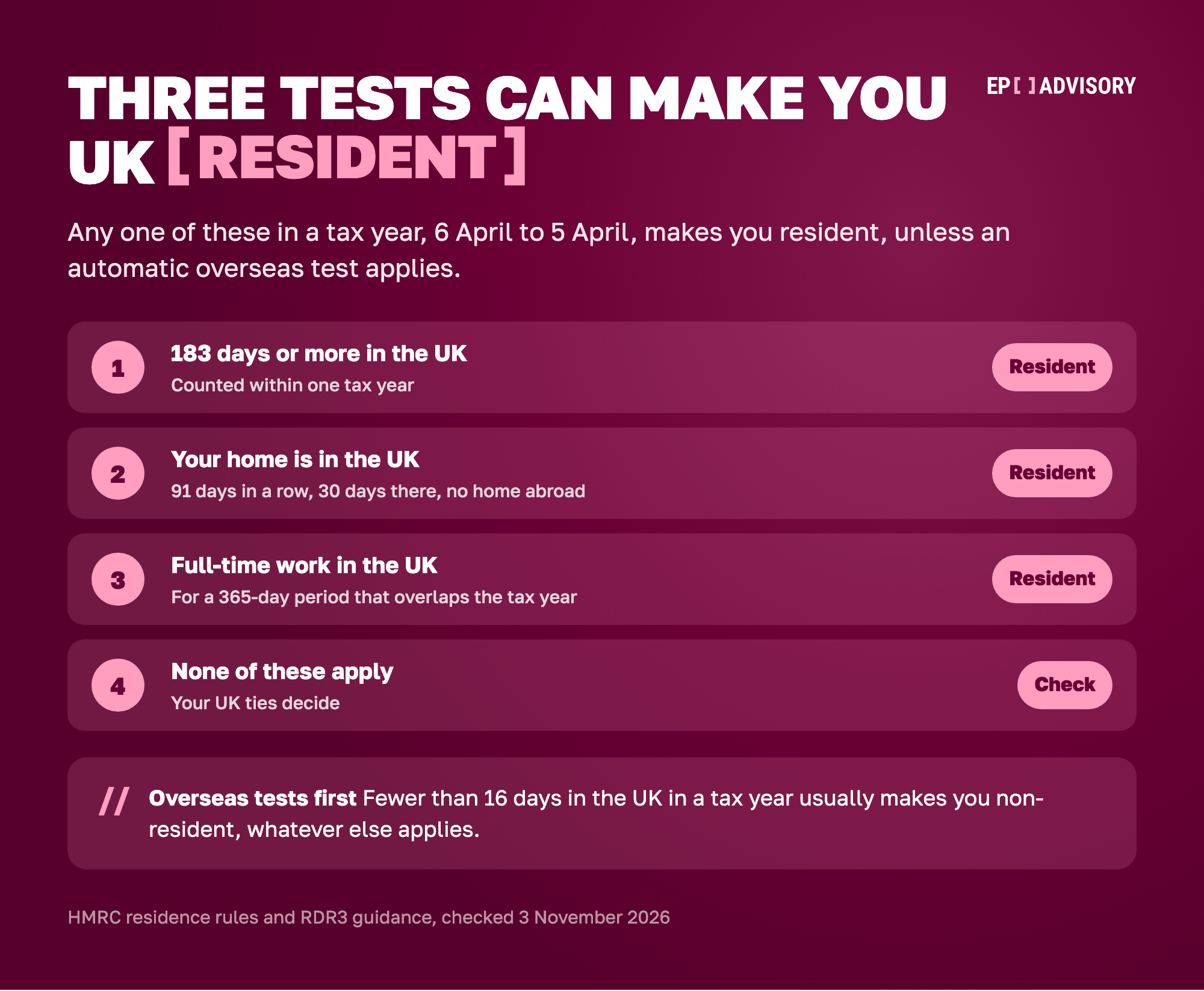
The UK tax year runs from 6 April to 5 April. HMRC’s residence rules say you are UK resident in a tax year if you meet any one of these automatic UK tests, and none of the automatic overseas tests:
- Days. You spend 183 days or more in the UK.
- Home. You have a UK home for 91 days or more in a row, at least 30 of them in the tax year, and you spend at least 30 days in it. You must also have no overseas home, or spend fewer than 30 days in it that year.
- Work. You work full-time in the UK for any period of 365 days, and at least one day of it falls in the tax year.
The automatic overseas tests come first. For example, fewer than 16 days in the UK in a tax year usually makes you non-resident. If no automatic test settles it, the sufficient ties test looks at your UK ties, such as family, a home or work here, together with the days you spend here. HMRC’s Statutory Residence Test guidance (RDR3) sets out every test, and GOV.UK has an online residence checker.
In the year you move, split-year treatment can split the tax year in two, so foreign income is taxed only for the time you live here. It has extra conditions.
Even as a non-resident, pay for days you work in the UK can count as UK income. The UK and US tax treaty has rules for short stays, and they depend on your facts. So check with HMRC or a cross-border tax adviser before a long work trip.
What your pay looks like on UK payroll
On £60,000 in England, you keep about three quarters after UK income tax and National Insurance.
That is about £45,357 a year, or £3,780 a month, at 2026 to 2027 rates. For the full breakdown and how it compares with a US salary, see our guide to UK vs US salary.
US tax: you still file every year
The US taxes its citizens on worldwide income, so a UK move does not end your US return.
The IRS says US citizens abroad are taxed on worldwide income. Two tools usually stop you paying twice on the same salary:
- The foreign earned income exclusion. For 2026 it lets you exclude up to $132,900 of foreign earned income, per IRS Revenue Procedure 2025-32. Your tax home must be abroad, and you must pass the bona fide residence test or the physical presence test.
- The foreign tax credit. UK income tax you pay can reduce your US tax on the same income. You cannot take the credit on income you have already excluded.
UK bank accounts bring a reporting duty too. If your foreign accounts total more than $10,000 at any point in the calendar year, you must file an FBAR, a report of foreign bank accounts. The UK and US tax treaty does not lower US tax for US citizens, apart from certain exceptions.
This is general information only. Talk to a cross-border tax adviser before your first UK tax year.
Social Security or National Insurance: usually one, not both
A UK and US agreement stops most people paying into both systems on the same work.
The UK and US social security agreement has been in force since 1985. Its starting rule is that you pay into the system of the country where you work. So someone living and working in the UK would normally pay UK National Insurance.
There is an exception for postings. If your US employer sends you to work in the UK, and the posting is not expected to last more than 5 years, you stay in US Social Security only. A certificate of coverage shows which system covers you.
If you moved on your own and kept your job remotely, the starting rule may apply instead. Ask your employer’s payroll team to check, or speak to a cross-border tax adviser, before your first UK payday.
When a UK employer is the better route
Keeping your US job works best for a fixed period. A UK employer is often the stronger long-term plan.
Consider a UK job instead if any of these apply:
- Your status needs a sponsor. If you have no visa that lets you work freely, a UK employer that holds a sponsor licence is the usual route. Our list of UK companies that sponsor visas is a good place to start.
- Your visa has an end date. The High Potential Individual visa cannot be extended. Graduate visas are time-limited too. Plan the next step a year ahead.
- Your employer will not set up UK payroll. Without it, you carry the tax admin and the risk.
- You want to settle. Under today’s rules, a Skilled Worker visa can lead to settlement after 5 years. On 2 November 2026 the government announced an earned settlement model: 5 years for people earning more than £50,271, and 10 years as the default. It has no start date yet. Most sponsored jobs must pay at least £41,700 a year, or the going rate for the job if higher. Our guide to the Skilled Worker salary threshold has the detail.
If you would rather stay remote but move employer, our guide to remote jobs in Europe covers where to look. For roles open to international candidates, see jobs in the UK for foreigners.
Next: if a UK employer looks like the better route, our guide on how to get a job in the UK as an American sets out the step-by-step plan, from sponsor list to visa. If your US employer has a UK office, read about an intra-company transfer to the UK.
A UK job hunt starts with your CV. UK employers expect a different format from a US resume. Getting ready to apply for jobs in the UK? Check your CV for free: see it the way a recruiter does, then fix each problem.
Key takeaways
- A visitor on an ETA may do some remote work for a US employer, but only when it is not the main purpose of the trip.
- There is no UK digital nomad visa, and Youth Mobility is not open to Americans.
- Graduate, High Potential Individual, Global Talent and partner visas let you work for any employer, including a US one.
- A US employer with no UK office usually does not have to run UK payroll, but it can choose to, or use an employer of record.
- Spending 183 days or more in the UK in a tax year makes you UK tax resident, and the US still taxes you as a citizen.
- If your status needs a sponsor or is ending, a UK employer is often the stronger route.
See what a recruiter sees, then fix it before you apply. An instant score, then the fix for every problem.
Free, no card. A free account unlocks every fix.
Frequently asked questions
Can I work remotely in the UK on a tourist visa?
Americans visit the UK on an ETA, not a tourist visa. As a visitor, you may do some remote work for your US employer, such as emails and calls. Work must not be the main purpose of the trip, and you cannot work for UK clients or make the UK your home.
How long can I work remotely in the UK as a visitor?
A visit is usually up to 6 months. There is no set number of remote work days. The test is whether work is the main purpose of your trip, and whether frequent visits mean you are really living here.
Do I pay UK tax if I work remotely for a US company?
Usually yes, once you are UK resident. You are automatically resident if, for example, you spend 183 days or more here in a tax year. Residents normally pay UK tax on all their income. Check your case with HMRC or a cross-border tax adviser.
Does my US employer need a UK company to employ me?
Not usually. HMRC does not treat an overseas employer as having a UK tax presence just because staff live here. The employer can choose to run UK payroll, use an employer of record or set up a UK branch.
Is there a digital nomad visa in the UK?
No. The UK has no digital nomad visa. To live here and keep a US job, you need a status that allows work, such as a Graduate, High Potential Individual, Global Talent or partner visa.