 By Alisa Schlosser, Career Consultant at EP Advisory
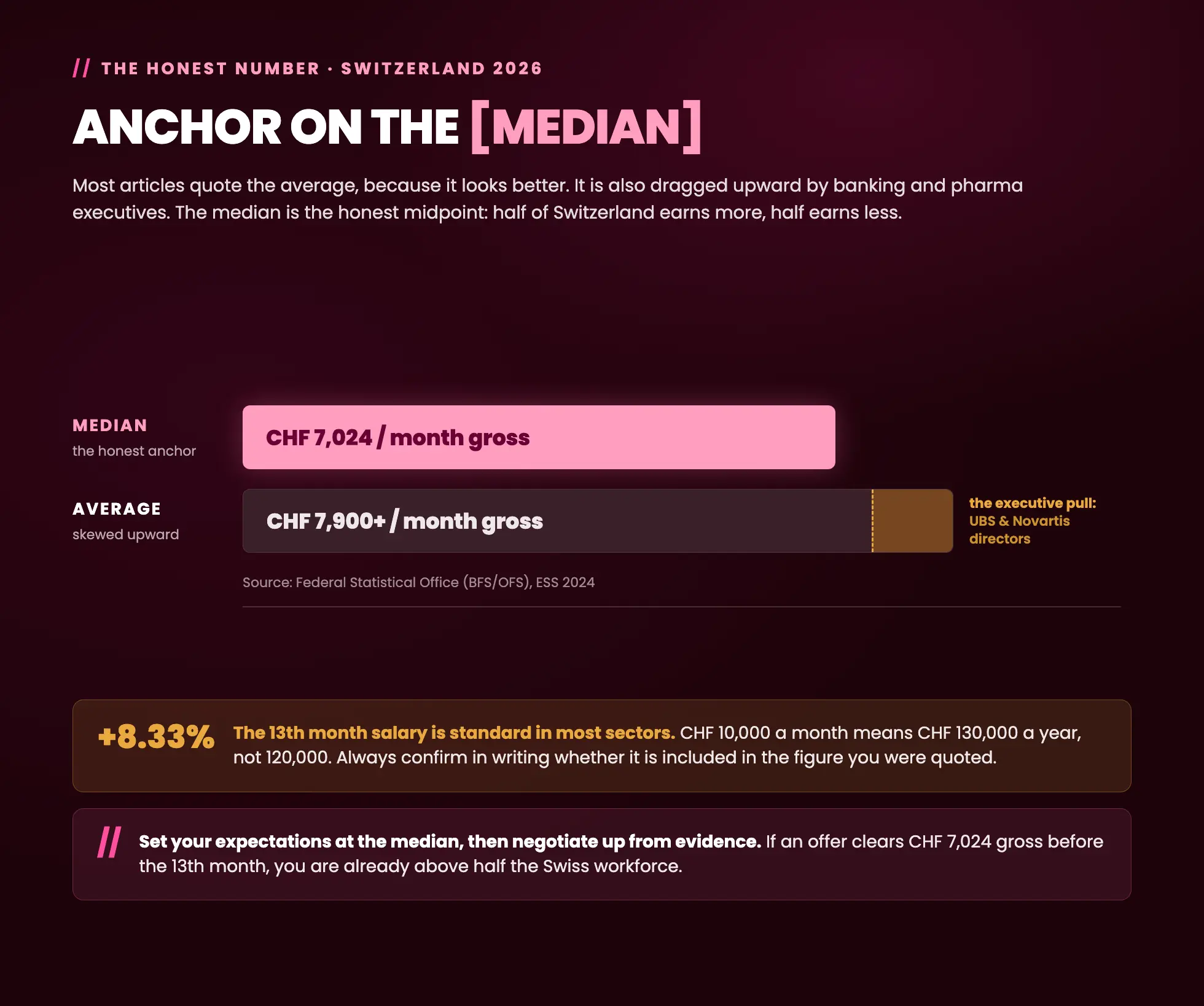
The short answer: The median salary in Switzerland in 2026 is CHF 7,024 per month gross. The average is higher, above CHF 7,900, because banking and pharma executives pull it up. After tax, pension and health insurance, a professional on CHF 130,000 keeps roughly CHF 7,360 a month. There is no federal minimum wage. Only Geneva sets one, at CHF 24.59 an hour.
| Switzerland, 2026 | Per month |
|---|---|
| Median salary (gross) | CHF 7,024 |
| Average salary (gross) | CHF 7,900+ |
| Typical take-home (CHF 130k role) | ~CHF 7,360 |
| Minimum wage | None federal. Geneva CHF 24.59/hr |
Switzerland pays the highest salaries in Europe. The national median sits at roughly CHF 7,024 per month gross, and in IT, pharma and finance the numbers climb well past CHF 10,000. But behind those figures hides the other half of the equation: CHF 2,500 for a one-bedroom flat in Zurich, CHF 400 a month per person for compulsory health insurance, and CHF 6 for a coffee.
This article isn’t about the “Swiss dream”. It’s about the arithmetic. We break down real salaries by sector, focus on the fields where foreign professionals actually get hired, subtract every mandatory cost, and show you what’s genuinely left at the end of the month.
Over 7 years, we’ve helped more than 5,000 professionals find jobs abroad. Want to assess your chances in Switzerland specifically? Find your career consultant.
What Is the Average Salary in Switzerland Per Month? (2026)
The average salary in Switzerland in 2026 is above CHF 7,900 per month gross, but that figure is inflated by banking and pharma pay. The median is the honest anchor at CHF 7,024 per month gross. A note on sources, because most articles disagree: CHF 7,024 is the Federal Statistical Office’s current LSE 2024 figure, published 25 November 2025. The CHF 6,788 you will see elsewhere is the superseded LSE 2022 release. Same survey, two years older. After tax, pension and social contributions a typical worker keeps roughly three-quarters of that, though the exact figure swings sharply by canton.
| Salary in Switzerland (2026) | Per month, gross | Per month, net (approx.) |
| Average full-time | ~CHF 7,900 | ~CHF 6,100 |
| Median (typical worker) | ~CHF 7,024 | ~CHF 5,500 |
| Geneva minimum wage (highest in the world) | ~CHF 4,475 | ~CHF 3,750 |
Net figures are approximate, vary widely by canton, and are shown before the mandatory health-insurance premium (~CHF 300–450/month), which you pay separately. See “The Arithmetic” section below for a full Zurich worked example.
Does Switzerland have a minimum wage? There is no federal minimum wage. Only five cantons set their own, and Geneva’s is the highest in the world at CHF 24.59 per hour from 1 January 2026, about CHF 4,475 per month full-time. Elsewhere pay floors come from sector collective agreements, not the law.
What counts as a good salary in Switzerland? Anything above the median, so roughly CHF 7,000 per month gross, is comfortable outside Zurich and Geneva. In the two big cities, where rents and health premiums bite hardest, CHF 8,500 and up gives real breathing room.
If the numbers work for you, the next step is practical: our guide to finding a job in Switzerland as a foreigner covers where the hiring actually happens, and the European work-visa salary thresholds show what an offer must pay before a permit is possible.
Swiss Salaries at a Glance: The Essentials
- Median salary: CHF 7,024/month gross (Federal Statistical Office data)
- Average salary: higher, above CHF 7,900/month (inflated by banking and pharma executives)
- 13th month salary: very widely paid, from contracts and collective agreements rather than statute. It is not extra money: the agreed annual salary is simply paid in 13 instalments, so compare annual totals, not monthly figures
- Minimum wage: none at federal level. Only 5 cantons have one (Geneva: CHF 24.59/hour, the highest in the world)
- Social contributions: ~13–15% of gross (AHV/IV/EO/ALV)
- Pension (2nd pillar, BVG/LPP): another 7–10%, depending on age
- Income tax: 10–28% depending on canton (Zug lowest, Geneva highest)
- Health insurance: CHF 300–500/month per adult. NOT deducted from salary, NOT paid by your employer
- Rent, 1-bedroom: Zurich CHF 2,200–3,000; Bern CHF 1,500–1,800
- Non-EU quota: 8,500 permits for 2026 (4,500 B + 4,000 L)
An important caveat about “median” versus “average”. Most of the salary pages we checked in August 2026 lead with the average, because it looks better. But it’s dragged upward by UBS and Novartis directors. The median is more honest: half of all workers earn more, half earn less. Anchor your expectations to the median.
Salaries by Sector: Where Foreign Professionals Actually Get Hired
This calls for honesty. Switzerland is not a country of open doors. For non-EU nationals there is a quota and a labour market test: the employer must prove they could not find a suitable candidate among Swiss citizens or EU/EFTA nationals.
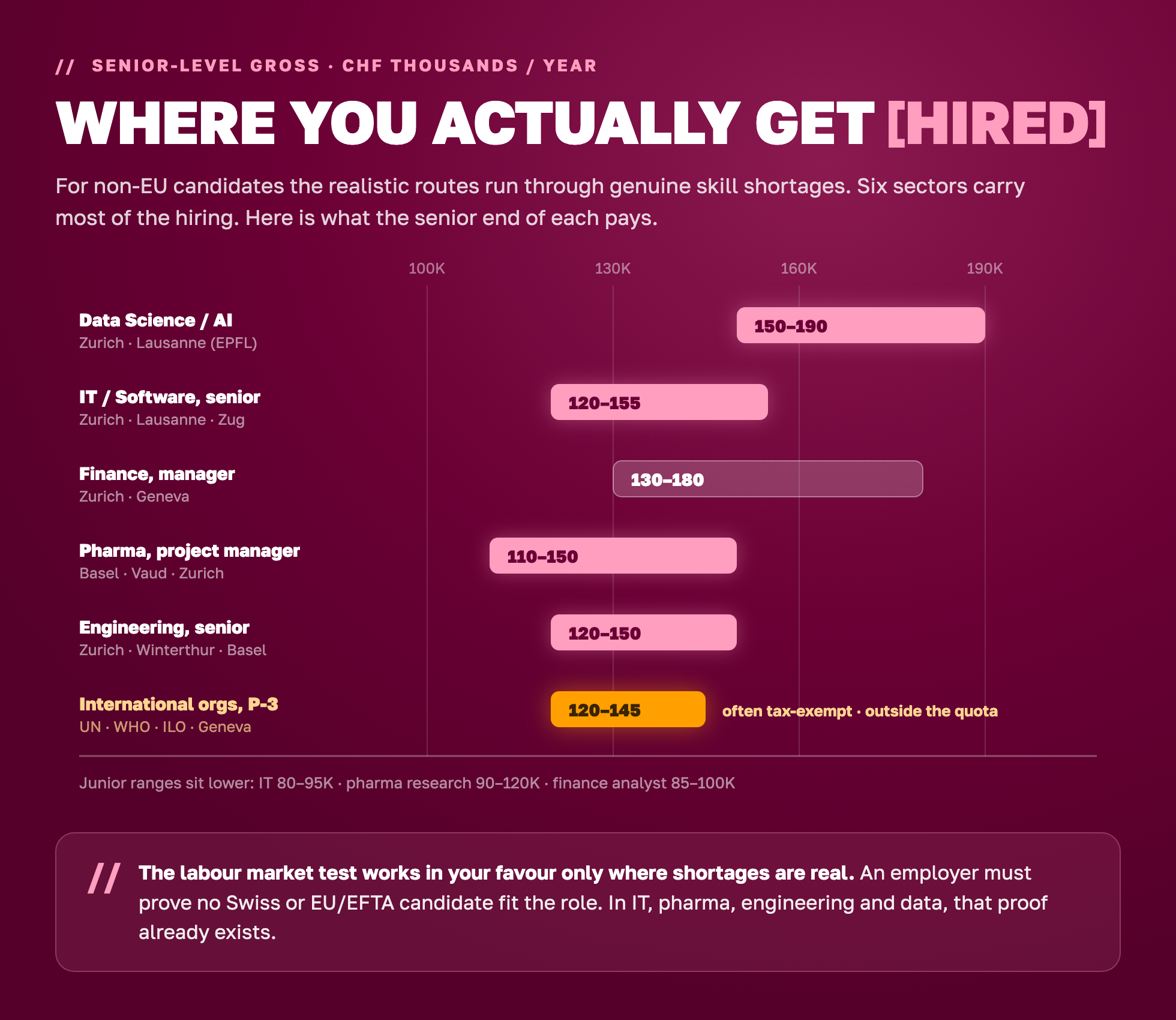
That means your realistic chances lie in sectors with genuine skill shortages and high qualification requirements. Here they are, with current gross annual ranges:
| Sector | Annual salary (CHF gross) | Cities | Odds for non-EU candidates |
| IT / Software development | Junior 80–95K · Senior 120–155K · Eng. Manager 150–200K | Zurich, Lausanne, Zug | High. Google, Microsoft and Meta all hire in Zurich |
| Pharma / Life Sciences | Research Scientist 90–120K · Project Manager 110–150K · Medical Affairs Director 180–250K | Basel, Vaud, Zurich | High. Roche, Novartis, Lonza: English-speaking environments |
| Finance / Banking | Junior analyst 85–100K · Manager 130–180K · Director 200–300K+ | Zurich, Geneva | Moderate. Deep local talent pool, you need a specialism |
| Engineering / Manufacturing | 75–110K · Senior 120–150K | Zurich, Winterthur, Basel | High. Engineers appear on the SEM shortage list |
| International organisations | P-3 ~120–145K · P-5 ~160–200K (tax-exempt) | Geneva | High. UN, WHO, ILO, UNHCR: outside the quota |
| Data Science / AI | 100–140K · Senior 150–190K | Zurich, Lausanne (EPFL) | High. Acute shortage |
| Healthcare / Nursing | Nurse 70–90K · Specialist physician 150–250K | All cantons | High, but your qualification must be formally recognised |
| Marketing / FMCG | Brand Manager 90–120K · Marketing Director 150–200K | Vevey, Zurich, Geneva | Moderate. Nestlé, Givaudan, Lindt |
A real example. A Senior Software Engineer in Zurich earns CHF 130,000–155,000 a year. In Geneva the same role pays CHF 115,000–140,000. That is roughly 12% less, while housing in Geneva costs more. The same offer in different cantons produces a very different net result.
Critical when negotiating: Swiss salaries are often quoted across 13 months. CHF 10,000/month means CHF 130,000 a year, not 120,000. Always confirm in writing whether the 13th month is included in the figure you’ve been given, and whether a bonus sits on top. In our August 2026 jobs.ch check, ads named the 13. Monatslohn as a benefit far more often than they printed figures (559 ads mentioned it against 28 quoting an annual wage), and the annual figures that did appear were flagged “inkl. 13. Monatslohn”.
First role abroad, a mid-career move, or a senior step up. Tell us where you are and we’ll match you with the right consultant and service.

Salaries by Region: Zurich, Basel, Geneva and Ticino
The FSO publishes wages by major region rather than by canton, and the spread is wide: Zurich clears the national median by nearly CHF 500 a month while Ticino trails it by CHF 1,300. Median gross monthly wage, full-time equivalent, LSE 2024 (FSO):
| Region (cantons) | Median (CHF/month) |
|---|---|
| Zurich (ZH) | 7,502 |
| Northwest (Basel-Stadt, Basel-Landschaft, Aargau) | 7,156 |
| Central Switzerland (Lucerne, Zug and others) | 7,092 |
| Lake Geneva (Vaud, Valais, Geneva) | 6,998 |
| Mittelland (Bern, Fribourg and others) | 6,964 |
| Eastern Switzerland (St. Gallen, Graubünden and others) | 6,623 |
| Ticino (TI) | 5,708 |
| Switzerland | 7,024 |
Ticino’s gap is the one to respect: cross-border competition from Italy holds wages down while Swiss prices still apply.
Salary by Age in Switzerland: How Pay Climbs
Swiss pay rises steeply with career stage, which matters if you are comparing your offer against the national line. Median gross monthly wage by age, LSE 2024 (FSO):
| Age group | Median (CHF/month) |
|---|---|
| Under 30 | 5,570 |
| 30–49 | 7,288 |
| 50 and over | 7,806 |
| All ages | 7,024 |
The distribution is wide too: the bottom tenth of full-time salaries sits below CHF 4,635 a month and the top tenth above CHF 12,526. An offer above the CHF 7,502 Zurich median is strong anywhere in the country.
Minimum Wage in Switzerland 2026: No Federal Rate, Geneva at CHF 24.59 per Hour
Switzerland has no federal minimum wage. Five cantons set their own: Geneva CHF 24.59 per hour in 2026 (the highest in the world, roughly CHF 4,400 gross per month on a 41-hour week), Neuchâtel and Jura around CHF 21.30–21.40, Basel-Stadt around CHF 22 and Ticino about CHF 20–20.50 depending on the sector. Cantonal rates are indexed every January, so check the canton’s own page for the current figure. Everywhere else the floor comes from collective labour agreements (GAV/CCT), and for a work permit the employer must pay the customary local rate for the role and region, which sits far above any minimum.
Where to Look for Work: Official Resources
- arbeit.swiss: the state employment service (RAV). This is precisely where an employer must advertise a role before hiring a non-EU candidate
- jobs.ch: among Switzerland’s largest private job boards
- jobup.ch: French-speaking Switzerland (Geneva, Lausanne, Vaud)
- LinkedIn Jobs: one of the main channels for international and English-language roles
- careers.un.org: UN and agency vacancies in Geneva (outside the non-EU quota)
- SwissDevJobs: IT only, with salary ranges published upfront
Official sources worth using to verify any figure:
- Federal Statistical Office (BFS/OFS): official salary statistics
- State Secretariat for Migration (SEM): quotas, permit types, procedure
- Priminfo: the official calculator for comparing health insurance premiums
- Federal Tax Administration (ESTV): tax calculator by canton
The Other Side: What Living Here Actually Costs
Now we subtract. Here is the structure of unavoidable costs for a single person.
Rent: the biggest line item (30–40% of your budget)
- Zurich: 1-bedroom in the centre CHF 2,200–3,000. Districts like Oerlikon and Altstetten run 20–30% cheaper
- Geneva: CHF 2,200–3,500. The tightest housing market in the country
- Basel: CHF 1,800–2,200. Around 15–20% below Zurich
- Bern: CHF 1,500–1,800
- Nebenkosten (service charges): add CHF 150–300/month on top. Frequently excluded from the advertised rent
What you need to know: landlords typically demand a deposit of up to three months’ rent, an extract from the debt-collection register (Betreibungsauszug) and proof of income. Competition for a flat in Zurich routinely means dozens of applications per listing.
Health insurance: a fixed cost you cannot avoid
This is the key difference between Switzerland and most other countries. Health insurance is mandatory by law, must be arranged within 3 months of arrival, is not paid by your employer and is not automatically deducted from your salary. You pay it yourself, every month.
- Basic insurance (LaMal/KVG): CHF 300–500/month per adult
- Children: CHF 80–150/month
- Deductible (franchise): from CHF 300 to CHF 2,500/year. A higher deductible means a lower monthly premium
- Dental care is NOT covered by basic insurance. A check-up costs CHF 150–300
Practical tip: premiums can and should be compared through the official Priminfo service. The gap between providers runs into hundreds of francs a year. You can switch insurer in November.
Everything else you have to pay
- Groceries: CHF 400–600/month (Migros, Coop). Aldi and Lidl are 20–30% cheaper
- Public transport: Zurich ~CHF 85/month per zone. The Halbtax card (CHF 190/year) gives −50% on every train in the country
- Internet: CHF 40–70/month
- Lunch out: CHF 20–35. The Tagesmenü (daily set menu) runs CHF 16–22
The Arithmetic: What Actually Lands in Your Account
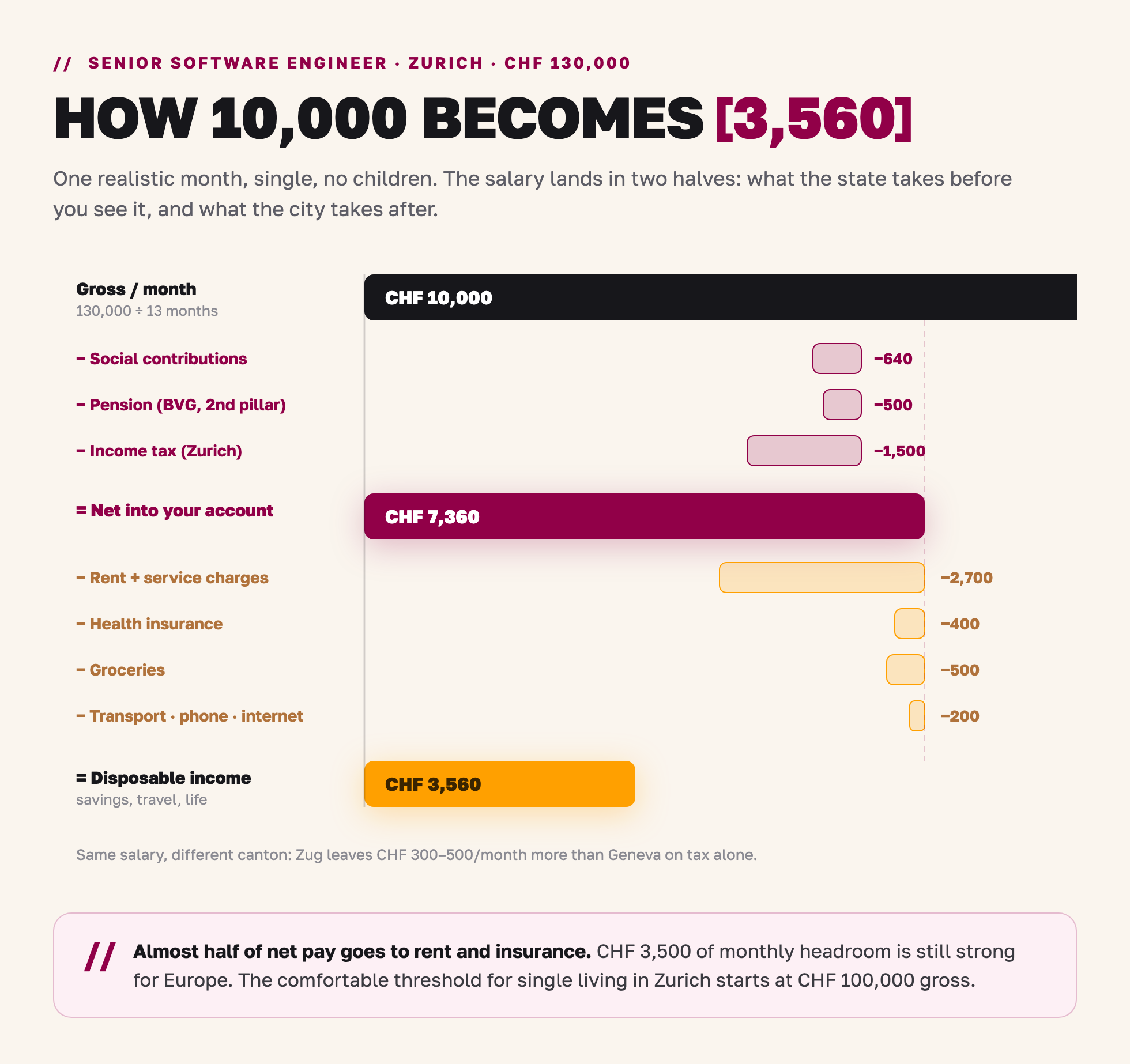
Let’s put it together. Take a realistic scenario: Senior Software Engineer in Zurich, CHF 130,000 a year (single, no children).
| Line item | CHF/month |
| Gross (130,000 ÷ 13 months) | 10,000 |
| − Social contributions (AHV/ALV, ~6.4% employee share) | −640 |
| − Pension, BVG 2nd pillar (~5%) | −500 |
| − Income tax (Zurich, ~15%) | −1,500 |
| = Net into your account | ~7,360 |
| − Rent, 1-bedroom + Nebenkosten | −2,700 |
| − Health insurance | −400 |
| − Groceries | −500 |
| − Transport, phone, internet | −200 |
| = Disposable income | ~3,560 |
Roughly CHF 3,500 a month of disposable income on a CHF 130,000 salary is a strong result by European standards. But note this: almost half of your net pay goes to rent and insurance.
And on a lower salary? At CHF 90,000 a year in Zurich (net around CHF 5,200/month), you’ll have roughly CHF 1,600 left after rent, insurance and food. Liveable, but saving is hard. This is exactly why the threshold for comfortable single living in Zurich starts at CHF 100,000 gross.
Your canton matters more than you’d think. That same CHF 130,000 in Zug yields CHF 300–500/month more than in Geneva, purely on the tax differential. Check your own case with the ESTV calculator.
First role abroad, a mid-career move, or a senior step up. Tell us where you are and we’ll match you with the right consultant and service.
The Work Permit: The Real Barrier
For non-EU/EFTA nationals a two-tier quota system applies. Since Brexit that includes UK citizens, alongside those from the US, India, Brazil and everywhere else outside the free-movement area.
- 2026 quota: 8,500 permits: 4,500 of type B (12 months and longer) and 4,000 of type L (short-term)
- Labour market test (Inländervorrang): the employer must demonstrate they searched in Switzerland and the EU and found no suitable candidate
- Candidate requirements: a university degree plus several years of relevant experience. Switzerland admits highly qualified professionals only
- Who applies: the employer, always. You cannot file on your own behalf
- Timeline: 6–12 weeks (canton + SEM + visa)
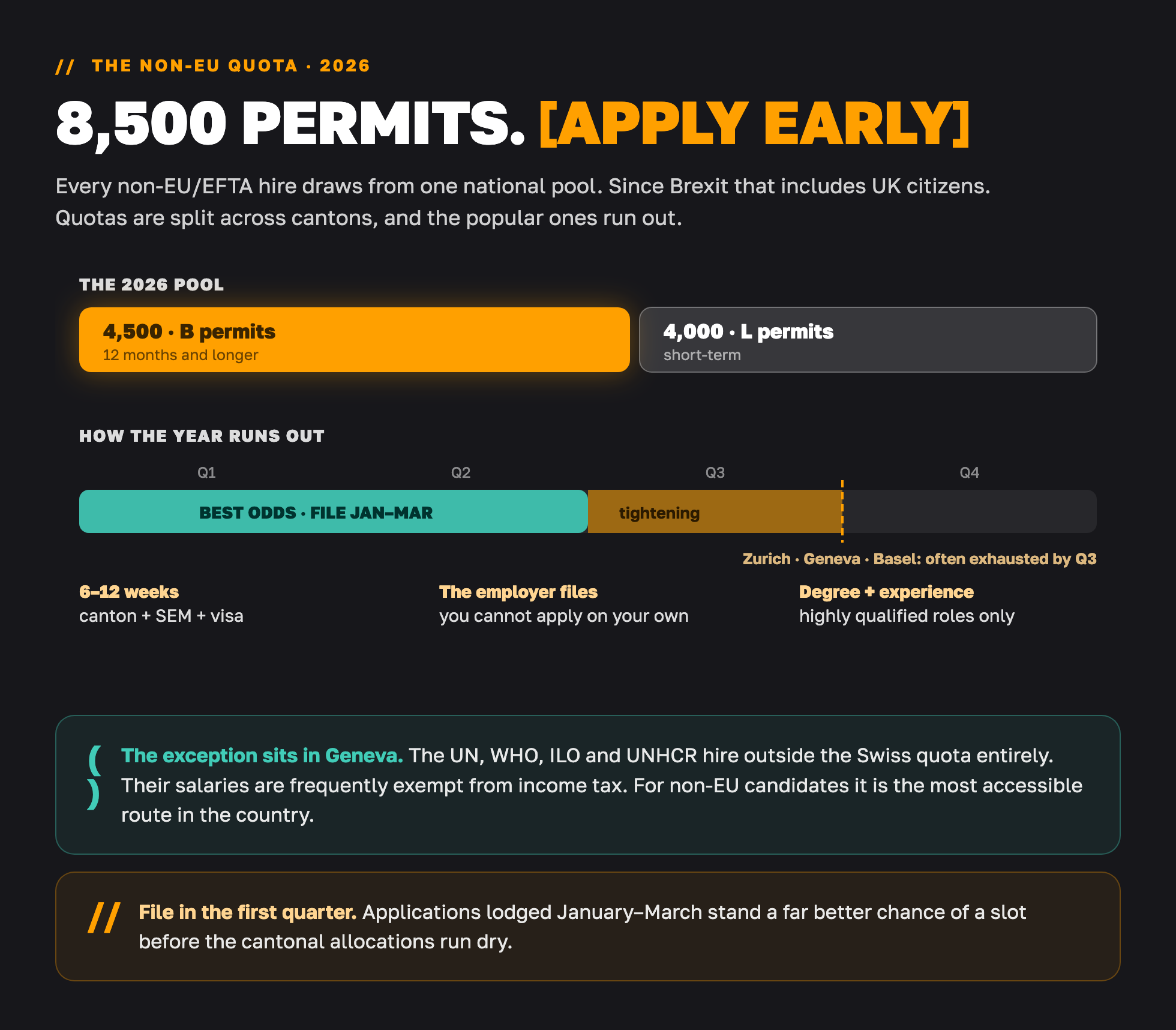
A practical detail: quotas are distributed across the cantons, and in the popular ones (Zurich, Geneva, Basel) they are often exhausted by the third quarter. Applications filed in January–March stand a far better chance of securing a slot.
One exception: international organisations in Geneva. The UN, WHO, ILO, UNHCR and other agencies hire outside the Swiss quota, and their salaries are frequently exempt from income tax. It is a separate route, and the most accessible one for non-EU candidates.
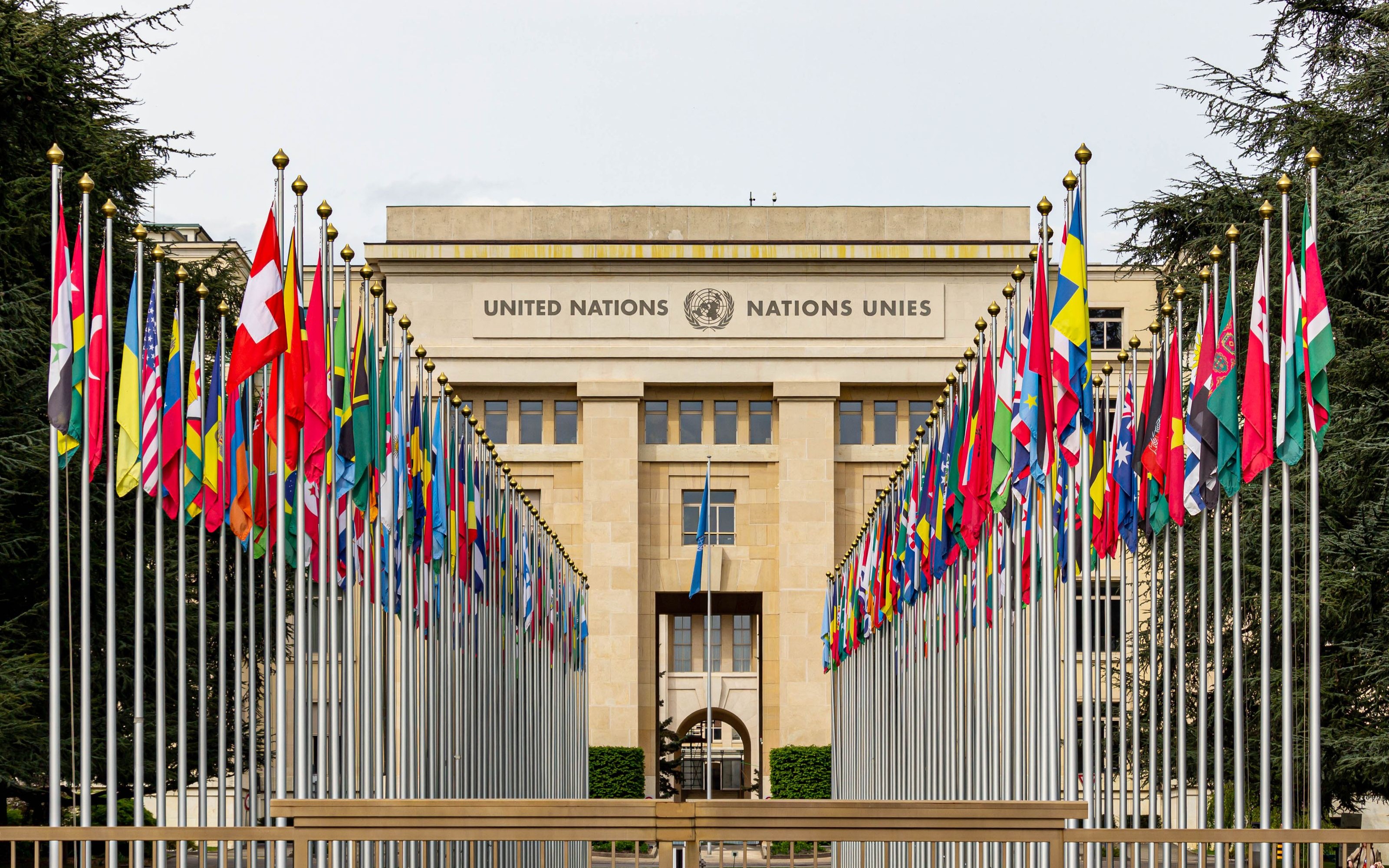
Current rules and shortage lists are published on the SEM website.
Related reading: How to find a job in Switzerland as a foreigner (2026 guide) · Work visa & Blue Card salary thresholds in Europe 2026 · Salaries in the UK in 2026
Key Takeaways
- Anchor on the median (CHF 7,024/month), not the average. The latter is skewed by executive pay.
- Genuine openings for non-EU candidates: IT, pharma, engineering, data science, healthcare, and international organisations in Geneva.
- Health insurance (CHF 300–500/month) is a fixed cost your employer does not cover. Budget for it from day one.
- On CHF 130,000 gross in Zurich you’re left with around CHF 3,500 of disposable income. The comfort threshold for a single person starts at CHF 100,000.
- Always confirm whether the 13th month is included: CHF 10,000/month is CHF 130,000 a year, not 120,000.
- Your canton affects net pay more than you’d expect: up to CHF 500/month between Zug and Geneva on an identical salary.
- The 2026 quota is 8,500 places for all non-EU nationals. Apply early in the year, before cantonal limits run dry.
If you’d like a personalised assessment of your chances, help tailoring your CV to the Swiss market and interview preparation, find your career consultant.
Frequently Asked Questions
What is the average salary in Switzerland in 2026?
The median is CHF 7,024 per month gross on the FSO’s current LSE 2024 release (published November 2025); the average is above CHF 7,900, pulled up by banking and pharma. A typical worker keeps roughly CHF 5,500 after tax, pension and health insurance.
What is a good salary in Switzerland?
Above the Zurich median of CHF 7,502 a month is strong anywhere in the country. The top tenth of full-time salaries starts around CHF 12,526 a month (LSE 2024).
Does Switzerland have a minimum wage?
There is no federal minimum wage. A few cantons set their own; Geneva’s is CHF 24.59 an hour, the highest in the world. Everywhere else, pay floors come from collective agreements or the market.
Why do sources disagree about the Swiss median salary?
Because they cite different years of the same survey. CHF 6,788 is the FSO’s LSE 2022 figure; CHF 7,024 is the current LSE 2024 figure, published 25 November 2025. Check which release an article quotes before comparing offers.