 By Alisa Schlosser, Career Consultant at EP Advisory
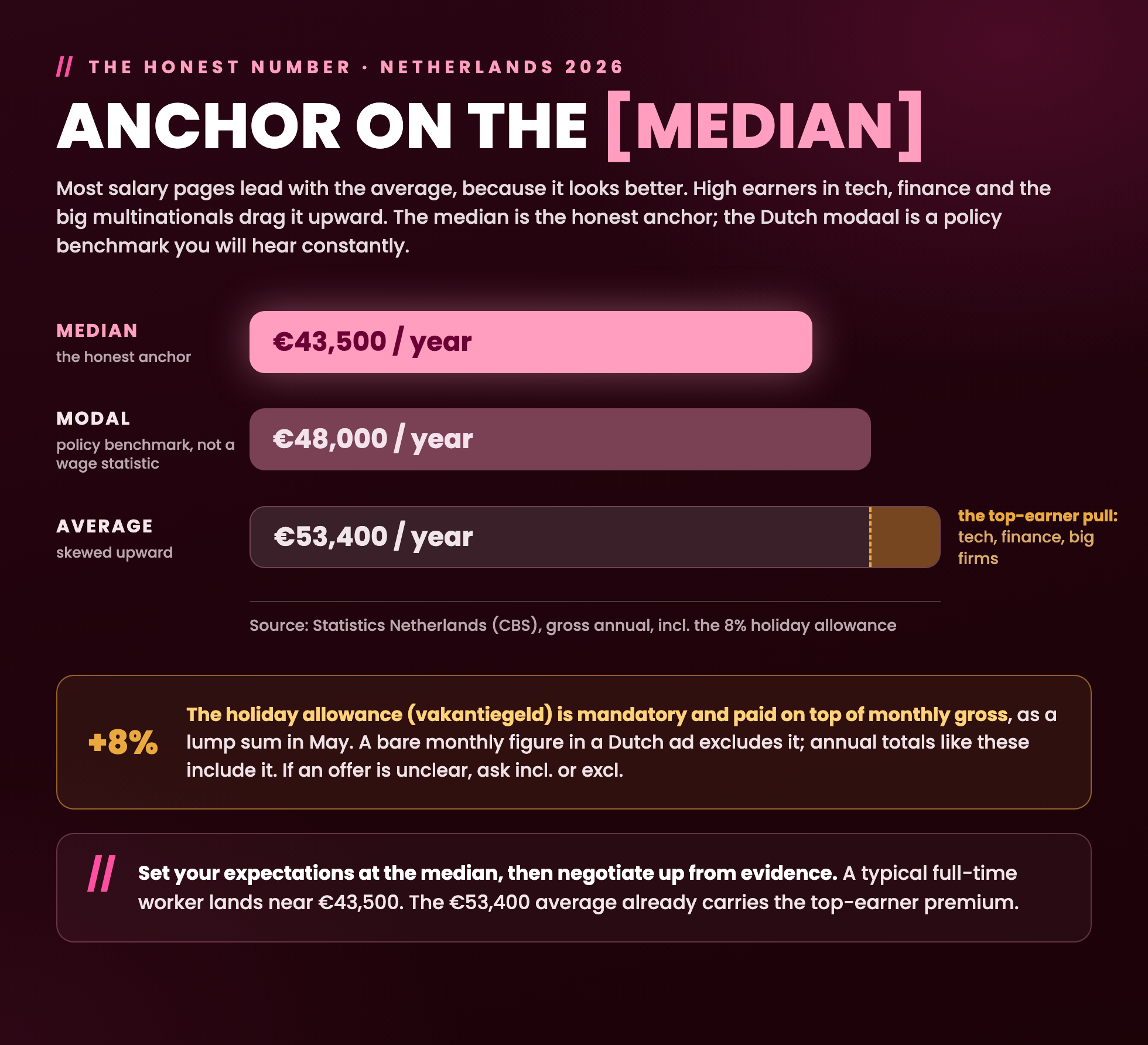
The average salary in the Netherlands in 2026 is about €4,450 a month gross, €53,400 a year; the median, what a typical worker actually earns, is closer to €43,500, with the Dutch ‘modaal’ benchmark between them at about €48,000. The Netherlands is one of the most accessible high-wage countries in Europe for foreign professionals. English is spoken almost everywhere, the Highly Skilled Migrant route is fast, and the famous 30% ruling can make take-home pay unusually generous. Add an Amsterdam one-bedroom near €1,900 a month and compulsory health insurance, and you get a country where a strong salary and a tight budget can share the same payslip.
So here is the arithmetic behind the headlines. We break down real salaries by sector, focus on the fields where foreign professionals actually get hired, subtract every mandatory cost, and show you what’s genuinely left at the end of the month.
Over 7 years, we’ve helped more than 5,000 professionals find jobs abroad. Want to assess your chances in the Netherlands specifically? Find your career consultant.
A quick word on what actually lands in your account. Two Dutch specifics move the net figure more than anything else. First, the 8% holiday allowance (vakantiegeld) is mandatory and paid on top of your monthly gross as a lump sum in May. A bare bruto-per-maand figure in a Dutch ad excludes it, and ads that include it say so explicitly. Annual totals like the CBS average do count it. Second, the 30% ruling: qualifying incoming employees can receive up to 30% of their salary tax-free for five years (dropping to 27% from 2027), which can lift take-home by hundreds of euros a month. Both are covered below.
What Is the Average Salary in the Netherlands Per Month? (2026)
The average salary in the Netherlands in 2026 is about €4,450 per month gross (€53,400 a year, including the 8% holiday allowance). In job-ad terms that is roughly €4,120 bruto per maand plus the 8% vakantiegeld on top. After tax a typical worker keeps roughly €3,300 per month net. The median is lower and more honest at €3,625 per month gross (€43,500 a year).
| Salary in the Netherlands (2026) | Per month, gross | Per month, net |
| Average full-time | ~€4,450 | ~€3,300 |
| Median (typical worker) | ~€3,625 | ~€2,900 |
| Statutory minimum wage (€14.71/hr) | ~€2,400 | ~€2,050 |
Net figures are approximate. Eligible migrants on the 30% ruling keep more. See “The Arithmetic” section below for the full breakdown.
Does the Netherlands have a minimum wage? Yes, and it is statutory and hourly. From January 2026 it is €14.71 per hour for workers aged 21 and over, rising to €14.99 in July, among the highest in the EU. Full-time that is about €2,400 per month gross.
What counts as a good salary in the Netherlands? Anything above the median, so roughly €3,625 per month gross, is comfortable outside the Randstad. Around €5,000 and up gives real breathing room in Amsterdam or Utrecht.
If the numbers work for you, the next step is practical: our guide to getting a Dutch work visa covers where the hiring actually happens, and the European work-visa salary thresholds show what an offer must pay before a permit is possible.
Dutch Salaries at a Glance: The Essentials
- Average salary: ~€53,400/year gross, about €4,450/month including the 8% holiday allowance (CBS)
- Modal income: ~€48,000/year for 2026. ‘Modaal’ is a policy benchmark used in Dutch budget tables, not a measured wage statistic, but salary talk here leans on it, so know the number
- Median salary: around €43,500, the honest middle of the distribution and the best anchor for a typical worker
- Holiday allowance: 8% of gross, mandatory, paid on top as a lump sum in May. Quoted monthly salaries exclude it; annual totals include it. Above 3x the minimum wage it can be waived in writing, and an all-inclusive salary needs a CAO basis plus pay of at least 108% of the minimum wage
- Minimum wage: statutory and hourly. €14.71/hour from January 2026, rising to €14.99 from July (age 21+), among the highest in the EU (Government.nl)
- Income tax (Box 1): 35.75% up to €38,883, 37.56% up to €78,426, 49.50% above (2026; the first band includes national insurance) (KVK)
- 30% ruling: up to 30% of salary tax-free for eligible incoming staff in 2026 (27% from 2027); salary norm €48,013, capped at €262,000 (Business.gov.nl)
- Health insurance: compulsory basic cover, ~€160/month per adult, plus a €385/year deductible. You pay it yourself, as in Switzerland (Government.nl)
- Rent, 1-bed Amsterdam: ~€1,700–2,400/month; cheaper in Rotterdam, Utrecht, Eindhoven
- Work permit (non-EU): Highly Skilled Migrant salary from €5,942/month (30+) or €4,357 (under 30) in 2026 (IND)
An important caveat about “median” versus “average”. Most of the salary pages we checked in August 2026 lead with the average, because it looks better. But it’s pulled upward by high earners in tech, finance and at the big multinationals. The median is the honest middle. The ‘modaal’ figure is a policy yardstick rather than a wage statistic, though Dutch salary talk uses it constantly. Anchor your expectations on the median.
Salaries by Sector: Where Foreign Professionals Actually Get Hired
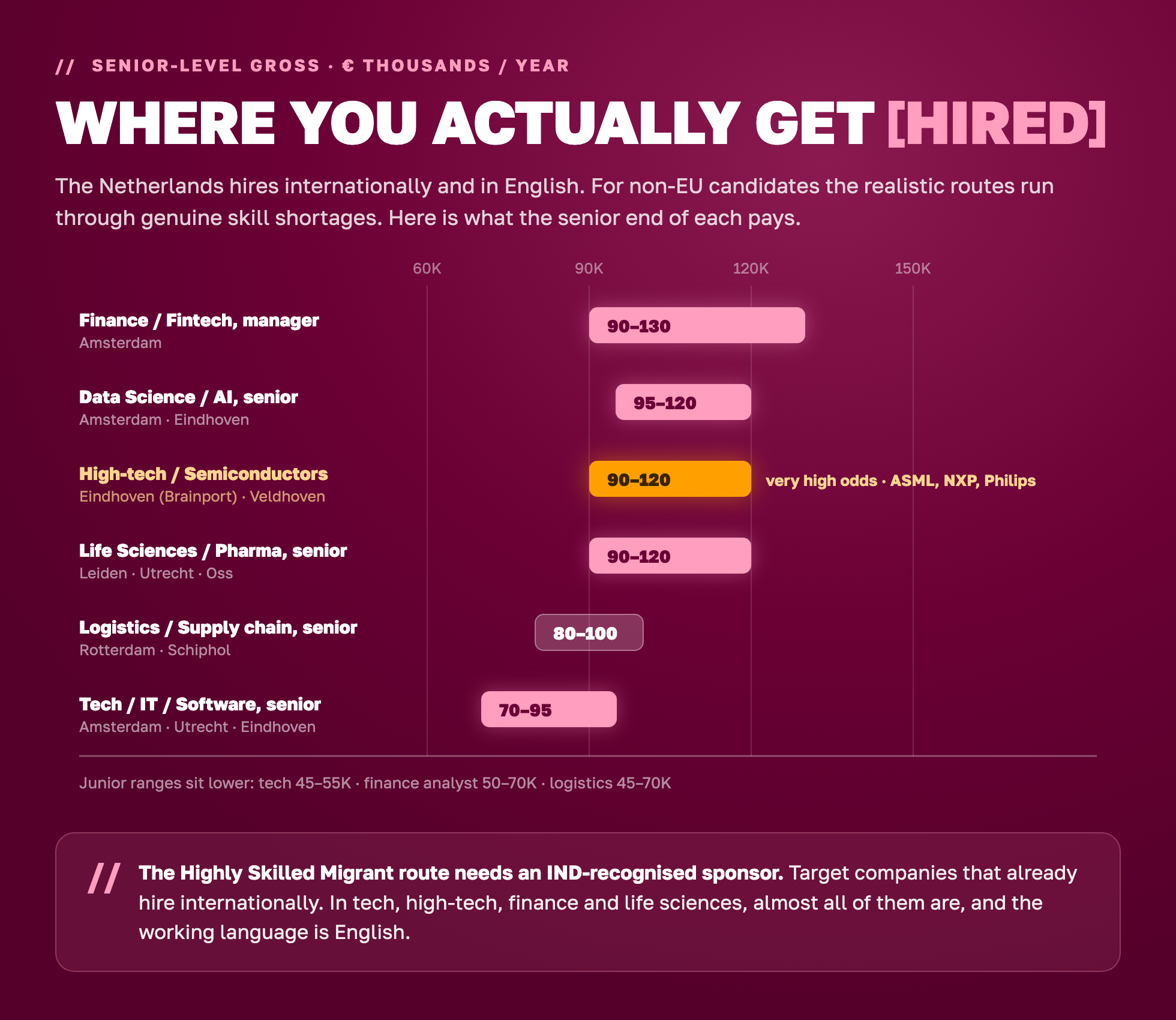
The Netherlands hires internationally and in English, and the Highly Skilled Migrant scheme is one of the smoother routes into Europe, provided your employer is an IND-recognised sponsor. Your realistic chances are strongest in sectors with genuine skill shortages. Here they are, with current gross annual ranges.
| Sector | Annual salary (€ gross) | Where the jobs are | Odds for non-EU candidates |
| Tech / IT / Software | Junior 45–55K · Senior 70–95K · Eng. Manager 100–130K | Amsterdam, Utrecht, Eindhoven | High. Booking.com, Adyen, Uber, Databricks |
| High-tech / Semiconductors / Engineering | 55–80K · Senior 90–120K | Eindhoven (Brainport), Veldhoven | Very high. ASML, NXP, Philips, VDL |
| Finance / Fintech | Analyst 50–70K · Manager 90–130K · Director 150K+ | Amsterdam | High. ING, ABN AMRO, Adyen, Mollie |
| Life Sciences / Pharma / MedTech | 50–80K · Senior 90–120K | Leiden, Utrecht, Oss | High. Genmab, Janssen, Philips |
| Logistics / Supply chain | 45–70K · Senior 80–100K | Rotterdam, Schiphol | Moderate to high. Europe’s largest port |
| Data Science / AI | 55–85K · Senior 95–120K | Amsterdam, Eindhoven | High. Acute shortage |
| Agri-food / AgTech | 45–70K | Wageningen (Food Valley) | Moderate. Unilever, FrieslandCampina |
| Healthcare / Nursing | Nurse 38–52K · Specialist 100K+ | Nationwide | Moderate. BIG registration and Dutch required |
A real example. A Senior Software Engineer in Amsterdam earns roughly €70,000–95,000 a year. The same profile in the Eindhoven high-tech cluster runs €65,000–90,000. That is similar money, with rent 20–30% cheaper, so the lived result is often better outside the capital. The headline number and what you keep can diverge sharply depending on where you land.
Critical when negotiating: confirm three things in writing. Whether the 8% holiday allowance and any 13th month are included in or added to the quoted figure; the pension contribution; and above all, whether you qualify for the 30% ruling, which changes your net pay more than a five-figure raise would. In our August 2026 sample of 31 Dutch ads with salary figures, no bare monthly figure included vakantiegeld, and the few that included it said “inclusief vakantiegeld” outright, so read a silent figure as excluding it.
First role abroad, a mid-career move, or a senior step up. Tell us where you are and we’ll match you with the right consultant and service.

Minimum Wage in the Netherlands 2026: €14.71 per Hour
The statutory minimum wage in the Netherlands is €14.71 per hour from 1 January 2026 for workers aged 21 and over, indexed to €14.99 from 1 July 2026. The Dutch minimum is set per hour, so the monthly figure depends on your contract: about €2,295 gross per month on a 36-hour week and about €2,550 on 40 hours. After tax credits (heffingskortingen) a 36-hour minimum-wage earner takes home roughly €2,150 per month, and the 8% holiday allowance comes on top in May. Amsterdam has no separate minimum wage: the national rate applies everywhere, with reduced youth rates under 21. Skilled-migrant permits carry far higher salary thresholds (see the work permit section below).
Where to Look for Work: Official Resources
- LinkedIn Jobs: one of the main channels for international and English-language roles
- Indeed NL: high volume of live listings
- IamExpat Jobs: English-language vacancies aimed at internationals
- Werk.nl (UWV): the public employment service
- IND register of recognised sponsors: check whether an employer can actually sponsor a Highly Skilled Migrant permit before you apply
Official sources worth using to verify any figure:
- Statistics Netherlands (CBS): official salary and income statistics
- Belastingdienst: income tax, the 30% ruling and the take-home rules
- IND: residence permits and the Highly Skilled Migrant salary thresholds
- Government.nl: minimum wage, health insurance and settling in
The Other Side: What Living Here Actually Costs
Now we subtract. Here is the structure of unavoidable costs for a single person, with Amsterdam as the worst case.
Rent: the biggest line item (30–40% of your budget)
- Amsterdam: a 1-bed in the free-market sector runs €1,700–2,400; the centre and Oud-Zuid run higher again
- Utrecht, Rotterdam & The Hague: €1,300–1,800, roughly 20–30% below Amsterdam
- Eindhoven & smaller cities: €1,100–1,600
- The catch: the market is extremely tight. Expect to move fast, put down one to two months’ deposit, and show proof of income. Many landlords ask for 3–4x the rent in gross salary
What you need to know: a large share of housing is regulated social housing with long waiting lists, so most newcomers rent in the pricier free-market (vrije sector). Verify what you’re offered and beware of scams asking for deposits before viewings.
Health insurance: compulsory, and you pay it yourself
This works much as it does in Switzerland, and it catches newcomers out. Basic health insurance (basisverzekering) is mandatory by law, must be arranged within four months of arrival, and is not deducted from your salary. You choose an insurer and pay the premium yourself, every month (Government.nl).
- Basic premium: around €160/month per adult in 2026 (children are free)
- Deductible (eigen risico): €385/year. You pay the first €385 of most care yourself
- Dental care for adults is not covered by the basic package. Budget for a top-up or pay out of pocket
- Healthcare allowance (zorgtoeslag): lower earners can claim a monthly subsidy back from the tax office
Everything else you have to pay
- Groceries: €300–400/month (Albert Heijn; Lidl and Aldi are 15–25% cheaper)
- Transport: most people cycle, the cheapest and fastest option in any Dutch city; an OV-chipkaart covers trains, trams and buses when you need them
- Utilities + internet: €200–300/month combined
- Lunch / beer out: a lunch runs €12–18; a beer €5–6. The 21% VAT is baked into every price
The Arithmetic: What Actually Lands in Your Account
Let’s put it together. Take a realistic scenario: a Senior Software Engineer in Amsterdam on €70,000 a year (single, no children), first without the 30% ruling.
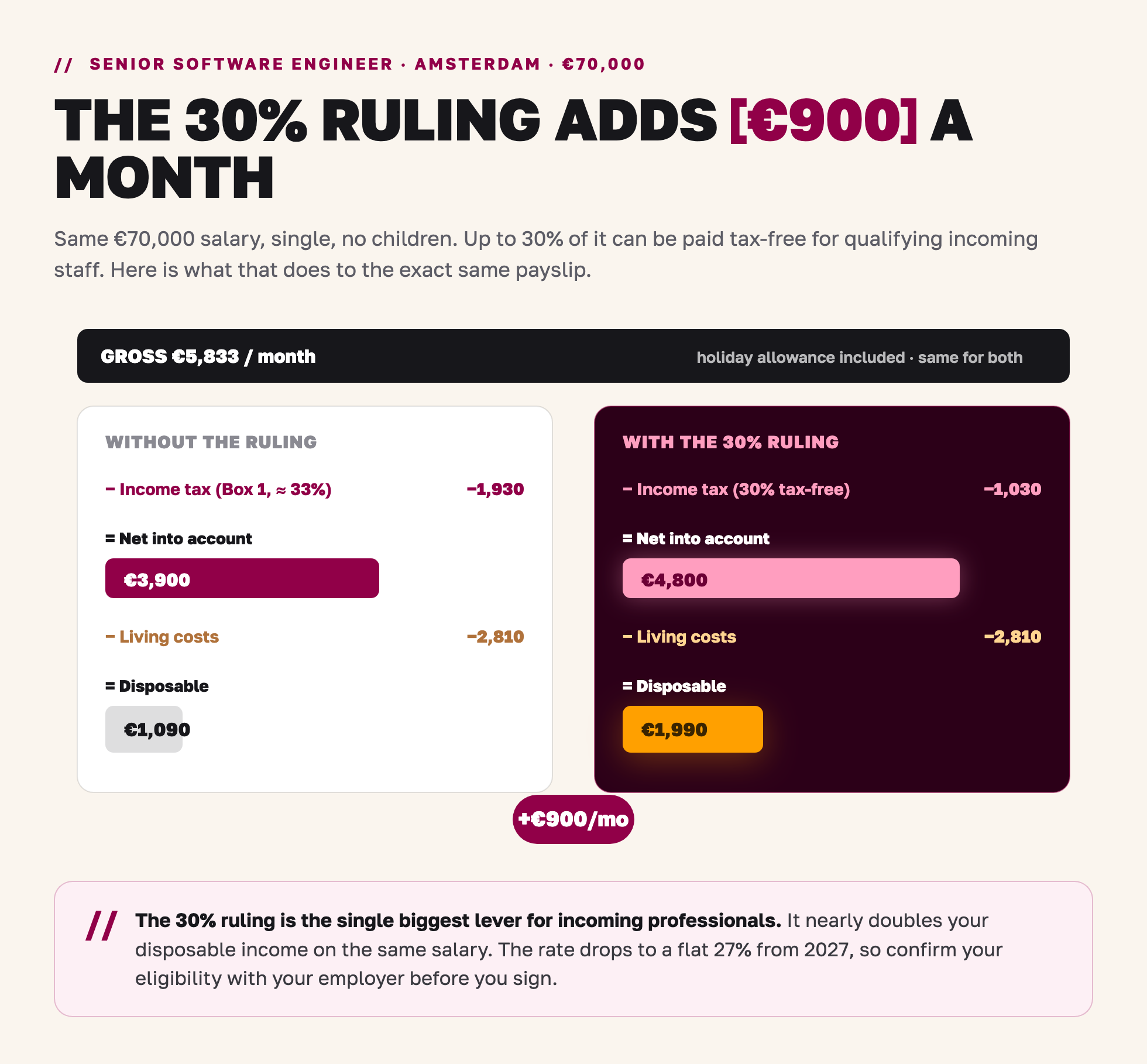
| Line item | €/month |
| Gross (70,000 all-in ÷ 12; an ad would quote ~€5,400 bruto/month + 8% vakantiegeld) | 5,833 |
| − Income tax + national insurance (Box 1, after credits ≈ 33%) | −1,930 |
| = Net into your account | ~3,900 |
| − Rent, 1-bed Amsterdam | −1,900 |
| − Health insurance (basic premium) | −160 |
| − Groceries | −350 |
| − Transport, phone, internet, utilities | −400 |
| = Disposable income | ~1,090 |
Roughly €1,100 a month of disposable income on a €70,000 salary is a modest result for a strong salary. Amsterdam rent alone swallows almost half your net pay. But this is where the 30% ruling changes everything.
With the 30% ruling. If you qualify, up to 30% of that salary is paid tax-free, lifting net pay from about €3,900 to roughly €4,800/month, and disposable income from €1,100 to nearly €2,000. On the same gross salary. This is the single biggest lever for incoming professionals, so confirm your eligibility before you sign. Always run your own figure through an official Belastingdienst-based take-home calculator.
And on a lower salary? At €45,000 in Amsterdam (net around €2,900/month without the ruling), after rent and bills you’re left with a few hundred euro. Liveable with flatmates, but the comfort threshold for single living in Amsterdam realistically starts around €55,000–65,000 gross, and drops sharply in Rotterdam, Eindhoven or Groningen.
First role abroad, a mid-career move, or a senior step up. Tell us where you are and we’ll match you with the right consultant and service.
The Work Permit: Your Route In
EU/EEA and Swiss citizens can work in the Netherlands with no permit. For everyone else, the Dutch system is unusually employer-driven, and the salary thresholds rose on 1 January 2026.
- Highly Skilled Migrant (kennismigrant): the main route. Minimum gross salary €5,942/month if you’re 30 or older, or €4,357/month under 30 (excluding the 8% holiday allowance). No labour market test, fast processing (IND)
- Recent graduates / orientation year: a reduced threshold of €3,122/month applies if you graduated recently or hold an orientation-year (zoekjaar) permit
- Recognised sponsor is required: only employers on the IND’s recognised-sponsor register can hire you this way. Check the register before accepting an offer
- EU Blue Card: an alternative for highly qualified staff with a degree and a qualifying salary
- Orientation year (zoekjaar): graduates of Dutch universities and top-ranked institutions abroad get a year to find work without a job offer first
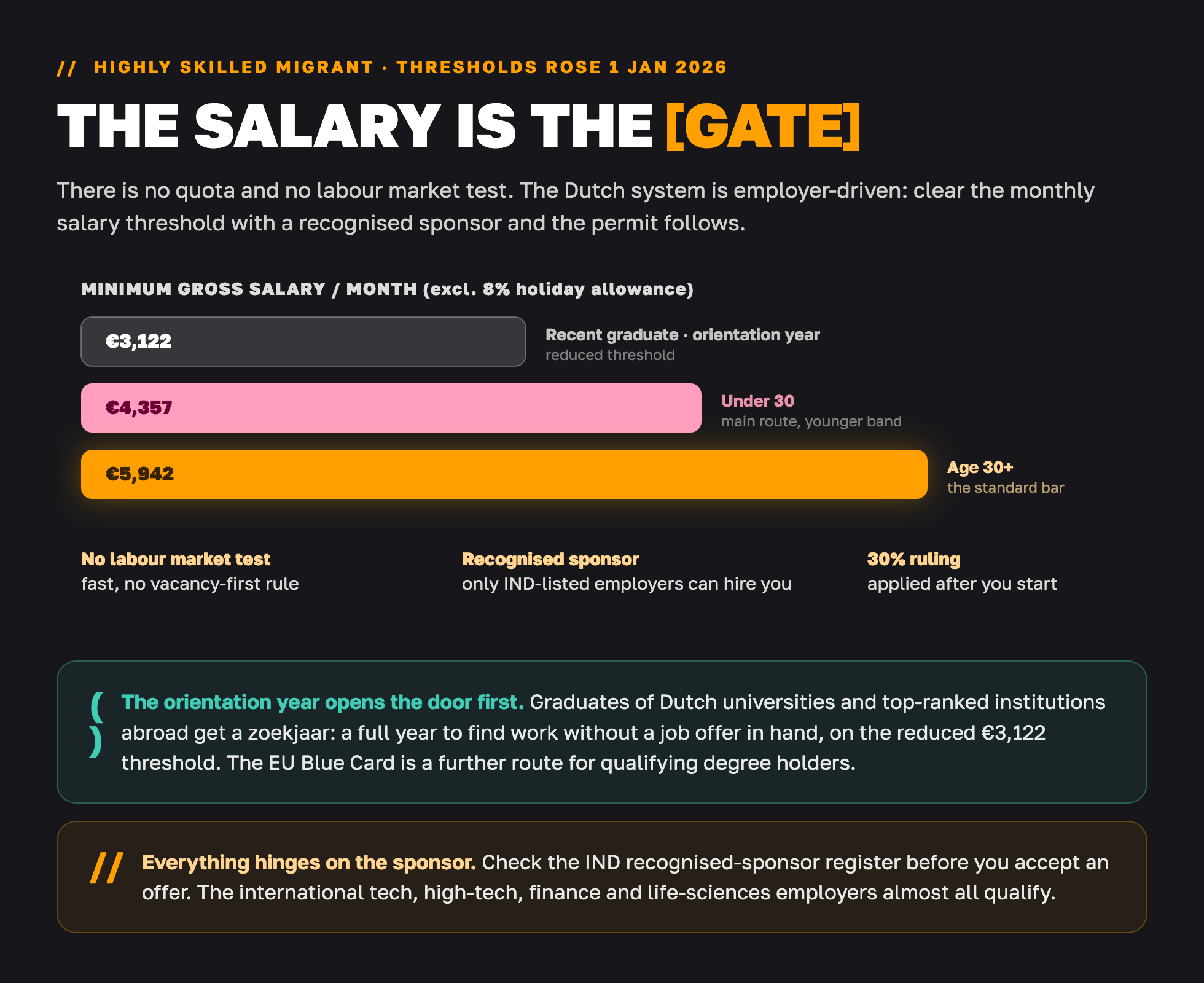
A practical detail: because everything hinges on the employer being a recognised sponsor, target companies that already hire internationally. The tech, high-tech, finance and life-sciences names above almost all are. The 30% ruling is applied for separately, together with the employer, after you start.
Current rules, thresholds and the sponsor register are published by the IND.
Related reading: Work visa in the Netherlands 2026: requirements and how to get one · Work visa & Blue Card salary thresholds in Europe 2026 · UK salaries in 2026 and the Skilled Worker threshold
Across the border, Belgium averages €4,076 gross but keeps less of it: no OECD country taxes salaries harder. See our guide to salaries in Belgium for the full picture.
Key Takeaways
- Anchor on the median (~€43,500). The Dutch ‘modaal’ (~€48,000) is a policy benchmark, not a wage statistic. The €53,400 average is skewed by top earners.
- The strongest openings for non-EU professionals are in tech, high-tech/semiconductors, finance, life sciences and data, and the working language is English.
- The 30% ruling is the decisive number: it can turn ~€3,900/month net into ~€4,800 on the same salary. Confirm eligibility before signing.
- Health insurance is compulsory and paid by you (~€160/month plus a €385 deductible), as in Switzerland. Budget for it from day one.
- The 8% holiday allowance is mandatory and paid on top of the monthly gross. Bare monthly figures exclude it, annual totals include it. If an offer is unclear, ask incl. or excl.
- Amsterdam rent is the decisive cost (~€1,900 for a 1-bed) and the market is very tight; Rotterdam, Utrecht and Eindhoven are materially cheaper.
- The Highly Skilled Migrant route needs an IND-recognised sponsor and a salary of €5,942/month (30+) or €4,357 (under 30) in 2026.
Frequently Asked Questions
What is the average salary in the Netherlands in 2026?
The average gross salary is around €53,400 a year (about €4,450/month including the 8% holiday allowance), according to CBS. In job-ad terms that is roughly €4,120 bruto per maand plus vakantiegeld. The median is around €43,500, the better guide to a typical worker. The Dutch ‘modaal’ benchmark is about €48,000, a policy yardstick rather than a measured wage.
What is the average take-home (net) salary in the Netherlands?
A typical full-time worker keeps around €3,300 per month after tax, from an average gross of about €4,450. Eligible migrants on the 30% ruling keep noticeably more.
Does the Netherlands have a minimum wage?
Yes. The statutory minimum wage is €14.71 per hour for workers aged 21 and over from January 2026, rising to €14.99 in July, among the highest in the EU. Full-time that is about €2,400 per month gross.
What is the 30% ruling and is it changing?
The 30% ruling lets qualifying incoming employees receive up to 30% of their salary tax-free for five years. In 2026 the rate is still 30%; from 1 January 2027 it drops to a flat 27%. The salary norm is €48,013 (lower for under-30s with a master’s), and eligible salary is capped at €262,000.
How much tax do you pay in the Netherlands?
Employment income (Box 1) is taxed at 35.75% up to €38,883, 37.56% up to €78,426 and 49.50% above that in 2026. The first band includes national insurance. Tax credits reduce the effective rate, and the 30% ruling lowers it further for those who qualify.
Do you need a job to get a Dutch work permit?
Yes. For non-EU nationals the main route is the Highly Skilled Migrant permit, which requires a job offer from an IND-recognised sponsor paying at least €5,942/month (30+) or €4,357 (under 30) in 2026. Graduates can use the orientation-year permit to look first.
If you’d like a personalised assessment of your chances in the Netherlands, help tailoring your CV and interview preparation, find your career consultant.