 By Alisa Schlosser, Career Consultant at EP Advisory
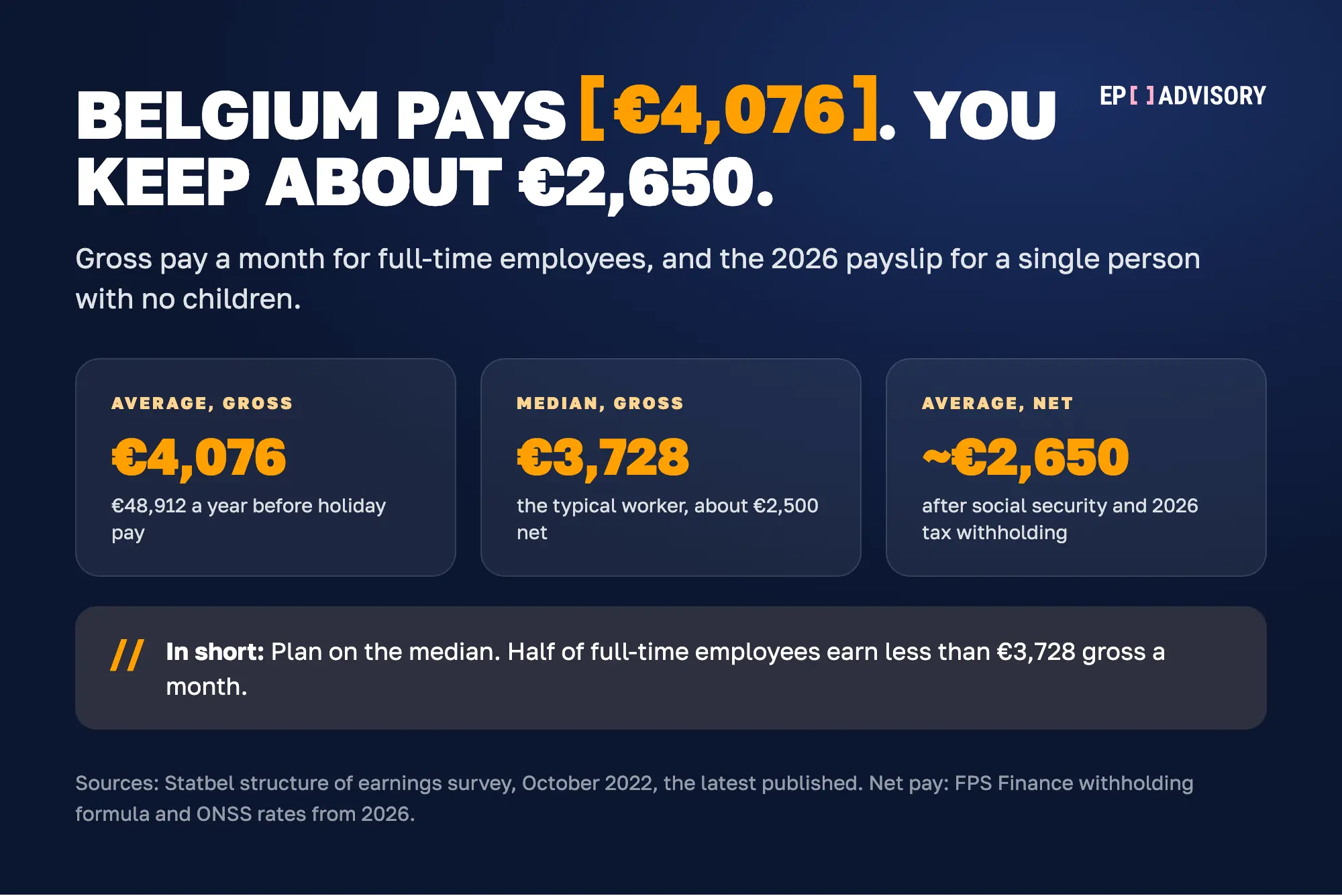
The short answer: the average salary in Belgium is €4,076 a month gross, and about €2,650 of that reaches your account on a 2026 payslip. The median, which describes the typical worker better, is €3,728 gross, or about €2,500 net. The statutory minimum wage is €2,233.61 a month from 1 July 2026. The pay figures come from Statbel’s latest earnings survey, reference October 2022.
| Belgium, 2026 | Per month |
|---|---|
| Average salary, gross | €4,076 |
| Median salary, gross | €3,728 |
| Take-home on the average | ~€2,650 |
| Take-home on the median | ~€2,500 |
| Statutory minimum wage, gross | €2,233.61 |
| Brussels EU Blue Card salary floor | €4,748 |
Belgium pays well and taxes harder than anywhere else in the developed world. Brussels is the most international labour market in continental Europe, English is a working language across the EU institutions and the head offices clustered around them, and salaries sit comfortably above the European average. Then the deductions arrive.
One detail almost every salary page gets wrong is worth knowing first. The €4,076 average you see quoted as a 2024 figure is not 2024 data. It comes from a Statbel survey with a reference month of October 2022, published in September 2024. It is still the newest official figure Belgium has, so it is the right number to use. It is simply older than the label suggests.
So here is the full arithmetic, honestly sourced: pay by sector, the deductions that follow, the expat regime that changes the answer for some newcomers, and the salary the work permit actually requires.
In nearly 10 years, we’ve helped more than 5,000 professionals find jobs abroad. Want to know if your CV will pass screening in Belgium? Check your CV for free: a score in 30 seconds, then a fix for each problem.
What Is the Average Salary in Belgium Per Month? (2026)
The average salary in Belgium is €4,076 a month gross, or €48,912 a year. After social security, income tax and the special social security contribution, a single full-time worker on that salary keeps about €2,650 a month on a 2026 payslip.
That average comes from Statbel, Belgium’s national statistical office, in its structure of earnings survey with a reference month of October 2022, published in September 2024. The median in the same survey is €3,728 a month gross. Half of Belgian full-time employees earn less than that, half earn more, and it is not dragged upward by a handful of very large salaries the way the average is. Anchor on the median.
The spread underneath is wide. Statbel puts the bottom tenth of earners below €2,443 a month and the top tenth above €6,305. A master’s degree is worth about 46% more than the national average. Geography matters too: the Brussels-Capital Region averages €4,748, some 16% above the national figure, while the Dinant district is the lowest in the country at €3,134.
| Salary in Belgium (2026) | Per month, gross | Per month, net |
| Top 10% of earners, above | €6,305 | ~€3,590 |
| Brussels-Capital Region average | €4,748 | ~€2,940 |
| National average | €4,076 | ~€2,650 |
| National median, the typical worker | €3,728 | ~€2,500 |
| Bottom 10% of earners, below | €2,443 | ~€2,150 |
| Statutory minimum wage, from 1 July 2026 | €2,233.61 | ~€2,080 |
Gross figures are Statbel, reference October 2022, published September 2024. Net figures are our estimates for a single person with no children on a 2026 payslip: employee social security of 13.07% less the work bonus, income tax withheld under the FPS Finance formula in force from 1 January 2026, and the special social security contribution. The withholding allows for an average municipal surcharge, and your commune’s actual rate of 0% to 9% is settled in the annual tax return. That moves the result by less than €60 a month on the average salary and by up to about €120 for the top tenth.
What is a good salary in Belgium? Anything above the median of €3,728 a month gross is comfortable outside Brussels. In the capital, where rents run highest, the comfortable line sits closer to €4,500 to €5,000 gross for a single person. Above €6,305 you are in the top tenth of earners nationally.
If the numbers work for you, the next step is practical: the European work-visa salary thresholds show what an offer must pay before a permit is possible, and Belgium’s regional bars are among the more awkward ones on that list.
Belgian Salaries at a Glance: The Essentials
- Average salary: €4,076/month gross, €48,912 a year (Statbel, reference October 2022, published September 2024)
- Median salary: €3,728/month gross, same survey, and the honest benchmark to plan against
- The spread: bottom 10% earn under €2,443/month, top 10% earn over €6,305/month
- Brussels premium: €4,748/month, about 16% above the national average, against €4,028 in Flanders and €3,794 in Wallonia. Dinant is the lowest district at €3,134
- Education effect: a master’s degree is worth roughly 46% above the national average
- Minimum wage: €2,233.61/month gross from 1 July 2026, up from €2,189.81 in April and €2,154.11 in January (National Labour Council, CCT no. 43)
- Tax wedge: 52.5%, the highest of all 38 OECD countries (OECD Taxing Wages 2026, covering 2025)
- Take-home share: on a 2026 payslip a single worker on the average salary keeps about 65% of gross, roughly €2,650 a month. The OECD’s 39.5% rate belongs to its higher, bonus-inclusive average wage of €62,348 a year
- Municipal tax: 0% to 9% of the income tax due, depending on your commune. On the average salary it moves the final figure by less than €60 a month, settled in the annual tax return
- Expat tax regime: up to 35% of gross paid free of tax for those who qualify, minimum salary €70,000 a year (Law of 18 December 2025)
- Holiday pay and 13th month: double holiday pay is statutory, about 92% of a month’s gross (RD 30 March 1967); the 13th month follows your sector’s collective agreement, and Joint Committee 200, the big white-collar committee, makes it mandatory. Ask which joint committee your contract sits under
- Healthcare: covered through social security, with no separate compulsory premium as in the Netherlands or Switzerland
A word on the average against the median. Most salary pages quote €4,076 because it is the bigger number, and it is pulled upward by petrochemicals, finance and the EU institutions. Use the median of €3,728 to set your expectations and the average to compare countries.
Salaries by Sector: Where Foreigners Actually Get Hired
Belgium hires internationally, and Brussels does so more than anywhere else in the country. The EU institutions, NATO, the diplomatic corps and the head offices that follow them support a concentration of roles where the working language is English rather than Dutch or French, unmatched anywhere else in the country. Pay tracks the sector closely, and the gap from top to bottom is larger than most newcomers expect.
| Sector | Average gross, per month |
| Petrochemical industry, the highest-paying sector | €6,431 |
| Head offices and management consultancy | €5,696 |
| Financial services | €5,472 |
| Brussels-Capital Region, all sectors | €4,748 |
| National average, all sectors | €4,076 |
| Hotels, bars and restaurants, the lowest-paying sector | €2,863 |
All figures are Statbel, reference October 2022, published September 2024, for full-time employees. One caveat other salary pages quietly ignore: Statbel’s earnings survey excludes education, healthcare and public administration. If you see a Belgian teacher or nurse salary presented as a Statbel figure, it is not one.
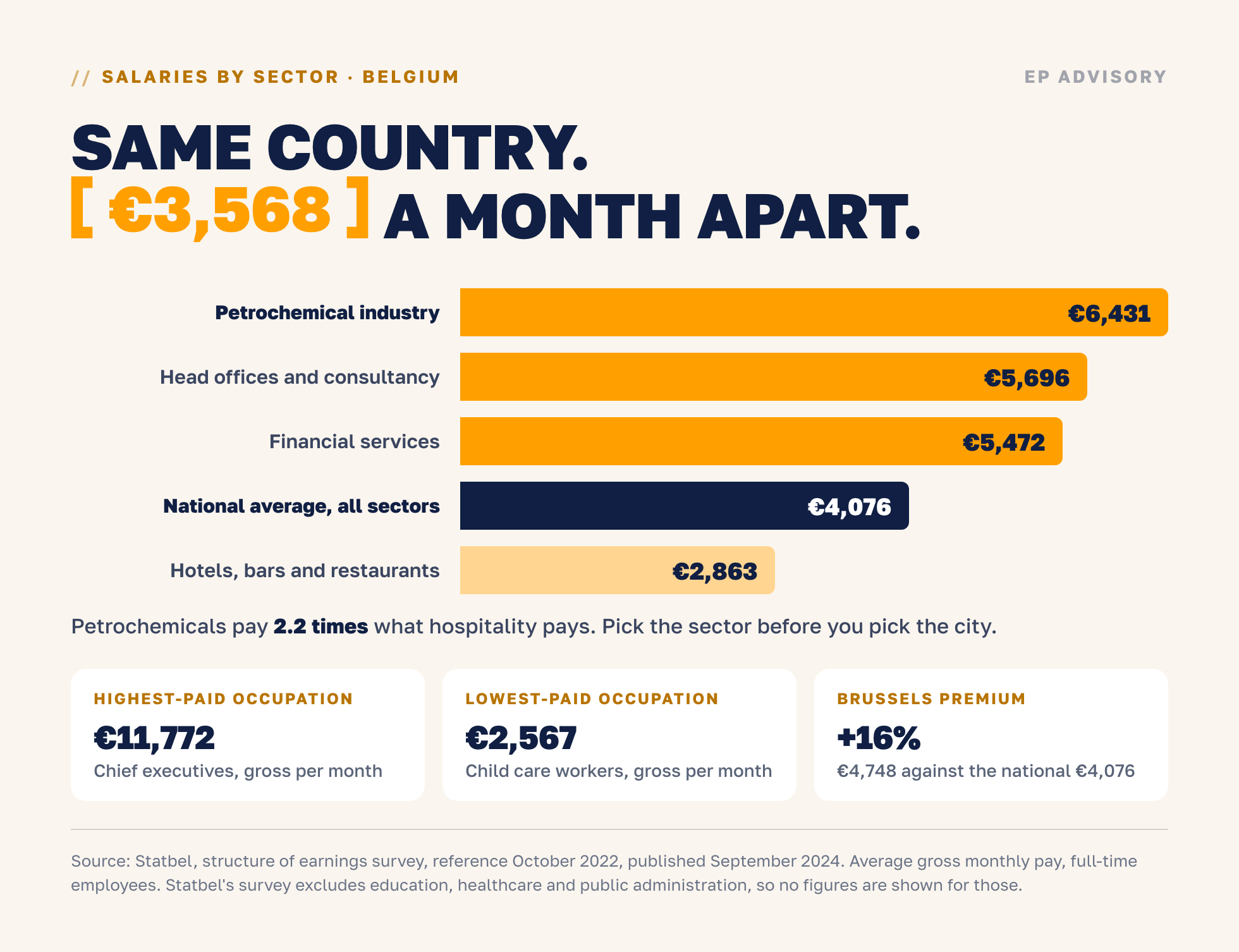
The occupational range is wider still. Statbel puts chief executives at €11,772 a month and child care workers at €2,567, a factor of more than four and a half within the same survey.
What to pin down before you sign. Get three things in writing: which joint committee (commission paritaire) the contract sits under, because that decides whether a 13th month is owed on top of the double holiday pay the law already guarantees, together worth roughly two months of pay a year; which region your workplace sits in, since that decides your permit threshold; and whether you qualify for the expat tax regime, which moves your net pay further than a five-figure raise would.
Average Salary by Region: Brussels, Flanders and Wallonia
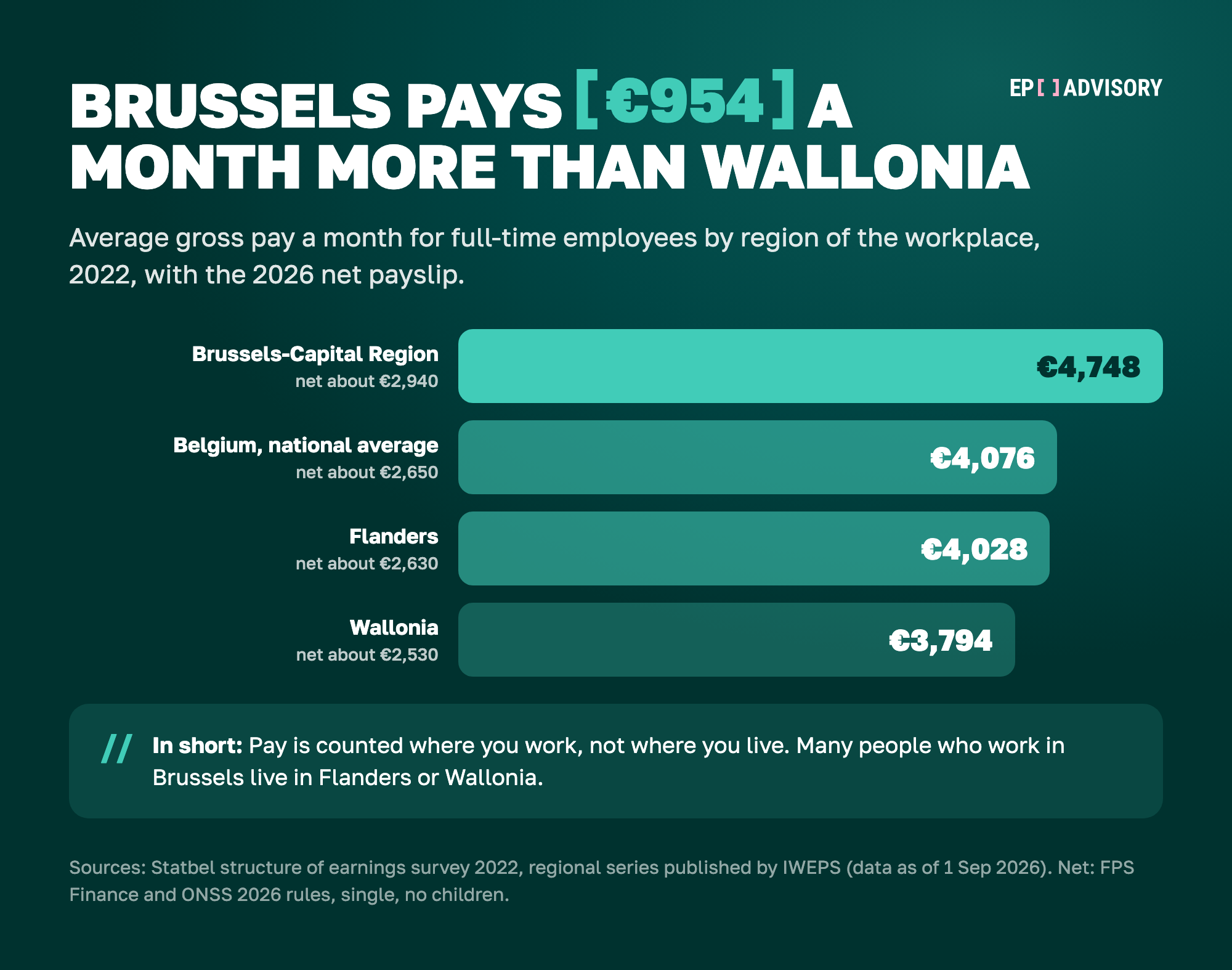
Brussels pays the most: €4,748 a month gross on average, about €2,940 net. Flanders averages €4,028 and Wallonia €3,794, so the average Brussels job pays €954 a month more than the average job in Wallonia.
| Region of workplace | Average, gross | Median, gross | Net on the average |
| Brussels-Capital Region | €4,748 | €4,310 | ~€2,940 |
| Flanders | €4,028 | €3,711 | ~€2,630 |
| Belgium | €4,076 | €3,728 | ~€2,650 |
| Wallonia | €3,794 | €3,540 | ~€2,530 |
Figures are monthly, for full-time private-sector employees at firms with 10 or more staff, from Statbel’s earnings survey with a reference month of October 2022, in the regional series published by IWEPS, the Walloon statistics institute. Net pay is our estimate for a single person with no children on a 2026 payslip.
Two points help you read the table. Pay is counted where the job is, not where the worker lives, and many people who work in Brussels live in Flanders or Wallonia. And the Brussels lead reflects the jobs based there: head offices, finance and business services cluster in the capital. The survey leaves out the public sector and the international institutions, so their pay is not in these figures. Rents run highest in Brussels too, so compare offers on what is left after housing, not on gross pay alone.
Score your CV in 30 seconds, then fix its biggest problems one by one. Both free.
Free, no card.

Minimum Wage in Belgium 2026: €2,233.61 a Month
Belgium’s statutory minimum wage is €2,233.61 a month gross from 1 July 2026.
The formal name is the guaranteed average minimum monthly income, or RMMMG, set nationally by collective agreement (CCT no. 43) rather than by an hourly rate. It applies to private-sector employees aged 18 and over. The figure moved three times in 2026: indexation to inflation in January and July, and an increase agreed by the social partners in April.
| Effective from | Minimum wage, gross per month |
| 1 January 2026 | €2,154.11 |
| 1 April 2026 | €2,189.81 |
| 1 July 2026 | €2,233.61 |
Source: National Labour Council, amounts in force from 1 July 2026. On a 2026 payslip a single worker on the minimum keeps about €2,080 a month, because the work bonus cancels employee social security at this level and cuts the income tax. Two consequences follow. Many sector agreements set floors above the national minimum, so the legal figure is a floor rather than a going rate. And the minimum sits far below every work-permit salary threshold in the country, so a minimum-wage job cannot sponsor a non-EU applicant.
Minimum wage by age. There is no lower youth rate for adult employees: the full €2,233.61 applies from age 18. Two groups sit outside it. Students aged 18 to 20 working on a student contract fall under a separate, reduced minimum set by collective agreement no. 50, and trainees on work-study schemes are not covered.
Where to Look for Work: Official Resources
Belgium runs four public employment services rather than one national one. As a jobseeker you register with the service for where you live; permit thresholds, by contrast, follow where the workplace sits.
- VDAB: the Flemish service, covering Antwerp, Ghent, Leuven and the rest of Flanders. Its annual shortage-occupation list is worth reading before you apply
- Actiris: the Brussels-Capital Region service, and the most useful of the three for English-speaking roles
- Le Forem: the Walloon service, covering Liège, Charleroi, Namur and French-speaking Belgium
- ADG: the Arbeitsamt of the German-speaking community in the east, the smallest of the four
- EURES: the European Commission’s portal, aggregating vacancies from all three Belgian services alongside the rest of the EU
To check the numbers yourself: Statbel for earnings, FPS Finance for income tax, and Belgian Social Security for contributions and healthcare cover.
The Other Side: What Living Here Costs
Belgium publishes excellent earnings statistics and no equivalent official household budget, so treat the ranges below as market observation rather than an official series.
Rent is the dominant line. A one-bedroom flat runs roughly €900 to €1,300 a month in Brussels, €800 to €1,100 in Antwerp and Ghent, and €600 to €900 in smaller cities and most of Wallonia. Landlords take a rental deposit, legally capped by region at two to three months’ rent, plus proof of income, and registering the lease adds cost at the start.
Healthcare does not need a separate premium. This is a real advantage over the Netherlands and Switzerland, where compulsory private health insurance takes a few hundred euros a month out of net pay. In Belgium, cover comes through the social security contributions already deducted at source. You join a health insurance fund (mutualité or ziekenfonds), which typically charges around €10 to €15 a month for the complementary cover funds bundle in, pay part of each consultation yourself and are reimbursed for most of it.
Everything else. Groceries land around €300 to €400 a month for one person, with Colruyt and Aldi at the cheaper end. Utilities and internet together run €200 to €300. An annual Brussels transport pass costs a few hundred euros, and VAT (21% standard, 6% on most food) is already inside every price you see.
The Arithmetic: What Actually Lands in Your Account
Three deductions come out of a Belgian salary before you see it. Social security takes a flat 13.07% of gross. Income tax is then withheld at source on rates rising from 25% to 50%, with the top rate reached at a low income by European standards, and the municipal surcharge of 0% to 9% is squared up in the annual tax return. A small special social security contribution comes last. Run that on the national average of €4,076 a month, for a single person on a 2026 payslip.
| Line | € per month |
| Gross salary, national average | 4,076 |
| − Employee social security, 13.07% | −533 |
| − Income tax withheld, 2026 formula | −859 |
| − Special social security contribution | −39 |
| = Net in your account | ~2,646 |
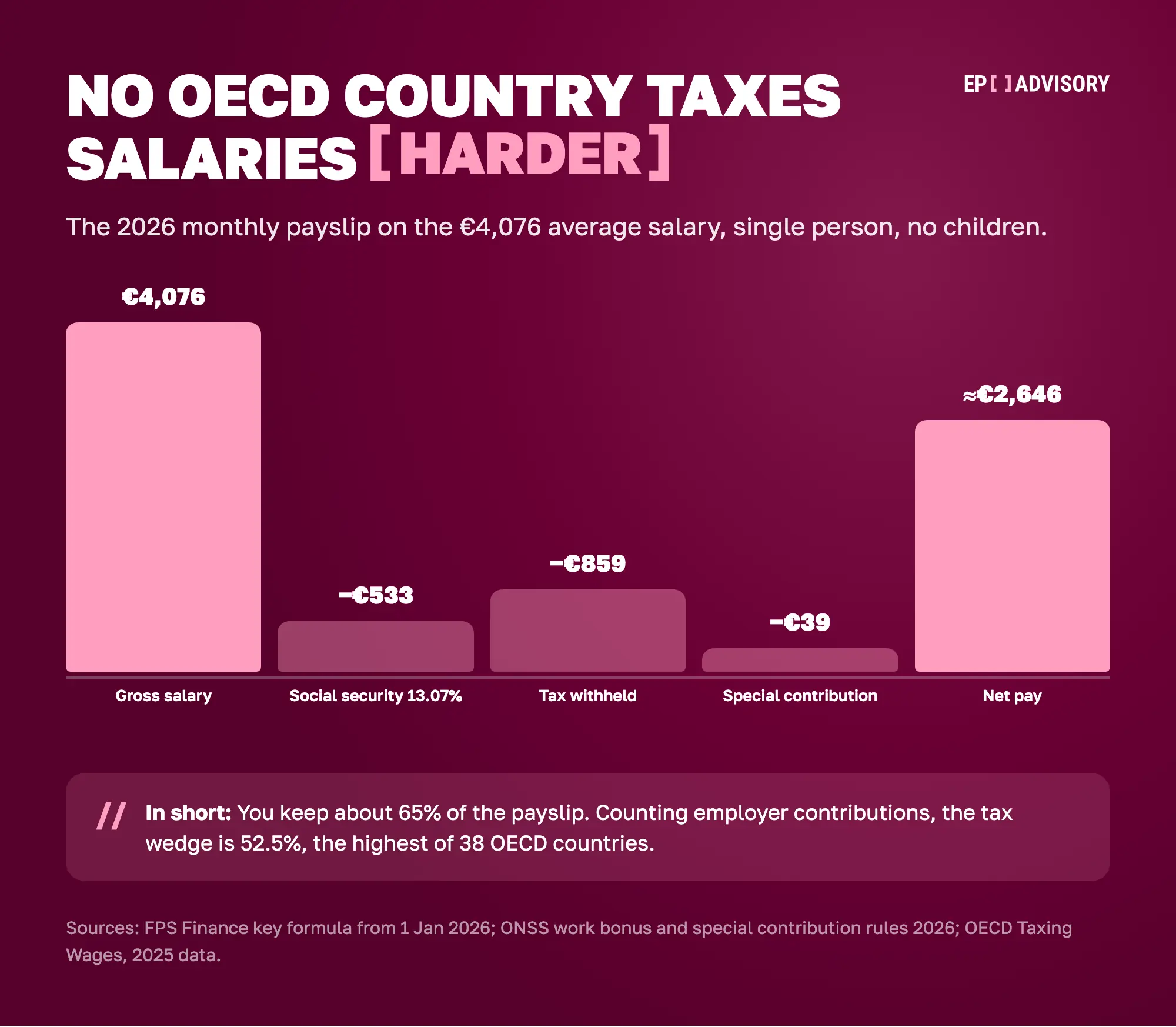
That is the headline finding, and it is not close. The OECD’s Taxing Wages 2026 report, covering 2025, puts Belgium’s total tax wedge on the average wage at 52.5%, the highest of all 38 OECD countries. The wedge also counts the employer’s social security, which is why it is far above the share that leaves your payslip. On the payslip itself, a single worker on €4,076 keeps about 65%, roughly €2,650. Your commune’s surcharge, squared up in the annual tax return, moves that by less than €60 a month.
Take-home pay at six salary levels. The share you keep falls as pay rises, from about 93% at the minimum wage to about 57% for the top tenth of earners.
| Gross per month | Social security | Income tax | Special contribution | Net per month | Share kept |
| Minimum wage, €2,233.61 | €0 | €138 | €11 | ~€2,084 | 93% |
| Bottom 10%, €2,443 | €58 | €219 | €13 | ~€2,152 | 88% |
| Median, €3,728 | €487 | €713 | €27 | ~€2,501 | 67% |
| Average, €4,076 | €533 | €859 | €39 | ~€2,646 | 65% |
| Brussels average, €4,748 | €621 | €1,140 | €47 | ~€2,941 | 62% |
| Top 10%, €6,305 | €824 | €1,830 | €61 | ~€3,590 | 57% |
Our estimates for a single person with no children, monthly, rounded to the euro. Social security is the employee’s 13.07% less the social work bonus. Income tax is withheld under the FPS Finance formula in force from 1 January 2026, after the fiscal work bonus. The special social security contribution follows the ONSS scale.
The OECD cross-check. The OECD measures take-home pay over a full year, bonuses included, for a single worker at three pay levels.
| OECD pay level, 2025 | Gross a year | Net a year | Share kept |
| Two-thirds of the average wage | €41,773 | €28,625 | 68.5% |
| Average wage | €62,348 | €37,691 | 60.5% |
| 167% of the average wage | €104,121 | €54,783 | 52.6% |
Source: OECD Taxing Wages, 2025 data, single person with no children. The OECD’s average wage of €62,348 a year includes bonuses and is measured differently from Statbel’s monthly survey, so its 39.5% net tax rate does not apply to the €4,076 figure.
What that leaves in practice. On the national average, after €1,100 of Brussels rent, €350 of groceries and roughly €400 of utilities, transport and connectivity, you are left with something around €800 a month of genuinely free money. That is modest for a country whose gross pay ranks among Europe’s best, and outside Brussels the same salary stretches noticeably further.
Two things improve the picture. The year holds more than 12 payments: double holiday pay is statutory, about 92% of a month’s gross under the annual-holidays rules (RD 30 March 1967), and in most white-collar sectors a 13th month arrives through the sector agreement, mandatory under Joint Committee 200. Together they add roughly two months of gross pay across the year. On the average salary, twelve months of €4,076 make €48,912; double holiday pay lifts that to about €52,660, and a 13th month to about €56,740. And for those who qualify, the expat regime changes the arithmetic more than anything else available.
The Expat Tax Regime: 35% of Your Salary Tax-Free
This is Belgium’s answer to its own tax wedge, and the most valuable thing on this page for anyone arriving from outside the country. Under the special regime for incoming taxpayers, an eligible employee can receive up to 35% of gross remuneration as a tax-free and contribution-free relocation allowance.
The Law of 18 December 2025 improved all three terms that matter:
- The tax-free share rose from 30% to 35% of gross remuneration
- The €90,000 annual cap on the allowance was abolished, so high earners now benefit in proportion rather than hitting a ceiling
- The minimum qualifying salary fell from €75,000 to €70,000 a year, widening eligibility
The practical effect is large. On a €70,000 salary, 35% is €24,500 a year arriving free of both income tax and social security, worth several hundred euros a month of extra net pay for no change in the gross number. The regime runs for five years, extendable to eight, and applies to people recruited from abroad or transferred into Belgium rather than to those already working locally.
Two conditions catch people out. Your employer applies on your behalf and the window after you start is short, so it has to be agreed before you sign. And the regime is entirely separate from your work permit. Qualifying for one tells you nothing about the other.
Work Permits: Your Route In
Citizens of the EU, EEA and Switzerland work in Belgium without a permit. Everyone else needs an employer willing to apply for a single permit, and Belgium’s federal structure creates its defining quirk: the three regions set their own salary thresholds, and the one that applies depends on where your workplace sits.
| Region and route | Minimum salary, 2026 |
| Brussels, highly qualified worker | €3,703.44 / month |
| Brussels, EU Blue Card | €4,748 / month |
| Flanders, highly qualified worker | €48,912 / year |
| Flanders, under 30 or nursing | €39,129.60 / year |
| Flanders, EU Blue Card | €63,586 / year |
| Wallonia, highly qualified worker | €53,220 / year |
| Wallonia, EU Blue Card | €68,815 / year |
Sources: Brussels Economy and Employment, KPMG and Moore, 2026 regional thresholds.
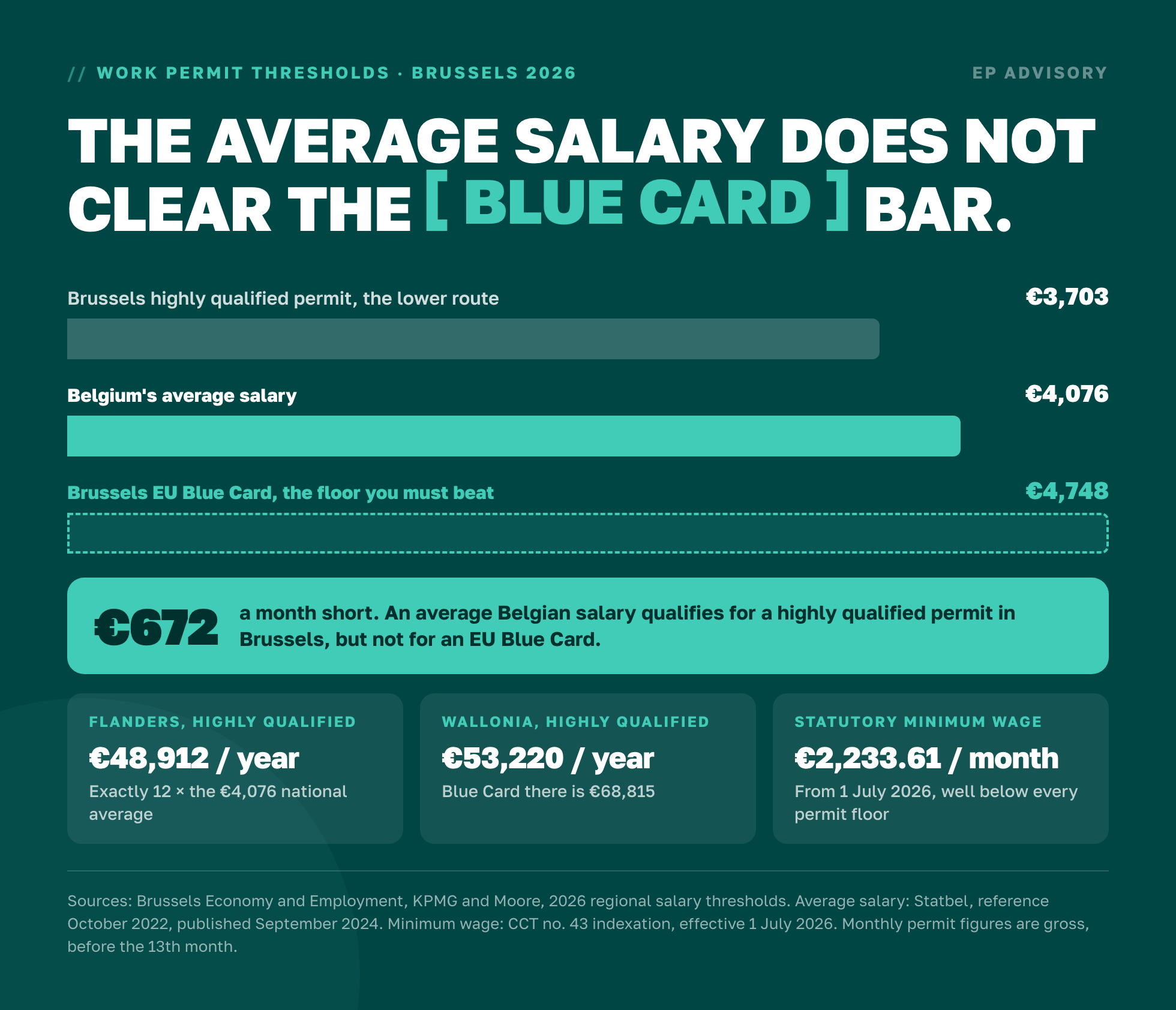
Two coincidences in that table tell you exactly how hard the Belgian bar is set.
The national average salary does not clear the Brussels Blue Card. The Blue Card floor in Brussels is €4,748 a month, which is precisely the average salary in the Brussels region. The national average of €4,076 falls €672 a month short. An average Belgian salary qualifies you for a highly qualified worker permit in Brussels, where the floor is €3,703.44, but not for a Blue Card.
The Flemish highly qualified threshold is the average salary, annualised. Flanders asks €48,912 a year, and 12 × €4,076 is €48,912 exactly. To work in Flanders on that route you must be offered, to the euro, the Belgian average salary. Wallonia sets its bar higher still at €53,220.
The lesson is the same in all three regions: aim at the threshold, not at the average. Target the sectors from the ladder above where pay clears the bar to begin with, and confirm the region of the workplace before you get attached to an offer. Our comparison of Belgium’s visa salary thresholds against 15 other European countries shows how unusual this three-region split is, and if you are weighing the neighbours, salaries in the Netherlands run a very different arithmetic on tax and housing.
Key Takeaways
- The average salary is €4,076 a month gross and the median €3,728. Plan against the median, and note that both come from a Statbel survey with an October 2022 reference month, not from 2024 data.
- On a 2026 payslip you keep about 65% of the average salary, roughly €2,650 a month. Belgium’s 52.5% tax wedge is the highest of all 38 OECD countries.
- The statutory minimum wage is €2,233.61 a month from 1 July 2026, below every work-permit threshold in the country.
- Brussels averages €4,748 a month, Flanders €4,028 and Wallonia €3,794. Pay is counted where the job is, so compare offers on net pay after rent.
- Sector decides more than city. Petrochemicals pay €6,431 against €2,863 in hospitality, a gap of €3,568 a month.
- The expat regime is the biggest single lever: up to 35% of gross tax-free, no cap since the Law of 18 December 2025, from €70,000 a year. Check eligibility before you sign.
- Healthcare comes through social security, with no separate compulsory premium as in the Netherlands or Switzerland. Double holiday pay is statutory, about 92% of a month; the 13th month follows your sector agreement and is mandatory in the big white-collar Joint Committee 200.
- Three regions, three sets of thresholds. The average salary clears Brussels’ highly qualified permit but falls €672 short of the Brussels Blue Card.
See what a recruiter sees, then fix it before you apply. An instant score, then the fix for every problem.
Free, no card. A free account unlocks every fix.
Frequently Asked Questions
What is a good salary in Belgium?
Anything above the median of €3,728 a month gross is comfortable outside Brussels. In the capital, where rents are highest, the comfortable line for a single person sits closer to €4,500 to €5,000 gross. Above €6,305 a month you are in the top 10% of earners nationally, according to Statbel.
What is the average salary in Belgium per month?
The average salary in Belgium is €4,076 a month gross, or €48,912 a year, according to Statbel’s structure of earnings survey with a reference month of October 2022, published in September 2024. The median in the same survey is €3,728 a month, a better guide to what a typical worker earns. On a 2026 payslip a single worker on the average keeps about €2,650 a month.
What is the minimum salary in Belgium in 2026?
The statutory minimum is €2,233.61 a month gross from 1 July 2026, set by the National Labour Council. It moved three times during the year: €2,154.11 in January, €2,189.81 in April and €2,233.61 in July. It applies in full from age 18, and a single worker on it keeps about €2,080 net. Many sector agreements set higher floors, and the minimum sits below every work-permit salary threshold.
How much is the take-home pay on the average Belgian salary?
About €2,650 a month on a 2026 payslip, or roughly 65% of the €4,076 gross, for a single person with no children. Social security takes €533, income tax withheld at source about €859 and the special social security contribution €39. Your commune’s surcharge is settled in the annual tax return and moves the result by less than €60 a month.
What is the average salary in Brussels?
The Brussels-Capital Region averages €4,748 a month gross for full-time employees, about 16% above the national average, and the median is €4,310. On a 2026 payslip that average leaves about €2,940 net. Flanders averages €4,028 and Wallonia €3,794. The figures are Statbel’s, by region of workplace, with a reference month of October 2022.
What salary do you need for an EU Blue Card in Belgium?
It depends on the region: €4,748 a month in Brussels, €63,586 a year in Flanders and €68,815 a year in Wallonia in 2026. The Brussels figure matters, because the national average salary of €4,076 falls €672 a month short of it. The lower highly qualified worker route asks €3,703.44 a month in Brussels and €48,912 a year in Flanders.
Getting ready to apply for jobs in Belgium? Check your CV for free: see it the way a recruiter does, then fix each problem.