 By Andre Atallah, CEO of EP Advisory
An interview is not a test of who you are. It is a test of how well you can show who you are, under pressure, in a short conversation. That is good news. It means interviewing is a skill, and skills can be built.
This guide walks through the full journey: the preparation that changes how you show up, the answers that win offers, and the behaviour that keeps you steady when it counts. It is written for professionals interviewing abroad, where the stakes are higher and the rules are often unfamiliar. Most hiring decisions still come down to a handful of interviews, so the margins are thin and preparation pays.
The mindset that changes everything: it is a date, not a test
Here is the reframe we teach before any technique. An interview is not a corporate meeting, and it should never feel like one. It is closer to a first date. The other person is deciding whether they like you and want to work with you, not marking a logical exam. A dry, historical recitation of your CV makes you seem boring on a date, and it does the same in an interview.
Two consequences follow. First, delivery beats detail. How you say something carries more weight than the fine print of what you say, so a well-delivered, human answer beats a perfect but flat one. Second, a useful trick is to simulate the best candidate in the world for your field. That person is not anxious about the questions; they are genuinely obsessed with the work, the way a surgeon you would actually want reads about your operation the night before. To step into that persona, spend five minutes before you prepare writing what that person would say about why they love this work, then let it colour your answers. They change on their own, without forcing.
Details don’t matter. Delivery does. A well-delivered, human answer beats a perfect but flat one.
Why interviews feel harder when you are interviewing abroad

If you are applying for a role in another country, you are carrying more than the usual pressure. You may be speaking a second language. The interview format may be different from what you grew up with. And the outcome may decide whether a whole relocation goes ahead.
That extra weight is real, and naming it helps. Three things change when you interview abroad:
- Language. You are performing in a language that is not your first. Simple answers can feel harder, and nerves make it worse.
- Culture. What counts as confident in one country reads as arrogant in another. Directness, small talk, and how you speak about achievements all vary.
- Stakes. A local candidate who fails an interview tries again next week. For you, the offer may be tied to a visa, a move, and a plan for your family.
Every section below is written with those pressures in mind.
Before the interview: research that changes how you show up
Preparation is the single biggest driver of a calm, convincing interview. When you are thoroughly prepared, uncertainty drops, and so do your nerves.
Read the job description at least three times. Highlight the four or five requirements the employer emphasises most. Those are the themes your answers must hit. Then make sure you can answer three questions about the company without hesitating:
- What does this company actually do, in one clear sentence?
- Who are its main competitors, and how is it different?
- What is one recent development in its business or industry?
For a role abroad, add one more layer of research: the local hiring norms. Find out whether interviews in that country tend to be formal or relaxed, whether they favour direct answers or modesty, and whether a case study or test is common in your field.
Prepare your answers with the STAR method
No good interview answer is improvised. The questions in most interviews are predictable, so prepare structured answers and you will handle the majority of what comes your way.
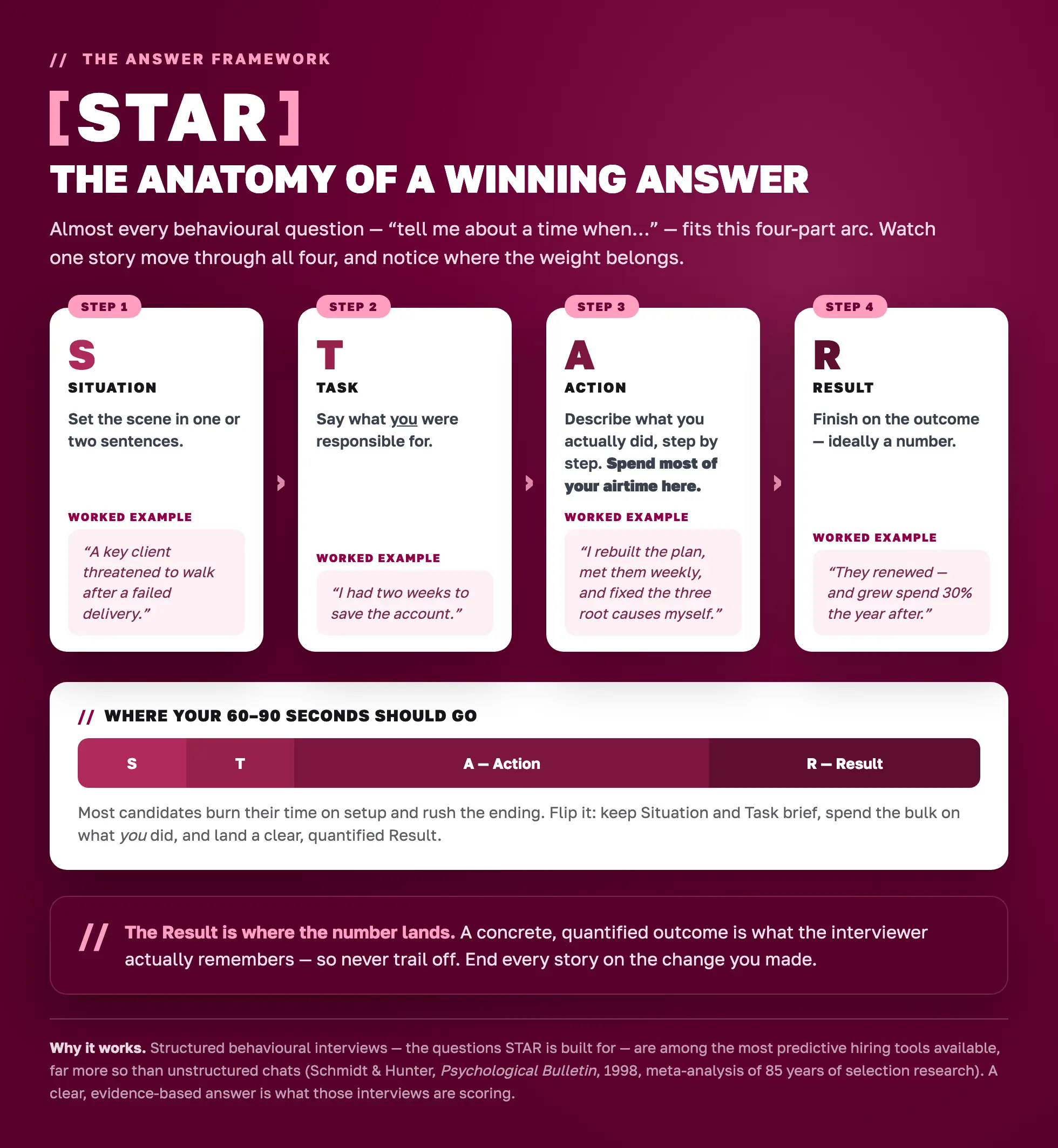
Behavioural questions, “tell me about a time when…”, make up most modern interviews. The reliable way to answer them is the STAR method:
- Situation: set the scene in one or two sentences.
- Task: explain what you were responsible for.
- Action: describe what you did, specifically.
- Result: finish with the outcome, ideally with a number.
Prepare eight to ten STAR stories that cover leadership, conflict, failure, a big win, and working under pressure. Each should take 60 to 90 seconds to tell. Good stories are reusable, so a well-built set will answer dozens of possible questions.
“Tell me about yourself”: the 90-second formula
This is the most common opening question, and the most commonly fumbled. Do not tell your life story. Use the Present–Past–Future formula and keep it to about 90 seconds:
- Present: who you are professionally right now.
- Past: the one or two experiences that led you here and fit this role.
- Future: why this job, in this country, is the logical next step.
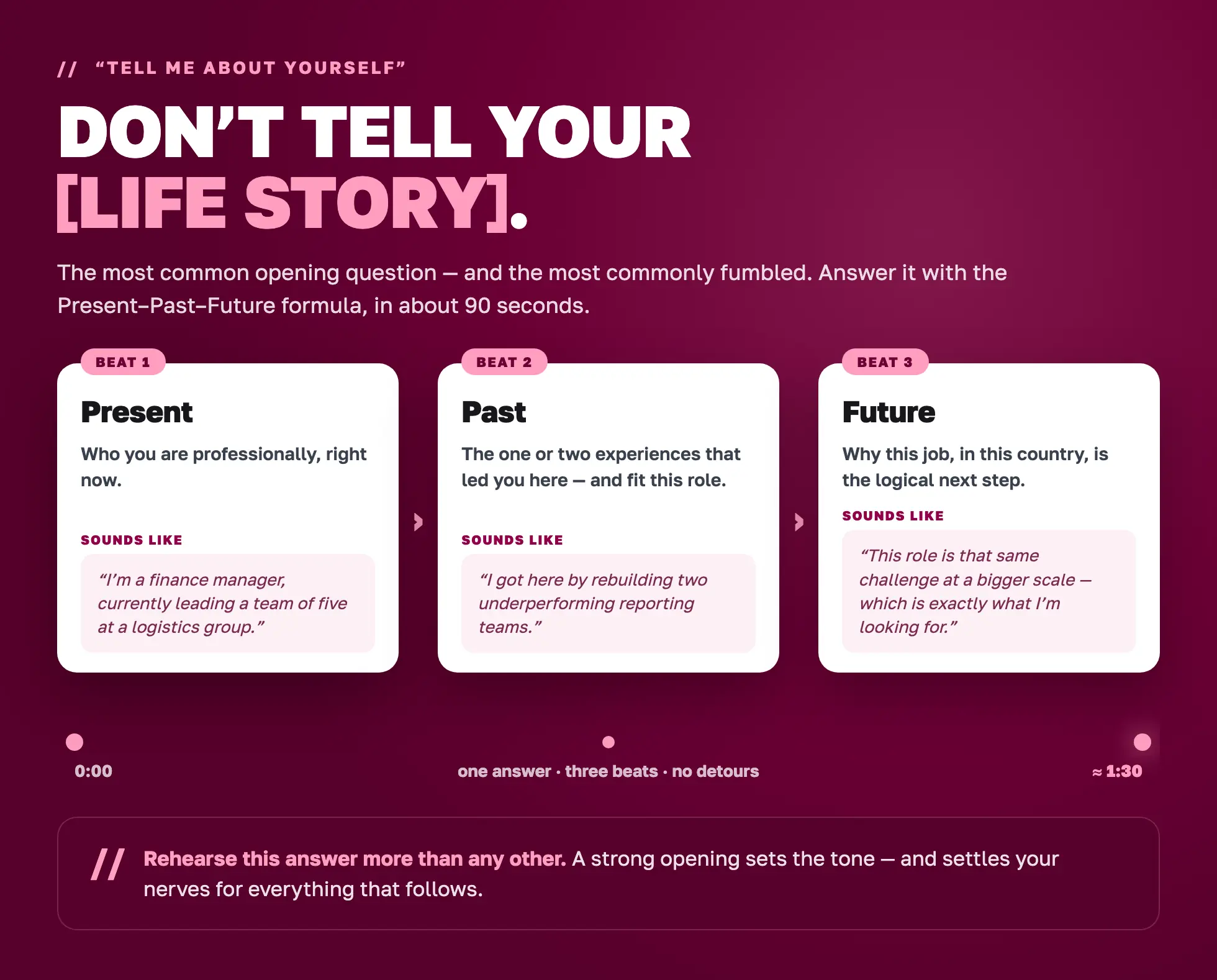
Rehearse this answer more than any other. A strong opening sets the tone and settles your nerves for everything that follows.
Practise out loud, not in your head
Rehearsing silently reveals nothing about pacing, clarity, or whether a story lands. Practising out loud is the most underused preparation step there is.
Say your answers aloud until they feel natural. Record yourself, or run a mock interview with a friend or a coach. If you are interviewing in a second language, this step matters even more, because it turns words you understand into words you can say smoothly under pressure.
Practising out loud is the most underused step there is. Silent rehearsal reveals nothing.
Interview formats and how each one changes your prep
The format shapes your preparation. Know which one you are facing and prepare for it specifically.
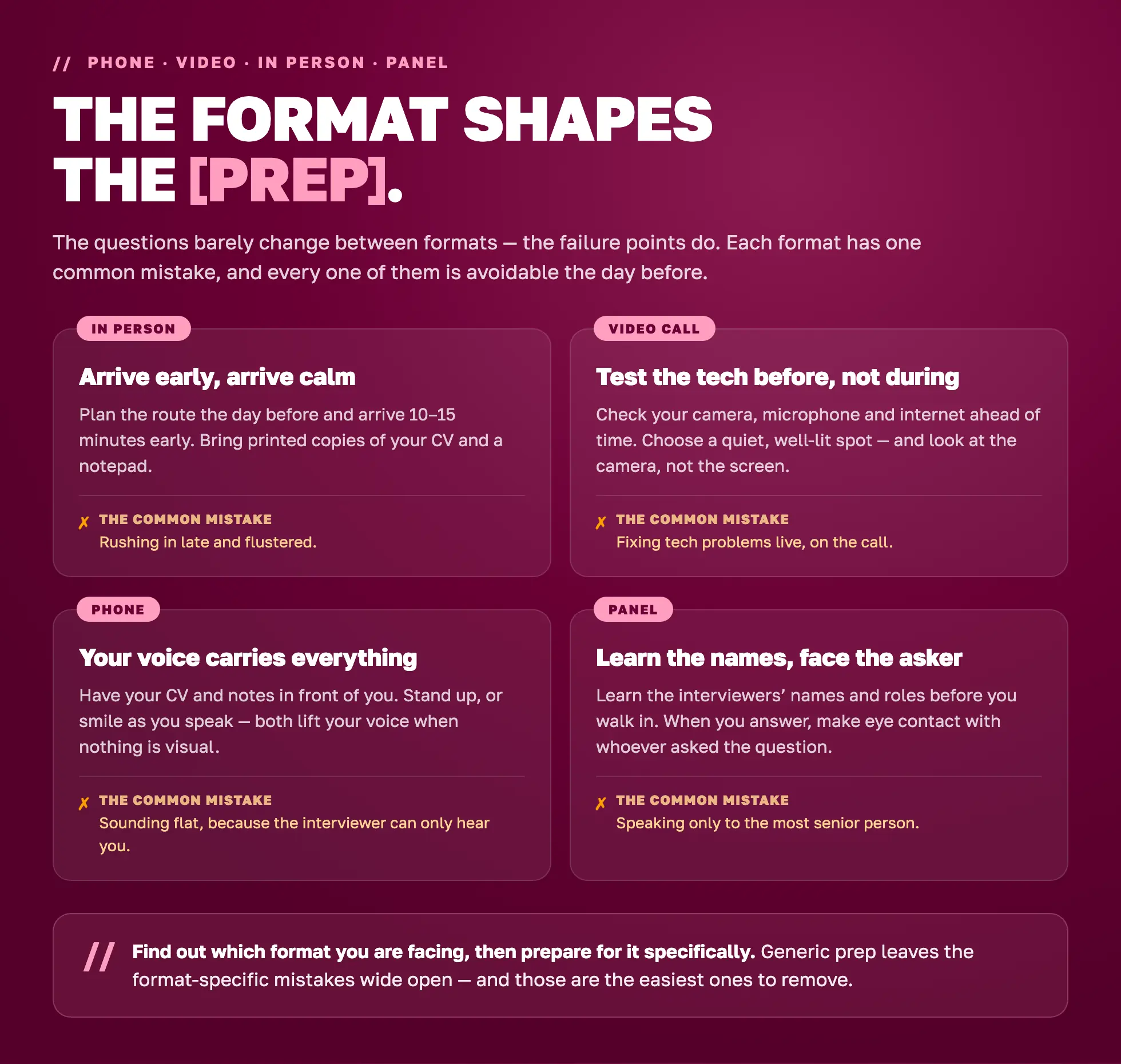
| Format | What to prepare | The common mistake |
|---|---|---|
| In person | Arrive 10–15 minutes early. Bring printed copies of your CV and a notepad. Plan the route the day before. | Rushing in late and flustered. |
| Video call | Test your camera, microphone, and internet ahead of time. Choose a quiet, well-lit spot. Look at the camera, not the screen. | Fixing tech problems live, on the call. |
| Phone | Have your CV and notes in front of you. Stand up or smile to lift your voice. | Sounding flat because nothing is visual. |
| Panel | Learn the interviewers’ names and roles. Make eye contact with whoever asked the question. | Speaking only to the most senior person. |
What to wear and how to present yourself
How you look is part of how you are read, especially in the first few seconds. Dress one level above the company’s everyday norm, and make sure you feel comfortable and confident in what you wear. Appearance is a confidence lever, not just a formality.
We cover this in depth in our guide on what to wear to an interview and how to present yourself.
Calm your nerves and stay composed
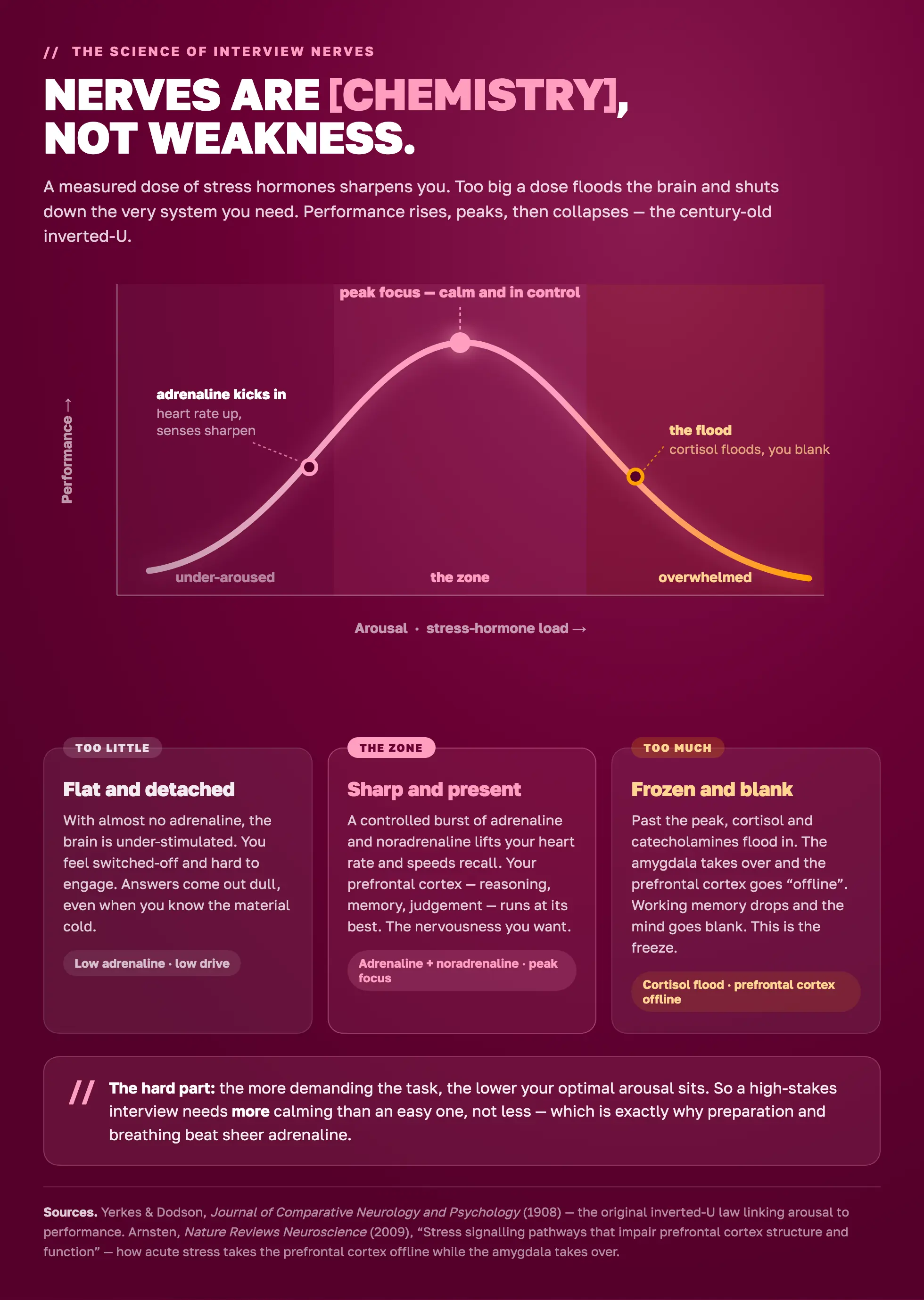
You can prepare perfectly and still lose the room if nerves take over. The fix is not to feel nothing. It is to control what you feel, mainly through your breath and your pace.
Slow your first answer down. Use pauses on purpose. Breathe between questions. For the full set of techniques, including breathing exercises you can use in the waiting room, read our guide on how to calm interview nerves.
Handling the hardest questions
Some questions are designed to see how you think under pressure: your weaknesses, a failure, a gap in your CV, or why you are leaving. The goal is not a perfect answer. It is an honest, composed one. Prepare these in advance so they never catch you cold. Our guide on answering the hardest interview questions gives you a framework for each.
Aptitude and psychometric tests
Many employers, especially larger and international ones, add a logic, numerical, or personality test before or after the interview. These reward practice and a calm, timed approach. If a test is part of your process, see our guide on passing psychometric and logic tests.
Questions to ask them
An interview is a two-way choice. Asking good questions shows genuine interest and helps you judge whether the role is right for you. Prepare three or four, such as what success looks like in the first six months, how the team is structured, and what the biggest challenge of the role is. For a move abroad, it is fair to ask about relocation support and the visa timeline.
After the interview: the follow-up
A short thank-you message within 24 hours keeps you front of mind and signals professionalism. Thank the interviewer, mention one specific thing from the conversation, and restate your interest in one line. Keep it brief and sincere.
When the offer comes: negotiate it
If the interviews go well, the process ends with a number, and most candidates simply accept it. Do not. The employer has just decided they want you, which is exactly when you have the most room to ask. Negotiate calmly, and look at the whole package: for a move abroad, relocation support, visa costs, and a salary review can matter as much as base pay. Our guide on how to negotiate your salary covers the full approach, from research to the ask itself.
If it does not work out: bouncing back
Even strong candidates get rejections, and the search abroad can be long. A “no” is data, not a verdict. If the search has been hard, read our guide on what to do when you cannot find a job to reset your approach and your mindset.
Your 4-week interview prep plan
Preparation works best in a sequence, because the earlier steps make the later ones possible. Here is the order we take clients through. If you have less time, compress it, but keep the order.
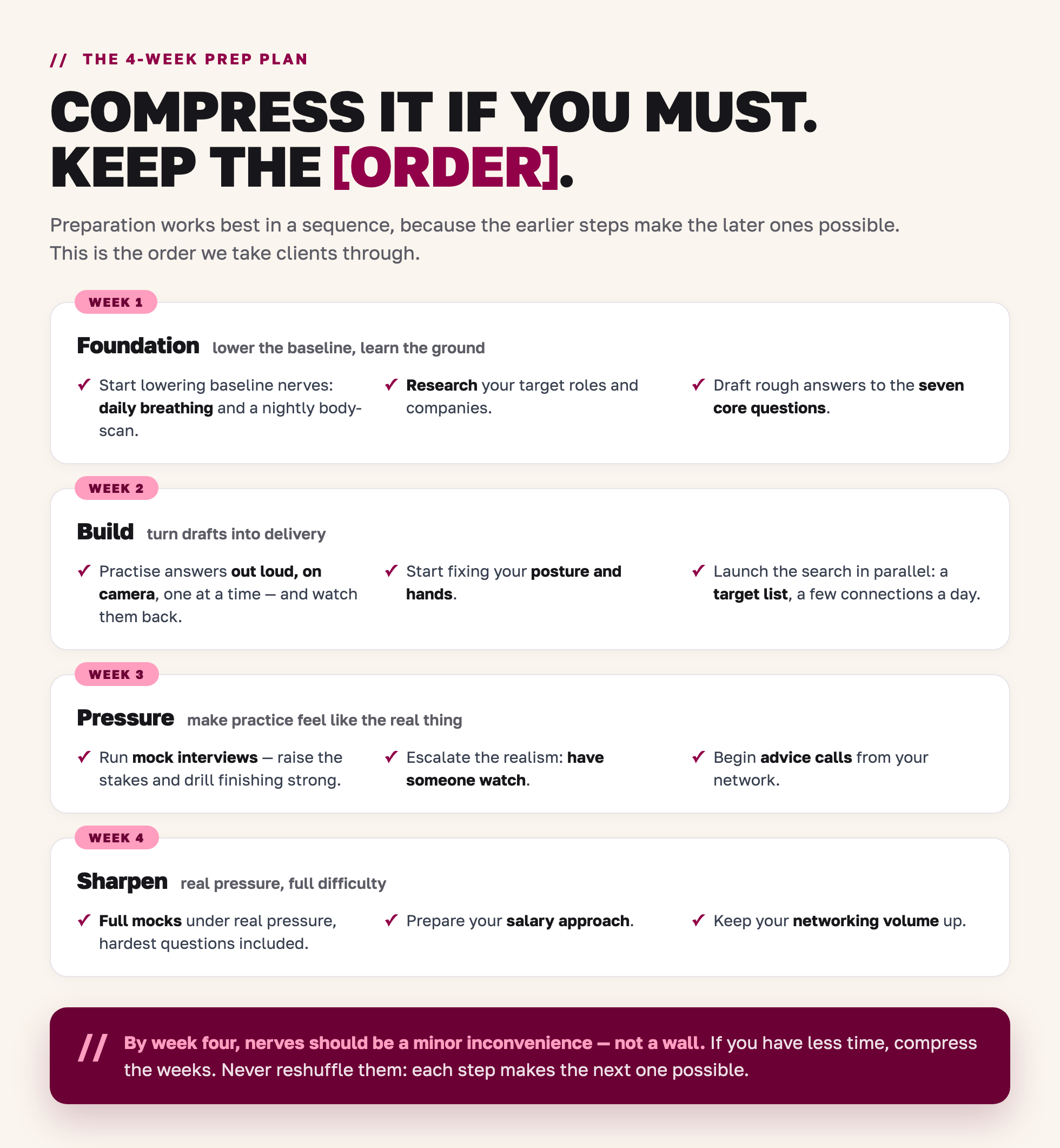
- Week 1, Foundation. Start lowering your baseline nerves with daily breathing and a nightly body-scan (see calming your nerves). Research your target roles and companies. Draft rough answers to the seven core questions (see tough questions).
- Week 2, Build. Practise your answers out loud, one at a time, on camera, and watch them back. Start fixing your posture and hands (see presenting yourself). Launch your job search in parallel: build a target list and begin a few connections a day (see the job-search plan).
- Week 3, Pressure. Run mock interviews. Drill raising the stakes and finishing strong. Escalate the realism by having someone watch. Begin advice calls from your network.
- Week 4, Sharpen. Full mocks under real pressure, including the hardest questions, and prepare your salary approach. Keep your networking volume up. By now your nerves should be a minor inconvenience, not a wall.
Summary and FAQs on passing a job interview
Interviews reward preparation more than talent. Research the role, build and rehearse your answers out loud, prepare for your specific format, and manage your nerves with your breath. Do that, and you walk in ready to show your best, not just hoping to.
If you are interviewing for a role abroad and want a second pair of eyes, a career coach who knows the local market can be the difference between a good interview and an offer. Use our free consultant picker tool to find the right expert for your target country.