 By Andre Atallah, CEO of EP Advisory
What should you wear to a job interview in 2026? Clothes that fit the company, fit you and then stop being noticed. In nearly 10 years EP Advisory has helped more than 5,000 clients prepare for interviews with international employers. This guide gives you outfits for women and men, the dress code by company, and what to wear on video, in summer and abroad.
Quick answer. Dress one level smarter than the people who already work there. For a bank, law firm or consultancy, wear a suit. For a corporate office, business casual: a jacket, trousers or a skirt, a shirt or blouse. For tech, startups and creative companies, smart casual: dark jeans or chinos, a plain top and clean shoes. For a video interview, dress exactly as you would in person. Keep to 2–4 calm colours. Make sure everything fits and is clean. If in doubt, especially abroad, choose the more formal option.
Why what you wear to an interview matters
First impressions form very fast. In a Princeton study, people saw a photo of a face for just 100 milliseconds. Their judgements closely matched those of people who looked for as long as they liked (Willis and Todorov, 2006). Your clothes are part of that picture. They will not get you the job, but they can distract from what you say.
The interviewer is asking two things: will you fit the team, and do you understand where you are. Clothes affect you as well. When you know your appearance is right, you answer more calmly. If nerves are your bigger problem, read our guide on how to calm interview nerves.
The interview dress code by type of company
The main rule is simple: dress one level smarter than the staff on a normal day. If the office is casual, wear smart casual. If it is smart casual, wear business casual. It shows you take the meeting seriously without looking out of place.
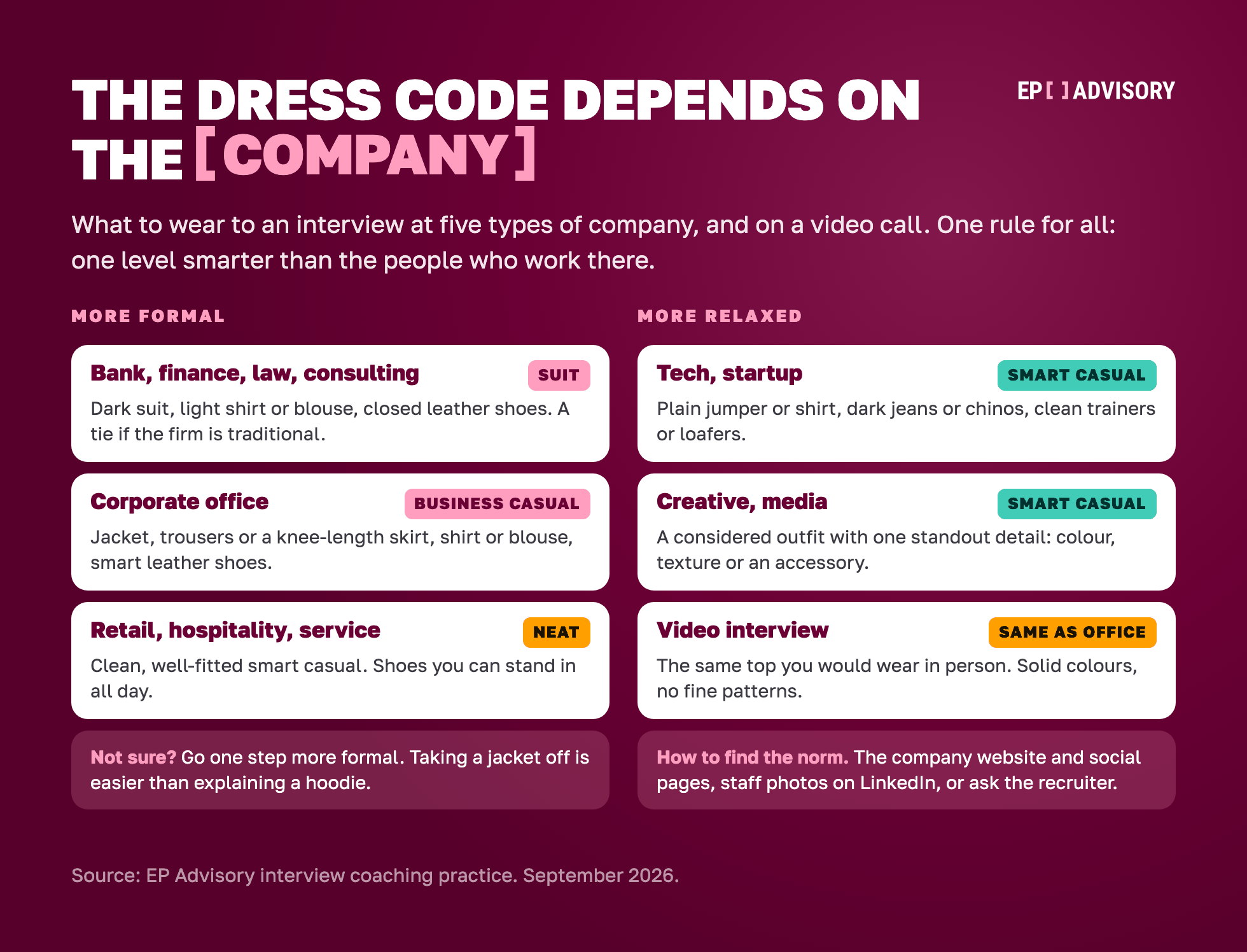
| Type of company | Style | What to wear |
| Bank, finance, law, consulting | Business formal | Dark suit, light shirt or blouse, closed leather shoes. Men at a traditional bank usually add a tie. |
| Corporate office, public sector | Business casual | Jacket, trousers or a knee-length skirt, shirt, blouse or fine jumper. A tie is optional. |
| Tech, startup | Smart casual | Dark jeans or chinos, a plain shirt or jumper, loafers or clean leather trainers. |
| Creative, media, agency | Smart casual with personality | A considered outfit with one standout detail: colour, texture or an accessory. Taste, not noise. |
| Retail, hospitality, service | Neat and practical | Clean, well-fitted smart casual. For a job with a fashion brand, one item from that brand works well. |
| Video interview | Same as in person | The same top you would wear to that company’s office. Solid colours, no fine patterns. |
To apply the rule, you need to know the norm. Check the company website and careers pages, look at how staff present themselves on LinkedIn and in company photos, and ask the recruiter. Recruiters get this question all the time. Asking it shows care, not weakness.
Smart casual and business casual: what they mean at an interview
These two terms cause the most confusion. Business casual is a suit without the suit: a jacket or blazer, smart trousers or a skirt, a shirt or blouse, leather shoes. No tie needed. Smart casual is one step more relaxed: dark jeans or chinos, a plain shirt, polo or jumper, loafers or clean leather trainers. A jacket is optional.
If you are told “smart casual”, aim for the smart end: dark jeans with a blazer is safer than chinos with a T-shirt. If you are told “business casual”, do not skip the jacket.
What to wear to a job interview: women
Office, bank or corporate
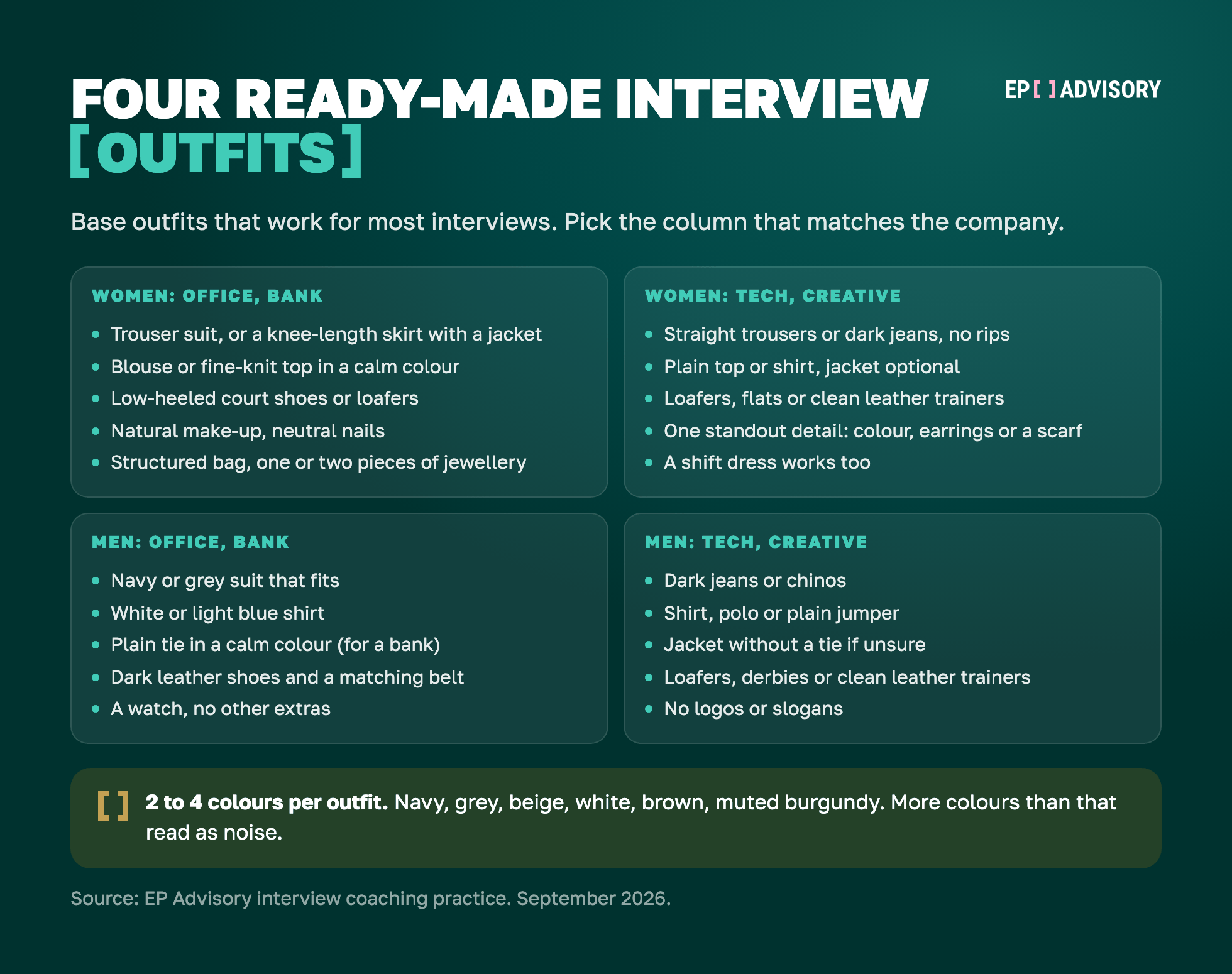
A trouser suit, or a knee-length skirt with a matching jacket, is the safest choice. Under it, a blouse or a fine-knit top in a calm colour. Shoes: low-heeled court shoes or smart loafers. A tailored dress with a jacket works just as well. Avoid anything tight, sheer, very short or low-cut.
Tech, startup or creative company
Straight trousers or dark jeans without rips, a plain top or shirt, and a jacket if you want it. Loafers, flats or clean leather trainers. This is where one standout detail fits: a colour, statement earrings or a scarf. A simple shift dress also works.
Do you need heels and tights?
No. Flat, smart shoes are fine in almost every office. In the UK, government guidance says that requiring women to wear high heels, make-up, manicured nails or specific hosiery is likely to be unlawful, unless there is an equivalent rule for men. The guidance covers job applicants as well as staff (GOV.UK, 2018). Some conservative firms still expect tights with a skirt. Treat that as a local habit, not a rule.
Make-up, nails and hair
Natural make-up, neutral or clear nails, clean hair that stays out of your face. The aim is to look well rested and cared for. Save evening make-up and bold nail art for after you get the offer.
Colours
Navy, grey, beige, white, brown and muted burgundy all work. Keep to 2–4 colours in one outfit. More than that reads as noise.
What to wear to a job interview: men
Office, bank or corporate
A navy or grey suit that fits you well, a white or light blue shirt, dark leather shoes and a belt that matches them. Fit matters more than price. Have the sleeves and trouser length adjusted if you need to. Socks should be dark and long enough to cover your leg when you sit.
Tech, startup or creative company
Dark jeans or chinos, a shirt, polo or plain jumper, loafers, derbies or clean leather trainers. No logos or slogans. If you are not sure how relaxed the company is, add a jacket and skip the tie. You can take the jacket off if everyone else is in T-shirts.
Do you need a tie?
For a traditional bank, law firm or a senior corporate role, yes: a plain tie in a calm colour. For most other interviews in 2026, an open collar with a jacket is normal.
Your CV gets you into the room, so check it too. Check your CV for free: a score in 30 seconds, then a fix for each problem.
Score your CV in 30 seconds, then fix its biggest problems one by one. Both free.
Free, no card. A free account unlocks every fix.

What to wear to a video interview
Dress for a video interview exactly as you would for the same company in person, from head to toe. You may need to stand up. Then set up the frame, because the interviewer sees your light and background for the whole call.
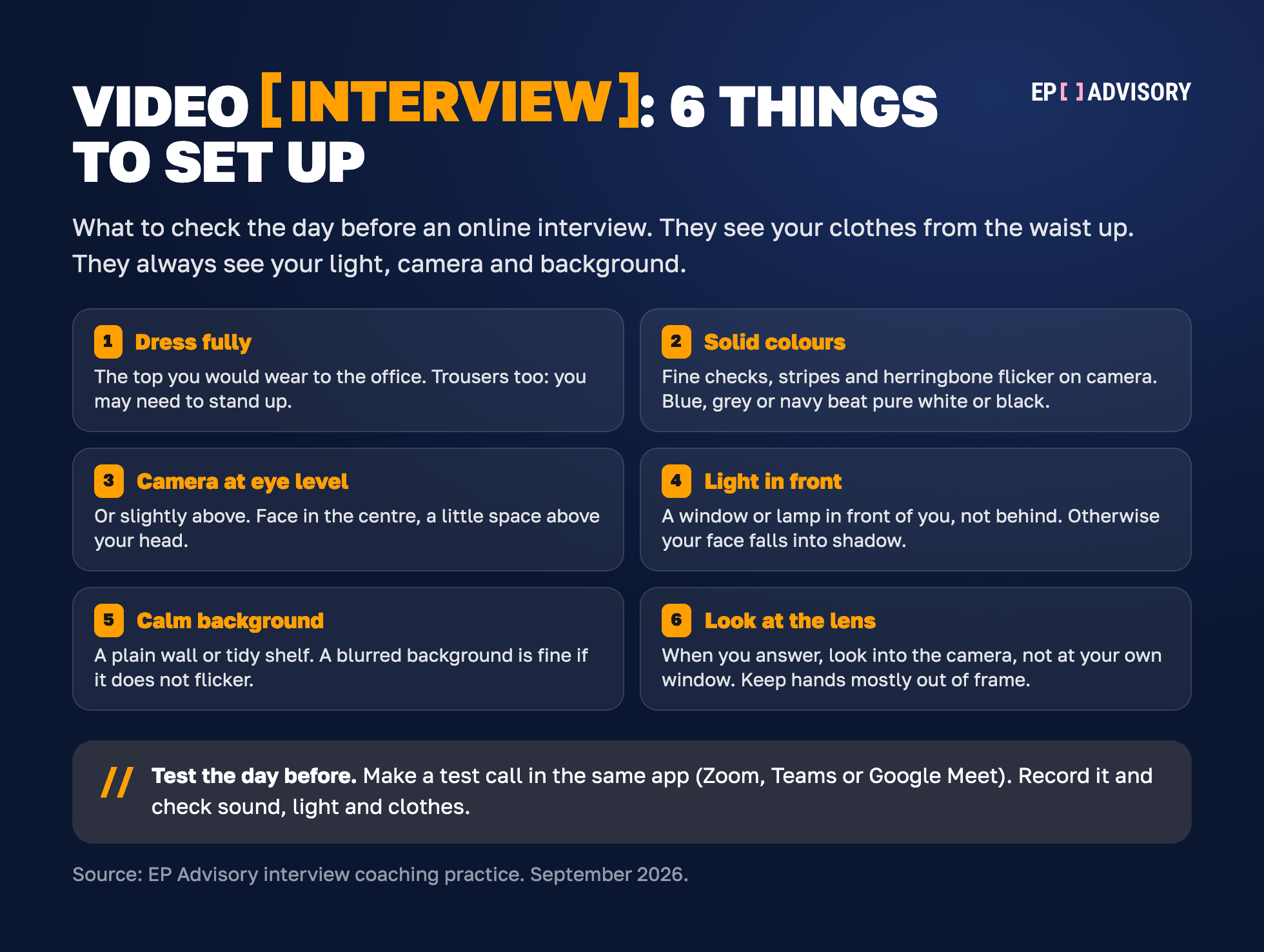
- Solid colours. Fine checks, thin stripes and herringbone can flicker on camera. Mid-tones such as blue, grey or navy look better than pure white or pure black.
- Camera at eye level or slightly above. Put your laptop on a stack of books. A camera that looks up at you is unflattering and feels tense.
- Light in front of you. A window or lamp behind the camera, not behind you.
- Look at the lens when you speak. It reads as eye contact.
- Test the day before. Make a test call in the same app (Zoom, Teams or Google Meet) and record it. Watch it back with the sound on.
Your face and hands matter as much as the outfit
Once the clothes disappear, three details decide how you come across.
A real smile, not a forced one. A genuine smile moves the muscles around your eyes. A forced one only pulls the mouth. You cannot fake it well, so think of a person or moment that makes you smile just before you go in.
Do not smile all the time. Constant smiling can make you look eager rather than capable. A frozen serious face is not the answer either. Let your expression follow what you are saying.
Keep your hands calm, especially on camera. On video, every time your hands enter the frame, attention leaves your words. A drill we give clients: practise your answers while sitting on your hands. The aim is not to freeze, but to cut most of that movement.
Interview dress codes abroad: UK, Germany, Netherlands, UAE
Many of our clients interview in a country they have not worked in yet. What reads as smart at home can read as casual, or as overdressed, somewhere else. The notes below come from our coaching practice, except where a source is linked. When in doubt abroad, lean formal. It is safer to be a little overdressed, and it shows respect for the local norm.
United Kingdom and London
London has several dress codes in one city. In the City and Canary Wharf (banks, insurers, law firms), expect suits and a more traditional look. Tech and creative companies in areas like Shoreditch are much more relaxed: smart casual is normal. Mayfair (private equity, hedge funds, luxury brands) tends to be polished and expensive-looking but understated. Employers may set a dress code, but it must treat men and women equally, and employers should not ban religious symbols that do not get in the way of the work (GOV.UK guidance).
Germany
In our experience, banks, insurers, large industrial firms and the public sector expect business formal or clean business casual at interview. Berlin startups and tech companies are far more relaxed. Punctuality and neat, practical clothes count for more than fashion. If you are unsure, a dark jacket over a plain shirt fits almost everywhere.
Netherlands
Dutch offices are among the most informal in Europe, in our experience. Outside finance, law and some consultancies, suits are rare. Smart casual is the usual interview choice. Over-formal can look stiff, so a jacket without a tie is often the right level.
United Arab Emirates
In our experience, interviews in Dubai and Abu Dhabi are more formal and more conservative than in much of Europe. Men usually wear a suit or at least a jacket. Women do well with covered shoulders and a skirt or dress at or below the knee, or trousers. Choose light fabrics for the heat outside, and bring a jacket for the air conditioning inside.
What to wear to an interview in summer or hot weather
The same rules apply, in lighter fabrics. Linen blends, cotton and tropical-weight wool breathe better than polyester. Men can wear a lightweight suit, or trousers with a shirt, and carry the jacket until they arrive. Women can wear a midi dress, or trousers with a blouse. Open sandals are best avoided for a formal office. Leave early so you do not arrive hot and rushed.
Can you wear jeans, trainers or shorts to an interview?
- Jeans: yes for tech, startups and creative companies, if they are dark, straight and without rips. For a bank, law firm or corporate office, wear trousers.
- Trainers: clean, minimal leather trainers are fine where the dress code is smart casual. Running shoes and worn-out pairs are not.
- Shorts: no. Even at a very casual company, shorts at an interview look like you did not take the meeting seriously.
- All black: fine, if it is well cut and not evening wear. Add one lighter piece so it does not look severe.
Tattoos, piercings and religious dress
In our experience, visible tattoos and small piercings are widely accepted in UK and European offices, especially in tech and creative roles. For client-facing roles in banking or law, some candidates cover large tattoos for the interview. That is a personal call. Religious dress such as a headscarf, turban or kippah is part of who you are, and UK guidance says employers should not ban religious symbols that do not interfere with the work.
Interview outfit mistakes to avoid
- Clothes that are creased, stained or do not fit.
- Tight, sheer or very short pieces, and deep necklines.
- Very high heels you cannot walk in.
- Ripped jeans, hoodies, shorts and flip-flops.
- Large logos, slogans and visible designer branding.
- Strong perfume or aftershave.
- A brand-new outfit you have never worn. Wear it once before, so you know it does not pinch or crease.
- More than 2–4 colours in one outfit.
Accessories, bag and fragrance
Keep accessories simple: a watch, one or two pieces of jewellery, a structured bag that holds a notebook and a printed CV. Wear fragrance lightly or not at all. Interview rooms are small.
Checklist: the day before and the morning of
- Find out the dress code: company website, staff photos, a question to the recruiter.
- Choose an outfit one level smarter than the norm.
- Try everything on the day before, including shoes and bag. Sit down in it.
- Wash, iron and clean your shoes.
- For video: a test call, light, camera and background.
- In the morning: clean hair and nails, light fragrance or none.
- Pack your CV, a notebook and a pen.
- Leave with time to spare so you arrive 10–15 minutes early.
Clothes are only part of the preparation. Practise your answers to the toughest interview questions, read the full guide to passing a job interview abroad, and get ready to negotiate your salary when the offer comes.
See what a recruiter sees, then fix it before you apply. An instant score, then the fix for every problem.
Free, no card. A free account unlocks every fix.
Frequently asked questions
What should I wear to a job interview in 2026?
Dress one level smarter than the people who already work there. A suit for banks, law firms and consultancies. Business casual (a jacket, trousers or a skirt, a shirt or blouse) for corporate offices. Smart casual (dark jeans or chinos, a plain top, clean shoes) for tech, startups and creative companies. Keep to 2–4 calm colours, and make sure everything fits and is clean.
What should a woman wear to a job interview?
For an office or bank: a trouser suit, or a knee-length skirt with a jacket, a blouse and low-heeled court shoes or loafers. For tech or creative companies: straight trousers or dark jeans, a plain top, loafers or clean trainers, with one standout detail. Avoid anything tight, sheer, very short or low-cut.
What should a man wear to a job interview?
For an office or bank: a navy or grey suit, a white or light blue shirt, dark leather shoes and a matching belt, plus a plain tie for traditional firms. For tech or creative companies: dark jeans or chinos, a shirt or jumper, and a jacket without a tie. Fit matters more than price.
Can I wear jeans to a job interview?
Yes for tech, startups and creative companies, if the jeans are dark, straight and without rips. Pair them with a shirt or a jacket. For a bank, law firm or corporate office, wear trousers.
Can I wear trainers to a job interview?
Clean, minimal leather trainers are fine where the dress code is smart casual, such as tech and creative companies. Running shoes and worn pairs are not. For formal and corporate interviews, wear leather shoes.
What should I wear to a video interview?
Exactly what you would wear to the same company in person, from head to toe. Choose solid colours, because fine patterns can flicker on camera. Put the camera at eye level or slightly above, the light in front of you, and make a test call the day before.
What colours are best for a job interview?
Calm colours: navy, grey, beige, white, brown and muted burgundy. Keep to 2–4 colours in one outfit. On video, mid-tones such as blue or grey look better than pure white or pure black.
What should I wear to an interview in summer?
The same level of formality in lighter fabrics: linen blends, cotton or lightweight wool. Carry the jacket until you arrive. Avoid shorts, and avoid open sandals for a formal office.
How should I dress for an interview in another country?
Find out the local norm and lean formal if in doubt. In our experience, London finance, German banks and the UAE are more formal, while Dutch offices and Berlin startups are more relaxed. In the UAE, choose modest cuts with covered shoulders.
Applying for jobs in English? Start with our guide to an effective CV in English.