 By Andre Atallah, CEO of EP Advisory

Short answer: yes, Americans can get jobs in Europe, but not on a visit. Your US passport gives you 90 days in any 180 in the Schengen area, with no right to work. A job needs a work permit, usually tied to a salary floor. Germany, the Netherlands and Spain let you apply without going home first. Pick 3 or 4 countries where your likely salary clears the 2026 floor, then apply there.
How to get a job in Europe as an American comes down to three checks: what your passport lets you do at the border, which countries let you apply for a work permit after you arrive, and whether your likely salary clears each country’s 2026 floor. Get those three right and your list of target countries shrinks from 27 to a realistic 3 or 4.
This guide covers the parts that are specific to a US passport: the new EU border system, the countries where you can switch from visitor to resident without flying home, the 2026 salary floors with dollar figures, the routes open to young Americans and the US tax rules that follow you abroad.
For nearly 10 years, we’ve helped more than 5,000 professionals find jobs abroad. Want to know if your CV will pass screening in Europe? Check your CV for free: a score in 30 seconds, then a fix for each problem.
Your US passport gets you in for 90 days, not a job
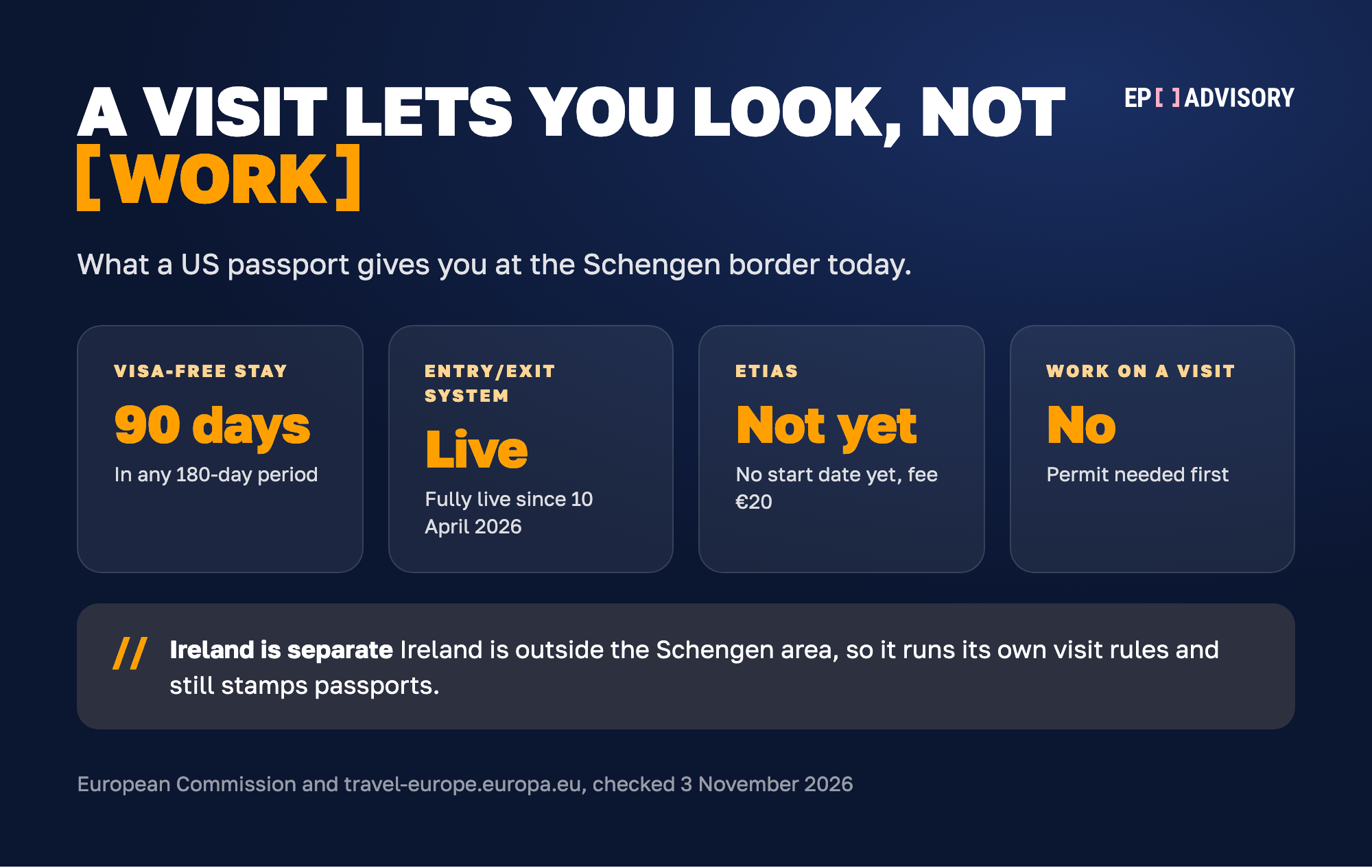
Americans do not need a visa to visit the Schengen area. That is the group of 29 European countries with no passport checks between them, including Germany, France, Spain, Italy and the Netherlands. The rule is 90 days in any 180-day period. On each day of your trip, count back 180 days. You can only have spent 90 of them inside the area.
A visit lets you go to interviews, meet recruiters and look at neighbourhoods. It does not let you work, even for a few days. The fix is to treat a visit as a scouting trip and to have the permit in place before your first working day.
Two border changes matter in 2026:
- The EES is live. The Entry/Exit System is the EU’s new digital border record. After a six-month rollout, it has been fully running at every external border since 10 April 2026, and passports are no longer stamped. At your first crossing, the border officer takes a face photo and, in most cases, fingerprints. The system then counts your 90 days for you, so an overstay shows up at once. Cyprus and Ireland still stamp passports by hand.
- ETIAS is not running yet. ETIAS is the planned online travel authorisation for visa-free visitors, similar to the US ESTA. The EU says it is not in operation and that it will announce the start date several months before launch. Its news pages still name the last quarter of 2026 as the plan, but no date had been announced by 3 November 2026. The announced fee is €20, with no fee for under-18s and over-70s. An approval will last 3 years or until your passport expires, whichever comes first. Today you need nothing extra.
Ireland is not in the Schengen area. It runs its own short-visit rules, and time there does not count towards your Schengen 90 days. Its immigration service says anyone coming to work needs an employment permit first.
Germany, the Netherlands and Spain let you apply without going home
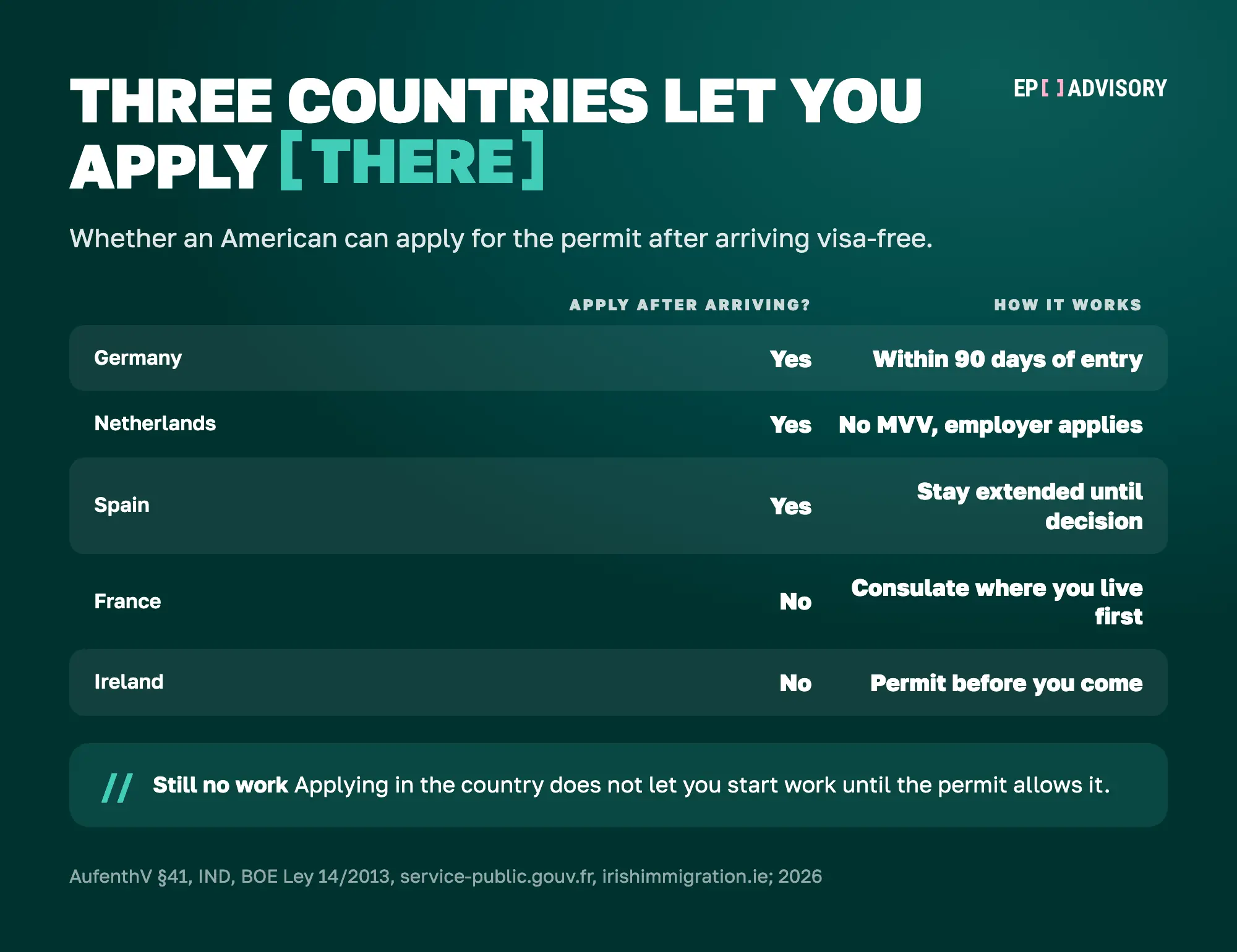
This is one of the biggest advantages of a US passport, and many guides skip it. In many countries you must apply for a work visa at a consulate in the US and wait there. A few countries let Americans arrive visa-free and apply for the residence permit on the spot. That saves a flight home and weeks of waiting once you have an offer.
| Country | Can an American apply after arriving? | What the rule says |
| Germany | Yes | US citizens can enter visa-free and get the residence permit in Germany. You must apply within 90 days of entry. Your stay then counts as legal until the decision. You cannot start work until the permit allows it. |
| Netherlands | Yes, through the employer | Americans are exempt from the MVV, the provisional entry visa most non-Europeans need. Your employer applies to the IND, the Dutch immigration service. |
| Spain | Yes, for skilled routes | An application to the Unidad de Grandes Empresas, Spain’s unit for skilled-worker permits, extends your legal stay until a decision. The law sets a 20-day decision time. |
| France | No | You apply to the French consulate in your country of residence, then complete an online step after arriving: validate the visa or apply for the residence card, depending on its length. |
| Ireland | No | The employment permit comes first. If you stay longer than 90 days, you also register with immigration. |
The practical effect is simple. In Germany and Spain, you can fly over for final interviews and stay while the paperwork runs, as long as you apply while your visa-free stay is still valid. In the Netherlands, you need no entry visa, which removes a consulate step. In France and Ireland, plan for the permit or visa before you move, so build that wait into your notice period.
Score your CV in 30 seconds, then fix its biggest problems one by one. Both free.
Free, no card. A free account unlocks every fix.

The 2026 salary floors decide which countries are realistic
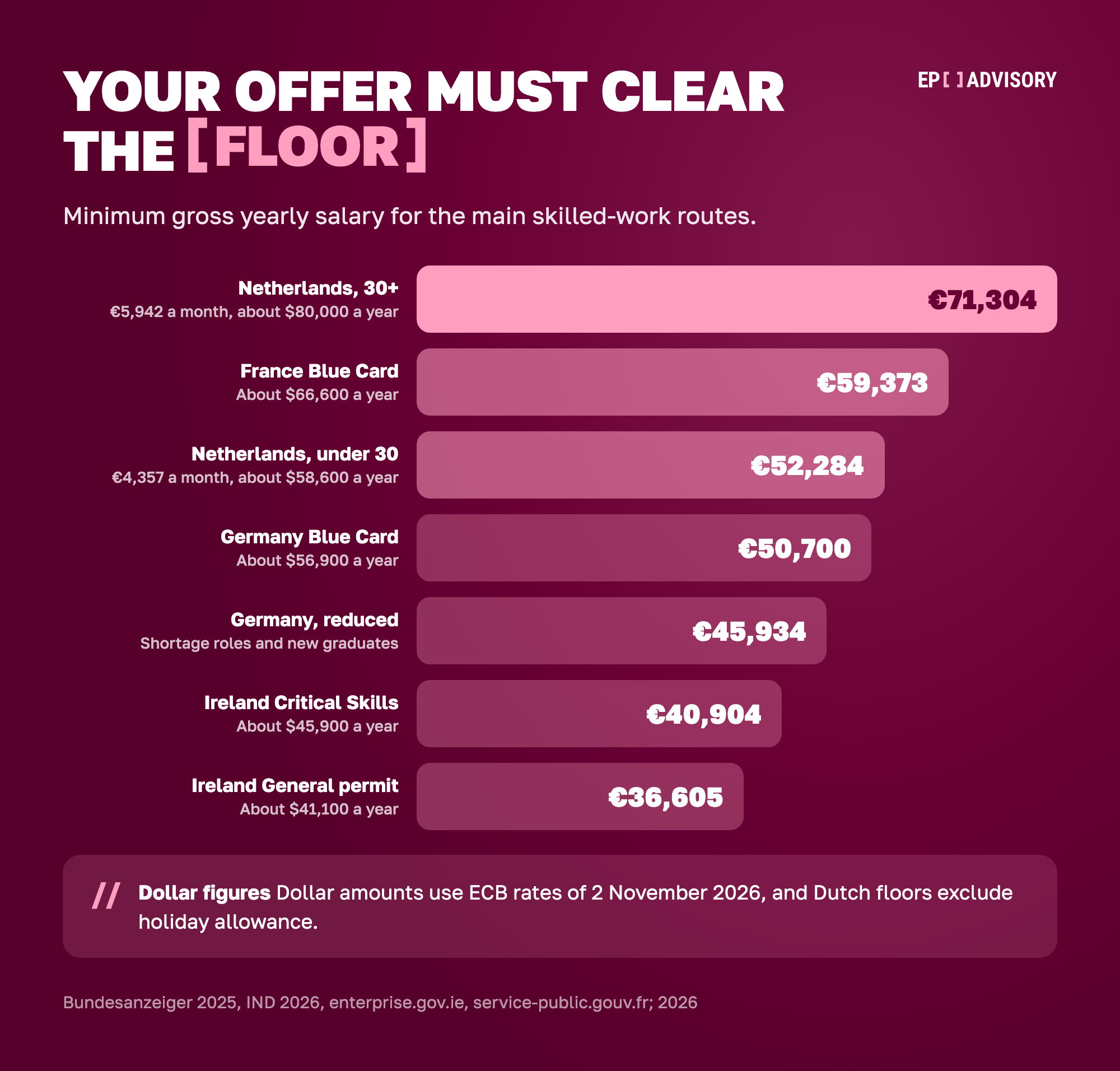
Most work permits for skilled jobs set a minimum gross salary. Gross means before tax and social charges. The main EU-wide permit is the EU Blue Card, a work and residence permit for graduates in skilled jobs. It exists in every EU country except Denmark and Ireland, but each country sets its own floor. If your likely offer is below a country’s floor, that route is closed there, however strong your CV is.
| Country and route | 2026 floor (gross) | In US dollars, at ECB rates of 2 November 2026 | Who it suits |
| Germany, EU Blue Card | €50,700 a year (Federal Gazette, 2026) | about $56,900 a year | Graduates with a job offer of at least 6 months |
| Germany, reduced Blue Card | €45,934 a year | about $51,500 a year | IT, engineering, medicine, teaching and science roles, and graduates within 3 years |
| Netherlands, highly skilled migrant, 30 or older | €5,942 a month (IND, 2026) | about $6,660 a month | Experienced hires at a recognised sponsor |
| Netherlands, highly skilled migrant, under 30 | €4,357 a month | about $4,890 a month | Younger professionals |
| Ireland, Critical Skills Employment Permit | €40,904 a year (current figure) | about $45,900 a year | Jobs on Ireland’s critical skills list, with a relevant degree |
| Ireland, General Employment Permit | €36,605 a year (current figure) | about $41,100 a year | Other roles, after the employer advertises the job locally |
| France, Talent EU Blue Card | €59,373 a year (service-public.gouv.fr, 2026) | about $66,600 a year | Senior hires with 3 years of higher education or 5 years of experience |
| Spain, highly qualified professional | No fixed figure published in the law | Not applicable | The Blue Card floor is set between 1.0 and 1.6 times Spain’s average gross salary |
The Dutch figures exclude the holiday allowance that Dutch employers pay on top, and they change every 1 January. Irish permit pages show the thresholds without a year, so treat them as the figures in force on 3 November 2026. Ireland also has a higher Critical Skills floor of €68,911 a year (about $77,300 at ECB rates of 2 November 2026) for jobs that are not on its list.
The fix if a floor is out of reach is to look at the reduced floors. Germany’s lower Blue Card floor covers most tech and engineering roles. The Netherlands has a lower floor for people under 30 and for recent graduates. Our guide to work visa salary thresholds in Europe compares more countries side by side.
Two neighbours run their own systems. For the UK, read our guide on how to get a job in the UK as an American. Switzerland is outside the EU and runs its own permits, which our guide on finding a job in Switzerland as a foreigner explains.
Apply to employers that already sponsor visas
The most common complaint from Americans is a wall of listings that say no visa sponsorship. Many of those employers are not saying no to Americans. They are saying no to permit paperwork they do not want to take on. The fix is to aim at employers who already do it.
- Netherlands: only an IND-recognised sponsor can hire a highly skilled migrant. The IND publishes the full public register of recognised sponsors. Every company on it can apply for a permit for you. Start your Dutch list there, then read our Netherlands work visa guide.
- Germany: large engineering, tech and research employers hire Blue Card holders regularly. Our guide to jobs in Germany for foreigners lists the sectors and job boards.
- Ireland: Dublin hosts the European offices of many US tech and pharma firms. They know the employment permit process well. Our guide on how to find a job in Ireland covers the market.
- Spain and France: skilled permits work best with multinationals and larger firms, where English is often the working language. See our guides to jobs in Spain for foreigners and jobs in France for foreigners.
Say your status early. One line in your cover letter or first call settles it: “I am a US citizen. Germany lets me apply for the Blue Card after I arrive, so there is no US consulate wait.” That turns an unknown risk into a plan the recruiter can pass on.
Under 30 or a recent graduate: use the routes built for you
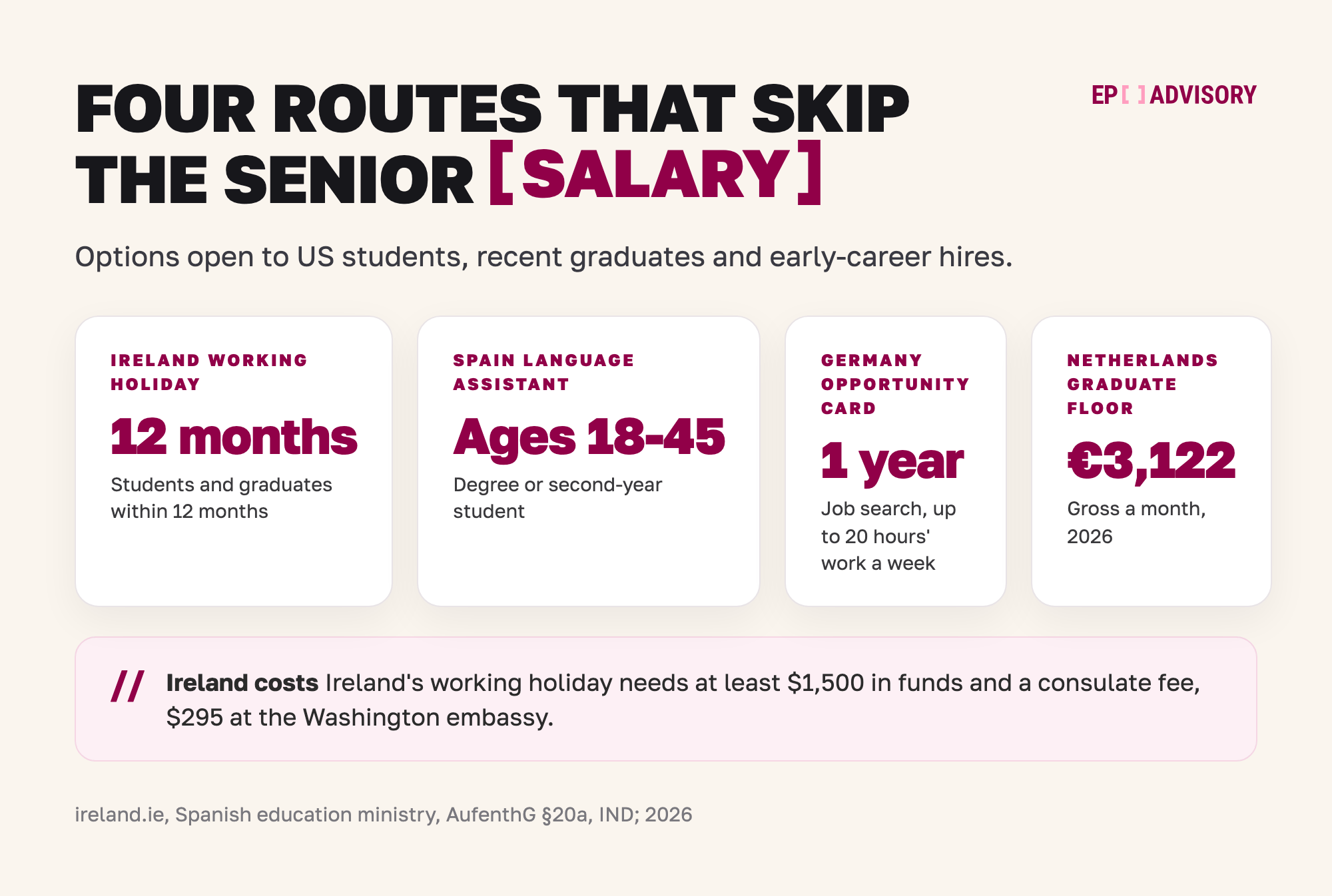
Young Americans have more options than most people think. None of them needs a senior salary.
- Ireland Working Holiday Authorisation. Any US citizen over 18 who is in full-time college (not part-time or online) or graduated in the last 12 months can work and travel in Ireland for up to 12 months. You need at least $1,500 in funds, a return ticket and insurance. The fee on the Washington embassy’s page is $295, and some consulates list a higher fee, so check yours. You must arrive within 6 months of approval, and it cannot be extended. You can use the year to meet Irish employers who sponsor permits.
- Spain language assistant programme. Spain’s education ministry places English language assistants in Spanish schools, and the United States is on its list. You need a degree, or to be at least a second-year college student, and to be aged 18 to 45.
- Germany Opportunity Card. The Chancenkarte is a job-search permit for up to 1 year. On the points route, you need a degree or a vocational qualification of at least 2 years recognised where you earned it, basic German (A1) or English at B2, and at least 6 points. It lets you work part-time, up to 20 hours a week on average, and take trial jobs of up to 2 weeks while you look. You apply at a German mission before you travel, because the law does not give it to a visa-free visitor already in Germany. You must show enough money to live on, so check the current figure with the mission.
- Lower graduate floors. The Netherlands uses a reduced floor of €3,122 a month (about $3,500 at ECB rates of 2 November 2026) for people who apply within 3 years of graduating, or after a Dutch orientation year, and meet the IND conditions. Germany’s reduced Blue Card floor of €45,934 covers graduates whose degree is less than 3 years old.
Already at a US company with European offices? Ask for a transfer
An intra-company transfer can be the fastest route, because the employer already knows you. The company moves you to its European office and handles the permit. France, for example, has an employee-on-assignment route for staff with at least 3 months in the group and a gross salary of at least €39,582 a year (about $44,400 at ECB rates of 2 November 2026).
Start with HR and with your manager, not the careers site. Ask which European offices have taken transfers before and what the business case needs to show. A manager who backs the move matters more than the form.
One exception to the table above: Germany’s apply-after-arriving rule does not cover the ICT Card, its permit for intra-company transfers. Plan that one before you travel.
If you would rather keep your US job and simply live in Europe, that is a different set of rules. Our guide to remote jobs in Europe covers it.
How to get a job in Europe as an American: pick 3 or 4 countries
Applying to all of Europe at once spreads your effort over 27 sets of rules. A short list lets you tailor every application and speak with confidence about your permit. Use these four checks to build it:
- Salary floor. Look up typical pay for your role in each country. Keep only the countries where that pay clears the floor in the table above.
- Language. In tech, research and multinationals, English often works in the Netherlands, Ireland and many German tech firms. Elsewhere you may need the local language, so be realistic about your level.
- Entry rule. Countries where you can apply after arriving let you fly over for final rounds and stay while the permit runs.
- Employer pool. Count how many sponsors in your field you can name. If you cannot name ten, the country is not ready for your list yet.
Once your list is set, the job hunt itself is much like anywhere else in Europe. Our guide on how to find a job in Europe covers job boards, LinkedIn and interviews step by step.
Next: write down your 3 or 4 countries and the floor for each. Then check your target salary against each floor before you send a single application.
Your CV is the next thing to change. European recruiters often expect more detail than a one-page US resume gives. Getting ready to apply for jobs in Europe? Check your CV for free: see it the way a recruiter does, then fix each problem.
US tax: you still file every year from Europe
The US taxes its citizens on worldwide income, wherever they live. Moving to Europe does not end your US tax return. Two tools help most Americans avoid paying tax twice on the same pay:
- Foreign Earned Income Exclusion (FEIE). For tax year 2026 you can exclude up to $132,900 of foreign earnings from US income tax. To qualify, your tax home must be abroad. You must also be a bona fide resident of a foreign country for a full tax year, or be physically present abroad for at least 330 full days in any 12 months in a row.
- Foreign tax credit. This lets you offset income tax paid to a European country against your US tax bill. You can use it instead of the FEIE, or on income the FEIE does not cover. A cross-border tax adviser can work out which saves you more.
One more rule catches new arrivals. If your foreign bank accounts together go above $10,000 at any point in the year, you must file an FBAR, the Report of Foreign Bank and Financial Accounts. A few months of salary in a local account can take you over that line.
This is general information, not tax advice. Your state, pension, stock options and the year you move all change the answer. Talk to a cross-border tax adviser before your first year abroad, ideally before you sign the offer. For permits, rules change often, so check the current rules with the official site or a regulated adviser before you apply.
Key takeaways
- Your US passport gives you 90 days in any 180 in the Schengen area, with no right to work.
- The EES now records every entry and exit. ETIAS is not running yet, and the EU will announce its start date months ahead.
- Germany, the Netherlands and Spain let Americans apply for a residence permit without going home first.
- Each country sets its own salary floor. Among the countries in this guide, they run from €36,605 a year in Ireland to €71,304 a year (€5,942 a month) in the Netherlands for over-30s.
- Young Americans can use Ireland’s working holiday, Spain’s language assistant programme or Germany’s Opportunity Card.
- Pick 3 or 4 countries where your likely salary clears the floor, then target employers that already sponsor.
- You still file US taxes. The 2026 FEIE is $132,900, and an FBAR is due once foreign accounts pass $10,000.
See what a recruiter sees, then fix it before you apply. An instant score, then the fix for every problem.
Free, no card. A free account unlocks every fix.
Frequently asked questions
Can Americans work in Europe without a visa?
No. A US passport lets you visit the Schengen area for 90 days in any 180 without a visa, but it does not let you work. You need a work permit or residence permit that allows work before your first working day. Germany, the Netherlands and Spain let Americans apply for that permit after arriving.
Do Americans need ETIAS to travel to Europe in 2026?
Not yet. The EU says ETIAS is not in operation and that it will announce the start date several months before launch. No date had been announced by 3 November 2026. The announced fee is €20, and an approval will last 3 years or until your passport expires. The Entry/Exit System is already live, so expect a face photo and fingerprints at your first crossing.
What is the minimum salary for an EU Blue Card in Germany in 2026?
The 2026 floor is €50,700 gross a year, about $56,900 at ECB rates of 2 November 2026. A reduced floor of €45,934 applies to shortage roles such as IT, engineering and medicine, and to graduates whose degree is less than 3 years old. The job offer must last at least 6 months.
What are the best countries in Europe for Americans to work?
Germany, the Netherlands and Ireland are common starting points for skilled Americans. Germany and the Netherlands let you apply after arriving and have large international job markets. Ireland has many US companies and a working holiday for students and recent graduates. The best choice depends on whether your likely salary clears each country’s floor.
Do I have to pay US taxes if I work in Europe?
You still file a US tax return every year. For tax year 2026 you can exclude up to $132,900 of foreign earnings under the Foreign Earned Income Exclusion, or claim a credit for income tax paid in Europe. You must also file an FBAR if your foreign accounts pass $10,000 at any time. Talk to a cross-border tax adviser before you move.