 By Andre Atallah, CEO of EP Advisory
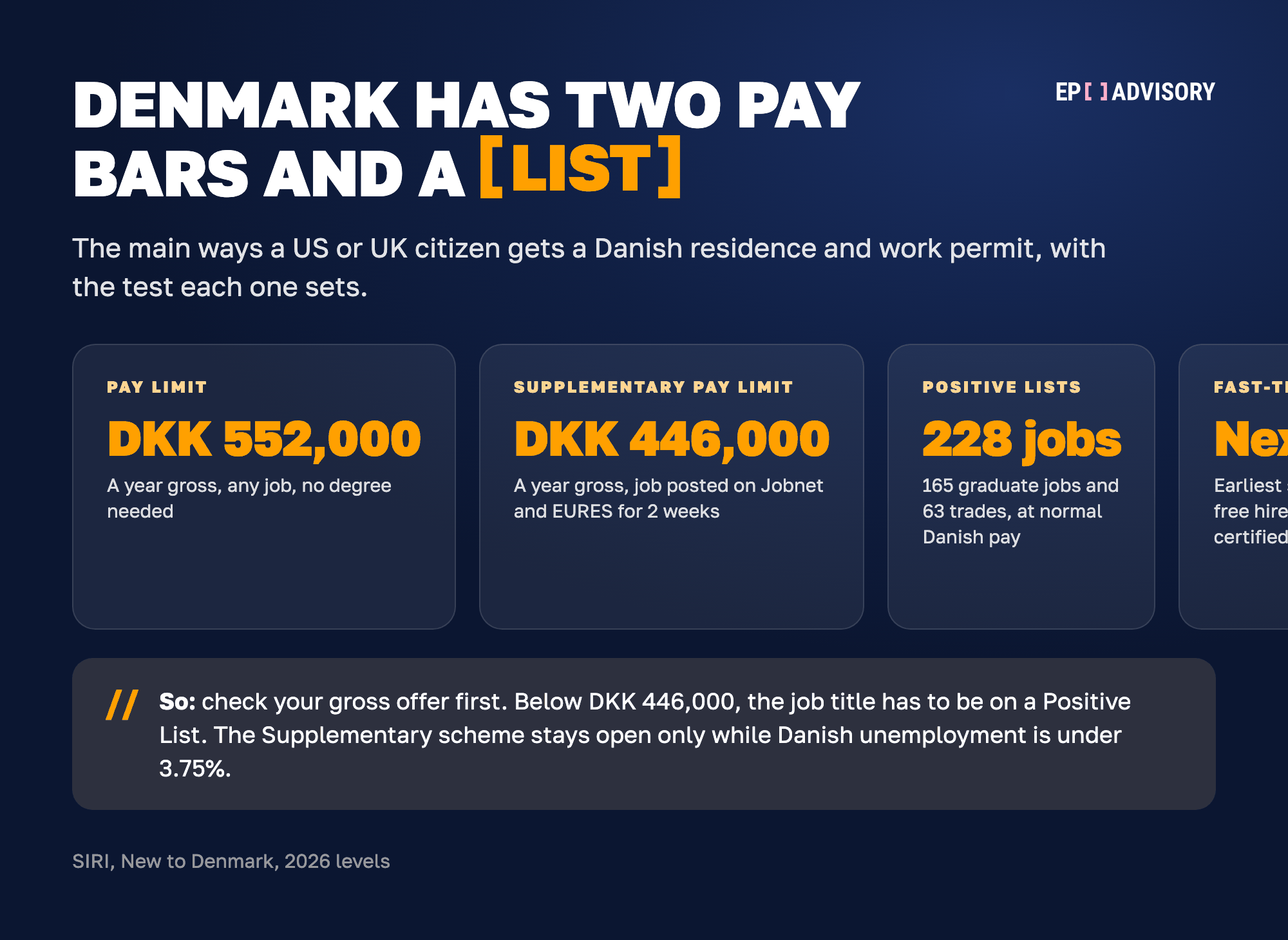
Short answer: most Americans and Britons move to Denmark with a job offer. A salary of at least DKK 552,000 a year opens the Pay Limit scheme, and DKK 446,000 opens the Supplementary scheme if the job was advertised in Denmark. Jobs on the Positive Lists qualify at normal Danish pay. Certified employers can get you started fast. After 4 to 8 years you can apply for permanent residence.
Denmark is one of the easier countries in Europe to move to once you have a job offer. Its permits are tied to clear salary bars and published job lists, not to quotas or lotteries. Most work permits are decided in about a month, and your partner can come with you and work from day one.
The catch is that almost every route starts with a Danish employer. This guide shows which permit fits your situation, what each one costs in 2026, and what to do in your first weeks after you land. Immigration rules change often, so check the current rules with SIRI or the Danish Immigration Service before you act.
For nearly 10 years, we’ve helped more than 5,000 professionals find jobs abroad. Want to know if your CV will pass screening in Denmark? Check your CV for free: a score in 30 seconds, then a fix for each problem.
How to move to Denmark: the main routes in 2026
Denmark has no general work visa. You get a residence and work permit through a named scheme, and each scheme has its own test. Two agencies run them. SIRI (the Danish Agency for International Recruitment and Integration) handles work and study. The Danish Immigration Service handles family reunification and permanent residence. Both use the same website, New to Denmark.
The table shows the schemes most US and UK readers use. Amounts are 2026 levels.
| Route | Who it fits | Main test | Fee | Normal decision time | Partner and children |
|---|---|---|---|---|---|
| Pay Limit scheme | Any well-paid job, no degree needed | DKK 552,000 a year gross | DKK 6,810 | 1 month | Yes, with work rights |
| Supplementary Pay Limit scheme | Mid-level jobs advertised in Denmark | DKK 446,000 a year gross, job on Jobnet and EURES for 2 weeks | DKK 6,810 | 2 months | Yes, with work rights |
| Positive List, higher education | Graduates in 165 listed jobs | Matching degree, Danish pay and terms | DKK 6,810 | 1 month | Yes, with work rights |
| Positive List, skilled work | Trades in 63 listed jobs | Matching training, Danish pay and terms | DKK 6,810 | 3 months | Yes, with work rights |
| Fast-track scheme | Hires by a SIRI-certified employer | One of five tracks, such as pay limit or researcher | DKK 6,810 | 1 month, start the next day at the earliest | Yes, with work rights |
| Study permit | Admitted students | DKK 7,426 a month in funds | DKK 3,060 | 2 months | PhD students only, for new applications |
| Spouse of a Dane | Partners of Danish citizens and PR holders | Both 24+, integration and housing rules, DKK 61,709 guarantee | DKK 8,490 | Up to 10 months | Not applicable |
Salary bars are adjusted every 1 January, so check the 2027 figure before you sign an offer for next year.
EU citizens, Britons and Americans: who needs a permit
EU, EEA, Swiss and Nordic citizens do not need a work permit. They live in Denmark under EU rules. They can stay up to six months before they must register, and they get an EU residence document instead of a permit (International House Copenhagen).
UK citizens are now treated like other non-EU nationals. New to Denmark states plainly that a UK citizen cannot apply for EU residence. So a Briton moving in 2026 uses the same schemes as an American. If you hold an Irish or other EU passport as well, use that one.
Both the United States and the United Kingdom are on Denmark’s visa-free list. You can visit for up to 90 days in any 180 days, for example to view flats or meet an employer. You may not work, study or settle on a visitor stay (Ministry of Foreign Affairs of Denmark). Visa-free status matters later too, because it lets you use the Fast-track quick start described below.
Work permits: which Danish scheme fits you
For most US and UK professionals, the salary decides the scheme. Start with your offer’s gross annual pay, then check the job title against the Positive Lists. If your employer is certified, the Fast-track scheme can sit on top of either.
The Pay Limit scheme: DKK 552,000 and up
If your Danish job pays at least DKK 552,000 a year gross in 2026, you qualify under the Pay Limit scheme. That is about €73,900, $83,200 or £61,600 at the Danmarks Nationalbank rates of 4 November 2026. You need no particular degree and the job can be in any field.
The rules that trip people up are practical. The job must be at least 30 hours a week. Your salary must be paid into a Danish bank account in your own name, opened within 180 days. Only guaranteed cash pay, pension contributions and paid holiday allowance count toward the bar. The permit can last up to four years, and it lapses if you give up your Danish address or stay abroad for more than six months in a row.
The Supplementary Pay Limit scheme: DKK 446,000
Denmark has a second, lower bar that most countries do not. Under the Supplementary Pay Limit scheme, a salary of DKK 446,000 a year gross in 2026 is enough (about €59,700). In return the employer must have posted the job on Jobnet and EURES for at least two weeks. The post must be no more than six months old when you apply.
The scheme only stays open while Danish unemployment is low. It closes if gross unemployment goes above 3.75% as a three-month average. The latest figure was 3.1% for July to September 2026 (SIRI). Decisions take about two months, so ask your employer to advertise early.
The Positive Lists: listed jobs at normal Danish pay
If your pay is below both bars, the Positive Lists may still work. They hold 165 jobs for graduates and 63 skilled trades. That is the 164 graduate titles from 1 July 2026 (SIRI news, June 2026) plus midwife, added on 1 October 2026 for Eastern Denmark only (SIRI news, October 2026). The graduate list includes software developers, IT architects, IT security consultants, mechanical and electrical engineers, nurses, doctors, pharmacists and auditors. The skilled list includes electricians, bricklayers, chefs and industrial mechanics.
Your degree or trade training must match the listed job, and the pay and terms must meet Danish standards. Health jobs such as nurse and doctor also need a Danish authorisation first. The lists change on 1 January and 1 July, but a title stays on for at least two years once it is added.
The Fast-track scheme: certified employers
Nearly 1,000 Danish employers are certified by SIRI, from Lego and Maersk companies to Google’s Danish arm (certified companies list). If one of them hires you, it can apply through the Fast-track scheme. You still need to meet a track, such as the pay limit, the supplementary pay limit or the researcher track.
The gain is speed and freedom. Because US and UK citizens are visa-free, SIRI can issue a provisional work permit the day after your employer applies, at the earliest. You can also work in Denmark and abroad in turns without losing the permit. The permit runs up to four years, or five on the supplementary track.
Researchers and the 32.84% tax scheme
Researchers with a paid position at a university or company can apply under the researcher scheme, with no fixed salary bar as long as pay meets Danish standards. Separately, the Danish Tax Agency runs a tax scheme for researchers and highly paid employees. It taxes your gross pay at a flat 32.84% for up to seven years.
To use it as a highly paid employee, you need a guaranteed salary of at least DKK 65,400 a month in 2026 (DKK 67,300 in 2027). You must not have been liable to Danish tax in the previous 10 years. You can use the scheme only once in your life, for up to seven years in total.
No EU Blue Card, and a new scheme in 2027
Denmark does not issue the EU Blue Card. It stays outside that EU directive and uses its own pay limit schemes instead. If you have read about Blue Card salary bars in our guide to work visa salary thresholds in Europe, the Danish equivalents are the two bars above.
From 1 January 2027 a new collective agreement scheme adds a third bar at DKK 322,000 a year (2026 level). It covers jobs under a Danish collective agreement at certified companies. It is open only to citizens of 16 countries. The bill names the UK and the US among them, with eight other top investment partners and six EU candidate countries (bill L 16). The minister publishes the final list, so check SIRI before you count on it.
Whichever scheme fits, the permit follows the job. Our guide to jobs in Denmark for foreigners covers where to search and which sectors hire. To see whether an offer clears the bar, compare it with typical pay in our guide to salaries in Denmark. Danish recruiters read short, factual CVs, so make yours easy to scan before you apply. Getting ready to apply for jobs in Denmark? Check your CV for free: see it the way a recruiter does, then fix each problem.
Score your CV in 30 seconds, then fix its biggest problems one by one. Both free.
Free, no card. A free account unlocks every fix.

Studying in Denmark: the 1 October 2026 change
Study is still a route in, but a narrower one for new students. A study permit costs DKK 3,060 and takes about two months. You must show DKK 7,426 a month for your living costs in 2026. On a state-approved programme you can work 90 hours a month, and full time in June, July and August.
The rules changed for applications made on or after 1 October 2026. Students below PhD level now get a job-seeking permit of six months or one year after graduation, not up to three years. Their spouses, partners and children can no longer come as accompanying family. PhD students keep a three-year job-seeking permit and can still bring family. Programmes that are not state-approved give no work rights at all for applications from 2 May 2025.
So a US or UK graduate who wants to stay should plan the job search from the first year, not the last semester.
Moving with family, or to join a Danish partner
If you move for work, your family can come with you on easy terms. A spouse, registered or cohabiting partner and children under 18 can apply as accompanying family at the same time as you. The fee is DKK 3,080 and decisions take about two months. Your partner gets the right to work in Denmark, and you do not need to show extra funds if you are paid a salary.
Joining a Danish partner is a different and much stricter route. Spouse reunification costs DKK 8,490 and can take up to 10 months. The main conditions are these:
- Both partners must be at least 24.
- As a couple, you must meet four of six integration conditions, such as Danish or English tests, work history and schooling.
- The Danish partner must have passed Prøve i Dansk 3, the upper Danish test, or worked five years in Danish.
- The Danish partner must not have received certain social benefits for three years and must post a DKK 61,709 guarantee (2026 level).
- You must meet a housing requirement, and your address must not be on the government’s housing list.
After the permit, you must pass Danish at A1 level within six months and A2 within nine. If you are married to a Dane and also have a job offer, a work scheme is usually the simpler way in.
Other routes: founders and graduates
Founders can apply through Start-up Denmark. A panel appointed by the Danish Business Authority must first approve your business idea. Then Start-up Denmark costs DKK 3,060 and takes about two months. You must also show funds, DKK 153,240 for a single person at the 2025 level.
Graduates of a full state-approved Danish degree get a job-seeking permit, and can then apply for a work permit without the usual limits. Outside these routes and the EU rules, you generally need a job offer, because the work schemes above all start with a job in Denmark. If you plan to keep a job with a foreign employer, read our guide to remote jobs in Europe before you plan a move.
Permanent residence and citizenship
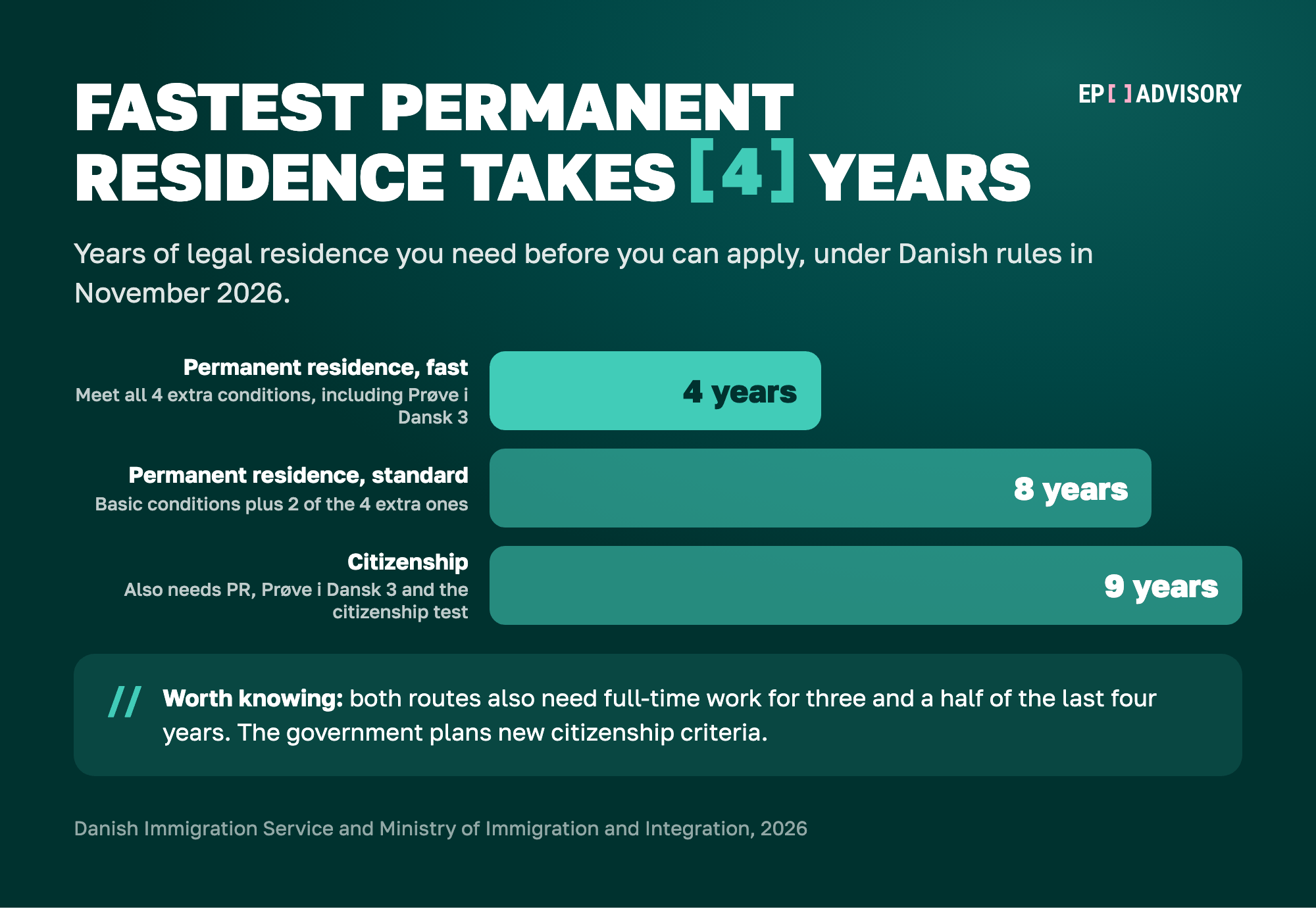
Most people need eight years before permanent residence, but four is possible. The permanent residence rules have basic and supplementary conditions. The basic ones are these:
- You are 18 or older and pass Prøve i Dansk 2, the middle Danish test.
- You worked full time for at least three and a half of the last four years.
- You have no overdue public debt and took no cash benefits in the last four years.
- You have no sentences that rule you out.
You must also meet at least two of four extra conditions. If you meet all four, the wait drops from eight years to four. The four are Prøve i Dansk 3, four years of work in the last four and a half, the active citizenship exam or a year of civic activity, and taxable income averaging DKK 346,156 a year over two years. The fee is DKK 7,570 on a work basis, and decisions take up to 12 months.
Citizenship takes longer. You need nine years of residence, permanent residence, Prøve i Dansk 3 and the citizenship test. You also need three and a half years of full-time work in the last four. Citizenship is granted by an act of parliament. Denmark has allowed dual citizenship since 1 September 2015, so check your own country’s rules too. In October 2026 the government announced plans to screen applicants and agree new criteria, so expect changes.
What moving to Denmark costs in fees
Government fees are modest next to the cost of the move itself. These are the 2026 fees. Ask your employer who pays the work permit fee before you sign.
| Application | Fee | About in euros |
|---|---|---|
| Work permit (Pay Limit, Supplementary, Positive Lists, Fast-track, researcher) | DKK 6,810 | €911 |
| Accompanying family of a worker | DKK 3,080 | €412 |
| Study permit | DKK 3,060 | €409 |
| Start-up Denmark | DKK 3,060 | €409 |
| Spouse of a Danish citizen or PR holder | DKK 8,490 | €1,136 |
| Permanent residence, work or study basis | DKK 7,570 | €1,013 |
Euro amounts use the Danmarks Nationalbank rate of 4 November 2026, €1 = DKK 7.4738. Budget separately for flights, a deposit on a flat and your first months of rent.
Your first weeks in Denmark: CPR, MitID and tax card
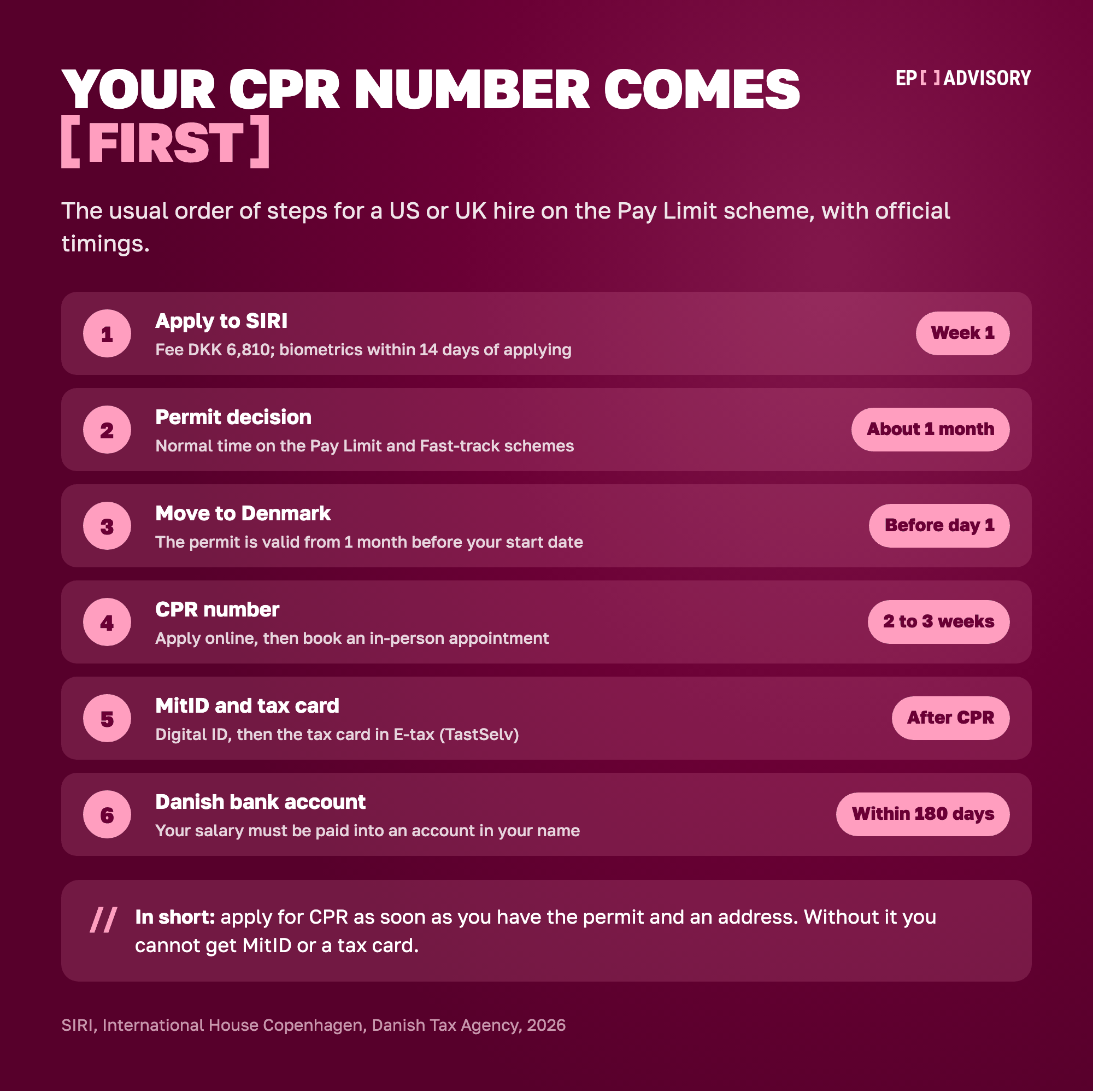
Your CPR number unlocks almost everything else. It is your personal ID number for the state, your doctor, your bank and your employer. In Copenhagen and 37 partner municipalities, International Citizen Service at International House Copenhagen handles CPR, MitID and tax cards for free. Do these in order:
- Get your permit and an address. You need the residence document from SIRI, a place to live and a plan to stay over three months.
- Apply for CPR online. Upload your passport, proof of address and permit. Processing may take two to three weeks. You then get an email link to book an in-person appointment.
- Get MitID. This is the national digital ID you use for banks, tax and public services. You can book it at International House, or set it up in the app with a chip passport in some cases.
- Get your tax card. Log in to E-tax (TastSelv) with MitID and fill in your preliminary income assessment. That creates your tax card. Give the primary card to your main employer only.
- Open a Danish bank account. On the pay limit schemes your salary must be paid into an account in your own name.
- Start Danish lessons. With a residence permit you are entitled to free lessons from your municipality once you are 18 and registered at a Danish address.
A residence-based CPR also gives you access to public healthcare. Start Danish early, even if your job is in English. You need it for permanent residence and for daily life outside work.
Next: once you know your scheme, find the employers who hire through it in our guide to jobs in Denmark for foreigners.
Weighing Denmark against its neighbours? Our guides on how to move to Norway and how to move to Sweden use the same format. If you are applying from the US, our guide to getting a job in Europe as an American covers the search side. Before you send applications, check the European CV format and how to write a cover letter for a job abroad.
Key takeaways
- Most Americans and Britons move to Denmark with a job offer, because every main permit is tied to a Danish employer.
- A gross salary of DKK 552,000 a year opens the Pay Limit scheme for any job, and DKK 446,000 works if the job was advertised in Denmark.
- Below those bars, a job on the Positive Lists at normal Danish pay can still qualify you.
- With a certified employer, the Fast-track scheme can let a US or UK citizen start work the day after the employer applies.
- Since 1 October 2026, new students below PhD level get a shorter job search after graduation and cannot bring family.
- Permanent residence takes eight years, or four if you meet all the extra conditions, and citizenship takes nine.
- Register for CPR first after you arrive, then MitID and your tax card.
See what a recruiter sees, then fix it before you apply. An instant score, then the fix for every problem.
Free, no card. A free account unlocks every fix.
Frequently asked questions
Can an American move to Denmark?
Yes. Most Americans move with a job offer under the Pay Limit, Supplementary Pay Limit or Positive List schemes. US citizens are visa-free for short visits, which also lets them use the Fast-track quick start with a certified employer.
How much do you need to earn to move to Denmark?
For the Pay Limit scheme you need at least DKK 552,000 a year gross in 2026. The Supplementary scheme needs DKK 446,000 and a job advertised in Denmark. Positive List jobs only need normal Danish pay for the role.
Can I move to Denmark without a job?
Usually not, unless you are an EU citizen, a student, a founder approved under Start-up Denmark, or the partner of a Dane or of someone with a Danish work permit. The main work schemes all start with a job offer in Denmark.
How long does it take to get permanent residence in Denmark?
The normal wait is eight years of legal residence. It drops to four years if you meet all four extra conditions, including Prøve i Dansk 3 and a high taxable income. Citizenship needs nine years.
Do I need to speak Danish to move to Denmark?
Not for a work permit. You need Danish later: Prøve i Dansk 2 for permanent residence and Prøve i Dansk 3 for citizenship. Lessons are free once you are registered.