 By Alisa Schlosser, Career Consultant at EP Advisory
The short answer: The median salary in Denmark is about DKK 48,100 per month gross (Statistics Denmark, 2025 data, including pension). The average is higher, DKK 52,846, pulled up by finance, pharma and ICT. After the 8% AM-bidrag and income tax at 2026 rates, a professional on DKK 660,000 keeps about DKK 34,900 a month. There is no statutory minimum wage. Sector agreements set pay floors instead. The industry agreement floor is DKK 143.40 an hour from 1 March 2026.
| Denmark (2025 pay, 2026 tax) | Per month |
|---|---|
| Median salary (gross, incl. pension) | ~DKK 48,100 |
| Average salary (gross, incl. pension) | DKK 52,846 |
| Typical take-home (DKK 660k role) | ~DKK 34,900 |
| Minimum wage | None statutory. Industry agreement floor DKK 143.40/hr from 1 March 2026 |
Denmark pays some of the highest salaries in Europe, and it does it in a country where healthcare is free at the point of use and university tuition is free for EU/EEA citizens (non-EU students pay fees). Average standardised earnings run to roughly DKK 330 per hour, about DKK 52,850 a month for a full-time job including pension (Statistics Denmark, 2025). In finance, engineering and software the averages climb well above that. But behind those figures sits the other half of the equation. Tax and the labour-market contribution take about 35–37% of a typical salary, and up to 60.5% of the top slice of very high pay. A small flat in Copenhagen costs DKK 8,000–10,000 a month. A beer in a bar costs about DKK 60 (Numbeo, September 2026).
So here is the arithmetic behind the headlines. We break down real salaries by sector, focus on the fields where foreign professionals actually get hired, subtract every mandatory cost, and show you what’s genuinely left at the end of the month.
In nearly 10 years, we’ve helped more than 5,000 professionals find jobs abroad. Want to know if your CV would pass in Denmark? Check your CV for free: a score in 30 seconds, then a fix for each problem.
A quick word on the currency. Denmark uses the krone (DKK), which is held in a fixed peg to the euro, so the rate barely moves, about €1 ≈ DKK 7.46 (Danmarks Nationalbank). An easy shortcut: divide any krone figure by roughly 7.5 to read it in euros. So DKK 50,000/month is about €6,700, DKK 55,000/month about €7,400, and DKK 660,000/year around €88,500.
What Is the Average Salary in Denmark Per Month? (2026)
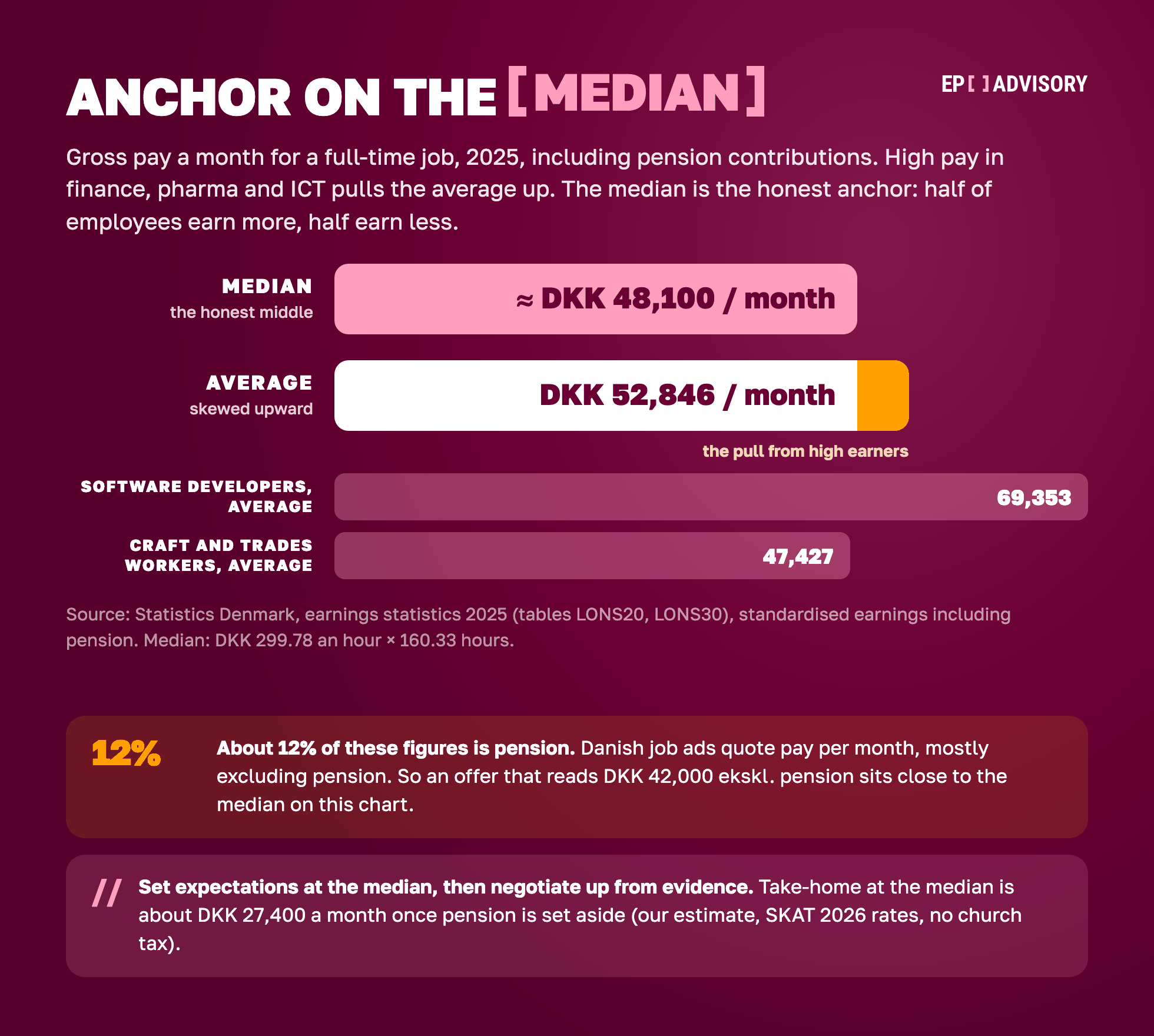
The average salary in Denmark is DKK 52,846 per month gross (roughly €7,100), according to Statistics Denmark’s latest full year, 2025. That figure includes pension contributions and is pulled up by finance and pharma. The median is the honest anchor at about DKK 48,100 per month gross. Denmark taxes heavily, so a typical worker keeps around DKK 27,000–30,000 per month net.
| Salary in Denmark (2025 pay, 2026 tax) | Per month, gross | Per month, net |
| Average full-time | DKK 52,846 | ~DKK 29,800 |
| Median (typical worker) | ~DKK 48,100 | ~DKK 27,400 |
Gross figures are Statistics Denmark’s 2025 monthly earnings, including pension. Net figures are our estimate: we set aside the pension share (about 12%) and applied 2026 SKAT rates with the average municipal tax and no church tax. See “The Arithmetic” section below for a full worked example.
Does Denmark have a minimum wage? No. There is no statutory minimum wage. Pay floors are set by sector collective agreements (overenskomster). The main industry agreement (Industriens Overenskomst) sets DKK 143.40 per hour for adults from 1 March 2026 (CO-industri). Other agreements set their own floors.
What counts as a good salary in Denmark? In our view, anything above the median, so roughly DKK 48,100 per month gross including pension, is comfortable outside Copenhagen. Around DKK 55,000 and up gives real breathing room in the capital, where the 2025 average was DKK 57,773.
If the numbers work for you, the next step is practical: our guide to jobs in Denmark for foreigners covers where the hiring actually happens, and the European work-visa salary thresholds show what an offer must pay before a permit is possible.
Danish Salaries at a Glance: The Essentials
- Average earnings: DKK 329.61/hour standardised, i.e. DKK 52,846/month gross full-time in 2025, including pension (Statistics Denmark)
- Median salary: lower, about DKK 48,100/month (DKK 299.78/hour, 2025, including pension), the more honest anchor for a typical worker
- No 13th month: unlike Switzerland or Austria. And when Danish ads state pay at all, they quote it monthly: every salary figure in our August 2026 Jobindex sample read “kr. pr. måned”, most marked “ekskl. pension”
- No statutory minimum wage: none at all. Pay floors are set by sector collective agreements (overenskomster), and each agreement sets its own. The industry agreement (Industriens Overenskomst) floor is DKK 143.40/hour from 1 March 2026 (CO-industri)
- Labour market contribution (AM-bidrag): 8% of gross, taken off the top before income tax (SKAT)
- Income tax: bottom-bracket 12.01% + municipal tax averaging 25.05% ≈ 37% for most earners (PwC)
- Top tax: after the 2026 reform, middle tax 7.5% above DKK 641,200, top tax 7.5% above DKK 777,900 and top-top tax 5% above DKK 2,592,700, all counted after AM-bidrag (about DKK 697,000, 845,500 and 2.82 million gross) (SKAT)
- Marginal tax ceiling: 60.5% in 2026, but only on income in the very top band (PwC)
- Healthcare: free, tax-funded (no compulsory insurance premium, unlike Switzerland)
- Pension: a labour-market pension on top of pay. Under the industry agreement it is at least 13% from May 2025: 11% from the employer and 2% from you (CO-industri). Other agreements differ. Add the small state ATP. Watch ads quoting pay “inkl. pension”: that figure is higher than the cash salary by the pension share
- Rent, small flat in Copenhagen: DKK 8,000–10,000/month for 1–2 rooms (City of Copenhagen)
- Work permit (non-EU): Pay Limit Scheme threshold DKK 552,000/year for 2026 (SIRI / nyidanmark). The Supplementary Pay Limit Scheme is lower, DKK 446,000/year, while unemployment stays at or below 3.75%
An important caveat about “median” versus “average”. Most of the salary pages we checked in August 2026 lead with the average, because it looks better. But it’s dragged upward by well-paid staff at Novo Nordisk, Maersk and the big banks. The median is more honest: half of all workers earn more, half earn less. Anchor your expectations to the median.
Salaries by Sector: Where Foreign Professionals Actually Get Hired
This calls for honesty. Denmark does not open its doors freely to non-EU nationals: you need either a high salary (Pay Limit Scheme) or a job on an official shortage list (Positive List). Its big advantage over Switzerland or Germany is that English is spoken almost everywhere, and in pharma, tech and shipping the working language is often English outright.
Your realistic chances lie in sectors with genuine skill shortages. Here they are, with Statistics Denmark’s 2025 average monthly pay for the matching occupation groups, including pension.
| Sector | Average monthly pay, 2025 (DKK gross, incl. pension) | Where the jobs are | Our view: odds for non-EU candidates |
| Pharma / Life Sciences | Life science professionals 65,932 · Chemical engineers 78,047 | Copenhagen, Kalundborg, Aarhus | High. Novo Nordisk, Lundbeck, Genmab, Leo Pharma, Novonesis |
| IT / Software development | Software developers 69,353 · All ICT professionals 68,645 | Copenhagen, Aarhus, Odense | High |
| Engineering / Cleantech / Wind | Engineers (excl. electrotechnology) 70,280 | Aarhus, Jutland, Copenhagen | High. Vestas, Ørsted, Grundfos, Danfoss, Rambøll |
| Shipping / Logistics / Maritime | No single occupation figure in the statistics | Copenhagen | High. Maersk, DFDS, DSV, English-speaking, global |
| Finance / Fintech | Finance professionals 70,684 · Financial analysts 79,647 | Copenhagen | Moderate. Danske Bank, Nordea, Saxo Bank, Nykredit |
| MedTech / Data Science / AI | Mathematicians and statisticians 78,686 | Copenhagen, Aarhus | High. Coloplast, Demant |
| Healthcare / Nursing | Nurses 51,754 · GPs 82,193 · Specialist doctors 103,070 | Nationwide | Moderate. Danish authorisation and language required |
| Skilled trades (Positive List) | Craft trades 47,427 · Electricians 49,352 | Nationwide | Moderate. 63 skilled trades on the list from 1 July 2026 |
| All employees (for comparison) | 52,846 | Nationwide |
Source: Statistics Denmark, table LONS20, standardised monthly earnings for 2025, full-time, including pension. Multiply by 12 for a rough annual figure.
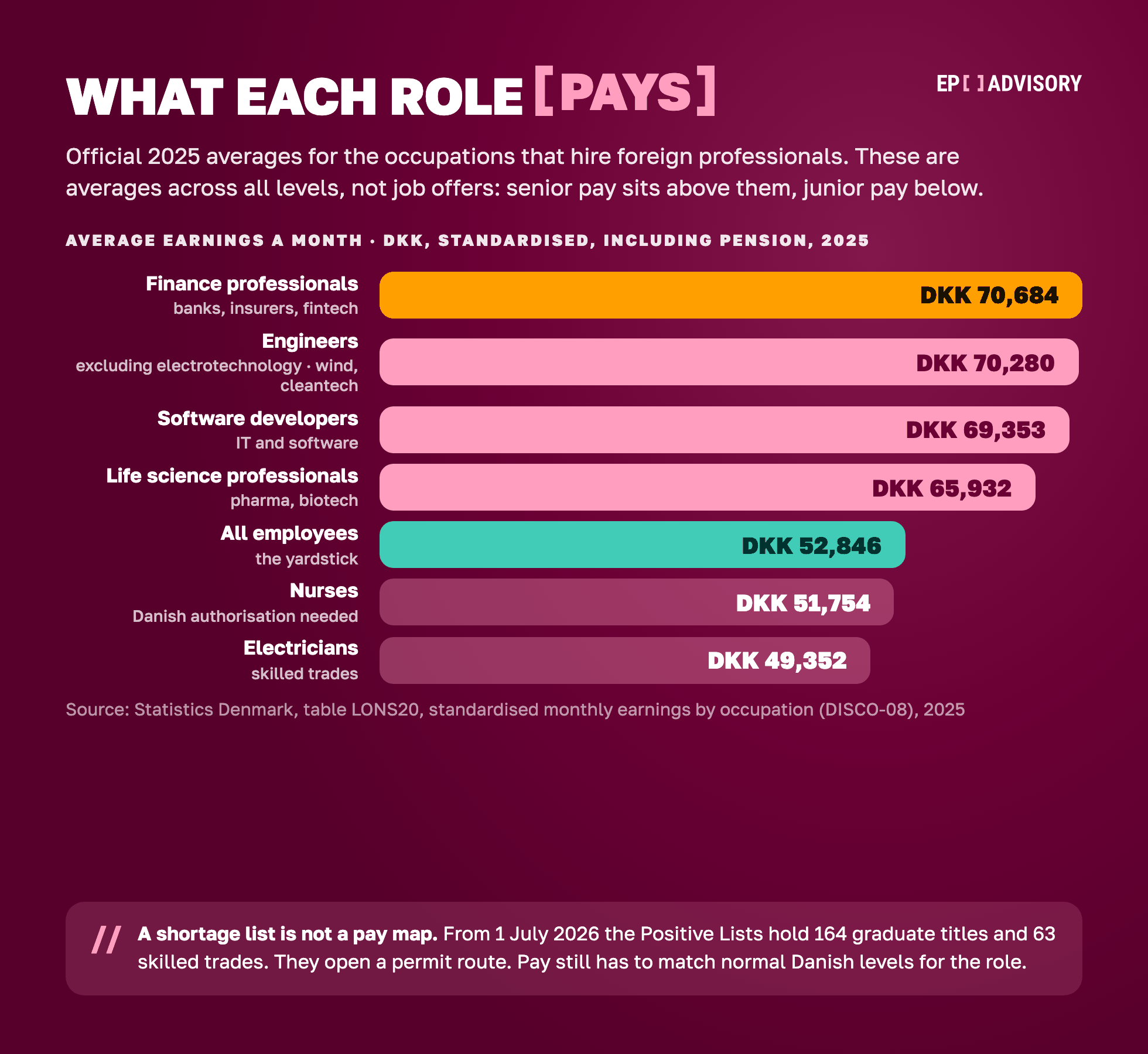
A real example. Software developers in Denmark averaged DKK 69,353 a month in 2025, including pension, or about DKK 832,000 a year (about €111,000). Pay is lower outside the capital. The average for all employees in Region Midtjylland, around Aarhus, was DKK 50,316 a month, about 13% below Region Hovedstaden’s DKK 57,773. Rent is usually lower there too, so check both sides of the sum. The headline number and what you keep can diverge sharply depending on where you land.
Critical when negotiating: Denmark has no statutory 13th-month salary, and offers are usually discussed as monthly pay: the dominant ad template in our August 2026 sample was “startløn … kr. pr. måned ekskl. pension”. The labour-market pension (at least 13% under the industry agreement: 11% from the employer, 2% from you) sits on top of that figure and is real money saved for you, but your own share comes out of gross. Always confirm in writing the pension rate, whether the quoted figure is ekskl. or inkl. pension, and whether a bonus, holiday supplement (ferietillæg) or shares sit on top of base.
Score your CV in 30 seconds, then fix its biggest problems one by one. Both free.
Free, no card.

Average Salary in Copenhagen 2026: What the Capital Pays
Copenhagen (Region Hovedstaden) pays roughly 7–10% above the national figures. In 2025 the regional average was 9.3% higher and the median about 8.5% higher, according to Statistics Denmark’s earnings by region. Many pharma, finance and shipping head offices sit here.
| Copenhagen (2025 pay, 2026 tax) | Per month, gross | Per month, net (approx.) |
|---|---|---|
| Average salary (full-time) | DKK 57,773 (≈€7,700) | ~DKK 32,300 |
| Median salary (typical worker) | ~DKK 52,000 (≈€7,000) | ~DKK 29,500 |
| Minimum wage | None by law; each sector agreement sets its floor | Industry floor DKK 143.40/hour from 1 March 2026 |
| Rent, small flat | DKK 8,000–10,000 for 1–2 rooms (City of Copenhagen) | |
A median Copenhagen salary therefore leaves roughly DKK 19,500–21,500 after rent, before food and transport. The gross figures include pension. The net figures are our estimate on 2026 tax rates, with the pension share set aside. The minimum wage in Copenhagen is the same as everywhere in Denmark: there is no statutory rate, and the collective agreement for your sector sets the floor.
Where to Look for Work: Official Resources
- Work in Denmark: the official state portal for international recruitment. Roles here often qualify for the Positive List
- Jobindex.dk: among Denmark’s largest private job boards
- LinkedIn Jobs: one of the main channels for international and English-language roles
- The Hub: startup and scale-up jobs, backed by Danske Bank
- Jobnet / official listings: public vacancies. Where a permit route carries an advertising requirement, as the Supplementary Pay Limit Scheme does, this is where the role must have been posted
Official sources worth using to verify any figure:
- Statistics Denmark (Danmarks Statistik): official salary and earnings statistics
- SKAT (Skattestyrelsen): tax rates, brackets and the official take-home calculator
- SIRI / nyidanmark.dk: work permits, Pay Limit Scheme and Positive Lists
- Life in Denmark (borger.dk): the official guide to healthcare, tax and settling in
The Other Side: What Living Here Actually Costs
Now we subtract. Here is the structure of unavoidable costs for a single person, with Copenhagen as the worst case.
Rent, the biggest line item
- Copenhagen: a small 1–2 room flat runs DKK 8,000–10,000; a 2–3 room flat DKK 13,000–15,000 (City of Copenhagen)
- Aarhus & Odense: usually cheaper than Copenhagen. There is no official city average, so check current listings
- Aalborg & smaller towns: usually cheaper still
- Deposit: landlords typically demand up to 3 months’ rent as deposit plus up to 3 months prepaid, a large sum to have ready on arrival
What you need to know: the Copenhagen rental market is tight and competitive. Many long-term flats are let through waiting lists (venteliste); expect to move fast and to be asked for proof of income and references.
Healthcare, free, and that changes the maths
This is the key difference between Denmark and Switzerland. Healthcare in Denmark is tax-funded and free at the point of use. Once you register and receive your yellow health card (sundhedskort), GP visits, hospital treatment and most specialist care cost you nothing (Life in Denmark).
- No monthly premium: unlike Switzerland, there is no compulsory health insurance bill
- Prescriptions: partly subsidised, with an annual cap on what you pay out of pocket
- Dental care for adults is not fully covered, so budget for check-ups yourself. Prices vary by clinic
- Optional private cover (sundhedsforsikring) is often provided by employers as a perk
Everything else you have to pay
- Groceries: as a rough guide, we assume about DKK 3,000/month for one person (Netto, Føtex, Rema 1000). Discounters are usually cheaper than supermarkets
- Public transport: the price of a Copenhagen commuter pass depends on how many zones you cross, so check it with the operator DOT. Many people cycle; the city is built for it
- Utilities + internet: about DKK 1,500/month combined as a rough guide. Numbeo users report about DKK 1,250 for utilities in an 85 m² flat and about DKK 260 for internet (September 2026)
- Beer / lunch out: a half-litre beer in a bar is about DKK 60; a meal at an inexpensive restaurant about DKK 150 (Numbeo, September 2026). The 25% VAT is baked into every price
The Arithmetic: What Actually Lands in Your Account
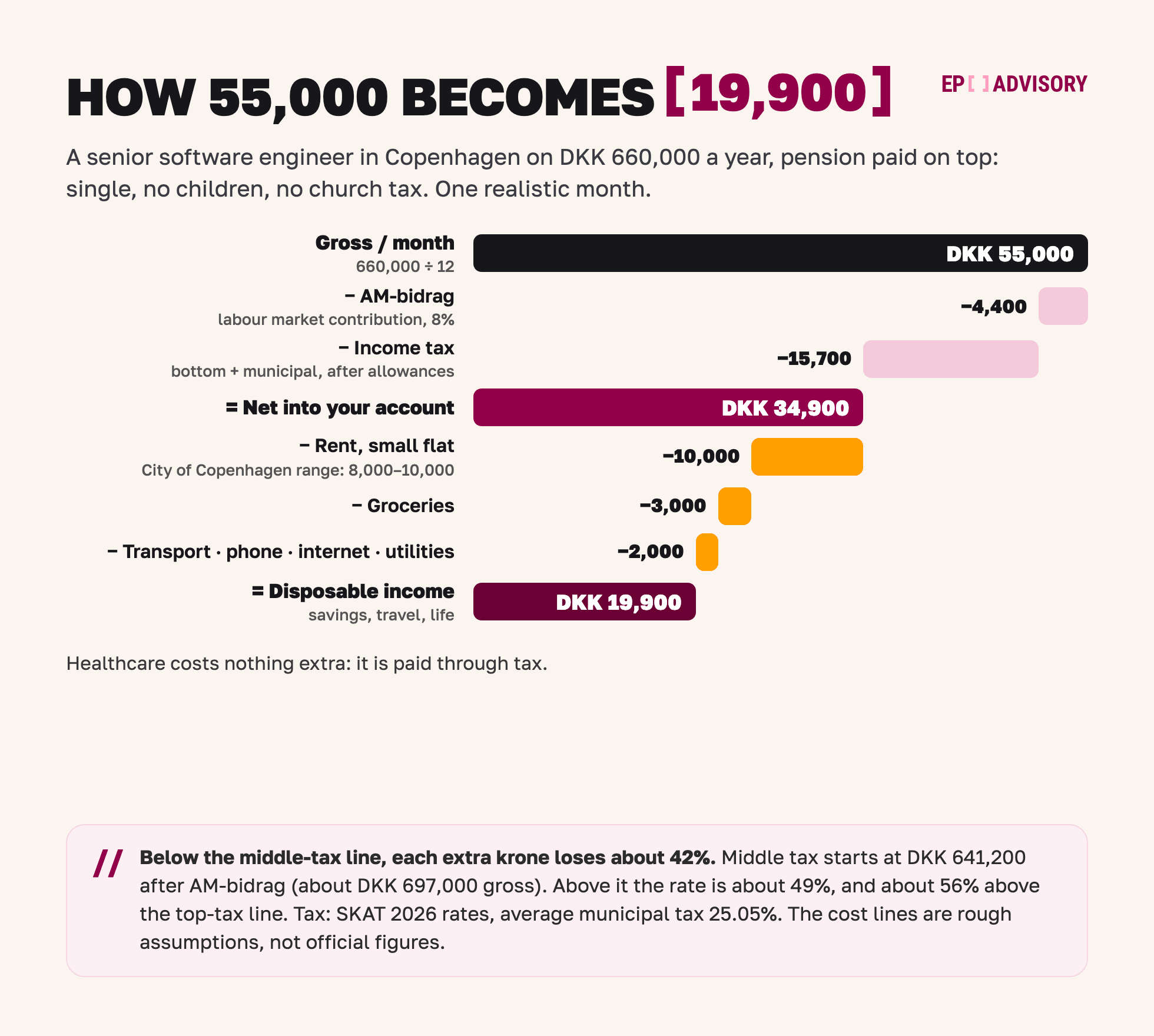
Let’s put it together. Take a realistic scenario: a Senior Software Engineer in Copenhagen on DKK 660,000 a year, DKK 55,000/month gross, about €7,400 (single, no children, no church tax, pension paid on top).
| Line item | DKK/month |
| Gross (660,000 ÷ 12) | 55,000 |
| − AM-bidrag (labour market contribution, 8%) | −4,400 |
| − Income tax (bottom 12.01% + average municipal 25.05%, after allowances) | −15,700 |
| = Net into your account | ~34,900 |
| − Rent, small flat in Copenhagen | −10,000 |
| − Health insurance | 0 (public, tax-funded) |
| − Groceries | −3,000 |
| − Transport, phone, internet, utilities | −2,000 |
| = Disposable income | ~19,900 |
Roughly DKK 19,900 a month of disposable income (about €2,700) on a DKK 660,000 salary is a strong result, and remember, healthcare is already paid for through your tax. The figure above stays below the middle-tax threshold of DKK 641,200 after AM-bidrag (about DKK 697,000 gross). So each extra krone is taxed at about 42%, including AM-bidrag. Above that line, middle tax lifts the marginal rate to about 49%. Above DKK 777,900 after AM-bidrag, top tax lifts it to about 56%. The rent, grocery and bills lines are rough assumptions, not official figures. Always run your own number through the official SKAT calculator before you sign.
And on a lower salary? At DKK 480,000 a year in Copenhagen (net around DKK 26,100/month), after the same rent and bills you’re left with roughly DKK 11,000. Liveable, especially with a cheaper flat or a flatmate, but saving is slower. Note too that this salary is below the Pay Limit threshold of DKK 552,000 but above the Supplementary Pay Limit of DKK 446,000. So your route in would be the Supplementary scheme, with the job advertised on Jobnet and EURES, or the Positive List if your occupation is on it.
See what a recruiter sees, then fix it before you apply. An instant score, then the fix for every problem.
Free, no card.
The Work Permit: Your Route In
EU/EEA and Swiss citizens can work in Denmark with no permit. For everyone else, there are three main routes, and the salary thresholds rose on 1 January 2026.
- Pay Limit Scheme (Beløbsordningen): minimum salary DKK 552,000/year for 2026, about €74,000 (up by DKK 38,000). No occupation restriction, but the salary bar is high. Your pay must be transferred into a Danish bank account in your own name (SIRI)
- Supplementary Pay Limit Scheme: a lower threshold of DKK 446,000/year for 2026. It is open to any occupation. The job must be advertised on Jobnet and EURES for at least 2 weeks. The scheme closes if average unemployment over 3 months rises above 3.75%. Permits run for up to 5 years (SIRI)
- Positive List: for occupations with a recognised shortage. From 1 July 2026 the list for higher education holds 164 job titles and the list for skilled trades 63 (SIRI). The salary only needs to match normal Danish levels for the role. The lists are refreshed every 1 January and 1 July
- Fast-track scheme: for employers certified by SIRI, allowing faster processing and easier job changes
- Who applies: employer and employee apply together via nyidanmark.dk; you need a concrete job offer first
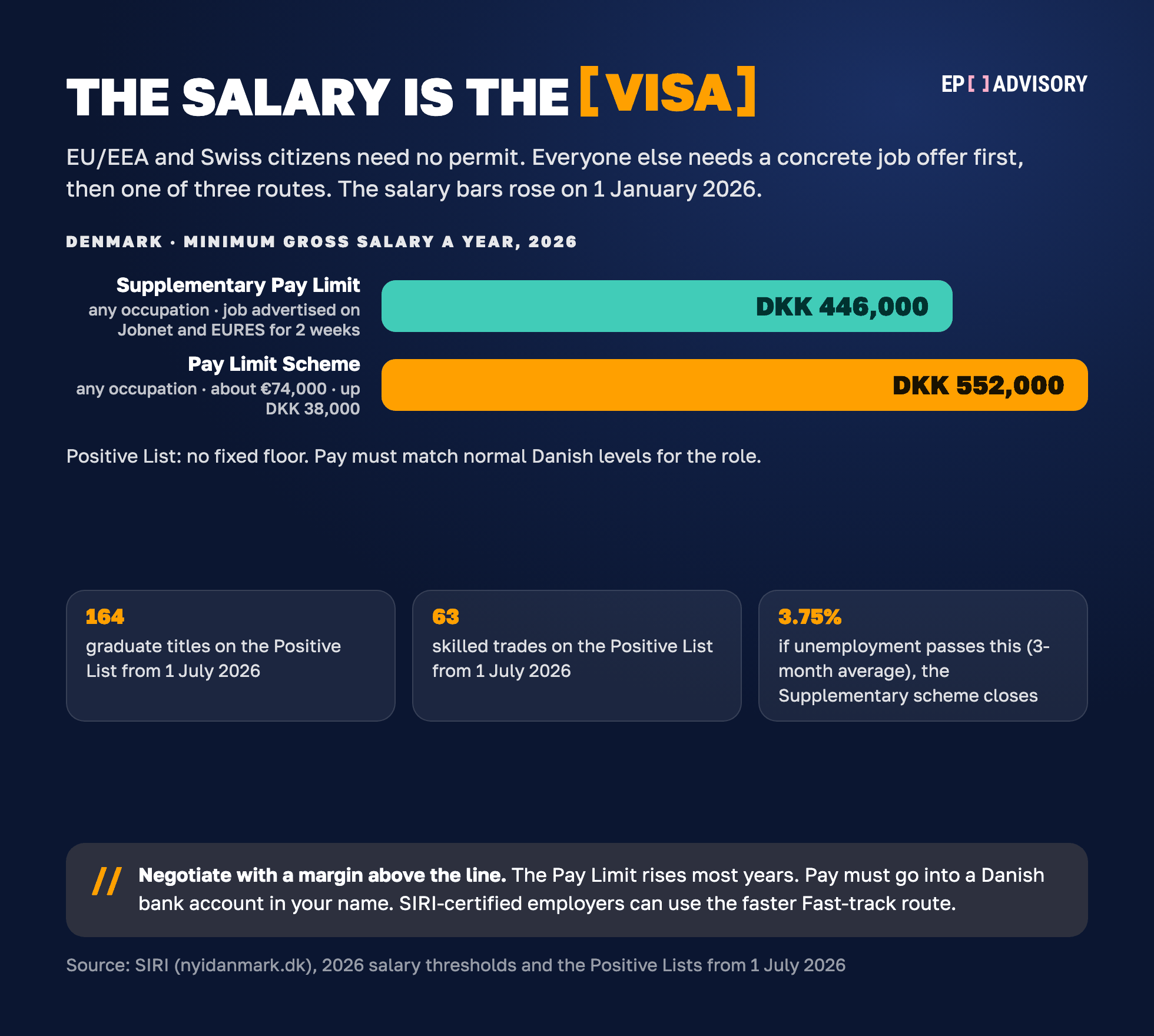
A practical detail: the Pay Limit threshold rises most years, so a salary that qualifies today may not next January, negotiate with a margin above the line. And because the Positive List changes twice a year, timing your application to the current list matters.
Current rules, thresholds and the occupation lists are published by SIRI (nyidanmark.dk).
Related reading: Work visa & Blue Card salary thresholds in Europe 2026 · Salaries in the UK in 2026
Key Takeaways
- Anchor on the median (about DKK 48,100/month in 2025, including pension), not the average. The average is pulled up by finance, pharma and ICT pay.
- The strongest openings for non-EU professionals are in pharma/life sciences, IT, engineering/wind, shipping and MedTech, and much of it works in English.
- Healthcare is free and tax-funded: there is no compulsory insurance premium as in Switzerland. That materially changes your monthly budget.
- There is no 13th-month salary. Danish offers are quoted monthly, and a labour-market pension sits on top of base: at least 13% under the industry agreement, 11% of it employer-paid. Confirm the rate and the ekskl./inkl. pension basis in writing.
- On DKK 660,000 in Copenhagen you keep about DKK 34,900/month net (≈€4,700) and roughly DKK 19,900 in disposable income after rent and bills.
- Watch the tax lines (after AM-bidrag): below DKK 641,200 your marginal rate is about 42% including AM-bidrag. Middle tax lifts it to about 49%, and top tax above DKK 777,900 lifts it to about 56%.
- For 2026 the Pay Limit threshold is DKK 552,000 (≈€74,000); the Supplementary scheme starts at DKK 446,000, and the Positive List offers a lower-salary route if your occupation is listed.
Frequently Asked Questions
What is the average salary in Denmark in 2026?
Standardised average earnings are around DKK 330 per hour according to Statistics Denmark, which works out to DKK 52,846 a month gross (about €7,100) for a full-time job in 2025, including pension. The median is lower, about DKK 48,100/month, and is a better guide to what a typical worker actually earns.
What is the average take-home (net) salary in Denmark?
A typical full-time worker keeps around DKK 27,000–30,000 per month after tax, by our estimate on 2026 tax rates. Tax and AM-bidrag take roughly 35–37% of a typical salary, but they fund tax-paid healthcare and education.
Does Denmark have a minimum wage?
No. Denmark has no statutory minimum wage. Pay floors are set by sector collective agreements (overenskomster). The main industry agreement sets DKK 143.40 per hour for adults from 1 March 2026.
How much tax do you pay in Denmark?
First, an 8% labour-market contribution (AM-bidrag) comes off the top. On the rest, most earners pay bottom-bracket tax of 12.01% plus municipal tax averaging about 25%, for a combined rate near 37%. Middle tax (an extra 7.5%) applies above DKK 641,200 after AM-bidrag, top tax (a further 7.5%) above DKK 777,900, and the overall marginal ceiling is 60.5% in 2026.
Do you need a job to get a Danish work permit?
Yes. For non-EU nationals you need a concrete job offer first, then apply under the Pay Limit Scheme (minimum DKK 552,000/year in 2026), the Supplementary Pay Limit Scheme (from DKK 446,000/year, job advertised on Jobnet and EURES), the Positive List (a listed shortage occupation at normal Danish pay), or the Fast-track scheme if the employer is certified.
Is Denmark a good place for foreign professionals?
Yes, English is widely spoken, especially in pharma, tech and shipping, and healthcare is free and university tuition is free for EU/EEA citizens. The trade-offs are high taxes, expensive housing in Copenhagen and a competitive rental market, but net pay and quality of life remain strong.
Getting ready to apply in Denmark? Check your CV for free: see what a recruiter sees, then fix each problem.