 By Andre Atallah, CEO of EP Advisory
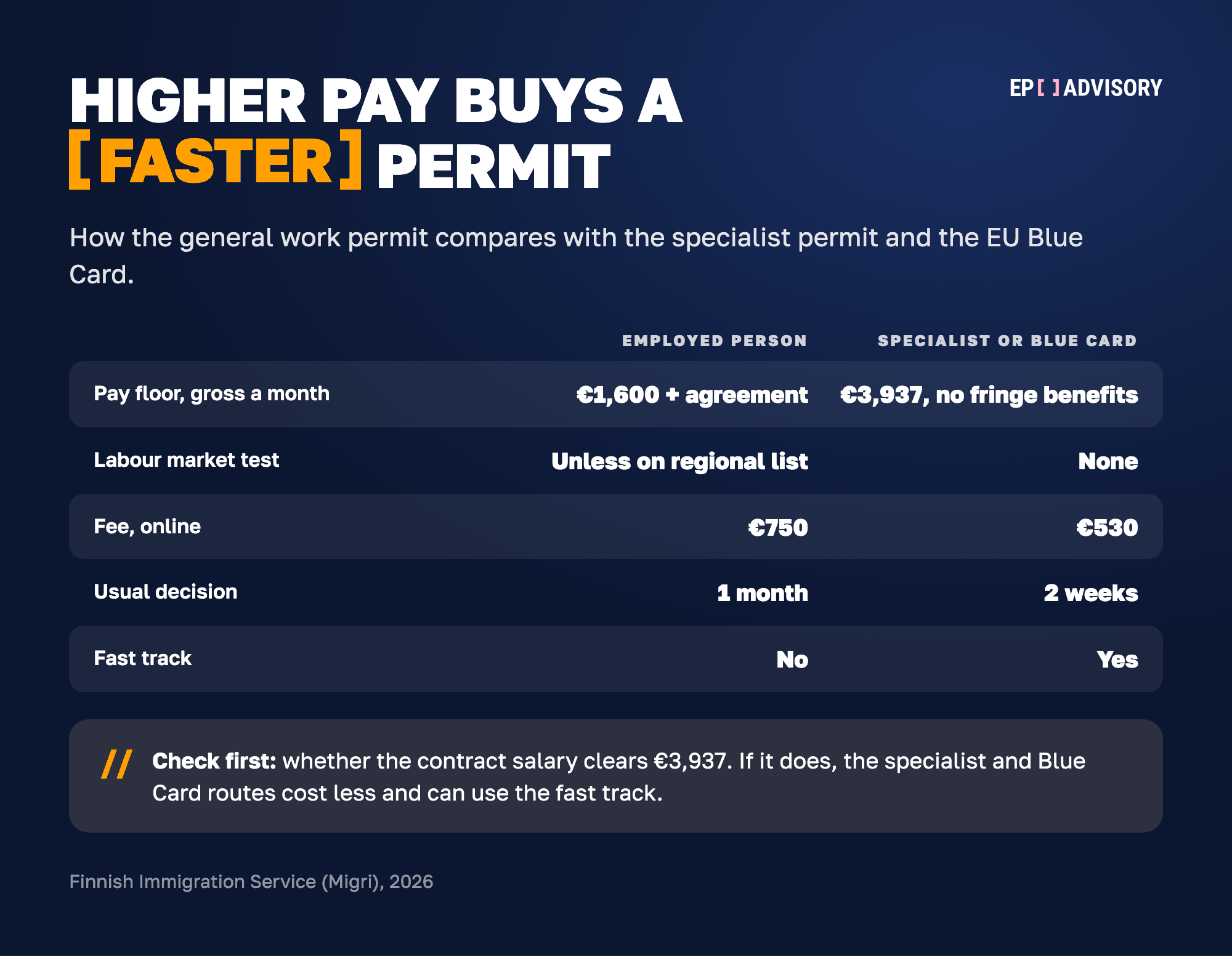
Short answer: yes, jobs in Finland for foreigners are real, but the market is competitive. EU citizens can start work straight away. Everyone else needs a job offer first, then a work permit from Migri, the Finnish Immigration Service. The standard permit needs at least €1,600 a month and the collective agreement rate. Specialists and EU Blue Card holders need €3,937.
Finland hires foreigners every week, but the market is tighter than it was. Your best chances are in the jobs employers find hard to fill. This guide shows the three permit routes and their pay floors, how long Migri takes, which jobs are in short supply, the sectors that hire in English, and a costed example from offer to first day.
For nearly 10 years, we’ve helped more than 5,000 professionals find jobs abroad. Want to know if your CV will pass screening in Finland? Check your CV for free: a score in 30 seconds, then a fix for each problem.
Jobs in Finland for foreigners: who needs a permit
Your passport decides your route. EU and EEA citizens and the Swiss can start work in Finland without a permit. If you stay longer than three months, register your right of residence with Migri. Nordic citizens register with the population register instead.
Everyone else needs a residence permit based on work before the first day of work. Three facts shape the whole process:
- The offer comes first. Every work permit is tied to a job and a signed contract. Start with the job search, not the permit.
- You apply from outside Finland. Migri says a first permit applied for inside Finland usually gets a negative decision. You cannot switch from a tourist visit to a work permit, as Migri’s employment FAQ explains.
- You do not work while you wait. Plan your notice period at home so you can leave once the decision arrives.
Two smaller routes exist. Founders with a Business Finland start-up statement can use the start-up permit. Graduates of Finnish universities can get a permit to stay on and look for work. Seasonal work in farming, forestry, berry picking and tourism has its own seasonal work permits, for at most nine months in any 12. This guide focuses on people moving with a job offer, which is how most foreign professionals arrive.
The three work permits and their 2026 pay floors
Which permit you get depends on your pay and your degree, not your job title. Finland has no statutory minimum wage. Collective agreements set pay floors by sector, and Migri adds its own minimums on top. Here are the three main routes for 2026.
| Permit | Pay floor, gross a month (2026) | Other conditions |
|---|---|---|
| Employed person | €1,600 and the collective agreement rate, both at once | Labour market test unless your job is on the regional list |
| Specialist | €3,937 | Higher education degree or expertise gained at work |
| EU Blue Card | €3,937 | Degree of at least 3 years, or usually 5 years’ professional experience; job of at least 6 months |
Here is what each permit costs and how long Migri takes:
| Permit | Fee, first permit | Decision time (Migri) |
|---|---|---|
| Employed person | €750 online, €950 on paper | 1 month in most cases |
| Specialist | €530 online, €630 on paper | 2 weeks in most cases |
| EU Blue Card | €530 online, €630 on paper | 2 weeks in most cases |
The employed person permit is the general route. Your pay must meet the relevant collective agreement and be at least €1,600 gross a month in 2026, according to Migri. Evening and night supplements do not count towards it. Fringe benefits can make up at most half your pay. Zero-hours and on-demand contracts do not qualify, so ask for fixed weekly hours in writing.
The specialist permit and the Blue Card share one bar: €3,937 a month. That is about $4,420 or £3,290 at ECB rates of 2026-11-02. It rose from €3,827 in 2025 and is reviewed every year. Unlike the general route, fringe benefits such as a company car or housing do not count, so check the cash salary in your contract. The specialist permit lasts up to two years. The EU Blue Card lasts up to two years, or the length of the job plus three months. It also moves with you more easily inside the EU later.
Say your offer clears €3,937 and the job needs special expertise. Then the specialist and Blue Card routes cost less than the general route. They also skip the labour market test and can use the fast track. Which permit fits a given case is for the employer and Migri to confirm. Our guide to work visa salary thresholds in Europe compares Finland’s bar with its neighbours.
Your first steps
- Get a signed job offer, with fixed weekly hours in writing.
- Check the cash salary in your contract against the pay floor for your permit.
- Book your identity appointment at a Finnish mission or visa centre.
- Apply online from outside Finland, in Enter Finland.
- Prove your identity at the appointment, within five working days on the fast track.
- Plan your notice period at home, so you can leave once the decision arrives.
Rules change each year, so check the current pages at Migri before you act.
How long Migri takes in 2026
Approved first permits are fast; refusals take far longer. In September 2026, first employed-person permits took 21 days on average when approved and 79 days when refused, according to Migri’s own figures. Extensions took 39 days when approved and 134 days when refused. A long wait often means a problem with the file, so answer any request for more information on the same day.
The numbers show how selective the route is. By the time of our check, 4,564 first applications for this permit had been filed in 2026. Migri had decided 4,566, and 3,147 of them were positive. That is about two in three. Before you file, check three things: the pay clears the floor, the contract states fixed hours and every document is attached. Each gap adds weeks.
Migri’s processing-time estimates for 2026, next to the maximum set by law, are:
- Employed person: one month in most cases, two months in a minority. The legal maximum is two months.
- Specialist and Blue Card: two weeks in most cases, two months in a minority. The legal maximum is two months.
- Extensions: Migri estimates one month in most cases for an employed person and two weeks for specialists and Blue Card holders. The legal maximum is two months for all three. File well before your card expires.
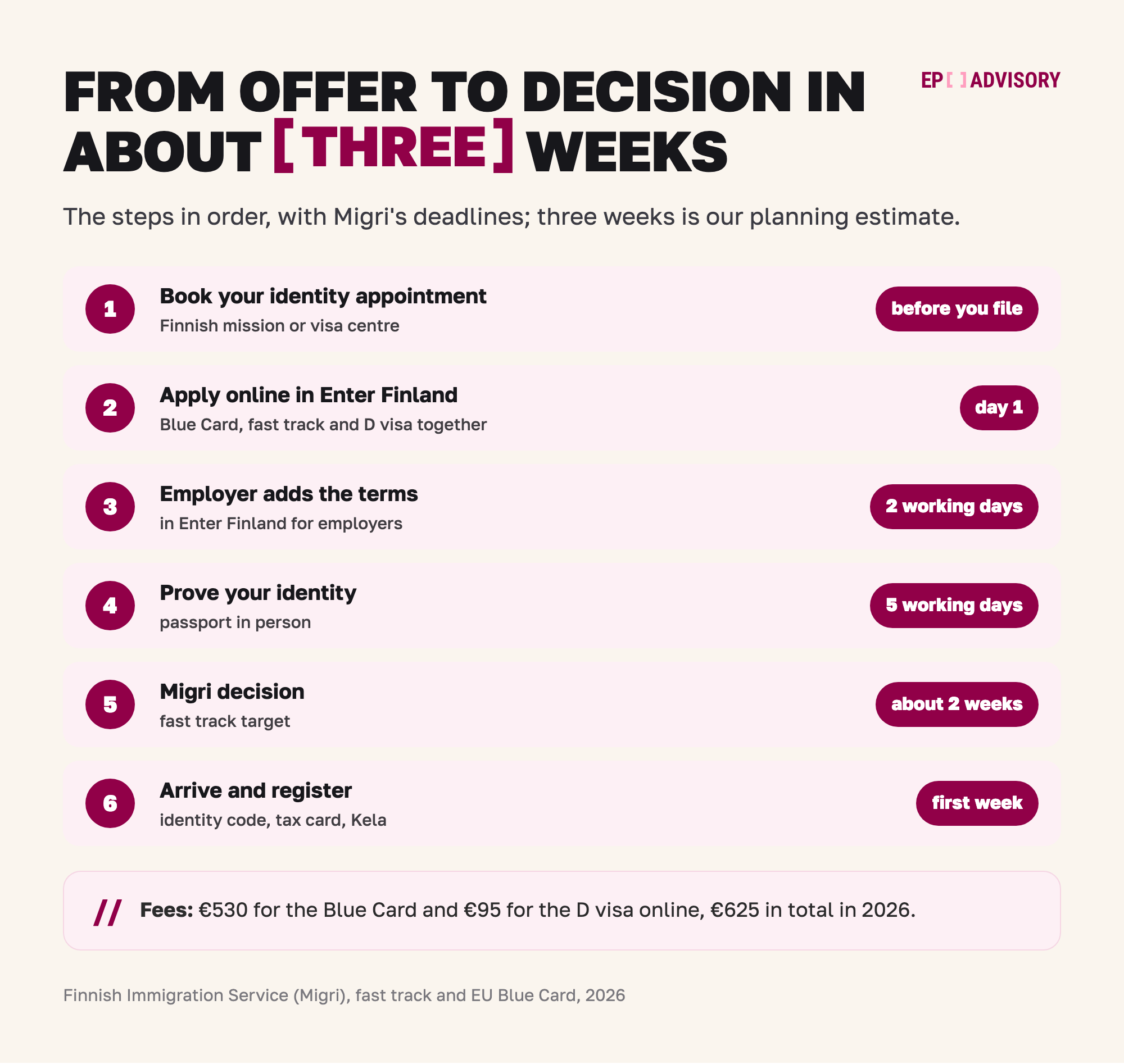
The fast track gives a decision in about two weeks. It covers specialists, Blue Card holders, start-up entrepreneurs, intra-corporate transferees and top or middle managers, according to Migri. It works only for first permits filed online from outside Finland. Two deadlines make or break it. Take these steps in order:
- Book your appointment at a Finnish mission or visa centre before you press submit.
- Submit your first permit application online, from outside Finland.
- Prove your identity at the mission or visa centre within five working days.
- Make sure your employer adds the terms of employment within two working days.
Family members can use the fast track too if they apply at the same time.
Score your CV in 30 seconds, then fix its biggest problems one by one. Both free.
Free, no card. A free account unlocks every fix.

 Sample report
Where Finland is short of workers
The official shortage lists show which jobs skip the labour market test. Only the employed person permit has a labour market test. The employer normally advertises the job on Job Market Finland for two weeks first, as the Economic Development Centres explain. If your occupation is on your region’s list, that step falls away. If the official Labour Force Barometer shows an oversupply of workers in your field, Migri says a permit usually cannot be granted.
Each region sets its own list twice a year, in June and December. The list in force runs from 1 June to 30 November 2026, published on tyovoimabarometri.fi. Check the new list in December before your employer files.
Across the 18 mainland regions, the same jobs appear again and again:
- General practitioners: on the list in 16 regions.
- Welders and metal machine-tool setters: 14 regions each.
- Cooks: 11 regions.
- Livestock workers, gardeners and electrical fitters: 9 regions each.
- Electrical engineers: 8 regions.
- Software developers and application programmers: 5 regions only: Kainuu, Kymenlaakso, North Ostrobothnia, Päijät-Häme and South Karelia.
- Registered nurses: 3 regions.
Doctors, nurses and other health professionals also need a licence to practise. It comes from the Finnish Supervisory Agency, which took over Valvira’s work on 1 January 2026, as Migri’s employed-person page notes. Start that early, because the permit depends on it.
Helsinki’s region lists health and care jobs only. All 14 occupations on the Uusimaa list are in health and care, from doctors and nurses to home-care workers. Are you a developer or an engineer aiming for Helsinki on the general permit? Then expect the labour market test, or earn enough for the specialist route. Åland, the Swedish-speaking island region, runs its own list of 80 occupations, valid until 31 July 2027.
The wider job market is tighter than it was. Trend unemployment was 10.6% in October 2026, according to Statistics Finland. 2,560,000 people were in work, 51,000 fewer than a year earlier.
The vacancy figures point the same way. Statistics Finland counted 26,600 vacancies in the third quarter of 2026, 2% fewer than a year earlier. A third of them were hard to fill. 76% were in private firms. Western Finland added 1,100 vacancies over the year, while public administration, education, health and social services lost 2,200. Use the lists and the regions with growth to choose where you apply, then target employers there by name.
Which jobs in Finland work in English
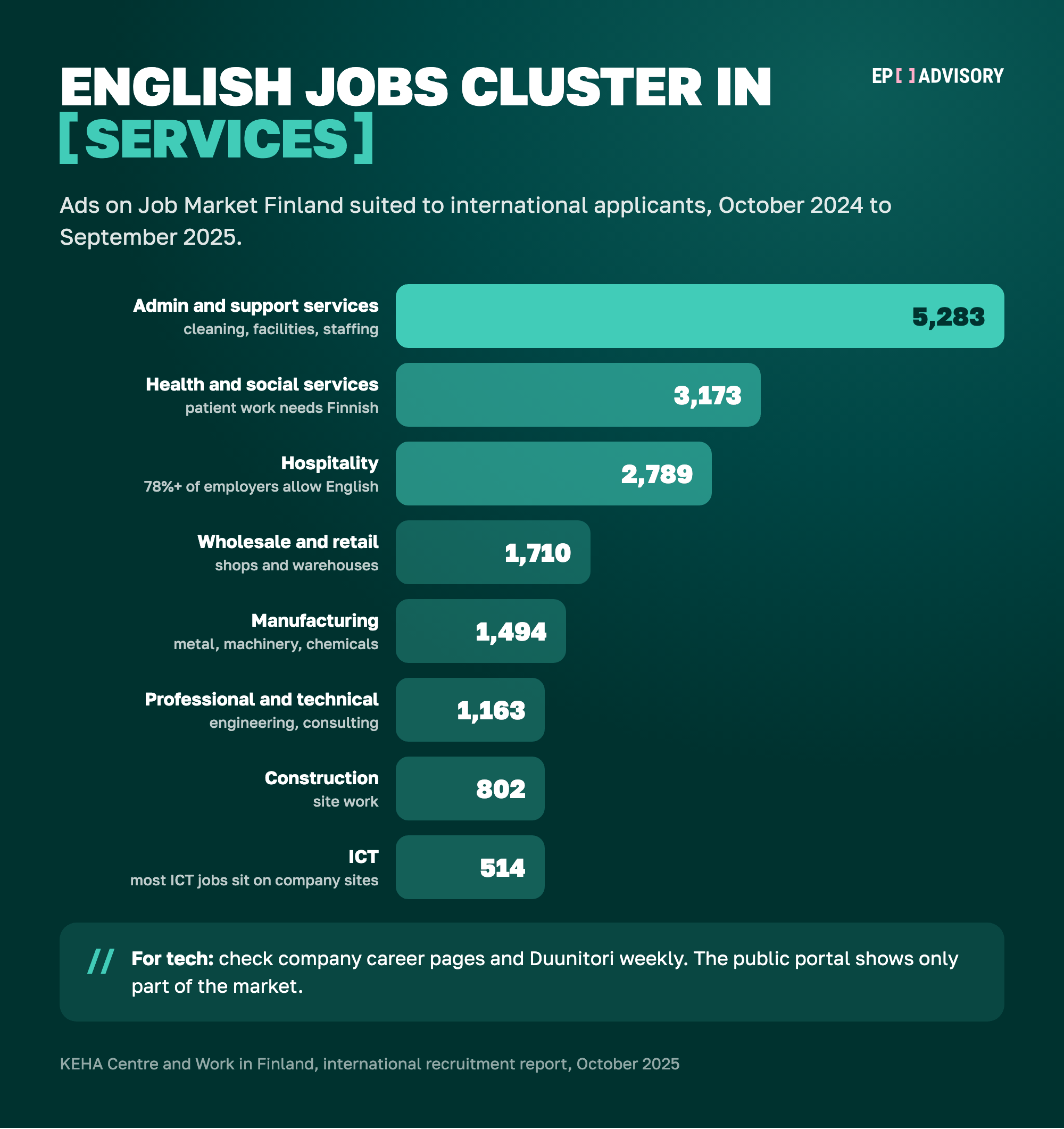
English-language jobs exist, but they cluster in a few sectors. An official report on international recruitment counted the job ads that suit international applicants. It treats these as English-language jobs. It covers ads on the public job portal (Job Market Finland) from October 2024 to September 2025. The report is by the KEHA Centre and Work in Finland. Here is the count by sector:
| Sector | Ads, Oct 2024 to Sep 2025 | What it means for you |
|---|---|---|
| Administrative and support services | 5,283 | The largest group; includes cleaning, facilities and staffing work |
| Health and social services | 3,173 | Licensed patient work usually needs Finnish or Swedish and a licence to practise |
| Hospitality | 2,789 | Over 78% of hospitality employers say work in English is possible |
| Wholesale and retail | 1,710 | English-language openings are high for the sector’s size |
| Manufacturing | 1,494 | Metal, machinery, chemicals and shipbuilding expect more international hiring in 2026 |
| Professional, scientific and technical | 1,163 | Engineering, consulting and research roles |
| Construction | 802 | Site work; trade skills matter more than language |
| ICT | 514 | Most ICT jobs are posted on company sites and Duunitori instead |
| Finance | 34 | The share of finance employers open to English fell to 50% in 2024 |
The ICT figure looks small for a reason. Many tech companies in Helsinki, Espoo, Tampere and Oulu work in English. The report notes they mostly post on their own career pages and Duunitori. If you work in tech, build a list of 30 to 50 target companies. Check their sites weekly instead of relying on the public portal.
Finnish still widens your options. Public sector, health and customer-facing jobs usually need Finnish or Swedish. Even in English-speaking teams, a basic course shows commitment. You can search for courses near you on finnishcourses.fi. Put your current level on your CV, even if it is A1.
Where to find jobs in Finland
Use the public portal for volume and company sites for professional roles. These are the main places to look:
| Site | Best for | Tip |
|---|---|---|
| Job Market Finland (Työmarkkinatori) | All sectors; the public employment service | Filter by working language; labour market test ads appear here |
| Work in Finland | Jobs open to international applicants | Part of the government’s Talent Boost programme |
| Duunitori | Private-sector and ICT jobs | A large commercial board; many ads in Finnish |
| Oikotie Työpaikat | Professional and office roles | Search in English and in Finnish job titles |
| Kuntarekry | Municipal and health jobs | Most posts need Finnish or Swedish |
| Valtiolle.fi | Central government jobs | Research and agency roles sometimes run in English |
| EURES | EU-wide postings | Useful for EU citizens comparing countries |
Many jobs are never advertised. InfoFinland calls them hidden jobs. You can send an open application to a company you want to work for. Ask it to keep your CV on file, as InfoFinland explains. Combine this with LinkedIn messages to team leads, not only to HR.
Never pay for a job. Recruitment in Finland is always free for job seekers. By law, employers and recruitment agencies may not charge placement fees, as Work in Finland states. Treat any offer that asks for money upfront or promises a visa as a scam.
Talent Boost is the government’s programme for work-based immigration. The Ministry of Economic Affairs and Employment runs it with the Ministry of Education and Culture until 2027. Once you arrive in the capital region, International House Helsinki helps you under one roof. It covers registration, the identity code, the tax card, social security and job-search advice. For a wider plan across countries, see our guide on how to find a job in Europe.
CVs, applications and interviews in Finland
Finnish recruiters want short, factual CVs. A CV is usually one to two pages, according to InfoFinland. Add a short profile at the top, list only the experience that matters for the job, and tailor it for each application. A photo is optional. Follow the advert, because some employers use anonymous recruitment and want no photo or personal details.
- Lead with results. Show what changed because of your work, in numbers where you can.
- State your permit status. Write “Requires a work permit; eligible for the EU Blue Card” if your pay and degree fit. It answers the recruiter’s first question.
- Keep the cover letter short. Half a page that links your experience to the job is enough. Our guide to a cover letter for a job abroad shows the structure.
- Call the contact person. Many Finnish ads name someone to call with questions. A short, prepared call gets your name noticed before screening.
In our coaching, the most common problem we see with CVs for Finland is overselling. Candidates from markets where bold claims are normal list every skill as expert level and describe themselves in adjectives. Finnish hiring managers read that as noise. We help clients cut the CV down to facts, dates, tools and measurable results, and to keep the tone modest and exact. The same applies in interviews: answer the question, give one concrete example, and stop. Silence after an answer is normal in Finland and not a bad sign. To rehearse, use our guide on how to pass a job interview.
Finnish employment contracts can include a trial period of up to six months, according to the occupational safety authority. Either side can end the contract during that time. Ask for the trial period length before you sign and plan your savings around it.
A CV written for your home market often hides what a Finnish recruiter scans for first. Getting ready to apply for jobs in Finland? Check your CV for free: see it the way a recruiter does, then fix each problem.
The European CV format guide covers layout choices that also work for Finland.
What jobs in Finland pay in 2026
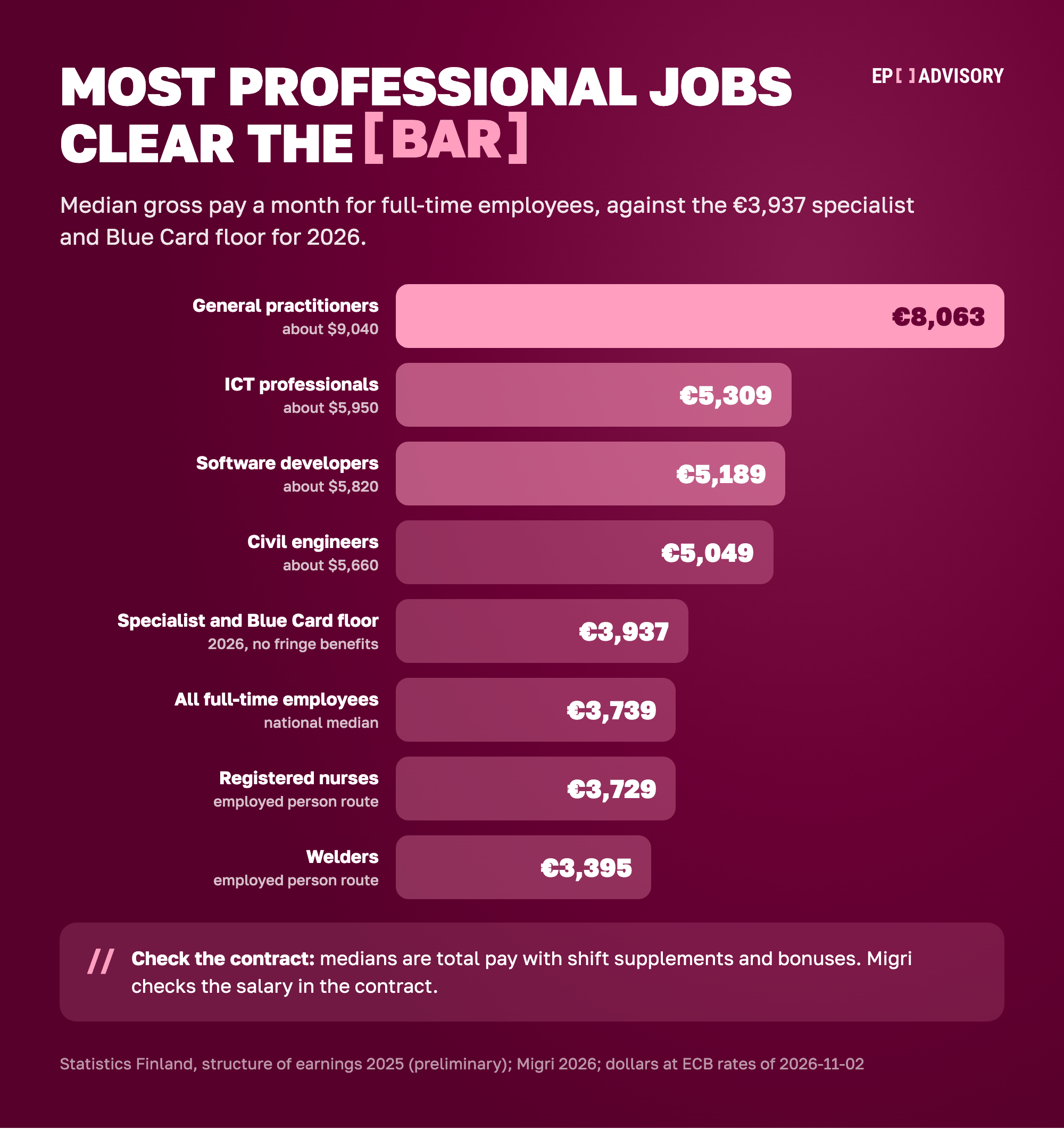
The average full-time worker earned €4,350 a month in the third quarter of 2026. That is a preliminary figure from Statistics Finland, whose earnings index rose 3.5% on a year earlier. It is about $4,880 or £3,640 at ECB rates of 2026-11-02. The median is lower. Half of full-time employees earned under €3,739 a month in 2025, in Statistics Finland’s preliminary structure of earnings figures. That is below the €3,937 specialist bar, so check where your job sits before you plan your route. One trap in the statistics: Finnish registered nurses are classed as nursing associate professionals. The nursing professionals group is the smaller group of head and ward nurses.
| Occupation | Median, gross a month (2025, preliminary) | Clears €3,937? |
|---|---|---|
| General practitioners | €8,063 | Yes |
| ICT professionals | €5,309 | Yes |
| Software developers | €5,189 | Yes |
| Civil engineers | €5,049 | Yes |
| Mechanical engineers | €4,827 | Yes |
| All full-time employees | €3,739 | No |
| Registered nurses | €3,729 | No: employed person route |
| Welders | €3,395 | No: employed person route |
| Practical nurses | €3,347 | No: employed person route |
These medians are total earnings, so they include shift supplements and bonuses. Migri checks the salary in your contract. For the specialist permit and the Blue Card, it leaves out fringe benefits. For the employed person permit, it leaves out evening and night supplements. Look at the contract salary, not your expected total.
Tax depends on your status. Foreign key employees pay a flat 25% tax at source from 2026, down from 32%, if they meet three conditions:
- They earn at least €5,800 a month.
- They do work needing special expertise.
- They were not tax residents of Finland at any time in the five calendar years before the year the work starts.
The rate applies for up to 84 months, according to the Finnish Tax Administration. Everyone else pays progressive tax through a tax card. The flat rate is not always cheaper. On our salary guide’s 2026 model for Helsinki, normal tax wins at €5,800. The flat rate pays off only from about €6,300 a month.
Next: see net pay, rent and the full occupation tables in our guide to salaries in Finland.
Worked example: a software developer from India moving to Tampere
Profile: Priya is a backend developer in Bengaluru with a four-year computer science degree and six years of experience. A Tampere software firm offers her a permanent job at €4,800 gross a month, about $5,380 at ECB rates of 2026-11-02. That is under the €5,189 median for software developers in Finland but above the €3,937 bar. Pirkanmaa, the Tampere region, does not list developers as a shortage occupation, but that does not matter on her route.
Route: her degree is at least three years long and her job is permanent, so she qualifies for the EU Blue Card. A specialist permit would also work. She picks the Blue Card with the fast track because it gives her the most freedom to move within the EU later.
- Day 1: she applies online. She files the Blue Card application in Enter Finland and ticks the fast track. She applies for a D visa in the same application, so she can travel as soon as the decision arrives. She has her appointment booked before she submits.
- Within 2 working days: her employer adds the terms. The Tampere firm fills in the employment terms in Enter Finland for employers.
- Within 5 working days: she proves her identity. She visits the Finnish mission or its visa centre with her passport.
- About two weeks later: the decision. Migri says fast-track applicants receive a decision in two weeks.
- Travel and first week. She flies on the D visa. She registers her address and gets her personal identity code from the Digital and Population Data Services Agency. She orders her tax card from the Tax Administration, and checks her Kela cover. Work in Finland counts towards Kela cover only if it pays at least €800.02 a month.
| Cost (2026, Migri fees) | Amount |
|---|---|
| EU Blue Card, first permit, online | €530 |
| D visa, online with the permit | €95 |
| Total government fees | €625 (about $700 or £520) |
Timeline: Migri’s target is two weeks. We plan on about three weeks from her online application to a decision. That leaves room for the identity visit, if she and her employer meet both deadlines. Add her notice period in India and the flight. Her tax rate is progressive, because €4,800 is below the €5,800 key-employee bar. Had she needed recognition of her degree from the Finnish National Agency for Education, for example for a regulated job, she would have added €495 and 3 to 4 months. Start that early if your field needs it.
After you arrive: your permit rules and the road to permanent residence
Your permit stays tied to work, so know what happens if the job ends. Since 11 June 2025, a permit holder whose job ends has three months to find a new one. Specialists, Blue Card holders, and senior and middle managers have six months, according to the Ministry of Economic Affairs and Employment. So do people who have lived in Finland for over two years on a work-based permit. If the job ends early, the employer must tell Migri within 14 days. If the new job falls outside your permit, you need a new permit. Keep your CV current from the first month, so you can move quickly if you have to.
Permanent residence now takes longer. Since 8 January 2026, the general rule is six years on a continuous (A) permit. You also need two years of work and B1-level (intermediate) Finnish or Swedish, according to Migri. A faster route gives permanent residence after four years if your taxable income is at least €40,000 a year. A developer on €4,800 a month earns €57,600 a year, which clears that line. Start Finnish classes in your first year to keep the six-year route open as well.
Other countries in the region work differently. Denmark has a pay limit scheme and its own shortage list, set out in our guide to jobs in Denmark for foreigners. If Sweden is also on your list, compare pay levels with our guide to salaries in Sweden before you decide where to focus.
When an offer arrives, check the contract salary against the bars above, then negotiate. Our guide on how to negotiate salary shows how to ask without risking the offer.
Key takeaways
- EU citizens can start work in Finland straight away; everyone else needs a job offer before a permit.
- The employed person permit needs €1,600 a month and the collective agreement rate; specialists and Blue Card holders need €3,937 a month in 2026, with fringe benefits not counted.
- Migri decided approved first employed-person permits in 21 days on average in September 2026; the fast track aims for two weeks.
- Shortage lists cut out the labour market test, but Helsinki’s region lists only health and care jobs.
- English-language ads cluster in support services, health and social care, hospitality and retail; tech jobs sit on company career pages.
- Keep your CV short, factual and results-led, and state your permit eligibility on it.
- If a job ends, you have three or six months to find another, depending on your permit.
See what a recruiter sees, then fix it before you apply. An instant score, then the fix for every problem.
Free, no card. A free account unlocks every fix.
Frequently asked questions
Can foreigners get jobs in Finland without speaking Finnish?
Yes, in some sectors. Support services such as cleaning, hospitality, retail, construction, industry and many tech companies hire in English. Health, public sector and customer-facing jobs usually need Finnish or Swedish. Learning basic Finnish still widens your options and helps later with permanent residence.
How long does a Finnish work permit take in 2026?
In September 2026, Migri decided approved first employed-person permits in 21 days on average and refused ones in 79 days. Specialists and Blue Card holders on the fast track can get a decision in about two weeks if they prove their identity within five working days.
What is the minimum salary for a work permit in Finland?
Finland has no statutory minimum wage. For the employed person permit, pay must meet the collective agreement and be at least €1,600 gross a month in 2026. For the specialist permit and the EU Blue Card, the gross salary must be at least €3,937 a month, with fringe benefits not counted.
Do I need a job offer before I move to Finland?
Yes, if you are not an EU, EEA or Swiss citizen. Work permits are tied to a job, and you must apply for your first permit from outside Finland. Migri usually refuses first permits applied for inside the country.
Which jobs are in demand in Finland for foreigners?
The regional shortage lists in force from June to November 2026 most often include general practitioners, welders, metal machine-tool setters, cooks, electrical fitters and electrical engineers. Software developers are on the list in five regions. In the Helsinki region, the list covers health and care jobs only.
What happens if I lose my job in Finland?
You have three months to find a new job on a standard work permit. Specialists, Blue Card holders, managers and people who have lived in Finland for over two years on a work-based permit have six months. If the new job falls outside your permit, you need a new one.