 By Andre Atallah, CEO of EP Advisory
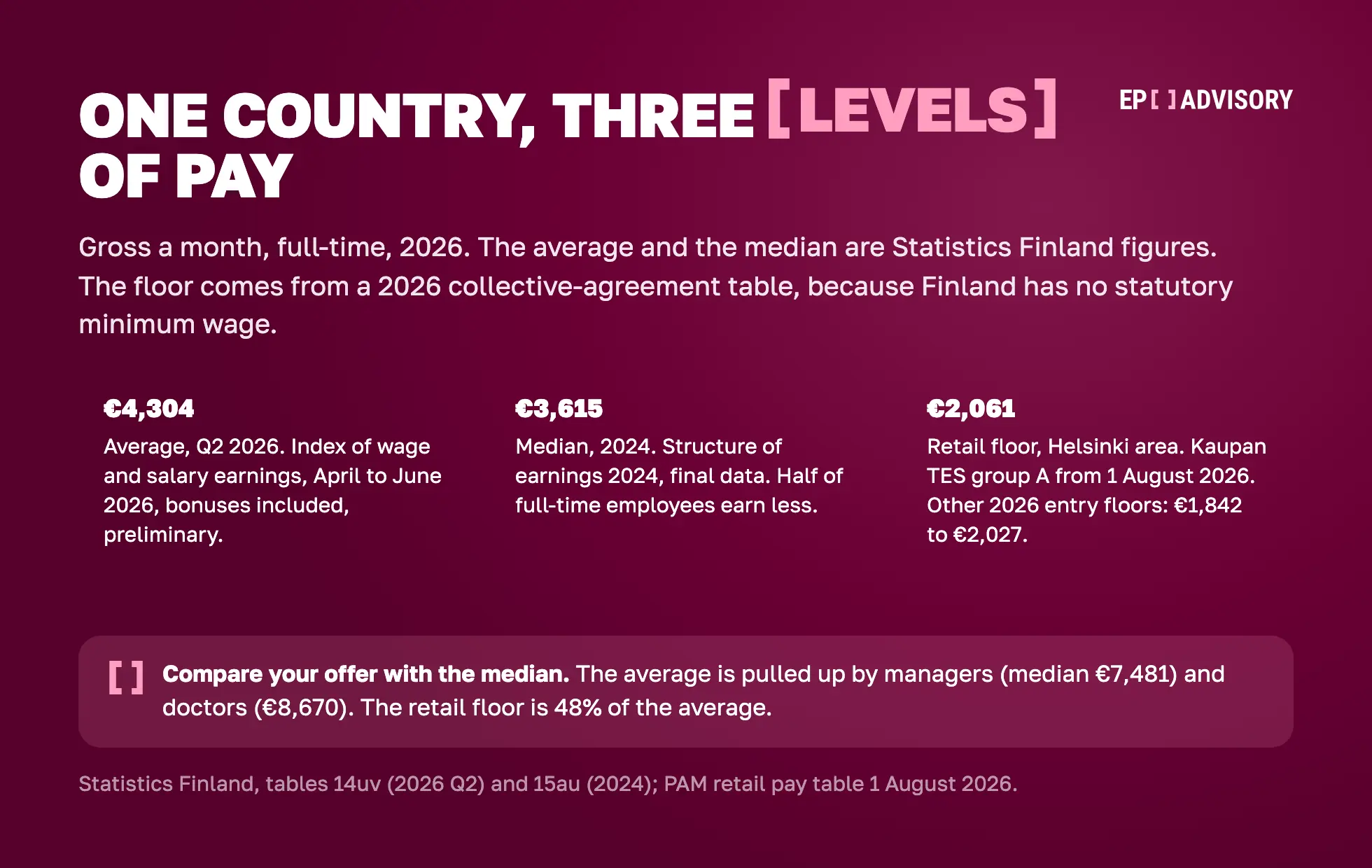
The short answer: the average salary in Finland is €4,304 a month gross for full-time employees (Statistics Finland, April to June 2026), or €51,648 a year over 12 payments. The median is €3,615. Take-home on the average is roughly €3,040 to €3,180 a month (EP model). Finland has no statutory minimum wage; collective agreements set 2026 floors of €1,842 to €2,061.
| Finland, 2026 | Figure |
|---|---|
| Average salary, gross (full-time, Q2 2026) | €4,304 / month |
| Annual equivalent (× 12, no 13th month) | €51,648 / year |
| Median salary, gross (full-time, 2024) | €3,615 / month |
| Holiday bonus (lomaraha) | About half a month extra in summer, not in the figures above |
| Take-home on the average (model) | ≈ €3,040–3,180 / month |
| Statutory minimum wage | None. Collective-agreement floors of €1,842–2,061 instead |
| Specialist permit and EU Blue Card bar | €3,937 / month gross |
Finland has a payslip problem, and it runs the other way from southern Europe’s. The headline average looks generous: €4,304 a month gross, with no 13th instalment to decode. But three things sit between that number and your account. Half of full-time employees earn under €3,615. There is no minimum wage, so the entry-level floor in a shop, a hotel or a factory is a collective-agreement table starting at €1,842 to €2,061. And the 2026 tax card takes about a quarter of the average before it lands.
This guide runs the arithmetic: the only official series with 2026 data, the 2026 collective-agreement floors that stand in for a minimum wage, a 2026 tax card line by line, and the €3,937 bar that decides whether a job can get you a specialist permit or an EU Blue Card. Every monthly figure states gross or net, its source and its period.
In nearly 10 years, we’ve helped more than 5,000 professionals find jobs abroad. Want to know if your CV will pass screening in Finland? Check your CV for free: a score in 30 seconds, then a fix for each problem.
What Is the Average Salary in Finland Per Month? (2026)
The average salary in Finland is €4,304 a month gross, according to Statistics Finland’s index of wage and salary earnings for April to June 2026, released on 26 August 2026 and rounded to €4,300 in the release text. It covers full-time employees in all sectors, counts regular pay plus performance bonuses and agreement-based one-off items, and is the only official series with 2026 data. The figure is preliminary.
Finland pays 12 instalments a year. There is no statutory 13th or 14th salary, so the conversion is short:
| Basis | Figure | What it is |
| Per month, gross, as published | €4,304 | Full-time employees, all sectors, Q2 2026 |
| × 12, gross | €51,648 / year | The annual equivalent. Nothing to add |
| Holiday bonus (lomaraha) | + roughly half a month | From the collective agreement, paid in summer. Not in the €4,304 |
The one wrinkle is the holiday bonus. The lomaraha comes from collective agreements, not the Annual Holidays Act, and it is usually 50% of holiday pay, roughly half a month’s salary extra, paid in summer. The official monthly figures exclude it.
What counts as a good salary in Finland? Anything above the 2024 median of €3,615 a month gross beats half of full-time employees. The top 10% start at €6,119 (Statistics Finland, structure of earnings 2024), and the Helsinki-region median is €3,967. Migri, the immigration service, treats €3,937 a month as specialist level for permits in 2026; the Tax Administration treats €5,800 as key-employee level.
If the numbers work for you, the next step is practical: the European work-visa salary thresholds show what an offer must pay before a permit is possible, and salaries in Sweden covers the neighbouring market that also runs on collective agreements instead of a minimum wage.
Finnish Salaries at a Glance: The Essentials
- Average gross salary: €4,304 a month, full-time, April to June 2026, up 3.4% on a year earlier in nominal terms and 1.6% in real terms (Statistics Finland, index of wage and salary earnings, Q2 2026)
- Pay frequency: 12 instalments, no statutory 13th or 14th salary; annual equivalent €51,648 gross (Occupational Safety and Health Administration)
- Median: €3,615 a month gross, full-time, 2024 final data; bottom 10% at €2,483 or less, top 10% from €6,119 (Statistics Finland, structure of earnings 2024)
- Gender gap: men €4,639, women €3,944 a month gross on the Q2 2026 index (Statistics Finland)
- Holiday bonus: usually 50% of holiday pay under the collective agreement; the Incomes Register median jumps from €3,520 in April 2026 to €4,034 in June (Statistics Finland; PAM)
- Take-home on the average: about €3,040 to €3,180 a month net, single worker, by municipality and church membership (own model on 2026 rates, cross-checked to Veronmaksajat)
- Minimum wage: none. About 160 generally applicable collective agreements set floors of €1,842 to €2,061 a month gross at entry level in 2026 (tyosuojelu.fi; PAM; Teollisuusliitto)
- Helsinki premium: Uusimaa averaged €4,513 a month gross in 2024 against €4,075 nationally, 10.7% more (Statistics Finland, table 15b2)
- Specialist permit and EU Blue Card: €3,937 a month gross in 2026, up from €3,827; an employed-person permit needs the collective-agreement wage and at least €1,600 a month (Migri, income requirement)
- Key-employee tax: 25% flat at source from 1 January 2026, down from 32%, from €5,800 a month (Finnish Tax Administration, 8 December 2025)
The Generous Average Trap: Why €4,304 Is Not What You Live On
Nobody hides an instalment from you, as they do in Italy or Spain. The trap is that the headline average sits on a long upper tail, with no legal floor underneath it and a heavy tax card on top.
First, the median. The €4,304 average is pulled up by the top: managers had a median of €7,481 a month gross in 2024 and medical doctors €8,670. Half of full-time employees earned less than €3,615 in 2024, the latest structure-of-earnings year. On that same basis the average was €4,075, a gap of €460 a month, or 11%. Against the 2026 headline it is €689, and part of that is two years of pay rises plus the bonuses the quarterly index counts and the structural survey does not. Either way, the honest comparison for your own offer is the median.
Second, the floor. Finland has no minimum wage. Pay comes from the collective agreement for your sector, the työehtosopimus or TES, and the 2026 entry-level tables sit at €1,842 a month gross in the technology industry, €1,903 in hospitality, €2,027 in cleaning and €2,061 in retail in the Helsinki area (pay groups and dates in the minimum-wage section). That is 43% to 48% of the average. A job at the floor is legal, common, and a long way from the headline.
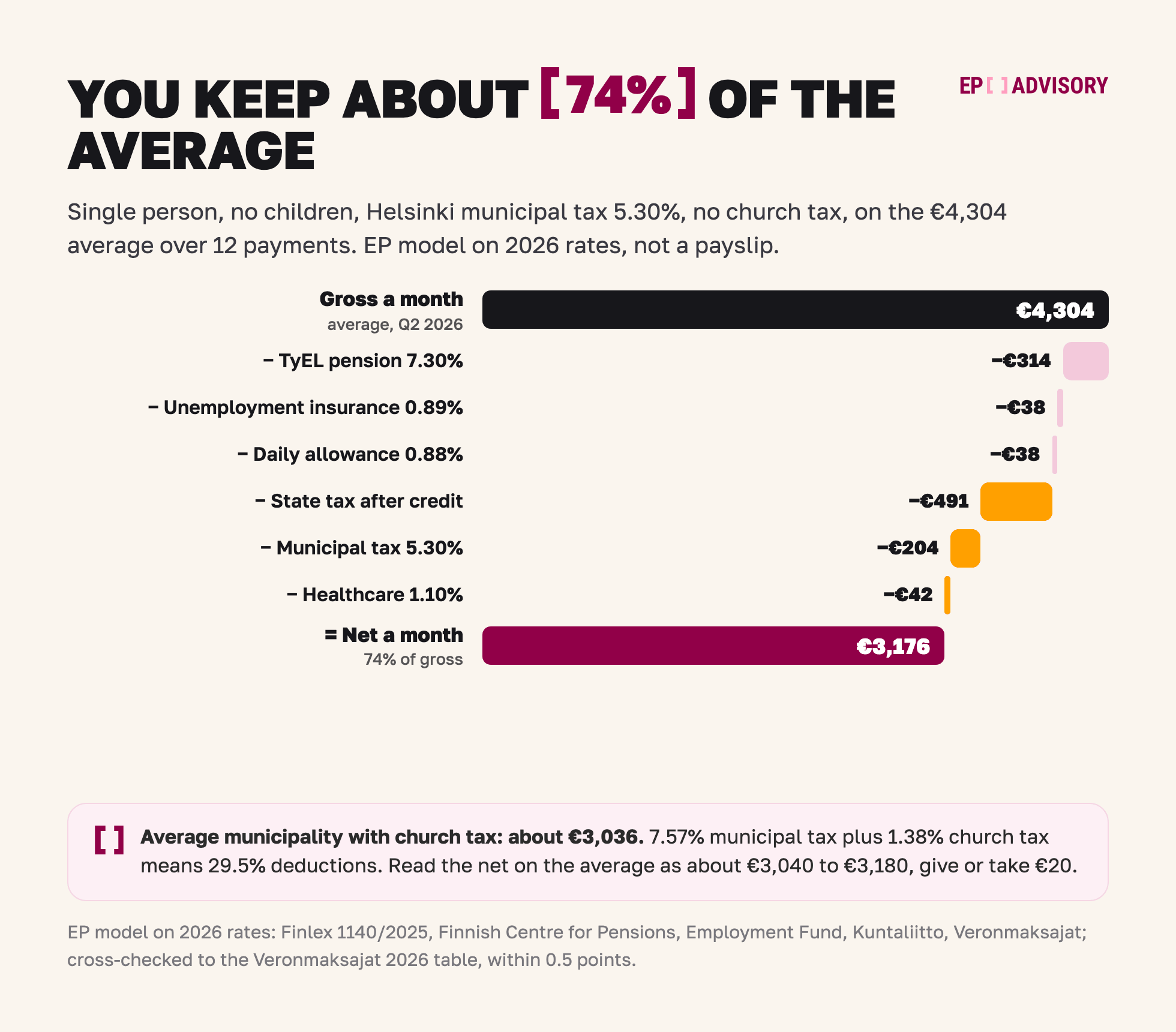
Third, the tax card. On the €4,304 average, a single employee in Helsinki who is not a church member loses about 26.2% to pension, unemployment insurance, health contributions, state tax and municipal tax, leaving about €3,176 net a month on our 2026 model. In an average-tax municipality with church tax it is about 29.5% and €3,036.
The questions to ask before you sign. Which collective agreement covers the role, and which pay group? Is the figure base monthly gross, and does it include shift supplements, which Migri does not count towards a permit? Is a holiday bonus paid? And which municipality will you live in, because Helsinki’s 5.30% municipal tax and Oulu’s 8.10% produce different payslips from the same salary.
One Country, Several Averages: Which Number to Trust
Ask what Finns earn and you get at least five defensible answers, all official. They measure different populations in different periods, and the gap between the highest and lowest monthly figure is close to €800.
| Figure | Source and year | What it actually measures |
| €4,304 / month | Statistics Finland, index of wage and salary earnings, Q2 2026 (preliminary) | Average monthly earnings of full-time employees, all sectors, bonuses included |
| €4,186 / month | Statistics Finland, same index, annual 2025 | The same measure across calendar 2025 |
| €4,075 average, €3,615 median | Statistics Finland, structure of earnings 2024 (final, June 2026) | Total earnings of full-time employees, October 2024, excluding holiday and performance bonuses. Not comparable with earlier years |
| €3,520 (April 2026), €4,034 (June 2026) | Statistics Finland, Incomes Register experimental median | All wage earners including part-time. June includes the holiday bonus |
| €50,569 / year (about €4,214 a month) | OECD average annual wages, 2025 | Whole-economy wage bill per full-time-equivalent employee |
We headline the Statistics Finland Q2 2026 figure because it is the only official series with 2026 data and it includes the bonuses a real full-time payslip carries. The 2024 median is the number to compare your own offer against: it describes the middle employee rather than the average one, and it is the only source that publishes the deciles.
And none of the five is what you live on. Here is the shape of the 2026 tax card on the €4,304 average for a single employee in Helsinki. The arithmetic section runs it in full.
Salaries by Sector and Role
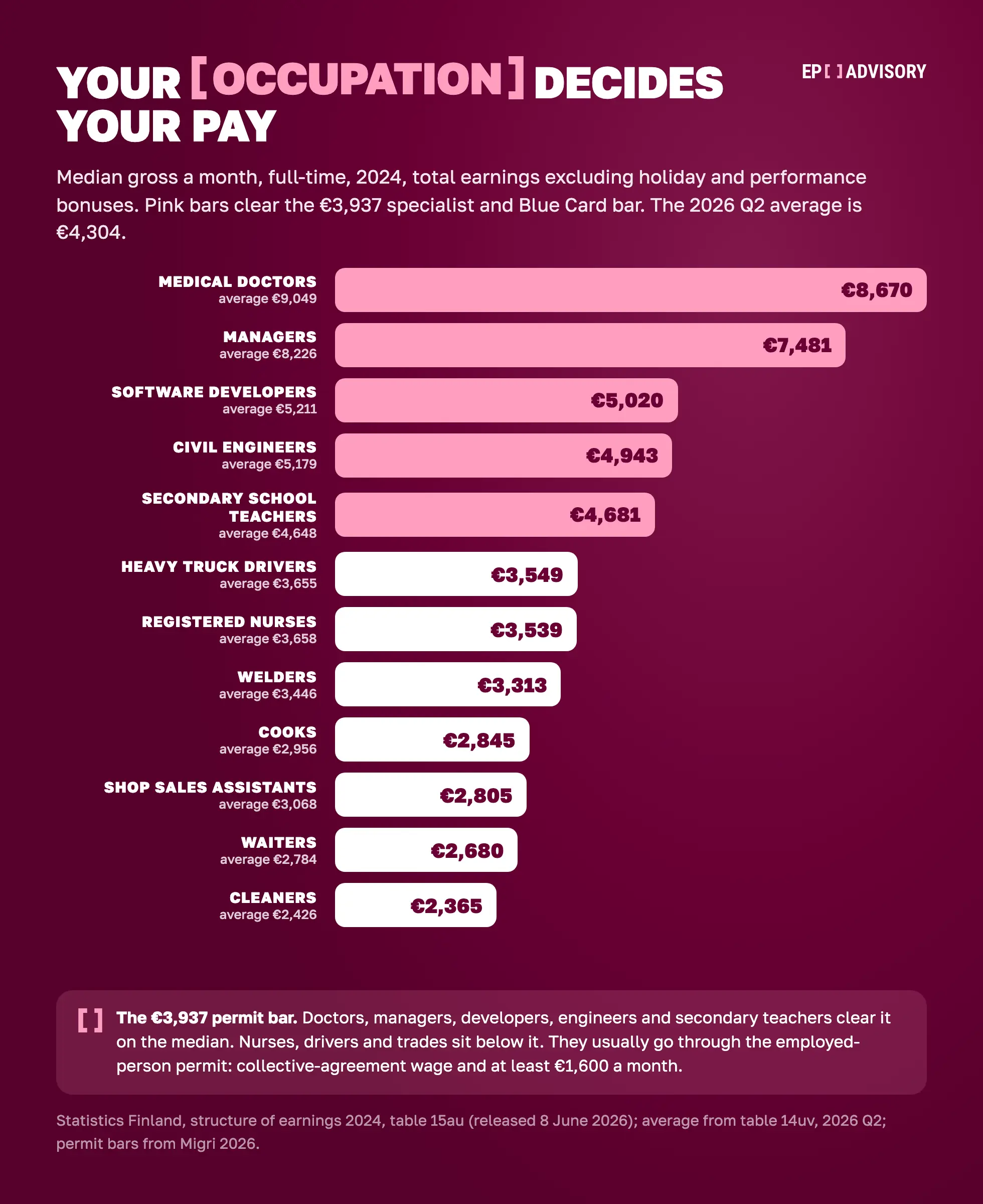
Two things move a Finnish salary more than anything else: the industry you work in and the occupation you are coded into. Statistics Finland publishes both from the 2024 structure of earnings. All figures in this section are gross per month for full-time employees, excluding holiday and performance bonuses, reference year 2024.
Industry first. Information and communication pays the highest median in the country and accommodation and food service the lowest, a ratio of 1.8 to 1.
| Industry (2024, gross per month) | Average | Median |
| Information and communication | €5,347 | €4,990 |
| Finance and insurance | €5,323 | €4,556 |
| Professional, scientific and technical | €4,705 | €4,249 |
| Manufacturing | €4,304 | €3,848 |
| Education | €4,189 | €4,146 |
| Construction | €4,107 | €3,764 |
| Wholesale and retail trade | €3,952 | €3,362 |
| Health and social work | €3,638 | €3,273 |
| Accommodation and food service | €2,910 | €2,720 |
| All industries | €4,075 | €3,615 |
Occupation second. The jobs foreigners most often ask us about, on the same 2024 basis:
| Occupation (2024, gross per month) | Average | Median |
| Medical doctors | €9,049 | €8,670 |
| Managers | €8,226 | €7,481 |
| Software developers | €5,211 | €5,020 |
| Civil engineers | €5,179 | €4,943 |
| Secondary school teachers | €4,648 | €4,681 |
| Primary school teachers | €4,145 | €4,175 |
| Plumbers | €3,791 | €3,700 |
| Registered nurses (sairaanhoitaja) | €3,658 | €3,539 |
| Heavy truck drivers | €3,655 | €3,549 |
| Carpenters | €3,545 | €3,476 |
| Welders | €3,446 | €3,313 |
| Shop sales assistants | €3,068 | €2,805 |
| Cooks | €2,956 | €2,845 |
| Waiters | €2,784 | €2,680 |
| Cleaners | €2,426 | €2,365 |
One coding note matters. Finnish registered nurses are classed as nursing associate professionals (56,199 people, median €3,539). The much smaller nursing professionals group (5,485 people, median €4,198) is senior and advanced nurses; pages quoting it as the nurse salary overstate by about €650 a month.
What this means for a job search. If you need a specialist permit or a Blue Card, the €3,937 bar is the line that matters. Developers, engineers, doctors and secondary teachers clear it on the median. Registered nurses, truck drivers and carpenters sit below it, which does not close the door: those jobs go through the employed-person permit on the collective-agreement wage, and nurses are on the 2026 shortage list. Hospitality and cleaning hire in English, but on the 2024 medians they pay €2,365 to €2,845 a month gross.
Score your CV in 30 seconds, then fix its biggest problems one by one. Both free.
Free, no card.

Is There a Minimum Wage in Finland? The TES Floors for 2026
No. Finland has no statutory minimum wage in 2026, and the Occupational Safety and Health Administration says so in plain words: there is no minimum wage law. Eurostat counted 22 of 27 EU states with a national minimum wage on 1 July 2026. The five without are Denmark, Italy, Austria, Finland and Sweden.
What Finland has instead is the työehtosopimus, or TES, a collective agreement between an employer federation and a union covering a whole sector. About 160 are confirmed as generally applicable (yleissitova) by a state board, which means they bind every employer in the sector, including those in no federation, and a contract clause that pays below them is void. Where no agreement applies, the employer must pay a wage that is usual and reasonable. For an employed-person permit, Migri requires both the collective-agreement wage and at least €1,600 a month gross in 2026.
| Collective agreement, entry level (2026) | Monthly floor, gross | Hourly | In force from |
| Retail (Kaupan TES), group A, Helsinki area | €2,061 | €12.88 | 1 August 2026 |
| Retail (Kaupan TES), group A, rest of Finland | €1,979 | €12.37 | 1 August 2026 |
| Cleaning and property services (KipaTES), pay group 2 | €2,027 | €12.59 | 1 August 2026 |
| Hospitality (MaRaVa TES), pay group 1, first two years | €1,903 | €11.97 | 1 June 2026 |
| Technology industry workers, job group 1 | €1,842 | €10.57 | 1 March 2026 |
Sources: PAM pay tables for retail and cleaning (1 August 2026) and hospitality (1 June 2026); Teollisuusliitto technology industry agreement 2025 to 2027.
Those are the bottom rungs. Retail group D reaches €2,928 a month in the Helsinki area at its top step, hospitality’s group 5 tops out at €2,453, cleaning’s group 10 is €2,882, and technology group 9 is €2,721 plus a personal component. Shift supplements come on top: €1.40 an hour for evenings and €2.37 for nights in hospitality from 1 June 2026.
Where the floor actually bites. The 2024 medians for these jobs were €2,365 a month gross for cleaners, €2,680 for waiters, €2,805 for shop sales assistants and €2,845 for cooks (Statistics Finland). Real pay sits a few hundred euros above the entry floor, and the lowest-paid tenth of waiters earned €1,926 or less.
The Helsinki-area line. Retail is the one agreement here with an explicit geography: the Helsinki metropolitan area pays 4.1% more at group A and 5.5% more at group D than the rest of Finland. The same split runs through pay and rent, as the next section shows.
Helsinki vs the Rest: The 10.7% Uusimaa Premium
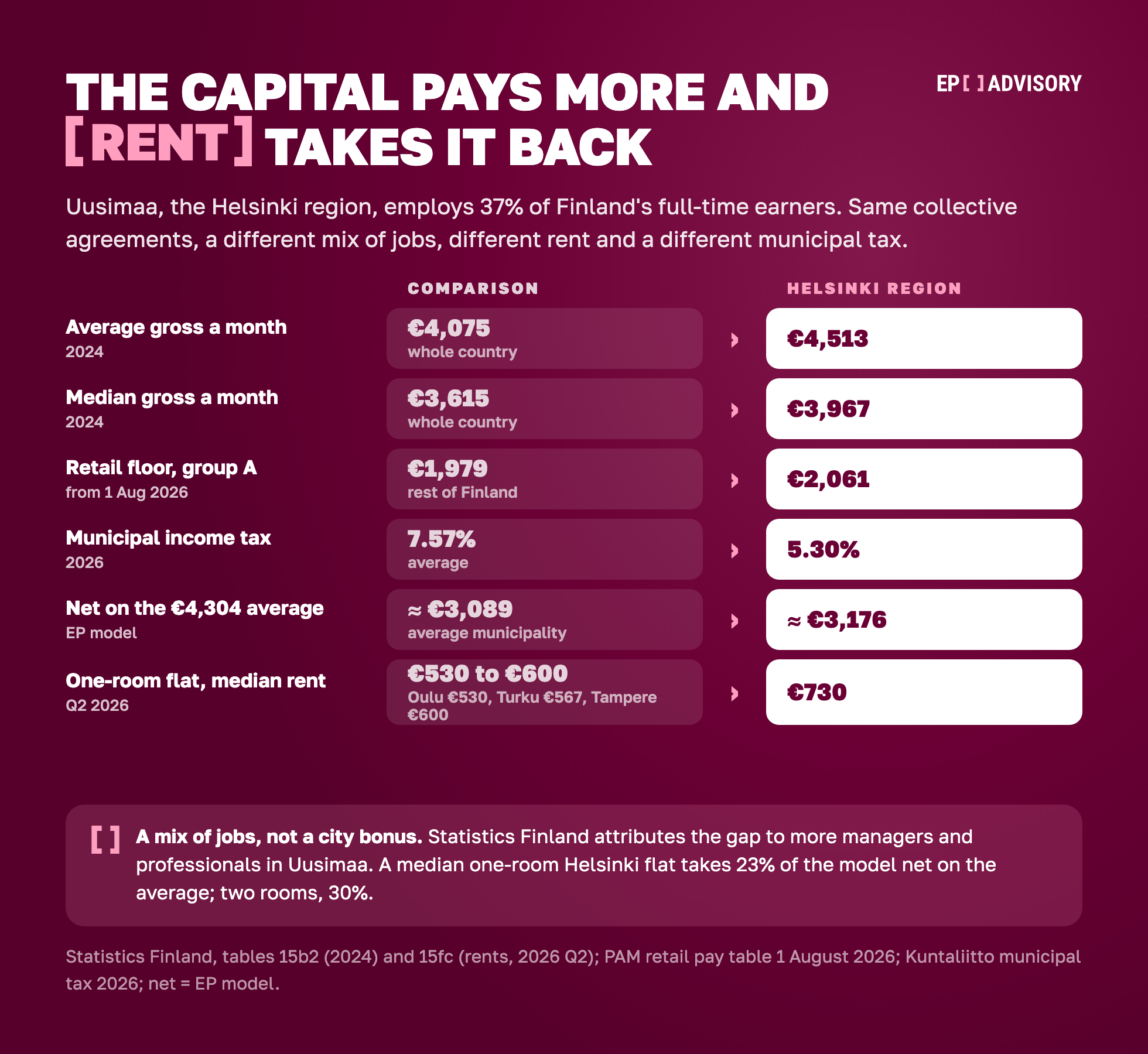
Uusimaa, the region around Helsinki, employs 37% of Finland’s full-time earners and pays them more. In 2024 the average there was €4,513 a month gross and the median €3,967, against €4,075 and €3,615 for the whole country: a premium of 10.7% on the average and 9.7% on the median (Statistics Finland, structure of earnings 2024). Pirkanmaa (Tampere) averaged €3,951, North Ostrobothnia (Oulu) €3,893, Southwest Finland (Turku) €3,806 and South Ostrobothnia, the lowest, €3,592. Statistics Finland’s explanation, in an earlier release on the same series, is occupational mix rather than a Helsinki bonus for the same job: about 5% of Uusimaa employees are managers and over 30% professionals, against about 3% and 23% elsewhere.
Two qualifications before you use the premium to choose a city.
First, rent takes most of it back. On Statistics Finland’s rent statistics for Q2 2026, the median rent for a one-room flat on the open market was €730 a month in Helsinki (€830 in the centre), €600 in Tampere, €567 in Turku and €530 in Oulu. Two rooms cost €950 in Helsinki and €779 in Tampere. On the model net of about €3,176 for the average salary in Helsinki, a median one-room flat takes 23% of take-home and a two-room 30%. Rents have stopped climbing: up 0.1% year on year nationally, down 0.3% in Greater Helsinki.
Second, the tax card runs the other way. Helsinki’s municipal income tax is 5.30% in 2026, one of the lowest in the country, against 7.60% in Tampere, 7.10% in Turku, 8.10% in Oulu and a revenue-weighted national average of 7.57%. On the average salary without church tax, our model gives about €3,176 net in Helsinki against about €3,089 in an average-tax municipality.
Where to Look for Work: Official Resources
Finnish hiring runs through a public portal, its English-language mirror and a strong domestic board. Start here.
- Työmarkkinatori (Job Market Finland): the public employment service’s vacancy portal
- Work in Finland: the English-language feed of the same vacancies, with relocation guidance
- Duunitori and its English-only feed jobsfinland.fi: where the official report says open IT positions and most English-language roles actually appear
- EURES: the EU mobility network, useful for employers already used to hiring non-locals
Two practical notes. On language: the official October 2025 report on international recruitment (KEHA-keskus and Work in Finland) says English-language jobs appear only in small numbers on the public portals. Between October 2024 and September 2025, Työmarkkinatori vacancies with English as the working language ran to 2,789 in hospitality, 1,710 in retail, 802 in construction, 514 in ICT and 334 in health, against 34 in finance. On sponsorship: employed-person permits usually pass a labour-market availability test, unless the job is on a regional shortage list. In July 2026, first employed-person permits took 17 days on average when approved and 64 days when refused. Specialists have a fast track with a two-week target (Migri). The April 2026 shortage list is short: nurses, practical nurses, psychologists, doctors, application designers, welders, kitchen workers, machine operators and early-childhood teachers. Check whether a company has hired non-EU staff before you invest time in the application.
The Arithmetic: What Actually Lands in Your Account
Six things come off a Finnish gross salary before it reaches you, and a seventh if you belong to a church. The 2026 rates:
- Earnings-related pension (TyEL): 7.30% of gross, all ages (Finnish Centre for Pensions)
- Unemployment insurance: 0.89%, up from 0.59% in 2025 (Employment Fund)
- Daily allowance contribution: 0.88% of wages above €17,255 a year
- Healthcare contribution: 1.10% of taxable earned income
- State income tax: 12.64% up to €22,000, 19% to €32,600, 30.25% to €40,100, 33.25% to €52,100 and 37.50% above (Act 1140/2025)
- Municipal income tax: Helsinki 5.30%, Turku 7.10%, Tampere 7.60%, Oulu 8.10%; revenue-weighted average 7.57% (Kuntaliitto)
- Church tax, members only: 1.00% in Helsinki, 1.25% in Tampere, 1.30% in Oulu
Against those come an earned-income credit of 18% of wages up to €3,430 and a €750 work-expense deduction, and the employee contributions are themselves deductible. Union fees stopped being deductible in 2026.
On the €4,304 average, €51,648 a year, the model for a single employee in Helsinki with no church tax runs: TyEL €314, unemployment insurance €38, daily allowance €38, state tax €491 after the credit, municipal tax €204, healthcare €42. That is €1,127 a month, 26.2% of gross, and a net of about €3,176. With Helsinki church tax it is about €3,138; in an average-tax municipality about €3,089 without church tax and €3,036 with it (29.5%). So take-home on the average is roughly €3,040 to €3,180 a month.
Read that as a model, not a payslip. Veronmaksajat’s published 2026 table gives 29.3% at €50,000 and 32.6% at €60,000 a year for an average municipality with church tax; our model runs 0.3 to 0.5 points lighter, so allow €20 a month either way. The scale is steep: 18.9% at €30,000 a year, 40.5% at €100,000, and a marginal rate of 52.3% from about €60,000. On the same model the €3,615 median leaves about €2,807 net in Helsinki and the €3,937 specialist floor about €2,982.
The foreigner’s regime, and the number that is out of date. Finland taxes foreign key employees at a flat rate at source, and from 1 January 2026 that rate is 25%. Pages still quoting 32% are describing 2025. The conditions, from the Tax Administration’s guidance of 8 December 2025: cash salary of at least €5,800 a month for the whole period, work requiring special expertise, no tax residence in Finland in the previous five calendar years, and an application within 90 days of starting work. It lasts up to 84 months; TyEL and unemployment contributions are still withheld.
Run the numbers before you apply. At the €5,800 floor the flat regime costs 25% plus 7.30% plus 0.89%, or 33.2%, leaving about €3,875 a month. Normal tax on the same salary in Helsinki without church tax is about 31.8%, leaving about €3,953, so the progressive scale wins. The break-even is about €6,300 a month in Helsinki, about €5,960 with Helsinki church tax, and from the €5,800 floor only in an average-tax municipality with church tax. At €8,000 the flat regime leaves about €5,345 against €5,075. Worth having, but not automatic money, and not 32%.
Salary and the Visa: The €3,937 Specialist and Blue Card Bar
This is the part that decides whether a move is possible at all.
For non-EU citizens, Finland runs three salary-gated routes, all through Migri. The residence permit for an employed person requires pay that matches the applicable collective agreement, and at least €1,600 a month gross in 2026, both at once. It usually passes a labour-market availability test, unless the occupation is on a regional shortage list. The specialist permit requires at least €3,937 a month gross in 2026 (€3,827 in 2025) and a higher-education degree or expertise acquired through experience; it has a two-week fast track and runs up to two years. The EU Blue Card uses the same €3,937 bar, needs a higher-education qualification of at least three years or five years of comparable experience and a contract of at least six months. Both cost €530 online. For the employed-person permit, fringe benefits count at their taxable value, up to half of pay, and evening and night premiums do not count. For the specialist permit and the Blue Card, fringe benefits and daily allowances do not count.
Now put the two numbers side by side. The average salary is €4,304 a month gross. The bar is €3,937. The average job clears it, by €367 a month. The median job does not: €3,615 misses by €322. We last checked these thresholds in September 2026. Migri updates them annually, so verify before you rely on them.
Three rules from the 2025 to 2026 tightening. Since 11 June 2025, a permit holder whose job ends has three months to find a new one, or six for specialists, Blue Card holders, senior and middle managers, intra-corporate transferees and anyone with over two years on a work permit; the permit is not extended for the search. Since 8 January 2026, permanent residence takes six years plus two years of work history and satisfactory Finnish or Swedish, with four-year paths for income over €40,000 a year or a recognised master’s degree plus two years of work; before that date it was four years. Citizenship takes eight years, or five with the language, and since 17 December 2025 applicants must show they have not relied on unemployment benefit or social assistance for more than three months in the past two years (Migri; Finnish Government).
The full comparison across European countries is in our guide to work visa and Blue Card salary thresholds in Europe.
Related reading: Work visa & Blue Card salary thresholds in Europe 2026 · Salaries in Sweden · Salaries in Norway
See what a recruiter sees, then fix it before you apply. An instant score, then the fix for every problem.
Free, no card.
Key Takeaways
- The average salary is €4,304 a month gross for full-time employees (Statistics Finland, Q2 2026), €51,648 a year over 12 payments. No 13th month, but the holiday bonus adds roughly half a month in summer.
- Compare your offer with the median, €3,615 (2024), not the average. The top 10% start at €6,119 and the bottom 10% end at €2,483.
- Finland publishes five defensible averages. The Q2 2026 index is the only one with 2026 data. The OECD’s €50,569 a year is a whole-economy figure, not a payslip.
- There is no statutory minimum wage. About 160 generally applicable collective agreements set the floors: €1,842 to €2,061 a month gross at entry level in 2026, and an employed-person permit needs the agreement wage and at least €1,600.
- Occupation decides more than city: software developers €5,020, civil engineers €4,943 and doctors €8,670 on the 2024 median, against nurses €3,539, waiters €2,680 and cleaners €2,365.
- Uusimaa pays 10.7% more on the average, Helsinki’s municipal tax is 5.30% against a 7.57% national average, and a Helsinki one-room flat rents for a median €730 against €600 in Tampere.
- Take-home on the average is roughly €3,040 to €3,180 a month (EP model). The 25% key-employee rate applies only from €5,800 a month and beats normal tax only above about €6,300 in Helsinki.
- The specialist and Blue Card bar is €3,937 a month gross in 2026. The average clears it by €367; the median misses it by €322. Last checked September 2026.
Frequently Asked Questions
What is the average salary in Finland per month?
The average salary in Finland is €4,304 a month gross for full-time employees, according to Statistics Finland’s index of wage and salary earnings for April to June 2026, up 3.4% on a year earlier. The 2025 annual average was €4,186. Finland pays 12 instalments, so the annual equivalent is €51,648 gross, plus a holiday bonus, usually half a month, paid under the collective agreement. The median, from the 2024 structure of earnings, is €3,615 a month gross.
What is a good salary in Finland?
Anything above the 2024 median of €3,615 a month gross puts you ahead of half of full-time employees. The top 10% start at €6,119, and the Helsinki-region median is €3,967. Migri treats €3,937 a month as specialist and Blue Card level in 2026, and the Tax Administration treats €5,800 as key-employee level. On the €4,304 average, a single person in Helsinki keeps about €3,176 net (EP model).
Is there a minimum wage in Finland?
No. Finland is one of five EU states without a statutory minimum wage, with Denmark, Italy, Austria and Sweden (Eurostat, 1 July 2026). About 160 generally applicable collective agreements set the floors instead. In 2026 the entry-level tables are €2,061 a month gross in retail in the Helsinki area, €2,027 in cleaning, €1,903 in hospitality and €1,842 in the technology industry. For an employed-person permit, Migri requires the collective-agreement wage and at least €1,600 a month.
How much of the average salary is left after tax in Finland?
About €3,176 a month net in Helsinki on the €4,304 average, single with no church tax, which is 26.2% in deductions: 7.30% pension, 0.89% unemployment insurance, 0.88% daily allowance contribution, 1.10% healthcare contribution, state tax on the 2026 scale and 5.30% municipal tax. In an average-tax municipality with church tax it is about €3,036, or 29.5%. Treat both as a model, with €20 either way.
What salary do you need for a work permit or EU Blue Card in Finland?
For an employed-person permit, the collective-agreement wage and at least €1,600 a month gross in 2026, both at once. For a specialist permit or an EU Blue Card, €3,937 a month gross in 2026. Fringe benefits and daily allowances do not count towards this bar. The Blue Card also needs a three-year degree or five years of comparable experience and a contract of at least six months. The average salary clears the bar by €367; the median misses it by €322. Last checked September 2026.
Getting ready to apply for jobs in Finland? Check your CV for free: see it the way a recruiter does, then fix each problem.