 By Alisa Schlosser, Career Consultant at EP Advisory
The short answer: The average salary in France is €2,733 a month net, which is €3,602 gross. The median is €2,190 net (INSEE, reference year 2024). But before you read any French salary figure, you need the decoder: job ads quote gross, while official statistics and everyday conversation quote net, and nobody labels which one you are hearing.
| France, 2026 | Value |
|---|---|
| Average salary, net | €2,733/month (€32,796/year) |
| Average salary, gross | €3,602/month (€43,224/year) |
| Median salary, net | €2,190/month |
| A bare number in a job ad | Gross (brut). Net is only used when announced |
| SMIC since 1 June 2026 | €1,867.02/month gross (€12.31/hour) |
| Talent card salary floor | €39,582/year gross |
France is one of the easiest countries in Europe to misread on pay. Not because salaries are low, but because the country quotes them in three different languages and almost never tells you which one it is speaking. A job advert, a government statistic and a French colleague will each hand you a number for the same salary. Only one of the three is comparable with the offer sitting in your inbox.
So here is the decoder first, then the arithmetic: what a bare number in a French job ad actually means, what INSEE’s famous average is measured on, how French people state their own pay, and how all of it connects to the salary floors that decide whether an employer can sponsor you at all.
In nearly 10 years, we’ve helped more than 5,000 professionals find jobs abroad. Want to know if your CV will pass screening in France? Check your CV for free: a score in 30 seconds, then a fix for each problem.
What Is the Average Salary in France Per Month? (2026)
The average salary in France is €2,733 a month net, equal to €3,602 a month gross. The source is INSEE Première n°2079, published on 23 October 2025, covering the private sector on a full-time-equivalent basis. Its reference year is 2024, and that matters: INSEE publishes this series about a year in arrears, so 2024 remains the most recent official national measurement available in 2026. Any page claiming a fresher French average is quoting a private survey, not the statistics office.
The median is the more useful benchmark when you are judging an offer. Half of French private-sector employees earn less than €2,190 a month net and half earn more. The €543 gap between the average and the median is what high earners at the top do to the arithmetic.
| Salary level (private sector, full-time equivalent) | Per month, net | Per month, gross |
| SMIC, the statutory minimum | ~€1,478 | €1,867 |
| First decile (D1): the bottom 10% earn less | €1,492 | not published |
| Median: half earn less, half earn more | €2,190 | not published |
| Average | €2,733 | €3,602 |
| Ninth decile (D9): the top 10% earn more | €4,334 | not published |
INSEE publishes the median and the deciles in net terms only, so we have not converted them. The deduction rate is not flat across salary levels, and a made-up gross median would mislead you.
What counts as a good salary in France? Above €2,733 net puts you ahead of the national average. Above €4,334 net puts you in the top ten per cent of full-time private-sector earners. In Paris the comfort threshold sits higher, because pay and rent in Île-de-France both run above the national level.
If the numbers work for you, the next step is practical: our guide to jobs in France for foreigners covers where the hiring actually happens, and the European work-visa salary thresholds show what an offer must pay before a permit is possible.
The Three Salary Languages of France
Ask three French sources what a job pays and you get three numbers measured three different ways. None of them is wrong. None of them is labelled. This is the section that decides whether you read every French offer correctly or misjudge all of them by about a quarter.
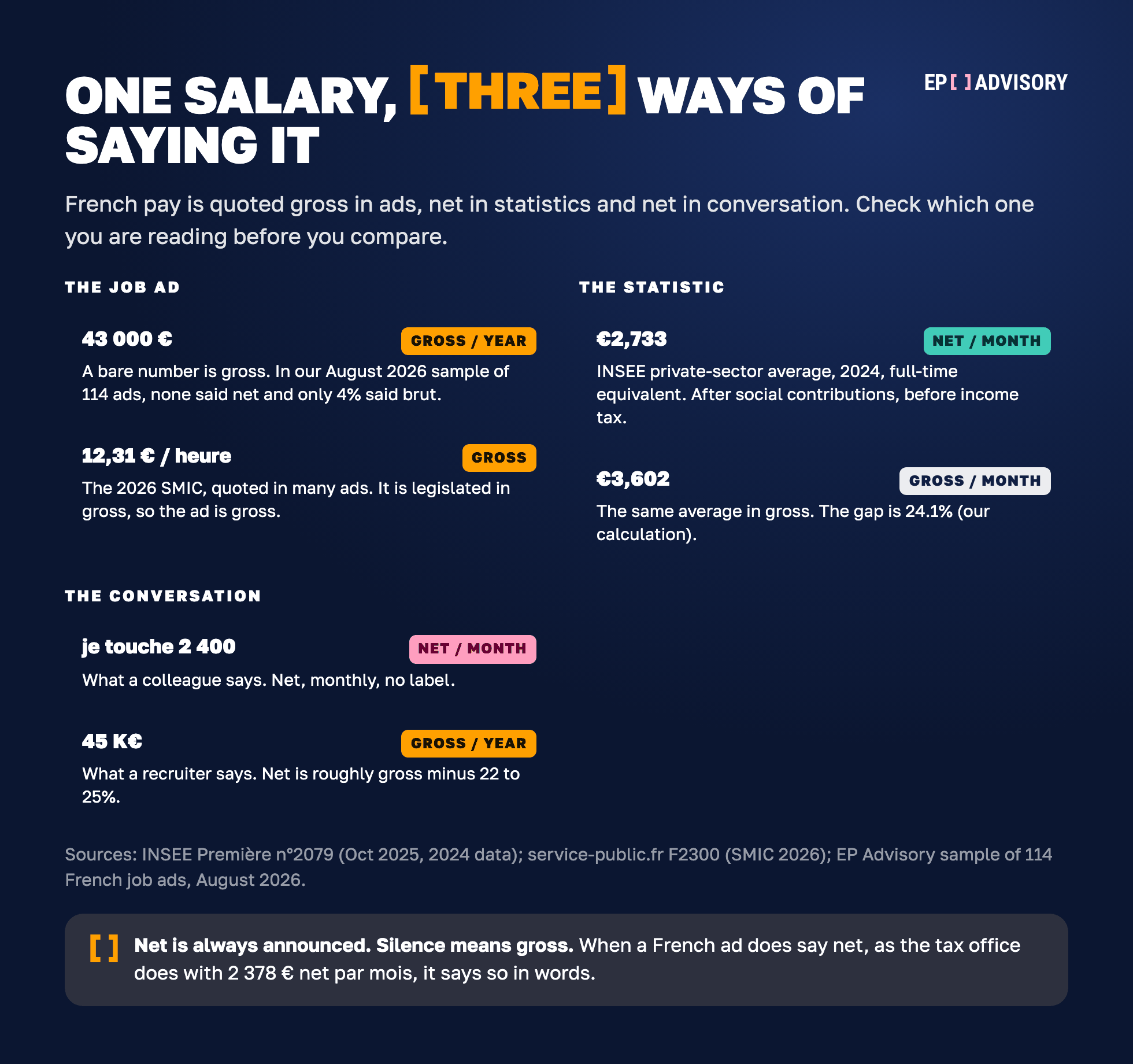
Language one: the job ad. A bare number means gross.
In August 2026 we ran our own sample of 114 salary-carrying postings across HelloWork, Indeed France and France Travail. The result was one-sided. Not a single figure was labelled “net”. Only 4% carried the word brut. Everything else was a bare euro number with no basis attached to it at all.
That bare number is provably gross, and the proof sits inside the ads. Dozens of them quote exactly “12,31 € / heure”. That is the 2026 SMIC, and the SMIC is legislated in gross. Net at the minimum wage works out at roughly €1,478 a month, so an hourly rate of €12.31 cannot be a net rate. Where French ads do label their figures, brut outnumbers net by roughly 95 to 5 on Indeed France in our August 2026 check. France Travail does not even leave it to the person writing the ad: its structured salary field is printed on the page as “Salaire brut :”.
The largest category of French job ad, though, shows no salary at all. Selon profil, meaning “depending on your profile”, appeared in more than 78,000 Indeed France listings when we checked in August 2026. In France the pay conversation is frequently deferred to the interview by design, which is why the negotiation section below matters as much as the numbers.
The rule that follows: net is always announced
If a French employer is quoting net, they say so. They say so precisely because it is the exception, and because a net figure looks smaller than the gross their competitors are advertising. So they only use it when their candidates think in take-home.
The clearest example is the public sector. The French tax administration, the DGFiP, advertises its own vacancies at “2 378 € net par mois”, spelled out. Some hospitality listings and small-company ads do the same. Allowances follow a third convention again: transport and meal money is normally quoted net while the wage itself stays gross, so the two halves of one advert can be on two different bases.
The practical rule: silence means gross. A euro figure with no word next to it is brut. Convert it before you get excited, and before you compare it with what you earn now.
Language two: official statistics. They are net.
INSEE’s headline sentence reads: “En 2024, un salarié du secteur privé gagne en moyenne 2 733 euros net par mois en équivalent temps plein.” The word net there means after employee social contributions: health, pension, unemployment, plus the CSG and CRDS levies. It does not mean after income tax. The gross equivalent from the same bulletin is €3,602, so employee contributions take 24.1% (our own calculation from INSEE’s pair of figures).
This is where cross-country comparison quietly breaks. Britain’s ONS and Germany’s Destatis publish gross headline salaries. Set France’s €2,733 beside them and you are comparing one post-contribution number with two pre-contribution numbers, which flatters the other country every time. The like-for-like French figure is €3,602 gross.
Language three: everyday conversation. Net, per month.
Ask a French colleague what they earn and you will hear something like “je touche 2 400”. That is net, monthly, and it arrives with no qualifier because between French people no qualifier is needed. Recruiters and job ads speak the opposite dialect: gross, annual, in thousands, as in 45 K€.
The French recruitment consultancy Storme-RH describes the failure mode precisely: a candidate hears “45 000 €”, pictures that landing in the bank account, and discovers at signature that it was gross for the year. A French forum puts it more bluntly: “les employeurs calculent toujours en brut.” Two people can hold a perfectly civil conversation about one salary and mean numbers about a quarter apart.
One legal point, so you do not overcorrect. When we checked in August 2026, French law did not require a salary in a job advert. That may change. The EU Pay Transparency Directive (2023/970) had to be written into national law by 7 June 2026, and it gives candidates the right to pay information before the interview. We could not confirm France’s transposition status on 28 September 2026, so check whether a French law now applies before you rely on it. Until one does, nothing obliges an employer to publish a range or to say whether their number is gross. The decoder above is your main tool.
French Salaries at a Glance: The Essentials
- Average salary: €2,733/month net, €3,602/month gross (INSEE Première n°2079, published 23 October 2025, reference year 2024, private sector)
- Median salary: €2,190/month net, so the average sits 25% above the typical worker
- The spread: D1 €1,492 and D9 €4,334 net per month, a factor of 2.9 between the tenth and ninetieth percentile
- What a bare job-ad number means: gross. Zero of the 114 postings in our August 2026 sample were labelled net, and only 4% said brut
- Implied employee deduction: 24.1% between the average gross and the average net (EP Advisory calculation from the two INSEE figures)
- Minimum wage (SMIC): €12.31/hour gross, €1,867.02/month gross on a 35-hour week since 1 June 2026, about €1,477.93 net (service-public.gouv.fr, fiche F2300)
- Gender pay gap: women earn 13.0% less than men in the private sector (INSEE, 2024)
- Paris premium: average private-sector pay in Île-de-France runs 27.3% above the national average (INSEE, 2024)
- State civil service: average net pay €3,018/month, State civil service only (INSEE Première n°2100, 2024)
- Talent card salary floor: €39,582/year gross; EU Blue Card: €59,373/year gross (arrêté of 21 August 2025)
Average versus median. Most salary pages quote the average because it is the bigger number, and it is lifted by cadres, by finance and by Île-de-France. The median describes what a typical French employee actually receives. Anchor there.
Salaries by Occupation: What Cadre Status Means
France sorts jobs into four statutory socio-professional categories, and they are the fastest way to place yourself on the ladder. Figures below are net monthly pay, private sector, full-time equivalent, from INSEE for reference year 2024.
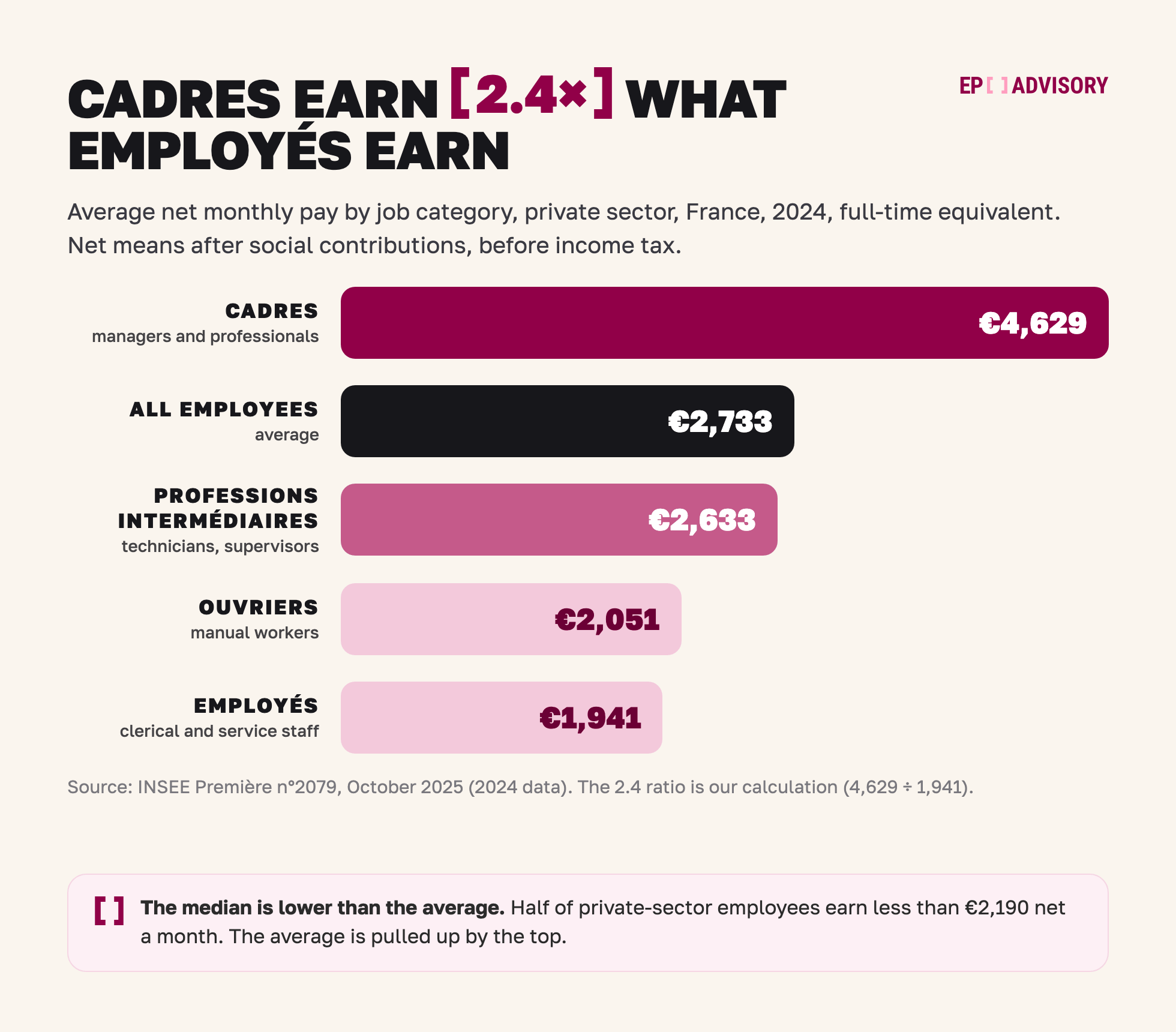
| Category | Who it covers | Net, per month |
| Cadres | Managers and qualified professionals | €4,629 |
| All employees | The national average | €2,733 |
| Professions intermédiaires | Technicians, supervisors, junior professionals | €2,633 |
| Ouvriers | Manual and production workers | €2,051 |
| Employés | Clerical, retail and service staff | €1,941 |
Look at the order carefully. Only one of the four categories sits above the national average. Cadres earn 2.4 times what employés earn, and it is cadre pay that drags the average past three of the four groups.
Cadre is not a job title. It is a payroll status. In France it is a legal category written into your contract and printed on your payslip. It changes your notice period and your trial period (a cadre’s initial trial period can run up to 4 months, against 2 months for most employees, per service-public.fr), and it usually means heavier employee contributions. A common payroll rule of thumb puts them at roughly 25% of gross for cadres against roughly 22% for non-cadres. This is an estimate, not an official rate. Two people on identical gross salaries can therefore see different net figures. So when you ask brut ou net ?, ask cadre ou non-cadre ? in the same breath. For a qualified professional moving to France, that one line in the contract decides which half of the chart above you land on.
The sector picture points the same way. Same source, same basis:
| Sector | Net, per month |
| Finance and insurance | €4,123 |
| Information and communication (IT, media, telecoms) | €3,853 |
| Industry | €3,021 |
| All sectors | €2,733 |
| Construction | €2,411 |
| Hospitality (hotels and restaurants) | €1,979 |
Finance and IT pay roughly twice what hospitality pays. If you need an offer to clear a visa threshold, that gap is the whole strategy: at the top of this table a sponsorable salary is routine rather than exceptional. Some hospitality ads are labelled net, which makes an already low number look lower still against a gross benchmark.
One more line worth knowing. Women in the French private sector earn 13.0% less than men on average (INSEE, 2024). Benchmark against the category and sector figures above, not against what you are told is normal for the team.
Score your CV in 30 seconds, then fix its biggest problems one by one. Both free.
Free, no card.

Minimum Wage in France 2026: €1,867 a Month Since 1 June
France has a statutory minimum wage, the SMIC, and it rose in the middle of 2026 rather than in the usual January cycle. Since 1 June 2026 the SMIC is €12.31 an hour gross, which is €1,867.02 a month gross on the standard 35-hour week and roughly €1,477.93 a month net. That was a rise of 2.41% (service-public.gouv.fr, fiche F2300).
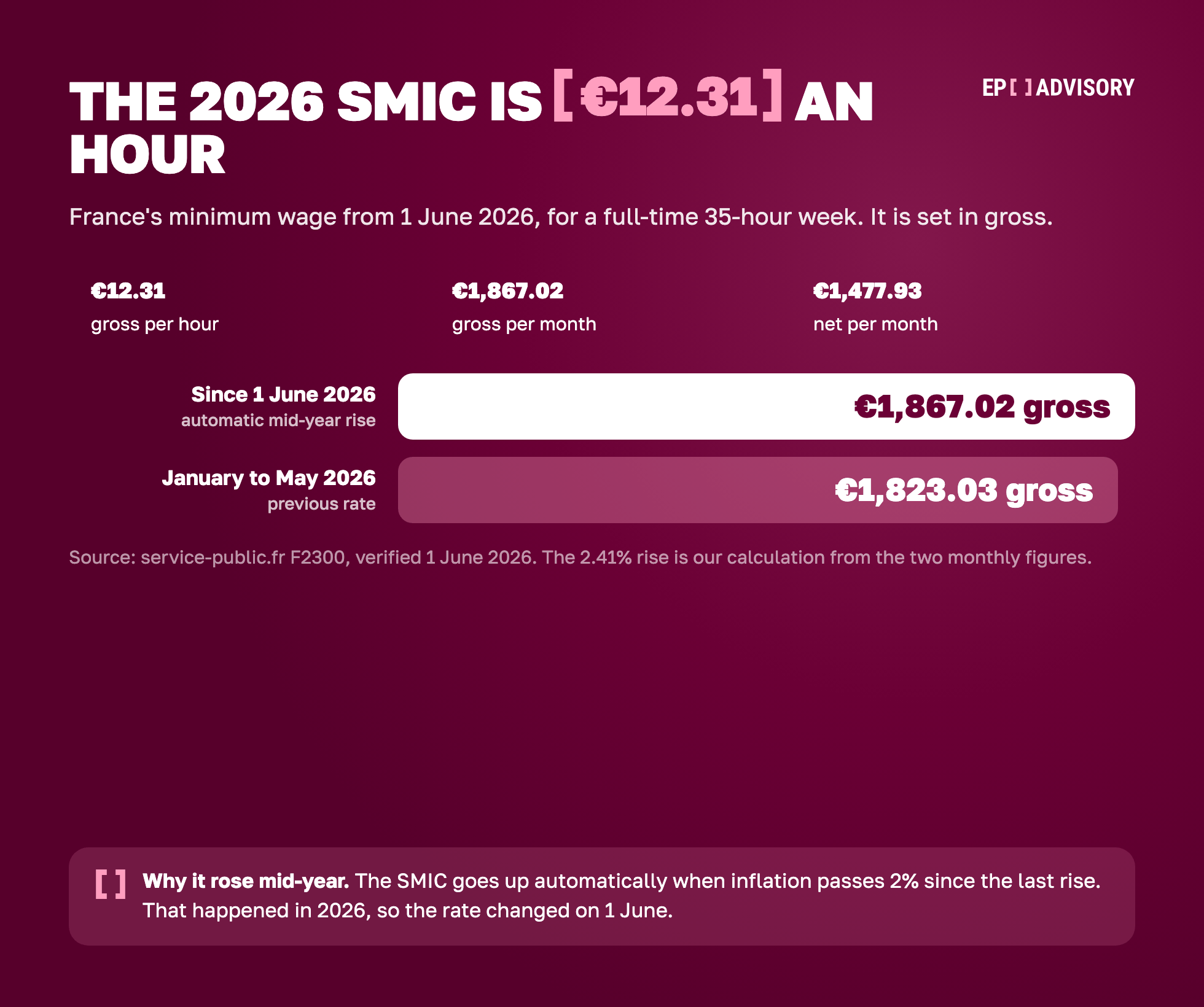
Check the date on any SMIC figure you read. From January to May 2026 the monthly SMIC was €1,823.03, and much of the search results page still quotes that number. It is one raise out of date. On our own calculation the current SMIC works out at about €22,404 a year gross, well under half the national average gross of €43,224. It is also the floor no employment contract in France can go below, whatever your nationality.
The SMIC is also the single most useful piece of evidence in the decoder above. Because it is legislated in gross and quoted verbatim in thousands of adverts as 12,31 € / heure, every one of those adverts is a gross advert that never says so.
Paris vs the Regions
Paris pays more, and by a wide margin. The cleanest way to see it is in percentages rather than euro figures, because the Paris premium is measured on several different bases and the euro numbers get quoted out of context.
- Average private-sector pay in Île-de-France runs 27.3% above the national average (full-time pay by place of work, INSEE, 2024 data). The spread inside the region is wide: Paris itself is 40.4% above the national average and Hauts-de-Seine 54.3% (INSEE, L’essentiel sur les salaires).
- Public-sector pay varies less, but Paris still pays more. INSEE finds public-sector pay much more even across France than private-sector pay, because pay scales are national. Paris is still 16.7% above the national average (2023 data). INSEE links this to ministry headquarters and higher residence allowances.
So the Paris premium is larger for a private-sector professional than for a public-sector employee. Set that 27.3% against Paris housing costs before treating a Paris offer as an automatic upgrade on Lyon, Toulouse or Nantes.
The public sector overall. Average net pay in the State civil service is €3,018 a month (INSEE Première n°2100, 2024). Note the scope: State civil service only, not the hospital or local-authority branches, which are measured separately. Some public-sector employers advertise in net, as the tax office example above shows, so read their adverts on their own terms.
How the French Talk About Pay (and How to Negotiate)
Once you know the three languages, negotiation becomes a translation exercise. Here is how the conversation actually runs in France.
The number exchanged in an interview is gross annual, spoken in thousands. A French hiring manager will say something like “entre 25 et 30 K€ brut annuel”. K€ means thousands of euros for a full year, before contributions. If you answer with a monthly take-home figure, you are answering in a different language and the two of you will be a quarter apart without noticing.
Ask “brut ou net ?” once, early, and then move on. This is the standard advice given to French candidates themselves by L’Etudiant, by APECITA and by the recruitment consultancy Storme-RH, which tells you it is a normal question rather than a foreigner’s mistake. Ask it the first time a figure is mentioned. Nobody will think less of you for it, and asking late looks like you did not understand the earlier conversation.
Then ask how many months. French salaries are usually stated over 12 months, but a thirteenth month (13e mois) is common in some sectors and collective agreements. The same €39,000 means €3,250 a month over 12 and €3,000 a month over 13. Ask “sur 12 ou sur 13 mois ?”.
Use the 22 to 25% rule to convert on the spot. In the French private sector, net is roughly gross minus 22 to 25%, with cadres at the higher end because their contributions are heavier. So €45,000 gross a year is about €3,750 a month gross and roughly €2,800 to €2,900 a month net before income tax. That is the number to compare with a French colleague’s “je touche 2 400”.
Four questions that settle the whole package. Is the figure brut ou net. Is it sur 12 ou sur 13 mois. Is the role cadre ou non-cadre. And what sits on top: French packages routinely add meal vouchers (tickets restaurant), an employer contribution towards public transport, and profit-sharing (participation or intéressement), none of which appears in the INSEE figures and some of which is paid net.
Always land on the gross annual number. The salaire brut annuel is the only figure comparable between two French offers, between France and another country, and against the visa thresholds further down, which are all set in gross.
Where to Look for Work: Official Resources
France runs a well-organised set of public and semi-public job channels, and for most foreign professionals they beat scattering applications across generic aggregators.
- France Travail, the national public employment service, renamed from Pôle emploi in January 2024. The largest single database of French vacancies, and the one place where the basis is unambiguous: its salary field is printed as Salaire brut :.
- Apec, the Association pour l’emploi des cadres. The cadre-specific service, and the right starting point for the roles that pay above the national average.
- Welcome to the Jungle, the dominant French board for tech, startups and scale-ups, with English-language listings.
- EURES, the European Commission’s mobility portal, useful mainly for spotting employers used to hiring across borders.
Three habits save time. Filter for cadre in the listing, because the status is usually stated and it tells you which half of the pay ladder the role sits on. Treat selon profil as an invitation to name your own gross annual figure rather than as a missing number. And check whether the employer has sponsored before: a company that has never applied for a work permit will treat your file as a project. The full route is in our guide to jobs in France for foreigners.
The Arithmetic: What Actually Lands in Your Account
Put the pieces together and a French salary runs through three stages, not two. Here it is on the national average.
| Stage | € per month |
| Salaire brut (gross), national average | 3,602 |
| − Employee social contributions, 24.1% | −869 |
| = Net à payer avant impôt (INSEE’s headline) | 2,733 |
| − Income tax withheld at source | a personal rate, set by the tax office |
| = Net paid into your account | below 2,733 |
The gross and the net are both INSEE’s, for reference year 2024. The €869 difference and the 24.1% are our own calculation from those two figures. A French payslip carries all three numbers, and the public statistic is the middle one.
Why we do not give you a single after-tax number. The third stage is genuinely personal. Your withholding rate (taux de prélèvement à la source) is set by the French tax office from your last declaration and moves with household size, a spouse’s income and any other income. A single person and a married parent of two on the same €3,602 gross take home visibly different amounts. Any page quoting one French after-tax figure for everyone is quoting an assumption it has not shown you.
Salary and the Visa: Talent Card Thresholds
If you are not an EU, EEA or Swiss citizen, this is the part that decides whether the move is possible at all. France gates its main skilled routes on salary, and the thresholds are set in gross annual terms, the same language the job ads use.
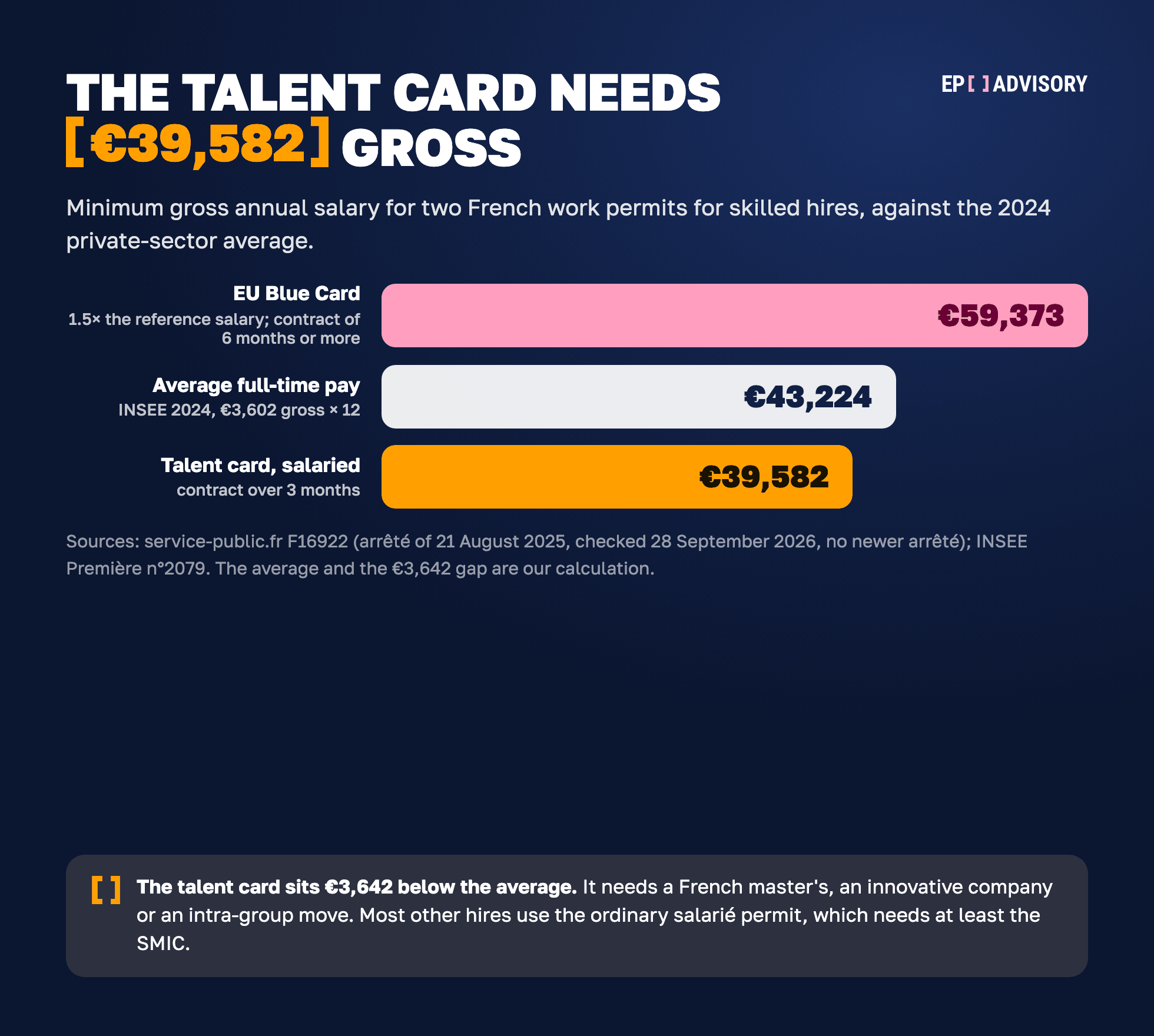
- Talent card, salarié qualifié: €39,582 a year gross. For a hire with a French master’s degree, a job at an innovative company, or an intra-group move after 3 months in the group. Most other foreign hires use the ordinary salarié permit, which needs a work authorisation and at least the SMIC.
- EU Blue Card in France: €59,373 a year gross. A higher bar, but a card with stronger mobility rights across the EU.
Both figures come from the arrêté of 21 August 2025 and on 28 September 2026 we checked that no newer arrêté has replaced it. They are normally reset by a new arrêté, so check service-public.fr for an update before relying on a number in a negotiation.
Now put the Talent threshold next to the national average. The floor is €39,582. The average French gross salary is €43,224, on our own calculation from INSEE’s monthly figure. An offer that just clears the visa threshold pays €3,642 a year less than the average French salary.
That is the reverse of the UK, where the Skilled Worker threshold sits above the median and forces employers to pay an above-average salary to sponsor at all. In France the legal minimum is genuinely a minimum, and because it gets quoted everywhere as “the salary you need”, plenty of candidates accept it as the going rate.
So treat €39,582 as the floor and negotiate against the market figure. For a cadre role the benchmark is not the national average at all: cadres average €4,629 a month net, which is roughly €6,100 gross. A cross-country comparison of every threshold is in our guide to work visa salary thresholds in Europe.
Related reading: Jobs in France for foreigners · Work visa and Blue Card salary thresholds in Europe · Salaries in Germany · Salaries in Italy · Salaries in Luxembourg · Salaries in Portugal
See what a recruiter sees, then fix it before you apply. An instant score, then the fix for every problem.
Free, no card.
Comparing southern options? Spain’s average is €29,540 gross a year (INE, 2024 data), often paid in 14 instalments: see our guide to salaries in Spain.
Key Takeaways
- France quotes pay in three languages: job ads in gross, official statistics in net, and everyday conversation in net per month. Identify which one you are hearing before you react to any figure.
- Net is always announced. Silence means gross. In our August 2026 sample of 114 French postings, none said net and only 4% said brut.
- The average French salary is €2,733 a month net and €3,602 gross; the median is €2,190 net (INSEE, reference year 2024, published October 2025).
- INSEE’s net is still before income tax. The prélèvement à la source comes off after it, at a rate personal to your household.
- In an interview, expect gross annual in K€. Ask brut ou net, ask 12 or 13 months, and convert with the 22 to 25% rule.
- Only cadres earn above the national average, and cadre is a legal payroll status, not a job title.
- The SMIC has been €1,867.02 a month gross since 1 June 2026, up 2.41%. Most competing pages still show January’s €1,823.03.
- The Talent card floor of €39,582 sits below the average gross salary of €43,224. Clearing the visa bar is not the same as being paid the market rate.
Frequently Asked Questions
What is the average salary in France per month in 2026?
The average salary in France is €2,733 a month net, or €3,602 a month gross, according to INSEE Première n°2079 (published 23 October 2025, reference year 2024, private sector, full-time equivalent). The median is lower at €2,190 net a month. No newer official national figure exists, because INSEE publishes this series about a year in arrears.
Are French salaries advertised gross or net?
Gross, almost always, and usually without saying so. In our own August 2026 sample of 114 salary-carrying postings across HelloWork, Indeed France and France Travail, not one figure was labelled net and only 4% carried the word brut. The rest were bare numbers. The proof that a bare number is gross is in the ads themselves: dozens quote exactly €12.31 an hour, which is the 2026 SMIC, and the SMIC is set in gross. The rule to carry with you is that net is always announced, so silence means gross. The exceptions that do announce it are the public sector (the tax office advertises “2 378 € net par mois”), some hospitality and small-company ads, and allowances such as transport and meal money, which are quoted net while the wage stays gross.
What is a good salary in France?
Above €2,733 a month net puts you ahead of the national average, and above €4,334 net puts you in the top ten per cent of full-time private-sector earners (INSEE, 2024). Cadres average €4,629 net a month, so for a qualified professional role that is the realistic benchmark. In Paris the bar is higher: private-sector pay in Île-de-France runs 27.3% above the national average (INSEE, 2024).
What is the minimum wage in France in 2026?
Since 1 June 2026 the SMIC is €12.31 an hour gross, which is €1,867.02 a month gross for a 35-hour week, or roughly €1,477.93 net (service-public.gouv.fr, fiche F2300). That was a 2.41% rise. From January to May 2026 the figure was €1,823.03 a month, and many salary pages still show the older number.
How much do you take home in France after tax?
Less than the €2,733 net that INSEE publishes. French payslips carry three numbers: gross, net before income tax, and net paid. INSEE’s headline is the middle one, so employee social contributions of about 24.1% have gone but income tax has not. Since 2019 income tax is withheld at source at a rate the tax office sets from your last declaration, which moves with household size and other income. That is why no single after-tax figure applies to everyone.
What salary do you need for a French work visa?
The Talent card for a salarié qualifié requires a gross annual salary of at least €39,582, and the EU Blue Card in France requires €59,373 (arrêté of 21 August 2025, checked 28 September 2026, no newer arrêté). The thresholds are normally reset by a new arrêté, so check for an update before you rely on them. The Talent floor sits below the average French gross salary of €43,224, so an offer that clears it is not automatically a good offer.
Getting ready to apply for jobs in France? Check your CV for free: see it the way a recruiter does, then fix each problem.