 By Alisa Schlosser, Career Consultant at EP Advisory
The short answer: the average salary in Spain is €2,110 a month gross on a 14-payment payslip, or €2,462 a month spread over 12. That is €29,540.26 a year (INE, 2024 data published May 2026). The 2026 minimum wage, Spain’s basic salary, is €1,221 a month over 14 payments, or €1,424.50 over 12, which is €17,094 a year. After deductions, the average salary leaves about €1,630 a month and the minimum wage about €1,142.
| Spain, 2026 | Month × 14 | Month ÷ 12 | Year |
|---|---|---|---|
| Average salary, gross | €2,110 | €2,462 | €29,540.26 |
| Average salary, net (estimate) | ≈ €1,630 | ≈ €1,902 | ≈ €22,823 |
| Median salary, gross | €1,750 | €2,041 | €24,497.17 |
| Minimum wage (SMI), gross | €1,221 | €1,424.50 | €17,094 |
| Minimum wage, net (no income tax in 2026) | ≈ €1,142 | ≈ €1,332 | ≈ €15,983 |
| EU Blue Card and highly qualified bar | €2,954 | €3,446 | €41,356.36 |
Spain has a number problem. Ask what people earn here and you get three different answers, all of them officially sourced, and none of them wrong. The reason is not bad data. It is that Spanish salaries are quoted per year, paid in 14 instalments, and measured by two separate national surveys that count different things.
This guide uses the freshest official source there is: the INE’s Encuesta Anual de Estructura Salarial for 2024, published on 28 May 2026. Most salary pages still quote 2023 or older. Below we run the annual figure, the monthly payslip in 14 and 12 payments, the take-home at several salary levels, the 2026 minimum wage, the regional gaps, the Beckham tax regime and the visa threshold. Every monthly number says which divisor produced it.
In nearly 10 years, we’ve helped more than 5,000 professionals find jobs abroad. Want to know if your CV will pass screening in Spain? Check your CV for free: a score in 30 seconds, then a fix for each problem.
What Is the Average Salary in Spain Per Month? (2026)
The average salary in Spain is €29,540.26 a year gross, according to the INE’s Encuesta Anual de Estructura Salarial (EAES) for 2024, published on 28 May 2026. Spanish employers pay in 14 instalments, so the figure on a monthly payslip is €2,110. Divide the same annual salary by 12 instead and you get €2,461.69, which is the number most salary sites publish.
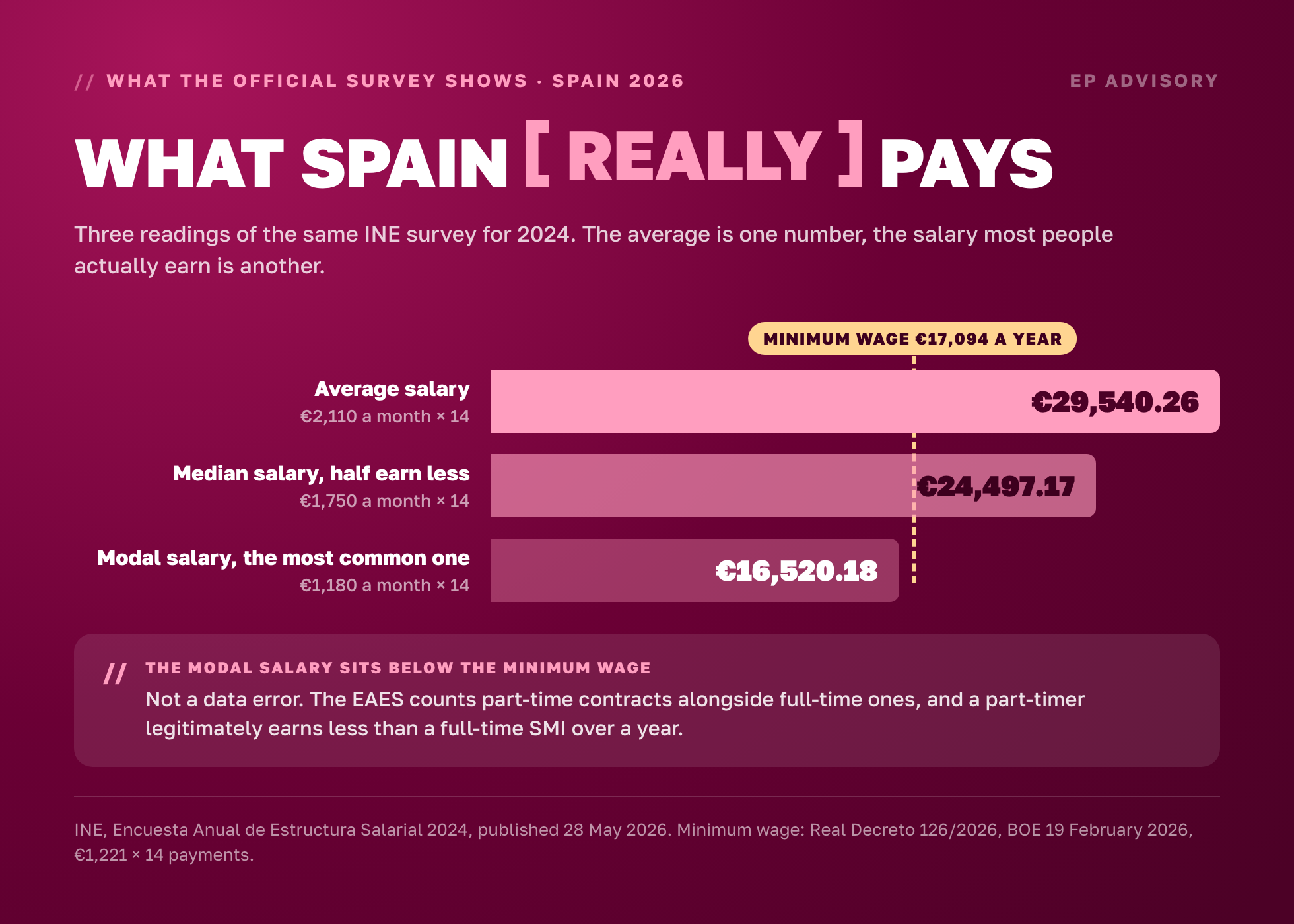
The average is not the typical salary. The median, the point where half of employees earn more and half earn less, is €24,497.17 a year, about €1,750 a month across 14 payments. The modal salary, the single most frequently paid amount, is lower still at €16,520.18.
| Salary level (INE EAES 2024) | Per year, gross | Per month × 14 | Per month ÷ 12 |
| Average salary | €29,540.26 | €2,110 | €2,462 |
| Median salary | €24,497.17 | €1,750 | €2,041 |
| Modal (most common) salary | €16,520.18 | €1,180 | €1,377 |
| Men | €32,057.55 | €2,290 | €2,671 |
| Women | €26,904.90 | €1,922 | €2,242 |
One caveat before you quote any of this. These are INE’s figures for the 2024 reference year, published in May 2026. They are the most recent official reading Spain has, and the next update is expected around mid-2027. Nobody has a genuine 2026 salary survey for Spain, so treat any page that promises one with suspicion.
Why you will see €2,386 quoted elsewhere. Both numbers are official, and they measure different things. Our €2,110 is the EAES annual average divided by 14. The EAES is an establishment survey: it asks employers across economic sectors B to S what they paid, and it counts part-time contracts alongside full-time ones. The €2,386 comes from the INE’s Encuesta de Población Activa salary decile release for 2024, published on 14 November 2025, which is a household survey of what people were actually paid in a month; its median is €2,001.40. We headline €2,110 because it is arithmetically tied to the €29,540.26 annual figure, and the annual figure is what job offers, collective agreements and the visa formula are all written in.
If the numbers work for you, the next step is practical: the European work-visa salary thresholds show what an offer must pay before a permit is possible, and our guide to salaries in Germany gives you a neighbouring market to compare against.
Spain Salary Per Month: Gross and Net, 12 vs 14 Payments
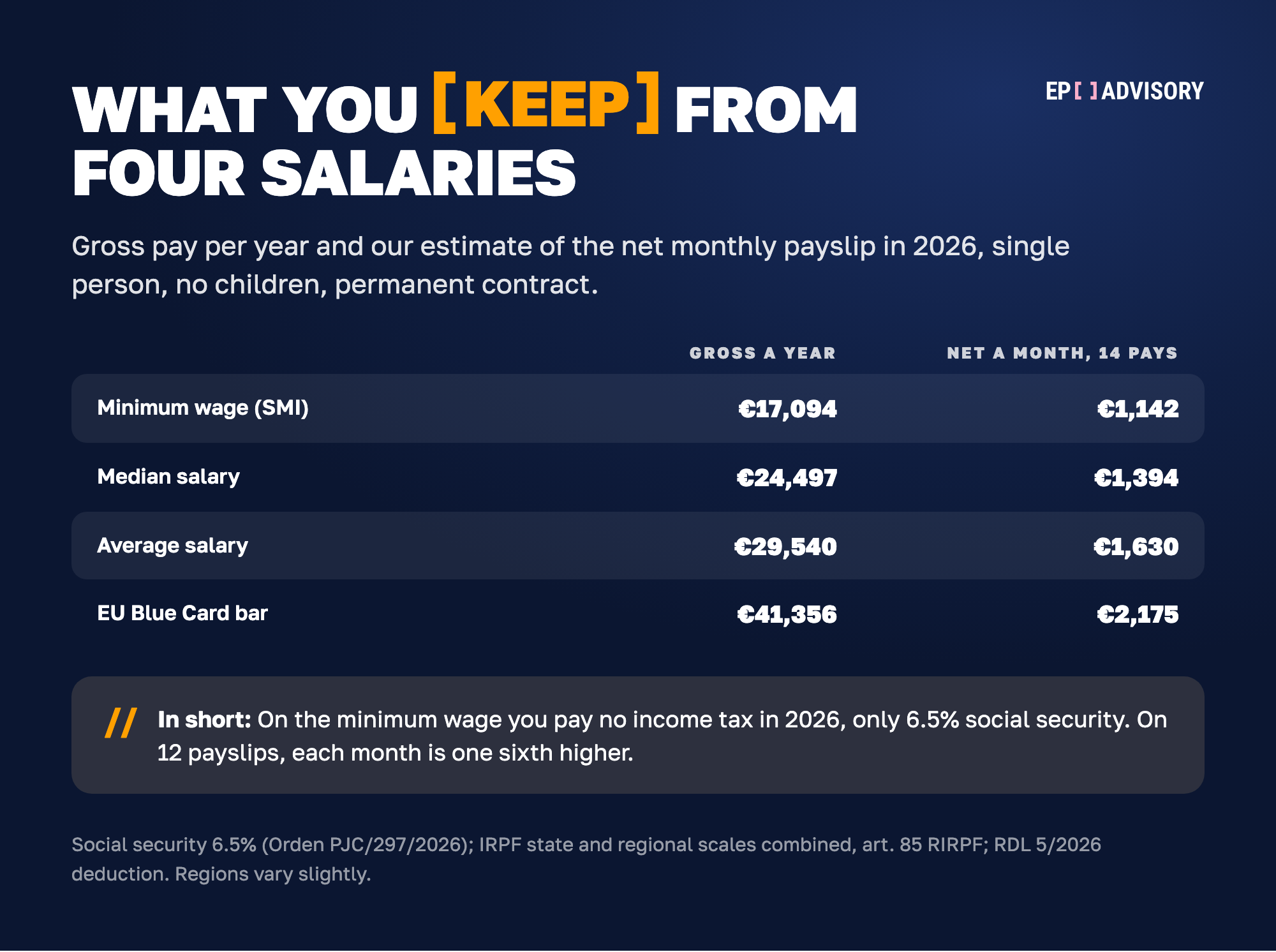
A monthly salary in Spain depends on two things: the annual figure, and whether it is paid in 14 or 12 instalments. The table shows both, before and after deductions, for the four salaries that matter most when you plan a move.
| Salary in 2026 | Gross × 14 | Gross ÷ 12 | Net × 14 | Net ÷ 12 |
| Minimum wage, €17,094 | €1,221 | €1,424.50 | €1,142 | €1,332 |
| Median, €24,497 | €1,750 | €2,041 | €1,394 | €1,627 |
| Average, €29,540 | €2,110 | €2,462 | €1,630 | €1,902 |
| EU Blue Card bar, €41,356 | €2,954 | €3,446 | €2,175 | €2,538 |
Net figures are our estimates for a single person with no children on a permanent contract: 6.5% employee social security plus income tax (IRPF) on the general 2026 scale. On the minimum wage, income tax is zero for 2026. On 12 payments each payslip is one sixth larger, but the annual total is the same.
Labour and entry-level jobs. Manual and service roles sit closer to the minimum wage. In INE’s 2024 survey, unskilled service workers such as cleaners and kitchen assistants average €16,063 a year, about €1,147 a month over 14 payments. Labourers in farming, fishing, construction, industry and transport average €22,030 (€1,574 a month), restaurant and shop staff €18,919 (€1,351) and skilled construction workers €24,445 (€1,746). These are 2024 averages and include part-time contracts, which is why the lowest sits below the 2026 annual minimum wage. Each sector’s collective agreement sets its own pay floor, and none may go below the SMI for full-time work.
Spanish Salaries at a Glance: The Essentials
- Average gross salary: €29,540.26/year, €2,110 a month across 14 payments (INE, EAES 2024, published 28 May 2026)
- Median gross salary: €24,497.17/year, about €1,750 a month across 14 payments
- Modal salary: €16,520.18/year, the single most common amount paid
- Pay frequency: 14 instalments is standard, 12 ordinary payslips plus two pagas extra, usually June and December
- Take-home on the average: roughly €1,630/month across 14 payments, about 77% of gross
- Deductions: 6.5% employee social security (Orden PJC/297/2026) plus IRPF at an effective 16.2% on the average salary
- Minimum wage (SMI) 2026: €1,221/month × 14 = €17,094/year, up 3.1%, retroactive to 1 January 2026 (Real Decreto 126/2026, BOE 19 February 2026)
- Take-home on the minimum wage: about €1,142/month across 14 payments, with no income tax in 2026 (Real Decreto-ley 5/2026)
- Gender gap: women average €26,904.90 against €32,057.55 for men, about 16% lower
- Highest-paying region: País Vasco at €35,170, 19.1% above the national figure
- Visa salary bar: €41,356.36/year for the EU Blue Card and the highly qualified permit, €33,085.09 on the reduced Blue Card tier
Average against median. Most salary articles quote the average because it is the bigger number. It is pulled upward by energy, finance and management pay. The median describes what a typical employee actually earns, and the modal figure shows what the largest single group of workers is paid. Anchor your expectations on the median, then adjust for your sector and region.
The 14-Payment Trap: Why Monthly Figures Differ by €350
This is the single most useful thing to understand about Spanish pay, and it is where nearly every English-language salary page goes wrong.
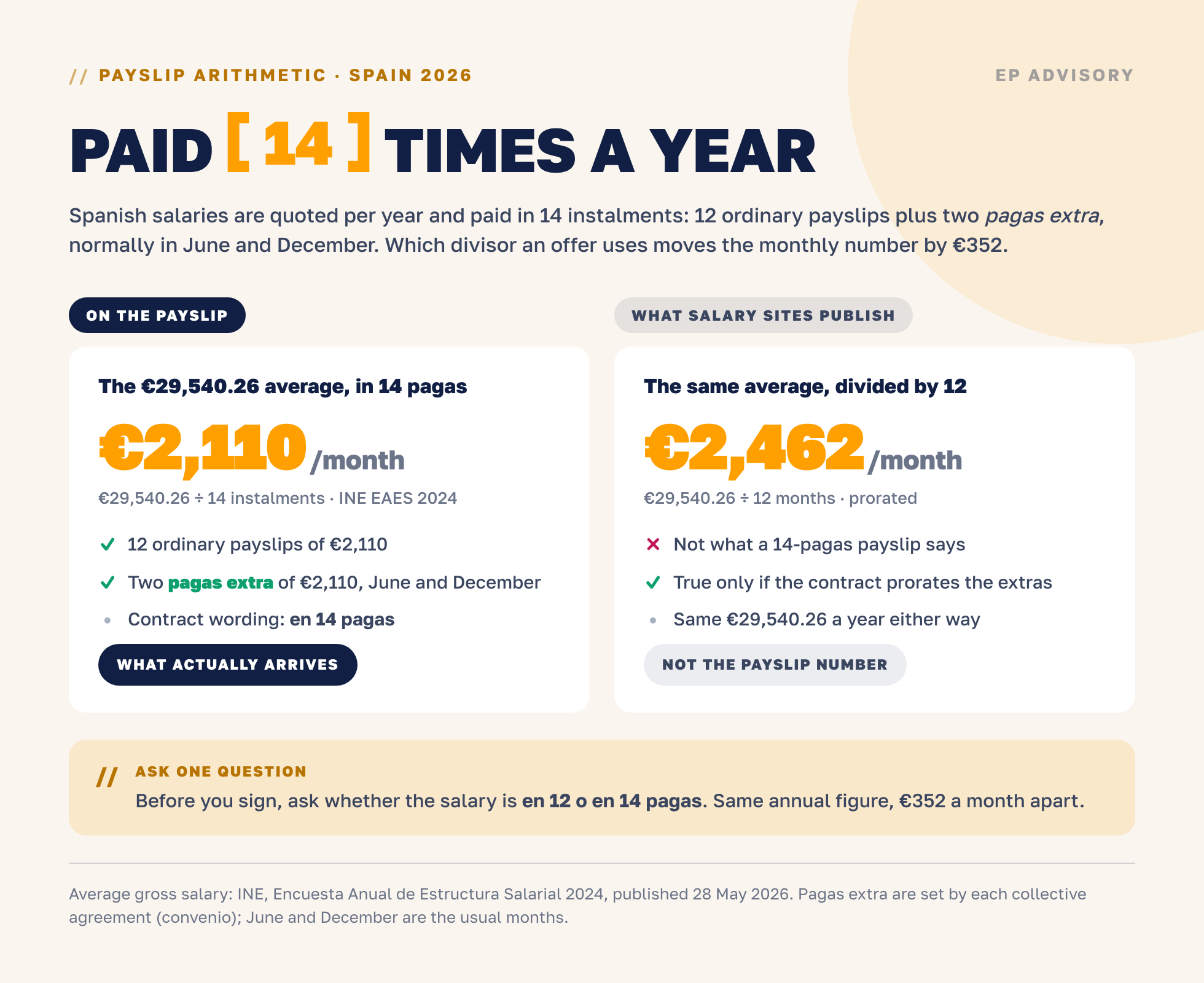
Spanish salaries are negotiated and written as an annual gross figure. That figure is then paid out in 14 instalments: 12 ordinary monthly payslips plus two pagas extra, additional payments of the same size that normally land in June and December. The exact months are set by your sector’s collective agreement, the convenio colectivo.
So the average salary of €29,540.26 produces two very different monthly numbers:
- €29,540.26 ÷ 14 = €2,110.02. This is what the payslip says in an ordinary month, and it is also what each paga extra is worth.
- €29,540.26 ÷ 12 = €2,461.69. This is the prorated figure, and you only see it monthly if your contract explicitly spreads the extras across all 12 months.
The gap is €351.67 a month. If you budget on €2,462 and get paid on a 14-instalment contract, you will be about €350 short every ordinary month, and then get two windfalls you did not plan for.
The question to ask before you sign. Ask whether the salary is en 12 o en 14 pagas. Both wordings describe the same annual money, but they produce completely different cash flow. Offers are sometimes quoted in 12 pagas to make the monthly number look bigger, so always convert back to the annual figure before comparing two offers.
The same rule applies to the minimum wage. The SMI is €1,221 a month over 14 payments, which is €17,094 a year, or €1,424.50 a month if it is prorated over 12. Any page that reports Spain’s minimum wage without naming the divisor is telling you half the story.
Salaries by Sector and Occupation
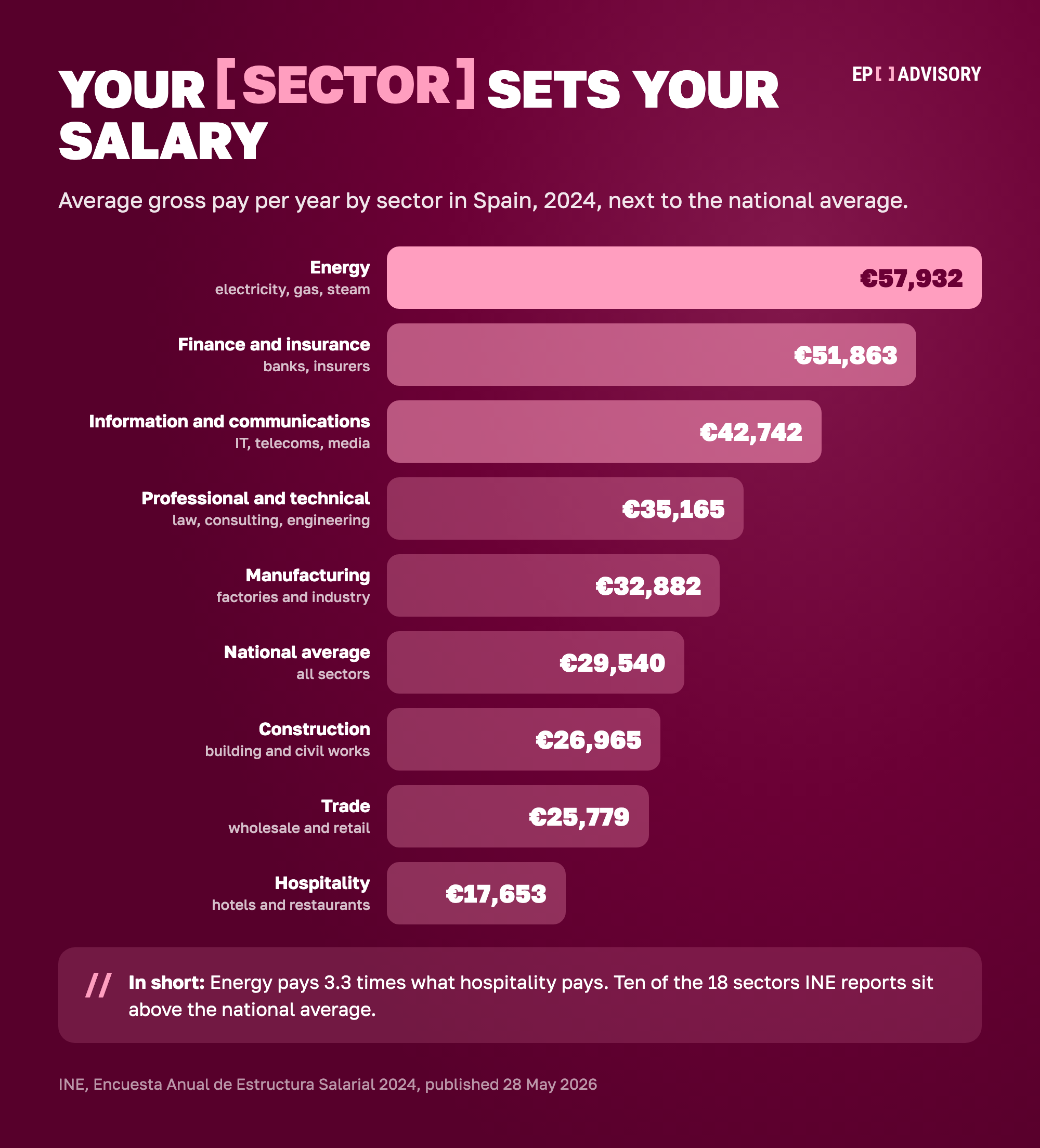
The spread by sector is enormous. Energy and utilities supply pays 3.3 times what hospitality pays, and the gap between the top and bottom occupation groups is close to four to one. These are gross annual figures from the same INE survey.
| Sector (INE EAES 2024) | Gross per year | Per month × 14 |
| Energy and utilities supply | €57,932 | €4,138 |
| Finance and insurance | €51,863 | €3,704 |
| Information and communications | €42,742 | €3,053 |
| Professional and scientific activities | €35,165 | €2,512 |
| Manufacturing | €32,882 | €2,349 |
| National average, all sectors | €29,540 | €2,110 |
| Construction | €26,965 | €1,926 |
| Trade, wholesale and retail | €25,779 | €1,841 |
| Hospitality, hotels and catering | €17,653 | €1,261 |
By occupation group the range is wider again. Directors and managers average €63,865 a year, scientific and intellectual professionals outside health and teaching, such as engineers, IT specialists and lawyers, €45,514, and unskilled service workers €16,063. Ten of the 18 sectors INE reports pay above the national average. Those below it include trade at €25,779, administrative and support services at €21,097 and hospitality at €17,653.
What this means for a job search. If you need to clear a visa threshold, sector selection does more work than city selection. Information and communications at €42,742 already sits above the €41,356.36 Blue Card bar on average. Hospitality at €17,653 is not a route to sponsorship, however many vacancies it advertises.
Score your CV in 30 seconds, then fix its biggest problems one by one. Both free.
Free, no card.

Basic Salary and Minimum Wage in Spain 2026: €1,221 Across 14 Payments
Spain’s statutory minimum wage, the Salario Mínimo Interprofesional or SMI, is €1,221 a month across 14 payments for 2026. That is €17,094 a year, a rise of 3.1%, set by Real Decreto 126/2026 and published in the BOE on 19 February 2026. The increase applies retroactively from 1 January 2026, so anyone on the minimum during January and February was owed back pay.
Prorated over 12 months instead, the same SMI is €1,424.50. Both numbers are correct, and they describe the same annual entitlement.
| Basic salary in Spain 2026 (SMI) | Amount |
| Per month, 14 payments | €1,221 |
| Per month, prorated over 12 | €1,424.50 |
| Per year | €17,094 |
| Per day | €40.70 |
| Temporary and seasonal work of up to 120 days, per working day | €57.82 |
| Domestic workers, per hour worked | €9.55 |
| Take-home per month, 14 payments (estimate) | ≈ €1,142 |
No income tax on the minimum wage in 2026. Real Decreto-ley 5/2026 raised the income tax deduction for low earners, first brought in for 2025, to €590.89 a year for employment income up to €17,094, as long as other income stays under €6,500. For a full-time worker on the SMI, that cancels the tax completely, so only the 6.5% social security comes off. The deduction shrinks above €17,094 and ends at €20,048.45. If an employer withholds a little tax during the year anyway, the annual return gives it back.
The honest part nobody publishes. The modal salary in the INE survey, €16,520.18, sits below the annualised minimum wage of €17,094. That looks impossible until you see what the survey counts. The EAES measures what each worker was actually paid over the year, including part-time contracts, temporary contracts and people who worked only part of the year. A half-time employee on the correct hourly SMI legitimately earns well under €17,094 in twelve months. Spain’s part-time and seasonal employment is concentrated in hospitality and retail, which is exactly why the most common salary lands where it does.
The practical takeaway: the SMI protects an hourly and full-time rate, not an annual income floor. When you compare a Spanish offer against one elsewhere, check the contract hours before you check the salary.
Madrid, the Basque Country and the Regional Gap
Spain’s regional spread is over €10,000 a year between the top and bottom autonomous communities. These are gross annual figures for 2024.
| Autonomous community | Gross per year | Per month × 14 | Against national |
| País Vasco (Basque Country) | €35,170 | €2,512 | +19.1% |
| Comunidad de Madrid | €34,410 | €2,458 | +16.5% |
| Navarra | €32,605 | €2,329 | +10.4% |
| Cataluña | €31,730 | €2,266 | +7.4% |
| Spain, national average | €29,540 | €2,110 | baseline |
| Canarias | €25,120 | €1,794 | −15.0% |
| Extremadura | €24,979 | €1,784 | −15.4% |
The Basque Country, not Madrid, is Spain’s best-paid region, driven by heavy industry, energy and a strong collective bargaining tradition. Madrid follows closely on the strength of headquarters, finance and technology. At the other end, Canarias and Extremadura sit roughly 15% below the national figure, with economies weighted towards tourism and agriculture.
A note on Barcelona. There is no official INE average salary for Barcelona, and there is none for Madrid city either. The EAES stops at the autonomous community level. Any page quoting a precise Barcelona salary is using a jobs-board sample or a private survey, not national statistics. The nearest official figure is Cataluña at €31,730 a year, and it covers the whole region, including Girona, Lleida and Tarragona, so a Barcelona city figure would sit somewhat above it.
Weigh region against cost of living, not in isolation. A €33,000 offer in Bilbao or Zaragoza usually leaves more disposable income than €36,000 in central Madrid or Barcelona, where rent absorbs the difference and then some.
Where to Look for Work: Official Resources
Spain’s job market runs on a mix of the state employment service and a few dominant private boards. Start with the official channels, because they are the ones that also show public-sector and EU-funded roles.
- SEPE and its Empléate portal: the public employment service, with the national vacancy database and regional offices
- InfoJobs: the largest private job board in Spain by volume, and the default for domestic hiring
- LinkedIn Spain: where international companies, technology firms and English-speaking roles concentrate
- EURES: the EU mobility network, useful for cross-border roles and for employers already used to hiring non-locals
Two practical notes. First, most Spanish vacancies are written and interviewed in Spanish, and outside Madrid and Barcelona the English-speaking market is thin. Second, check whether an employer has hired non-EU staff before, because the sponsorship paperwork sits with them, not with you. For permits, the jobs in demand and where English is enough, read our guide to jobs in Spain for foreigners.
The Arithmetic: What Actually Lands in Your Account
Two deductions come off a Spanish payslip: employee social security contributions and IRPF, the income tax withholding. Here is the calculation on the national average salary.
| On the average salary | Per month (of 14) | Per year |
| Gross | €2,110 | €29,540 |
| − Social security, 6.5% | −€137 | −€1,920 |
| − IRPF withholding, 16.2% effective | −€343 | −€4,797 |
| = Net into your account | ≈ €1,630 | ≈ €22,823 |
Total deductions come to about 22.7%, so you keep roughly 77% of gross. Spread over 12 months instead of 14, the same annual net is about €1,900 a month. The OECD’s Taxing Wages 2026 puts take-home for a single worker on its own Spanish average wage measure, €32,678 in 2025, at 76.5%. That is a close independent check on the same arithmetic.
Net Salary in Spain 2026: Four Quick Calculations
The same method at four round salaries, per year for the deductions and per month for the take-home. Find the line nearest your offer.
| Gross a year | Social security | Income tax (IRPF) | Net × 14 | Net ÷ 12 |
| €20,000 | −€1,300 | −€2,035 | €1,190 | €1,389 |
| €30,000 | −€1,950 | −€4,926 | €1,652 | €1,927 |
| €45,000 | −€2,925 | −€9,475 | €2,329 | €2,717 |
| €60,000 | −€3,900 | −€14,664 | €2,960 | €3,453 |
Read these as estimates, not as a payslip. The figures above assume a single person with no children, using the general 2026 withholding scale, which combines the state and regional rates. Payroll withholding uses that one scale across Spain, except in the Basque Country and Navarra, which run their own tax systems. Each region does set its own share of the final tax, so the annual return then adds or refunds a small amount. Madrid and Andalucía run lighter regional scales, Cataluña and Valencia heavier ones. Children, a mortgage, disability status and a working spouse all change the withholding, and Spain reconciles the whole year in the annual declaración de la renta.
The social security rate of 6.5% is set for 2026 by Orden PJC/297/2026 and covers healthcare, pension and unemployment. There is no separate monthly health insurance premium to budget for, which is a genuine advantage over the Netherlands or Switzerland.
Moving for a job? Ask about the Beckham regime. People who move to Spain for work can opt to pay a flat 24% income tax on employment income up to €600,000 a year, and 47% above that, instead of the normal progressive scale. It covers the year you arrive and the five years after. You qualify if you were not tax resident in Spain in the previous five years and you come for a Spanish job, a posting, remote work on the international telework visa, or certain director and entrepreneur roles. You must apply within six months of joining Spanish social security. On our estimate, the flat rate beats the normal scale from about €58,000 a year, and the saving grows quickly above that.
Salary and the Visa: The 1.4× Rule
This is the part that decides whether you can move at all, and it is where the freshest information matters most.
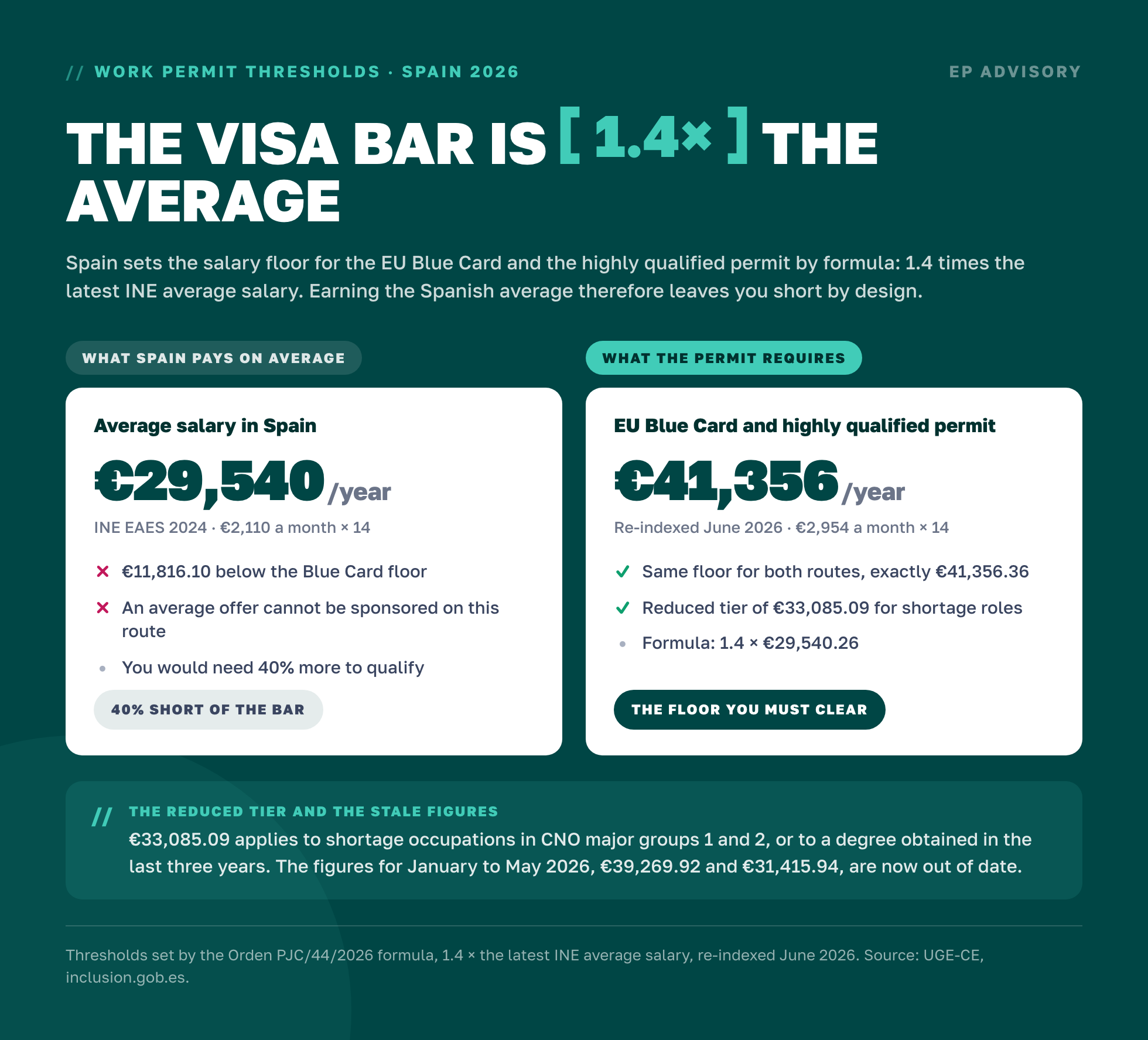
Spain does not pick its highly qualified salary threshold by negotiation. It sets it by formula: 1.4 times the latest published INE average salary. When the INE released the 2024 EAES in May 2026, the average moved, and the thresholds moved with it.
- EU Blue Card and the highly qualified professional (HQP) permit: €41,356.36 a year. That is 1.4 × €29,540.26, and it is the same floor for both routes.
- Reduced Blue Card tier: €33,085.09 a year for shortage occupations in CNO major groups 1 and 2, or where the applicant’s degree was obtained in the last three years.
- These figures were re-indexed in June 2026, per the official note from the Unidad de Grandes Empresas y Colectivos Estratégicos (UGE-CE) on inclusion.gob.es. Expect the next re-indexation around May or June 2027.
- The figures you will still find on most of the web, €39,269.92 and €31,415.94, applied from January to May 2026 only. They are out of date.
Now put the two numbers side by side. The average Spanish salary is €29,540.26. The Blue Card bar is €41,356.36. The gap is €11,816.10 a year, and it is not an accident: because the threshold is defined as 1.4 times the average, earning exactly the Spanish average always leaves you short of the visa bar by construction: the bar sits 40% above the average. There is no year in which an average salary qualifies.
What follows from that is a job-search strategy, not a salary expectation. Target the sectors that already pay above the bar, information and communications, finance, energy and professional services, and check whether your occupation sits in a CNO group that unlocks the reduced €33,085.09 Blue Card tier. The full comparison across 16 European countries, with the new June 2026 Spanish figures, is in our guide to work visa and Blue Card salary thresholds in Europe.
Related reading: Work visa & Blue Card salary thresholds in Europe 2026 · Salaries in France · Salaries in Germany · Salaries in Portugal
See what a recruiter sees, then fix it before you apply. An instant score, then the fix for every problem.
Free, no card.
Italy runs the same instalment logic with 13 payments and no minimum wage at all: see our guide to salaries in Italy.
Key Takeaways
- The average salary is €29,540.26 a year gross, which is €2,110 on a monthly payslip across 14 payments, not €2,462. Always state the divisor.
- The median, €24,497.17, is the honest anchor, and the most common salary of all is €16,520.18.
- You keep about 77% of gross, roughly €1,630 a month on the average, with no separate health insurance premium to pay.
- The 2026 minimum wage is €1,221 × 14 = €17,094 a year, retroactive to 1 January 2026. It pays no income tax in 2026, which leaves about €1,142 a month.
- Sector beats city. Energy pays 3.3 times what hospitality pays, and 10 of the 18 sectors clear the national average.
- País Vasco leads the regions at €35,170, ahead of Madrid. There is no official INE figure for Barcelona or Madrid city.
- The visa bar is €41,356.36, re-indexed in June 2026, and by formula it will always sit 40% above the average salary.
Frequently Asked Questions
What is the average salary in Spain per month?
The average salary in Spain is €29,540.26 a year gross, which is €2,110 a month on a payslip because Spain pays in 14 instalments. Divided by 12 the same salary is €2,461.69. The figures come from INE’s Encuesta Anual de Estructura Salarial for 2024, published on 28 May 2026.
What is a good salary in Spain?
Anything above the median of €24,497.17 a year, about €1,750 a month across 14 payments, puts you ahead of half the workforce. In Madrid, Barcelona or the Basque Country, comfortable single living generally starts nearer €35,000 a year. Above €41,356.36 you also clear the Blue Card salary bar.
What is the basic salary (minimum wage) in Spain in 2026?
The SMI, Spain’s basic salary, is €1,221 a month across 14 payments, or €1,424.50 a month prorated over 12. That is €17,094 a year, up 3.1%, set by Real Decreto 126/2026 (BOE, 19 February 2026) and applied from 1 January 2026. Workers on the SMI pay no income tax in 2026, so take-home is about €1,142 a month over 14 payments.
How much is take-home pay on the average Spanish salary?
Roughly €1,630 a month across 14 payments, about €22,823 a year, so you keep around 77% of gross. Deductions are 6.5% employee social security and IRPF at an effective 16.2%. This is an estimate for a single person with no children. Your region’s share of income tax adjusts the final figure slightly in the annual return.
What is the Beckham law in Spain?
It is a special tax regime for people who move to Spain for work. You pay a flat 24% income tax on employment income up to €600,000 a year, instead of the progressive scale, for the year you arrive and the next five. You must not have been tax resident in Spain in the previous five years, and you must apply within six months of joining Spanish social security.
What salary do you need for an EU Blue Card in Spain?
€41,356.36 a year, re-indexed in June 2026, and the same floor applies to the highly qualified professional permit. The reduced Blue Card tier is €33,085.09 for shortage occupations in CNO major groups 1 and 2 or for a degree obtained in the last three years. Because the threshold is set at 1.4 times the INE average salary, an average Spanish salary is always short: the bar sits 40% above the average.
Getting ready to apply for jobs in Spain? Check your CV for free: see it the way a recruiter does, then fix each problem.