 By Aleksei Gavrilov, Career Consultant at EP Advisory
The short answer: The median salary in Sweden in 2026 is about SEK 38,300 per month gross (Statistics Sweden). The average is higher, at SEK 42,900 (SCB, 2025), but the gap to the median is smaller than in most countries, because Swedish pay is relatively compressed. After tax, someone on the median keeps roughly SEK 28,000 a month. There is no legal minimum wage. Collective agreements set the floor by sector instead.
| Sweden, 2026 | Per month |
|---|---|
| Median salary (gross) | ~SEK 38,300 |
| Average salary (gross) | SEK 42,900 |
| Typical take-home (median role) | ~SEK 28,000 |
| Minimum wage | None. Set by collective agreement |
| Work-permit salary floor | SEK 34,470/month (from 16 June 2026) |
Sweden pays well, but not in the way Switzerland does. The national median is about SEK 38,300 per month gross, and in tech and engineering the figures climb past SEK 55,000. What sets Sweden apart is the arithmetic on the other side: high income tax, a punishing housing queue in Stockholm, and a rental market where newcomers rarely get a first-hand contract.
This article is not about the Nordic dream. It is about what actually lands in your account. We break salaries down by sector, focus on the fields where foreign professionals get hired, subtract every real cost, and show you what is genuinely left at the end of the month.
Over 7 years we have helped more than 5,000 professionals find jobs abroad. Want to assess your chances in Sweden specifically? Find your career consultant.
What Is the Average Salary in Sweden Per Month? (2026)
The average salary in Sweden in 2026 is SEK 42,900 per month gross (roughly €3,800), on SCB’s whole-economy series for 2025. Other official cuts of the same survey run lower, the public sector at 41,000 and municipal employers at 37,400, which is why quoted averages differ. The median is the honest anchor at SEK 38,300 per month gross (Statistics Sweden), and Swedish pay is compressed, so the two sit close together. After tax a typical worker keeps around SEK 28,000 per month net.
| Salary in Sweden (2026) | Per month, gross | Per month, net |
| Average | SEK 42,900 | ~SEK 30,900 |
| Median (typical worker) | ~SEK 38,300 | ~SEK 28,000 |
Net figures are approximate and vary by municipality. See “The Arithmetic” section below for a full worked example.
Does Sweden have a minimum wage? No. There is no statutory minimum wage. Each sector sets its own floor through a collective agreement (kollektivavtal), and 88% of employees were covered by one in 2025 (Medlingsinstitutet).
What counts as a good salary in Sweden? Anything above the median, so roughly SEK 38,300 per month gross, is comfortable outside Stockholm. Around SEK 45,000 and up gives real breathing room in the capital.
If the numbers work for you, the next step is practical: our guide to jobs in Sweden for foreigners covers where the hiring actually happens, and the European work-visa salary thresholds show what an offer must pay before a permit is possible.
Swedish Salaries at a Glance: The Essentials
- Median salary: about SEK 38,300/month gross (Statistics Sweden, SCB)
- Average salary: SEK 42,900/month (SCB, 2025), only modestly above the median because pay is compressed
- Minimum wage: none in law. Each sector sets its own floor through a collective agreement (kollektivavtal), which covered 88% of employees in 2025 (Medlingsinstitutet)
- Income tax: municipal tax of roughly 29–35% (about 32% on average), the single biggest deduction. A basic allowance and an earned-income credit lower the effective rate
- State tax: an extra 20% on the part of your income above about SEK 55,000/month
- Social contributions: paid by the employer (about 31.4% on top of your salary), not deducted from your pay
- Holiday: 25 days by law, with holiday pay on top (semestertillägg)
- Work-permit salary floor: SEK 34,470/month from 16 June 2026, around 90% of the median. A lower floor of SEK 28,725 (75%) applies to certain shortage occupations
- Rent, central 1-bedroom in Stockholm: SEK 8,000–12,000 first-hand (long queue), or SEK 14,000–18,000 on a sublet
A note on “median” versus “mean”. In many countries the gap is huge. In Sweden it is modest, and that is the point. Pay is deliberately compressed, so the median (half earn more, half less) is a reliable anchor. Do not expect a Swiss-style spread between ordinary and top salaries.
Salaries by Sector: Where Foreign Professionals Actually Get Hired
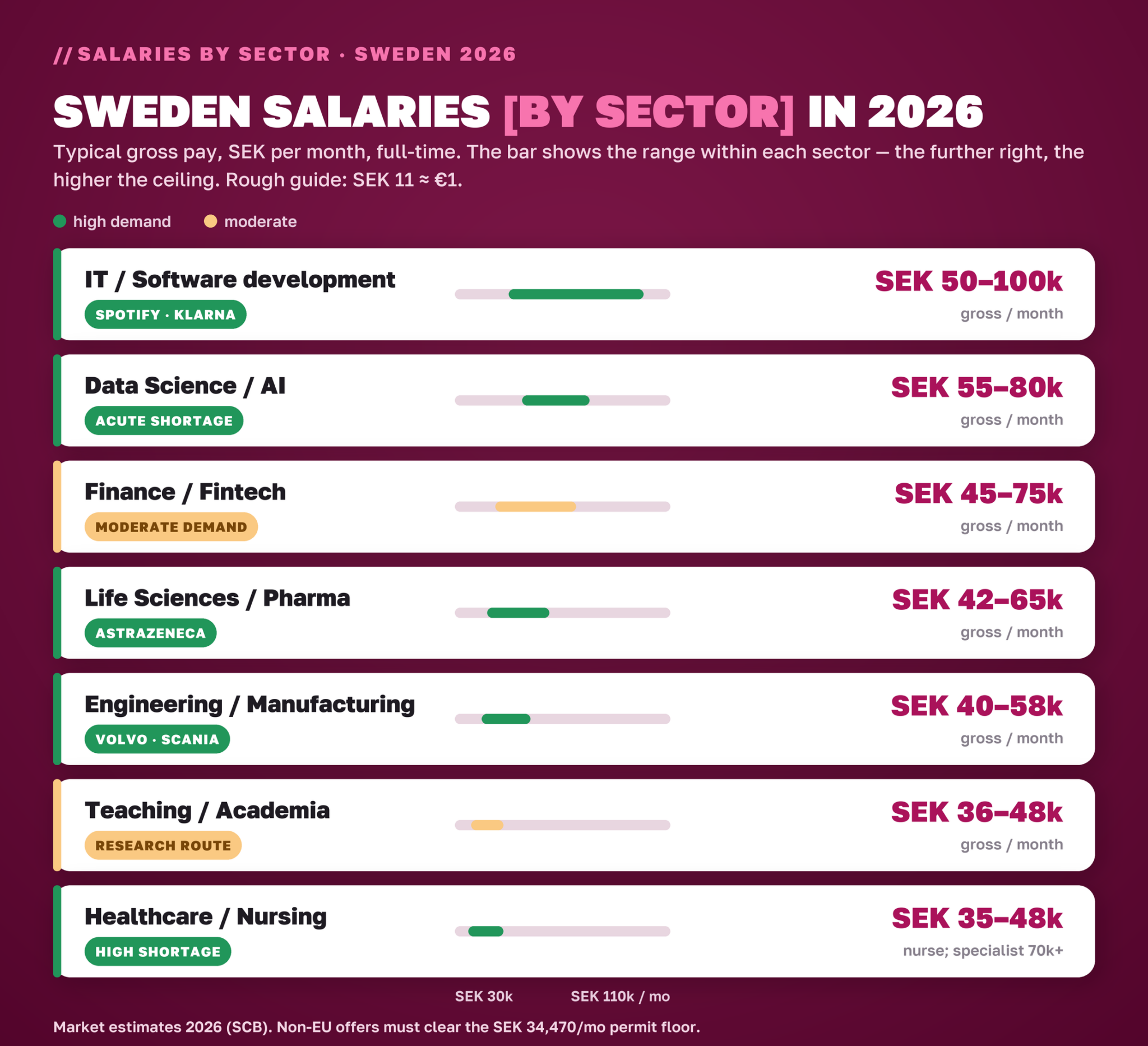
Sweden hires foreign talent where it has genuine shortages. For non-EU nationals the offer must also clear the work-permit salary floor and match collective-agreement terms. These are the sectors where that lines up, with typical gross monthly pay.
| Sector | Monthly salary (SEK gross) | Cities | Odds for non-EU candidates |
| IT / Software development | Mid 50,000–70,000 · Senior 75,000–100,000 | Stockholm, Gothenburg, Malmö | High. Google (Stockholm), Spotify, Klarna, Ericsson and King all hire internationally |
| Data Science / AI | 55,000–80,000 | Stockholm, Lund | High. Acute shortage |
| Engineering / Manufacturing | 40,000–58,000 | Gothenburg, Västerås, Södertälje | High. Volvo, Scania and ABB recruit abroad |
| Life Sciences / Pharma | 42,000–65,000 | Stockholm, Uppsala, Lund | High. AstraZeneca, English-speaking teams |
| Finance / Fintech | 45,000–75,000 | Stockholm | Moderate. Strong fintech scene (Klarna, Trustly) |
| Healthcare / Nursing | Nurse 35,000–45,000 · Specialist physician 70,000–100,000+ | Nationwide | High shortage, but your qualification must be recognised by Socialstyrelsen |
| Teaching / Academia | 36,000–48,000 · Senior researcher higher | University cities | Moderate. Postdoc and research roles are the usual route |
A real example. A senior software engineer in Stockholm earns around SEK 70,000–90,000 a month. The same role in Gothenburg or Malmö tends to pay 5–10% less, but rent there is markedly cheaper, so the net result is often better outside the capital.
Watch the total package, not just the salary. Outside tech, Swedish employers rarely pay large bonuses (the international tech names add equity and bonuses on top). The base is statutory: 25 days of holiday under semesterlagen, and parental leave paid through social insurance. The collective agreement adds the occupational pension (tjänstepension), and many employers volunteer a wellness allowance (friskvårdsbidrag), a tax-favoured perk required by neither law nor agreement. Confirm the pension and holiday terms in writing.
Find out your chances of relocating
Our career consultant will assess your profile and help you build a strategy for the Swedish market
Find your consultant 🚀
Salaries by Region: Stockholm, Gothenburg and Malmö
SCB publishes whole-economy pay by greater region (riksområde) rather than by county. Stockholm’s premium is real; the rest of the country sits within a few percent of the national line. Average monthly salary, all sectors, 2025 (SCB):
| Region (main city) | Average (SEK/month) |
|---|---|
| Stockholm | 48,300 |
| Västsverige (Gothenburg) | 42,300 |
| Sydsverige (Malmö) | 41,700 |
| Östra Mellansverige (Uppsala) | 40,500 |
| Sweden overall | 42,900 |
Stockholm pays about 13% above the national average, and central-Stockholm rents claim most of that premium. Gothenburg and Malmö sit near the national line with far gentler housing costs.
Is Your Offer Good? The Swedish Pay Ladder
Swedish pay is famously compressed, which makes percentiles the honest yardstick for an offer. National monthly salary distribution, all sectors, 2025 (SCB):
| Percentile | SEK/month gross | What it means |
|---|---|---|
| P10 | 28,000 | One in ten earns less |
| P25 | 32,000 | A quarter earn less |
| Median | 38,300 | The middle of the market |
| P75 | 48,000 | Beats three in four employees |
| P90 | 61,700 | Top 10% of the country |
An offer above SEK 48,000 a month out-earns three in four Swedish employees; above SEK 61,700 you are in the top tenth. Use those two lines, not the average, when you judge a package.
Where to Look for Work: Official Resources
- Platsbanken: the state job board run by Arbetsförmedlingen, the Swedish Public Employment Service
- LinkedIn Jobs: one of the main channels for English-language and international roles
- The Hub: startup and scale-up jobs across the Nordics
- Academic Work: strong for early-career and graduate roles
- Blocket Jobb: a large general job board
Official sources worth using to verify any figure:
- Statistics Sweden (SCB): official salary statistics by occupation
- Swedish Migration Agency (Migrationsverket): work permits, the salary threshold and the procedure
- Swedish Tax Agency (Skatteverket): tax tables and a take-home calculator

The Other Side: What Living Here Actually Costs
Now we subtract. Here is the structure of unavoidable costs for a single person in Stockholm.
Rent, and the housing queue you cannot skip
- First-hand, central 1-bedroom: SEK 8,000–12,000. Regulated and cheaper, but behind a housing queue (bostadskö) with a multi-year wait.
- Sublet (andrahand), central 1-bedroom: SEK 14,000–18,000. What most newcomers actually pay: second-hand rents run 30–50% above first-hand.
- Outer districts (Skärholmen, Farsta, Järva): roughly 20–30% cheaper.
- Gothenburg and Malmö: roughly 20–30% cheaper than Stockholm
What you need to know: a first-hand contract (förstahandskontrakt) is allocated through the municipal housing queue (bostadskö), and the wait in Stockholm runs into years. Most newcomers start with a sublet (andrahand), which is legal but more expensive and less secure. Budget for the sublet reality, not the queue price.
Tax, the deduction that defines your net pay
Unlike Switzerland, Sweden funds most of your safety net through income tax rather than separate insurance premiums. Healthcare is tax-funded, so there is no compulsory private health insurance to pay.
- Municipal tax: about 29–35% depending on your kommun, averaging near 32%. This is the main deduction. A basic allowance and an earned-income credit soften it, so the effective rate on a normal salary is lower than the headline.
- State tax: an extra 20%, but only on income above about SEK 55,000/month.
- Employer social fees: about 31.4% on top of your gross. Your employer pays these, so they do not appear on your payslip.
Practical tip: use the Skatteverket calculator to see your exact net, because the municipal rate varies by where you live. Two identical salaries can differ by hundreds of kronor a month across kommuner.
Everything else you have to pay
- Groceries: SEK 3,500–5,000/month (ICA, Coop, Willys). Lidl is noticeably cheaper.
- Public transport: the SL monthly pass in Stockholm is about SEK 1,020.
- Internet and phone: SEK 400–600/month.
- Lunch out: SEK 110–160. The dagens lunch, the daily set menu, is the value option.
The Arithmetic: What Actually Lands in Your Account
Let’s put it together. Take a realistic scenario: a mid-level professional in Stockholm on SEK 45,000 a month (single, no children). We use a rough 30% effective tax rate. Your exact figure depends on your kommun and tax credits.
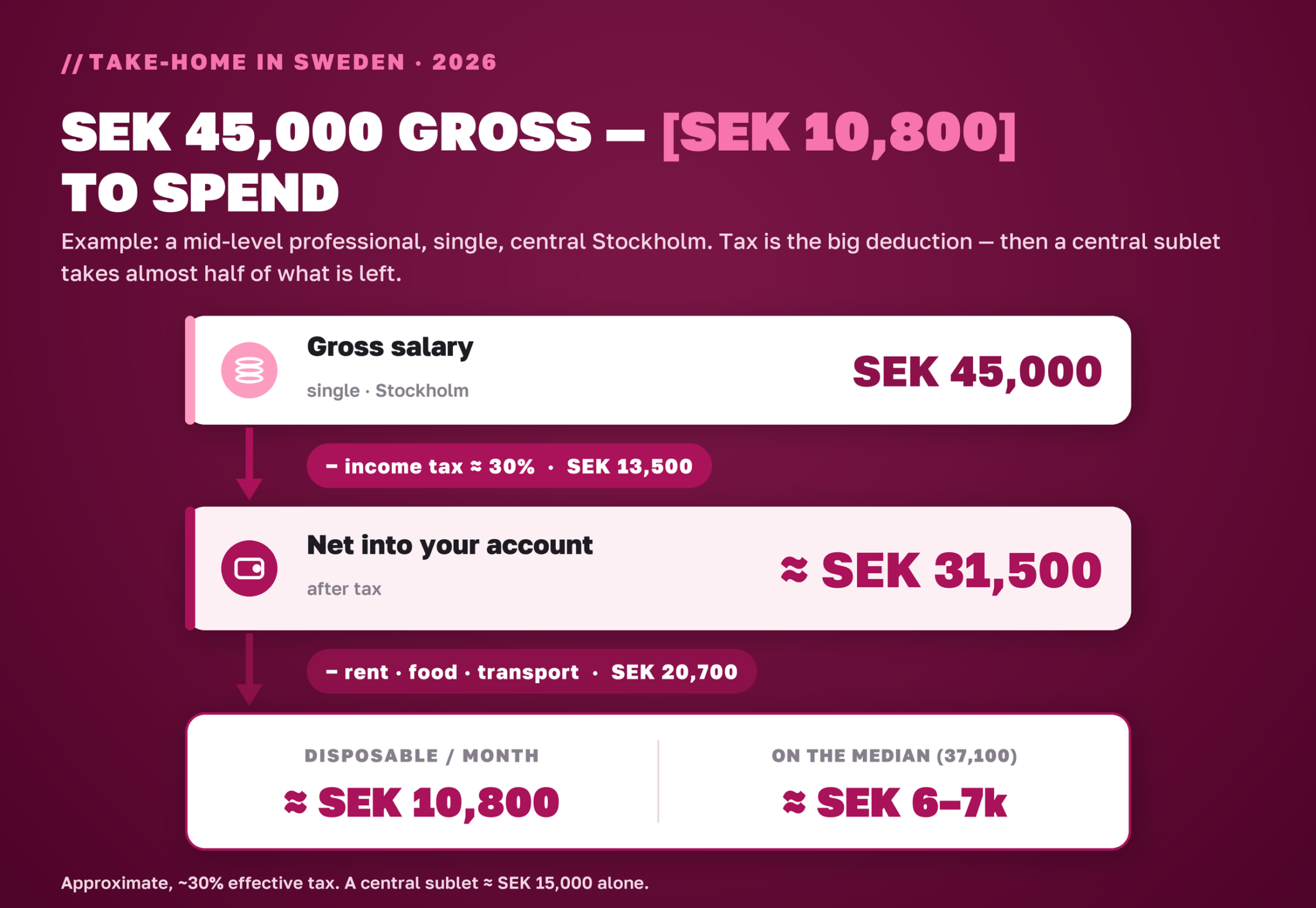
About SEK 11,000 a month of disposable income on a SEK 45,000 salary is still a solid result, and better than the same maths in Zurich. But note where it goes: a central sublet takes almost half of your net pay.
And on the median salary? On SEK 38,300 a month (net around SEK 28,000), a central sublet plus essentials leaves roughly SEK 7,000–8,000. Liveable, but tight in central Stockholm. This is why many professionals choose an outer district or Gothenburg, where the same salary stretches much further.
Subscribe to EP Advisory’s newsletter for the best insights sent straight to your inbox.
By subscribing you agree to our Privacy Policy
We take on a limited number of clients each month for Job Offer Guarantee. If you’re serious about making a change, let’s talk.
Book Your Career Discovery CallThe Work Permit: What Non-EU Candidates Need
Sweden runs no annual quota, which makes it more open than Switzerland. The gate is the salary, not a headcount limit.
- Salary floor: SEK 34,470/month from 16 June 2026, around 90% of the median. Your offer must meet or beat it. A reduced floor of SEK 28,725 (75%) applies to certain shortage occupations.
- Collective-agreement terms: your pay, insurance and holiday must match the relevant collective agreement or industry standard.
- Employer-driven: the employer advertises the role in the EU/EEA for at least 10 days, then applies on your behalf.
- Timeline: processing varies, from a few weeks for certified employers to several months otherwise.
A practical detail: the floor rose in June 2026 and is tied to the median, so it will keep climbing. A role that paid enough two years ago may no longer qualify. Always check the current figure on the Migrationsverket site before you rely on an offer.
Related reading: How to find a job in Sweden as a foreigner (2026 guide) · Work visa & Blue Card salary thresholds in Europe 2026 · UK salaries in 2026: what you take home · Salaries in Finland
Key Takeaways
- Anchor on the median, about SEK 38,300/month. In Sweden the average is only around 12% higher, because pay is compressed.
- Tax, not insurance, is the big deduction. Expect to keep roughly SEK 28,000 of a median salary after tax.
- There is no minimum wage. Collective agreements set the floor and covered 88% of employees in 2025, so check the agreement for your sector.
- Real openings for non-EU candidates: IT, data science, engineering, life sciences and healthcare.
- Housing is the catch. First-hand contracts sit behind a multi-year queue, so budget for a sublet in Stockholm.
- The work-permit salary floor is SEK 34,470/month from June 2026 and tied to the median, so it keeps rising. A 75% floor (SEK 28,725) applies to some shortage jobs. Verify the current figure before relying on an offer.
- Your kommun and city change the maths. Gothenburg and Malmö stretch the same salary much further than central Stockholm.
If you’d like a personalised assessment of your chances, help tailoring your CV to the Swedish market and interview preparation, find your career consultant.
Frequently Asked Questions
What is the average salary in Sweden in 2026?
About SEK 42,900 per month gross on Statistics Sweden’s whole-economy series (2025 count), roughly €3,800. The median is SEK 38,300, and after tax someone on the median keeps about SEK 28,000 a month.
What is a good salary in Sweden?
Above SEK 48,000 a month gross beats three in four Swedish employees (the 75th percentile); above SEK 61,700 you are in the top 10%. In Stockholm aim higher: the regional average is SEK 48,300.
Does Sweden have a minimum wage?
No. Sweden has no statutory minimum wage; collective agreements set pay floors sector by sector. For non-EU hires the work-permit salary floor is SEK 34,470 per month from June 2026, with a 75% level for some shortage roles.
What is the average salary in Stockholm?
SEK 48,300 per month gross on SCB’s regional series (2025), about 13% above the national average. Gothenburg’s wider region averages SEK 42,300 and Malmö’s SEK 41,700.