 By Andre Atallah, CEO of EP Advisory
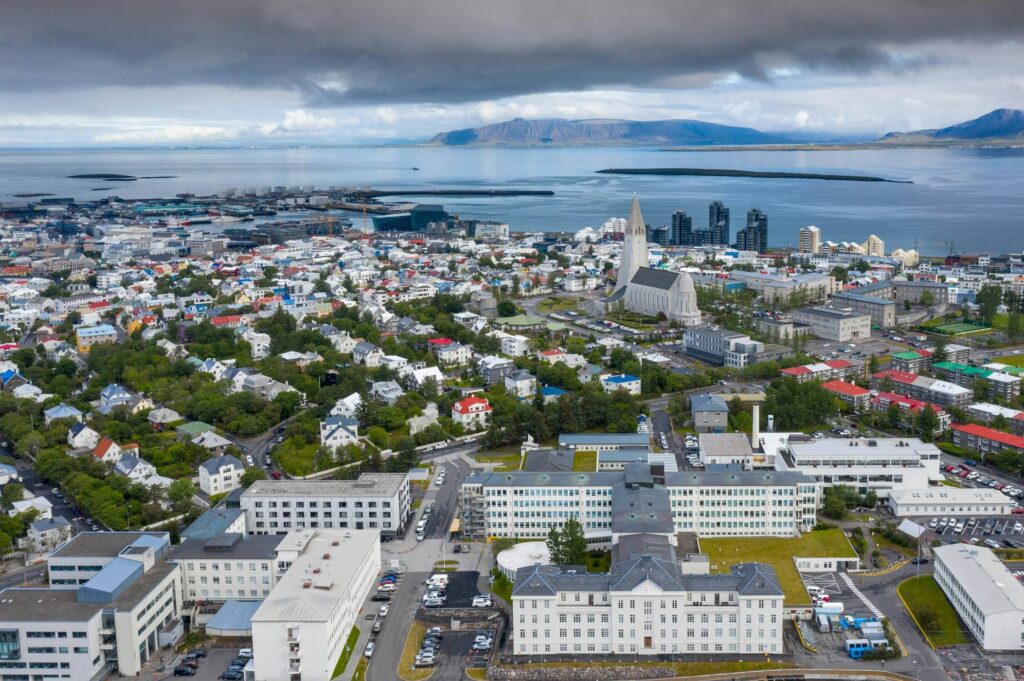
Short answer: yes, foreigners work in Iceland in large numbers, and the rules depend on your passport. EEA, EFTA, Swiss and Faroese citizens need no permit and can take any job. Everyone else needs an employer who files a work permit for one named job, and that permit is mostly for experts or genuine shortages. Pay for every job is set by a collective agreement, from about ISK 476,000 a month.
Iceland is small, and a large share of its workforce comes from abroad. Of 396,500 residents in mid-2026, 71,130 were foreign citizens, or 17.9% (Statistics Iceland). Tourism alone made up 9.5% of all hours worked in 2025 (tourism accounts). Fish processing, hotels, health care and building sites all rely on people who moved there for work.
The market is tighter than it was a year ago. Registered unemployment was 4.0% in September 2026 (Directorate of Labour), and employers had 3,540 vacancies in the second quarter, 1,870 fewer than a year before (job vacancy survey). So timing your search to the seasons, and knowing which permit your job fits, matters more in 2026. This guide covers both, plus pay, language and where Icelandic employers post jobs.
For nearly 10 years, we’ve helped more than 5,000 professionals find jobs abroad. Want to know if your CV will pass screening in Iceland? Check your CV for free: a score in 30 seconds, then a fix for each problem.
Your passport decides almost everything in Iceland
EEA, EFTA, Swiss and Faroese citizens need no work permit in Iceland. You can take any job with any employer and change jobs freely. If you stay longer than 3 months, you register with Registers Iceland, which can take up to 10 working days (registration of EEA nationals). You also need a kennitala, the 10-digit ID number used for pay, tax, banking and phone contracts. EEA citizens request it in person at Registers Iceland (kennitala for immigrants).
Everyone else needs a work permit before the first day of work. That includes citizens of the UK, the US, Canada, India, the Philippines and every other country outside the EEA. The employer applies, not you, and the permit names one employer and one job (work permit rules). Working before the permit is granted can bring fines, or up to 2 years in prison, for both the worker and the employer. This also covers tour guides and other tourism staff.
One change in 2026 matters for anyone reading older guides. Since 8 July 2026, the Directorate of Immigration (Útlendingastofnun) processes and issues work permits. The Directorate of Labour no longer does (Directorate of Immigration). Many sites still send readers to the old office, so check the address before your employer files anything.
Non-EEA permits are built for experts and real shortages
Iceland does not run a points system, a job-seeker visa or a general work visa. If you want to search on the ground first, our guide to job seeker visas in Europe lists the countries that allow it. The permit follows the job, and the job has to fit one of a few categories. For most readers outside the EEA, two of them matter.
| Permit | Who it fits | First grant | If the job ends |
|---|---|---|---|
| Expert knowledge | Jobs that need university-level education, or industrial, artistic or technical training recognised in Iceland | Usually 1 year, up to 4 years | 12-month job-search permit |
| Shortage of labour | Temporary gaps the employer cannot fill from Iceland or the EEA, such as one season | Up to 1 year; renewals up to 2 years | 6-month job-search permit |
| Working holiday | Citizens of Andorra, Canada, Chile, Japan and the UK | Set by each country’s agreement | See the permit conditions |
| Family reunification | Spouses, partners and children of permit holders | Linked to the main permit | Linked to the main permit |
| EEA, EFTA, Swiss, Faroese | Any job | No permit needed | Look for work freely |
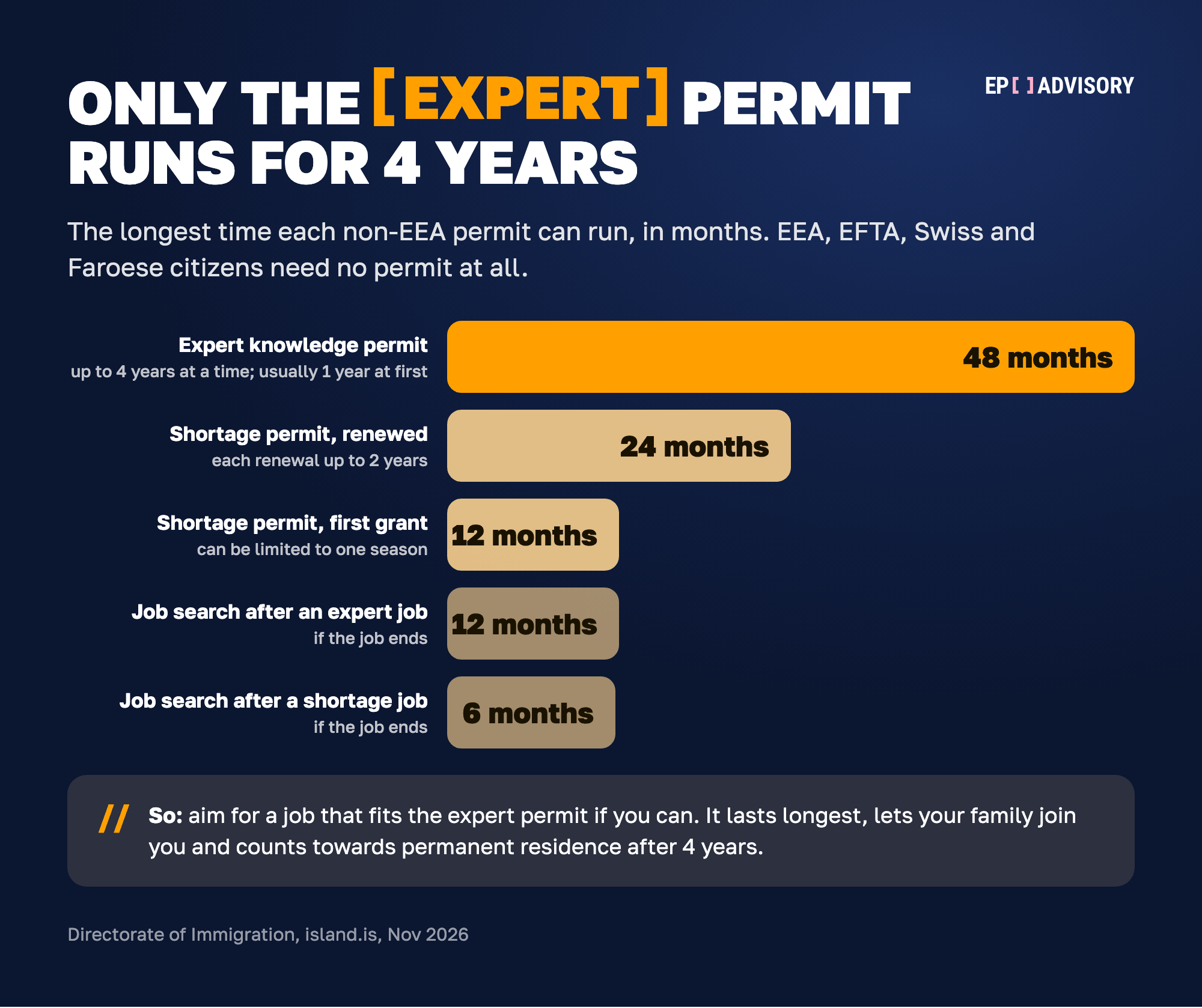
The expert permit is the realistic choice for most professionals. The contract must be for a job that needs expertise, and that expertise must be essential to the company. Before the permit is granted, the employer must ask the Directorate of Labour for help finding someone in Iceland, the EEA or the Faroes (expert permit). A government regulation lists specialist jobs in temporary shortage, which makes that test easier. The expert permit also lets you bring your family, and it counts towards permanent residence. If you lose the job, you get 12 months to find another.
The shortage permit is narrow by design. It is granted only in exceptional cases, for temporary swings in demand, and the employer must explain in detail why it cannot hire locally (shortage permit). The Directorate may also ask for the job to be advertised through the Directorate of Labour and EURES, preferably for at least 3 weeks. The permit can be limited to one season, such as the slaughter season. If you need a visa to enter Iceland, you wait outside the country while it is processed.
Working holiday permits cost ISK 40,000 and are free for Japanese citizens (working holiday permit). If you hold one of those five passports, read the conditions for your country before you plan a season.
Some jobs need a licence on top of the permit. Health professionals need one from the Directorate of Health. Craft trades, such as electricians and carpenters, first get their papers recognised through ENIC/NARIC Iceland, then a licence from the District Commissioner of East Iceland for ISK 2,700 (craft licence). Start this early, because the employer files the permit with the licence in hand.
Score your CV in 30 seconds, then fix its biggest problems one by one. Both free.
Free, no card. A free account unlocks every fix.

From offer to residence card, every step has a deadline
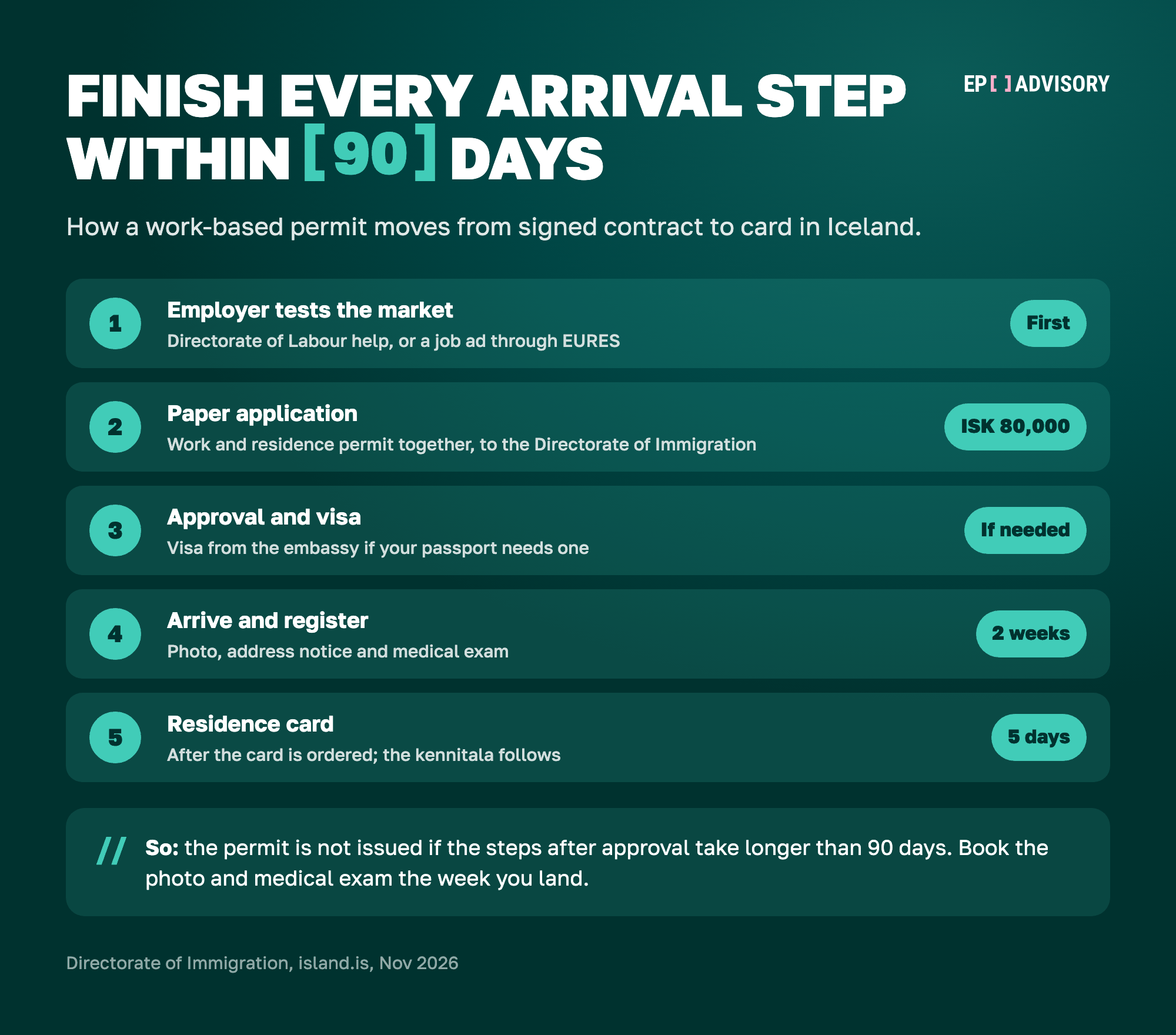
The employer and you file together. The work permit and the residence permit go to the Directorate of Immigration as one paper application, and the fee is ISK 80,000, about €585 (permit based on work). Expedited processing is no longer offered. Current waiting times are on the Directorate’s waiting-time page, so check it on the day you sign.
- Employer tests the local market. For an expert job, it asks the Directorate of Labour for help. For a shortage job, it advertises in Iceland and through EURES.
- You sign a contract on agreement pay. The pay must meet the collective agreement for the job, or the terms are invalid.
- You prove the basics. You show at least ISK 259,951 a month gross, which your salary covers. You also need private health insurance for the first 3 months with at least ISK 2,000,000 of cover, and a clean criminal record (requirements).
- The paper application goes in. Experts may stay in Iceland while it is processed if their stay is legal. Shortage applicants who need a visa wait abroad.
- Approval, then arrival. If you need a visa, you request it from the embassy. Within 2 weeks of arrival you book a photo, notify your address and take a medical exam (after approval).
- Card and kennitala. The residence card is ready 5 days after it is ordered, and Registers Iceland issues your kennitala.
All steps after approval must be done within 90 days, or the permit is not issued. Put the dates in your calendar the day the approval arrives. If you plan to renew, file 4 weeks before the permit ends.
Longer term, the expert permit counts towards permanent residence, which is generally possible after 4 years. You need 150 lessons of Icelandic with at least 85% attendance, or a passed test, and the fee is ISK 60,000 (permanent residence). Being away for more than 3 months in a row can put your permit at risk, so plan long trips home with care (permit rights).
Plan your search around tourism and fishing seasons
Iceland’s labour demand swings with two calendars: visitors and fish. Employers hire ahead of each peak, so your search should start a few months before.
Tourism peaks from June to August. Foreign passenger departures reached 314,000 in August 2026, against 119,000 in January (Icelandic Tourist Board). July had 293,000 and June 223,000. Hotels, restaurants and tour operators hire ahead of that rush. Accommodation alone made up 3.2% of all hours worked in 2025.
Fish landings peak from late winter into spring, and again in autumn. The capelin season drove February’s catch to 137,000 tonnes in 2026, with 86,000 tonnes of capelin (fish catch, February). June was the quietest month at about 32,000 tonnes. By September, pelagic fish lifted the catch back to 102,000 tonnes (fish catch, September). Processing plants in coastal towns hire around those landings.
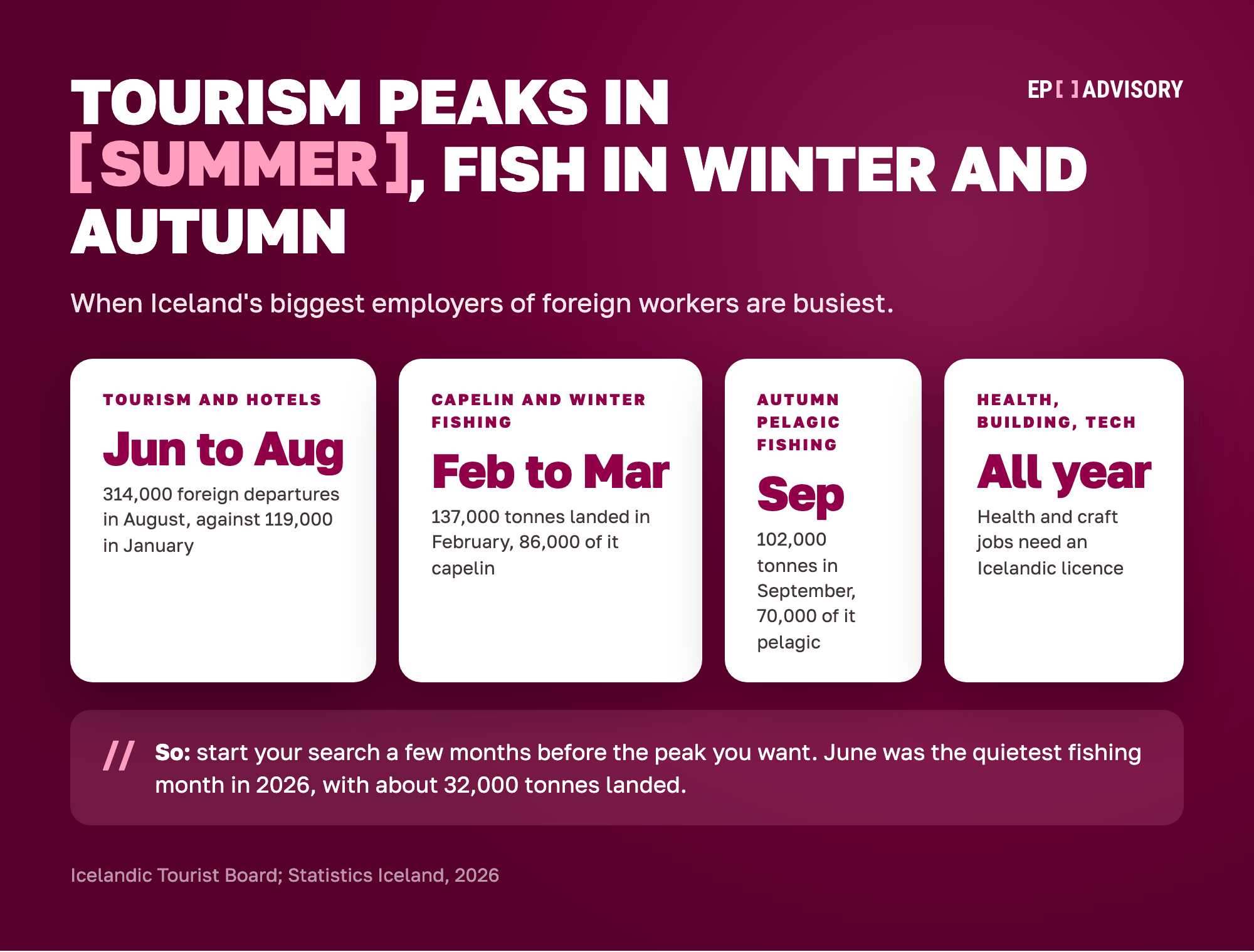
Health care, construction and tech hire all year. Hospitals and care homes recruit nurses and doctors who can get an Icelandic licence. Building firms need licensed trades. Software, engineering and data roles in Reykjavik are the ones most likely to qualify for an expert permit.
One legal point affects seasonal plans. Icelandic law has no legal definition of a seasonal employee (EURES Iceland). A summer job is an ordinary contract with full agreement rights, including holiday pay. For non-EEA citizens, a seasonal job still needs a shortage permit, and that is hard to get for roles EEA workers fill each year.
Collective agreements set your pay floor, and it is high
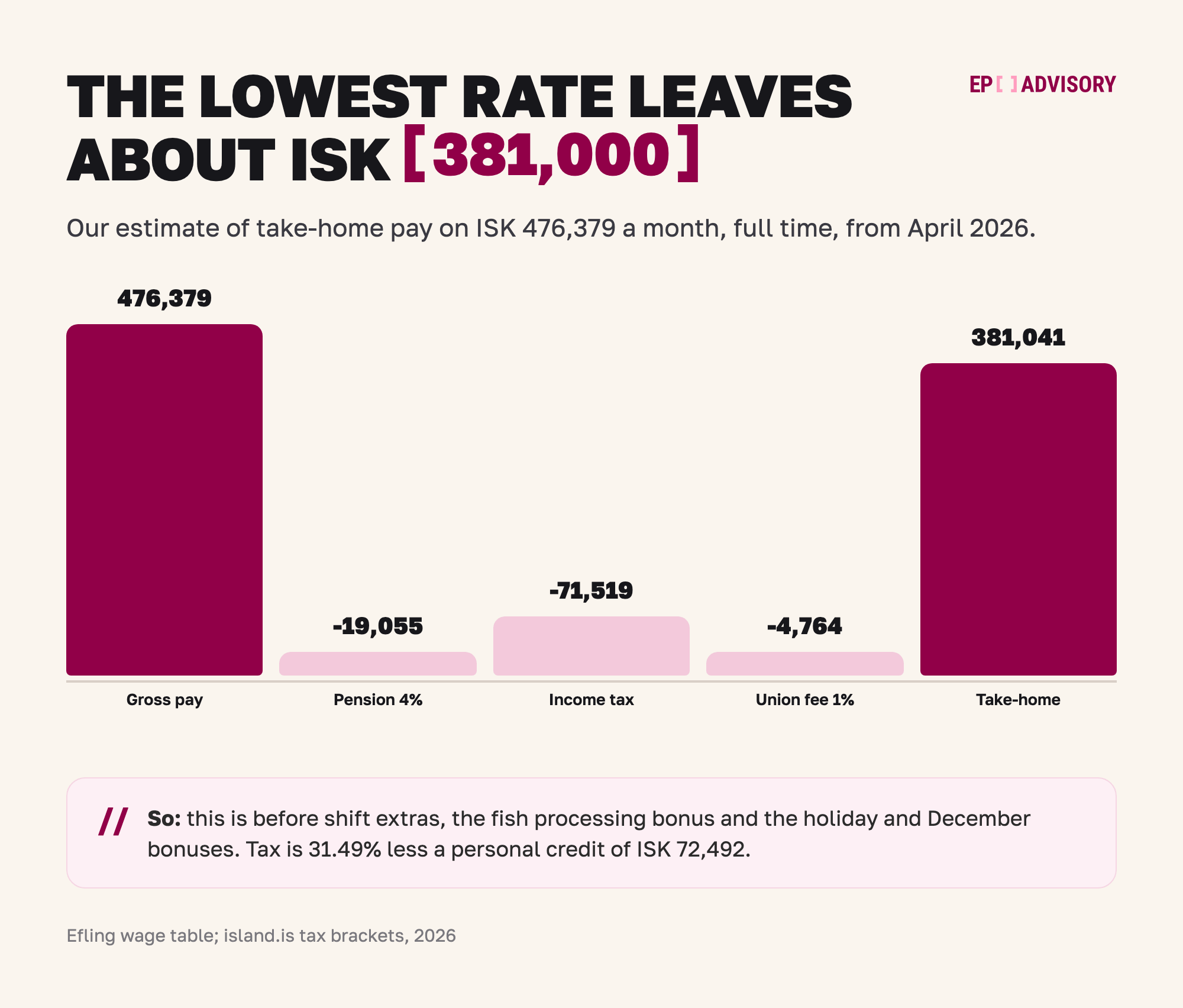
Iceland has no statutory minimum wage, but no one may be paid below the collective agreement. Any contract term below it is invalid (collective agreements). The agreements set the minimum pay for each job and add a holiday bonus and a December bonus. Employees pay at least 4% into a pension, and the union fee is commonly 1% (salary basics).
Efling, the largest general union in the capital region, publishes the rates most entry-level foreign workers are paid on. These are monthly minimums for full-time work from April 2026.
| Job (Efling band) | Monthly minimum | In euros |
|---|---|---|
| Lowest band (4), general work | ISK 476,379 | about €3,482 |
| General fish processing (5) | ISK 479,142 | about €3,503 |
| General restaurant staff (6) | ISK 481,921 | about €3,523 |
| Fish technician (13) | ISK 501,831 | about €3,668 |
The rates come from Efling’s general wage table and its hotels and restaurants table. Euro figures use the ECB rate of ISK 136.80 to €1 on 4 November 2026.
Extras add a lot on top. Fish processing workers get a bonus of at least ISK 352.38 per paid hour. In restaurants, evening hours pay 33% more, and nights and weekends 45% to 55% more. The 2026 holiday bonus is ISK 62,000 and the December bonus ISK 114,000. Efling’s wage calculator lets you check a payslip line by line.
Tax takes 31.49% of monthly income up to ISK 498,122, then 37.99%, and 46.29% above ISK 1,398,450. A personal tax credit of ISK 72,492 a month comes off the bill (tax brackets 2026). On the lowest band, that leaves about ISK 381,000 a month after tax, pension and union fee, by our estimate.
Professional pay sits well above those floors. Median total income was about ISK 730,000 a month in 2025 (income statistics). Use the agreement rate as your floor, not your target, when you negotiate salary for a skilled role.
Living costs eat a large part of that pay. Iceland had one of the highest household price levels in Europe in 2024: 172.7 against an EU average of 100. Denmark was at 142.8 and Norway at 134.1 (Eurostat price levels). Food was 43.9% above the EU average and housing 64%. Rent in the capital region is the biggest cost, so ask early whether the employer helps with housing, and get any housing deal in writing.
Next: compare these rates with what similar roles pay elsewhere in the Nordics in our guide to salaries in Norway.
English gets you hired in some sectors, Icelandic keeps you there
Most Icelandic employers advertise in Icelandic. Ads posted through EURES also come with an English version. In tourism, tech, research and many hotels, English is the working language with guests and colleagues.
Health care, schools, public offices and customer-facing jobs outside tourism usually expect Icelandic. Even where English works, a few words of Icelandic in an interview show you plan to stay. The language is also a legal step later on, since permanent residence needs 150 lessons or a passed test.
The Multicultural Information Centre lists Icelandic courses and services for newcomers in several languages. Put your Icelandic level on your CV, even if it is “beginner, in a course”. If your CV was written for another market, adapt it to a European format before you send it to Iceland. Getting ready to apply for jobs in Iceland? Check your CV for free: see it the way a recruiter does, then fix each problem.
Search where Icelandic employers actually post
Iceland’s job market runs on a handful of local boards. Most ads are short and in Icelandic, so use a browser translator and search in both languages. Icelandic employers expect a CV plus a cover letter, and many use their own online forms.
| Where | Best for | Language of most ads |
|---|---|---|
| Alfreð | The widest range of private jobs, including seasonal tourism | Icelandic, some English |
| Starfatorg | Public sector jobs, including hospitals | Icelandic |
| EURES Iceland | Jobs open to EEA candidates, with English versions | Icelandic and English |
| Directorate of Labour jobs | Vacancies employers register with the state | Icelandic, some English |
| storf.is, mbl.is/atvinna, job.is | Private sector and trade jobs | Icelandic |
| Tech, engineering and international firms in Reykjavik | English |
For jobs in Reykjavik, about 253,000 of Iceland’s 396,500 residents live in the capital region, so most office, tech and health roles are there. Fish processing jobs sit in coastal towns, and many tourism jobs are in the south and in remote hotels. Write directly to firms too: a short email in English with your CV can work in a market this small. Our guide to cover letters for jobs abroad shows how to explain why you want Iceland in two lines.
If you are comparing Nordic options, read our guides to jobs in Norway, jobs in Sweden and jobs in Denmark. Each has its own permit rules and pay floors. For a wider plan, our guide on how to find a job in Europe covers the steps that apply everywhere, and how to pass a job interview helps once calls start.
Spot a fake Iceland job offer before you pay anything
The state fee is ISK 80,000, and the employer files the application. Anyone who asks you for a large “visa fee”, a “placement fee” or a deposit to hold a job is not following Iceland’s process. Watch for these signs:
- An “EU Blue Card for Iceland”. Iceland is not in the EU and has no Blue Card. Offers that mention one were copied from another country’s page.
- Pay below the agreement rate. A contract at ISK 300,000 a month for full-time work breaks the collective agreement. A union such as Efling can help you check an offer against the agreement.
- “Start now, the permit comes later”. Working before the permit is granted is illegal for you and the employer.
- An employer you cannot find. Every Icelandic company is in the company register. Search the name and its ID number before you sign.
- Old office names. Since 8 July 2026 the Directorate of Immigration handles work permits. An offer that sends you elsewhere to pay is a warning sign.
Some jobs in remote towns and hotels come with housing. That can be fine, but the rent should be in writing and taken from your pay only as agreed.
Key takeaways
- EEA, EFTA, Swiss and Faroese citizens can take any job in Iceland without a permit.
- Non-EEA citizens need an employer to file a work permit for one named job, mostly as an expert or for a real shortage.
- The Directorate of Immigration has handled work permits since 8 July 2026, and the fee is ISK 80,000.
- After approval, every arrival step must be done within 90 days.
- Tourism hires for June to August, and fish landings peak from February to April and again in autumn.
- Collective agreements set pay from about ISK 476,000 a month, and lower pay is invalid.
- Living costs are among the highest in Europe, so check housing before you accept.
See what a recruiter sees, then fix it before you apply. An instant score, then the fix for every problem.
Free, no card. A free account unlocks every fix.
Frequently asked questions
Can foreigners get a job in Iceland in 2026?
Yes. EEA, EFTA, Swiss and Faroese citizens can take any job without a permit. Citizens of other countries need an employer to file a work permit for a named job, usually as an expert or for a labour shortage. Since 8 July 2026, the Directorate of Immigration processes these permits.
Can I get a job in Iceland with visa sponsorship?
Yes, if the job fits a permit category. The employer files the work permit and residence permit together, for a fee of ISK 80,000. Most sponsored hires are expert permits for roles that need a degree or recognised training. Shortage permits exist but are granted only in exceptional cases.
Are there unskilled jobs in Iceland for foreigners?
Yes, in tourism, fish processing, cleaning and construction labour. Most go to EEA citizens, who need no permit. For non-EEA citizens, an unskilled job needs a shortage permit, which is rare and often limited to one season. Pay starts at about ISK 476,000 a month under the Efling agreement.
Can I find jobs in Reykjavik without speaking Icelandic?
Yes, in tech, tourism, hotels, research and some international firms, where English is the working language. Health care, schools and public jobs usually expect Icelandic. About 253,000 of Iceland’s 396,500 residents live in the capital region, so most office and tech roles are there.
How much does a work permit cost in Iceland?
The residence permit based on work costs ISK 80,000, about €585, and is filed on paper with the work permit. Expedited processing is no longer offered. You also need private health insurance for the first 3 months, with at least ISK 2,000,000 of cover.
What is the minimum wage in Iceland?
Iceland has no statutory minimum wage. Collective agreements set the minimum for each job, and lower pay is invalid. Under the Efling agreement from April 2026, the lowest band pays ISK 476,379 a month, and general fish processing pays ISK 479,142, plus bonuses.