 By Andre Atallah, CEO of EP Advisory

Short answer: yes. An American lawyer can work in London without requalifying, as long as the work is advice on US law or other unreserved work. You mainly need to register with the Solicitors Regulation Authority (SRA) if you want to be a partner or owner of an SRA-regulated law firm. To call yourself a solicitor, you pass the SQE1 exam (£2,006) and either pass SQE2 (£3,086) or win an exemption. Qualified lawyers skip the 2-year work experience rule.
This guide is for American attorneys, and US law graduates, who want to practise in London. Maybe your firm has a London office. Maybe you want to move for a partner, or for the deal work. Either way, you can do it, and many US lawyers already do.
You get the three ways to work here and what each one allows, the real SQE route for a US attorney with 2026/27 fees, the firms and practice areas that hire Americans, London pay against US pay, and the visas lawyers use. Dollar figures are at ECB rates of 2 November 2026 (£1 = $1.3419).
For nearly 10 years, we’ve helped more than 5,000 professionals find jobs abroad. Want to know if your CV will pass screening in the UK? Check your CV for free: a score in 30 seconds, then a fix for each problem.
Can an American lawyer work in London? Yes, often without requalifying
Your US licence already lets you do most of what London clients hire an American for.
England and Wales does not license “the practice of law” as a whole, the way US states do. It protects six named tasks, called reserved legal activities, and the title “solicitor”. A few other laws cover specific work, such as immigration advice. Most other legal work is open. That includes advice on New York or Delaware law, drafting and negotiating US-law contracts, and advising on SEC rules for a bond deal run from London.
So the first question is not “do I need to requalify?”. It is “which work do I want to do?”. If your London job is US capital markets, US private equity or US regulatory advice, your US bar admission is the qualification that matters. If you want to run English court cases or sign off a property transfer, you need to qualify here.
Two terms you will meet straight away:
- Solicitor: the lawyer who advises clients, runs deals and handles most litigation. Most lawyers at London firms are solicitors. The SRA regulates them.
- Barrister: a specialist advocate who argues cases in the higher courts and gives expert opinions. Barristers are regulated by the Bar Standards Board (BSB). The US has no split like this.
In our experience, Americans do well in London because the market runs on US-style deals. Private equity, leveraged finance and international bonds are often documented under New York law. A London team needs someone who knows it.
Three ways to practise in London as a US attorney
Pick the option that matches the work, then add the next one only when you need it.
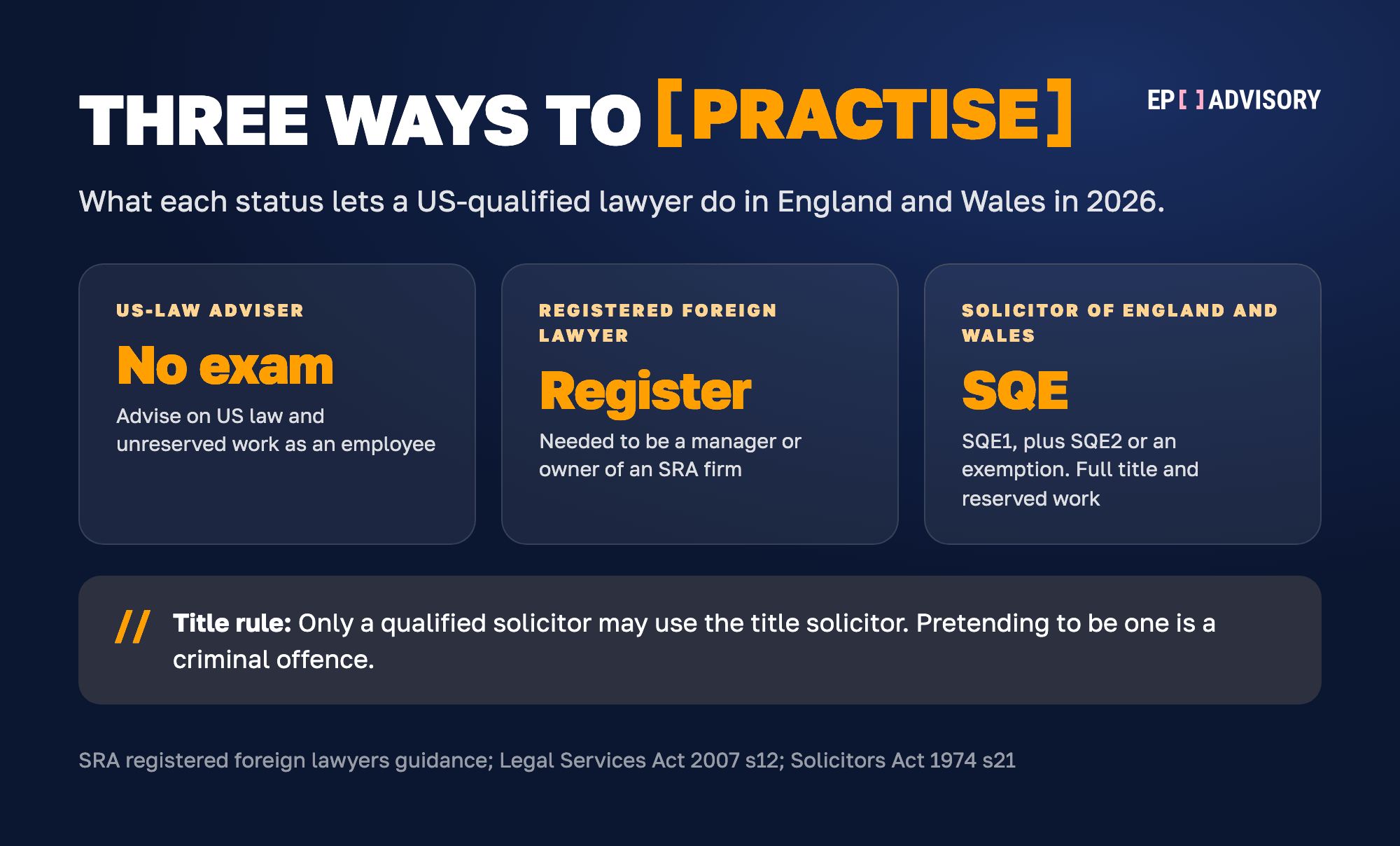
1. Work on US law as a foreign lawyer
This needs no exam and, in most cases, no registration. The SRA says a foreign lawyer who is not a manager or owner of a law firm, and does not do certain supervised work, does not need to register. A US associate employed in a London office, advising on US law, is the common case. Immigration work is the exception: it needs separate authorisation from the Immigration Advice Authority (IAA).
You still cannot call yourself a solicitor. Under section 21 of the Solicitors Act 1974, pretending to be one is a criminal offence. Use your real title: “Attorney admitted in New York”, or “US-qualified lawyer”.
2. Register as a registered foreign lawyer (RFL)
An RFL is a foreign lawyer on the SRA’s register. You must register if you want to be a manager or owner of an SRA-authorised law firm, for example a partner in a firm that also has English solicitors. This does not apply to a licensed body, a type of firm that can have non-lawyer owners. The SRA’s RFL guidance sets out what changes:
- You can: practise US law, advise on English law and do unreserved work the firm is allowed to do.
- Under supervision only: help with litigation and with reserved instrument work, under a person at your firm who is entitled to do that work, such as a solicitor.
- You cannot: practise as a sole practitioner or freelancer.
- Each year: renew by 31 October and pay a fee.
The SRA says it is reviewing this guidance after the Court of Appeal’s March 2026 decision in CILEX v Mazur, a case about who may conduct litigation under supervision. If your role touches English court work, ask your firm’s risk team how it applies today.
3. Qualify as a solicitor of England and Wales
This makes you dual-qualified. You can do the reserved work solicitors are authorised for, such as running litigation and reserved instrument work, use the title and become a full partner on equal terms. Notarial work and advocacy in the higher courts need extra qualifications. It takes an exam and some paperwork, but much less than it once did. The next section shows the route.
The six reserved legal activities
Section 12 of the Legal Services Act 2007 lists the reserved legal activities. These are the main tasks you need an English qualification (or supervision) for. A few other laws restrict specific work too, such as immigration advice:
| Reserved activity | What it means in practice |
|---|---|
| Rights of audience | Speaking for a client in court |
| Conduct of litigation | Formally starting and running court proceedings |
| Reserved instrument activities | Preparing certain documents, such as land registration transfers |
| Probate activities | Preparing papers to obtain a grant of probate |
| Notarial activities | The work of a notary public |
| Administration of oaths | Taking sworn statements |
Corporate, finance, funds and advisory work sit outside this list. That is why so many US transactional lawyers work in London on their US licence alone.
Score your CV in 30 seconds, then fix its biggest problems one by one. Both free.
Free, no card. A free account unlocks every fix.

How a US attorney qualifies as a solicitor: the SQE route
As a qualified lawyer, you skip the 2-year training period that English graduates must do.
The Solicitors Qualifying Examination (SQE) is now the route for qualified lawyers. The old Qualified Lawyers Transfer Scheme (QLTS) has closed, and the SRA’s old QLTS page now sends you to the SQE pages. Some websites still describe the QLTS. Ignore them.
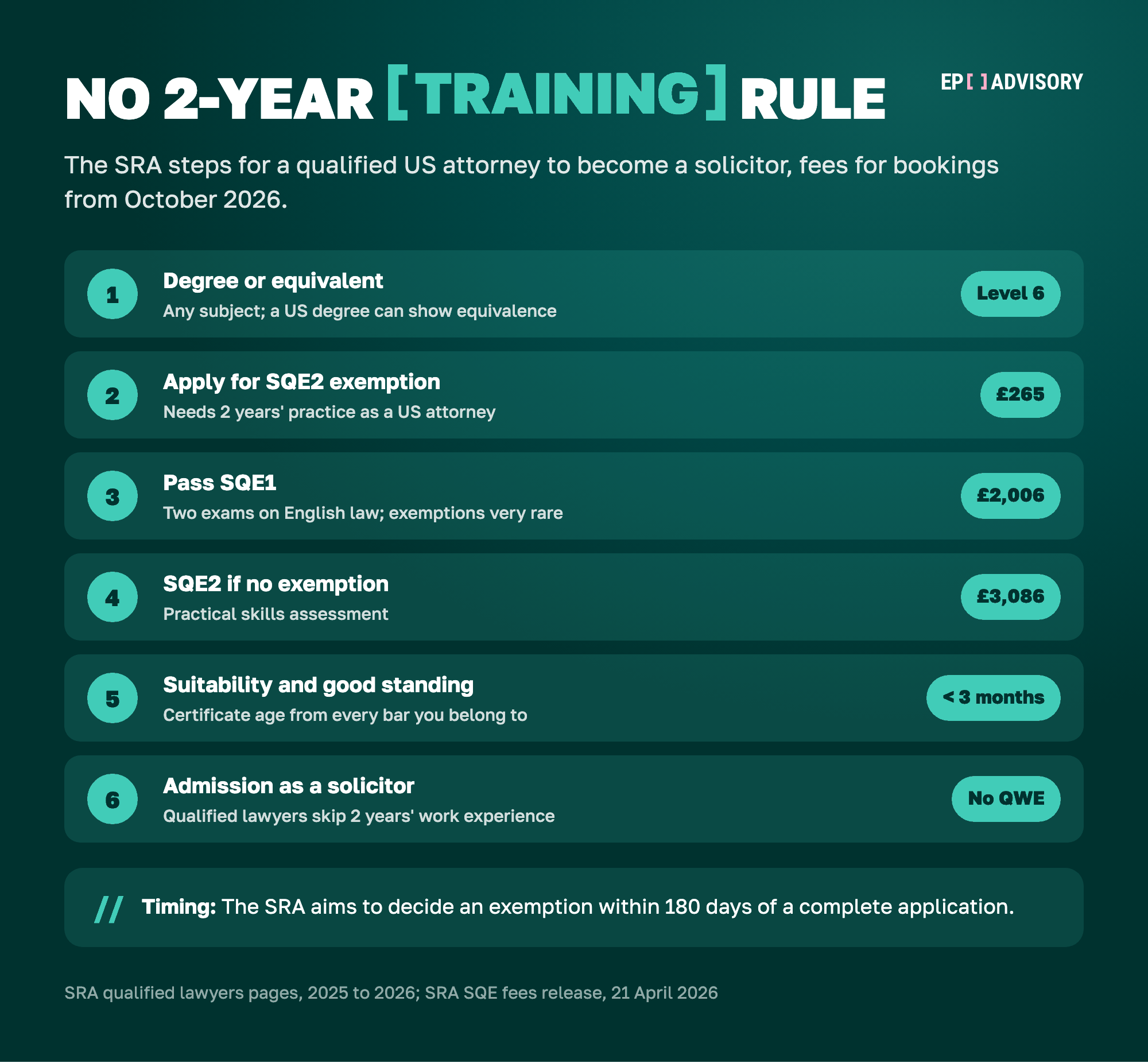
The SRA’s steps for qualified lawyers are:
- A degree or equivalent. A UK degree or an equivalent level 6 qualification, in any subject. You can show equivalence with an overseas degree, other qualifications or work experience.
- Pass SQE1. Two multiple-choice exams on English law, called Functioning Legal Knowledge 1 and 2. They cover areas such as contract, tort, property, wills, trusts and business law.
- Pass SQE2 or get an exemption. SQE2 tests practical skills such as advocacy, client interviewing, legal drafting and writing. US attorneys with 2 years of practice can apply to skip it (see below).
- Character and suitability. You pass a background check before admission. Tell the SRA early about anything in your record.
- Apply for admission. You upload a certificate of good standing from every bar you belong to. It must be less than 3 months old, and the SRA suggests no more than 2 months.
Qualified lawyers do not need the two years of qualifying work experience (QWE) that other SQE candidates must complete. Several guides still say you do. The SRA says you do not, once you add your professional title and qualification date to your mySRA account.
The SQE2 exemption for American attorneys
The SRA keeps a list of jurisdictions with agreed exemptions. The United States (all states) is not one of them. The SRA’s jurisdiction finder says a US attorney “can apply for an individual SQE2 exemption”. You send:
- Proof of your qualification: an admission certificate or a certificate of good standing.
- A reference: showing at least two years’ legal work experience after qualifying as an American attorney. The SRA’s SQE2 exemption page says references must be written for the application and dated within the last three months.
- Proof of your referee’s qualification: their own admission or good standing certificate.
Your experience must cover every skill SQE2 tests, and you need practising rights in at least one of five areas, such as civil litigation or business organisations. The SRA does not grant part exemptions. The application costs £265, and the SRA aims to decide within 180 days of a complete application. It says complex applications can take longer. If you are refused, you have 28 days to ask for a review. If you are granted an exemption, you must also show English language competence. Check which evidence the SRA accepts before you apply.
Apply before you book SQE2. You cannot get an exemption for a part you have failed, or a part you are waiting for results on. You can sit SQE1 while the SRA considers your SQE2 exemption, and your SQE1 result does not affect that decision.
Plan on sitting SQE1. The SRA says SQE1 exemptions are very rare, with only one granted since 2021. English property, wills and criminal procedure differ from US law, so plan real study time for them.
What about the Bar?
If you want to be a barrister, the route runs through the Bar Standards Board, not the SRA. You apply as a transferring qualified lawyer, and the BSB decides which parts of Bar training you can skip. For now, the BSB only accepts these applications if you have an offer of pupillage or a job that needs a Bar practising certificate. Its transferring lawyers page has the latest position, and the Bar Qualification Manual has the rules. For most US transactional lawyers, the solicitor route fits the work better.
What dual qualification costs in 2026/27
The SRA’s own fees are £2,271 with an SQE2 exemption and £5,092 without one.
The SRA set new SQE fees for anyone booking from October 2026: £2,006 for SQE1 (was £1,934) and £3,086 for SQE2 (was £2,974).
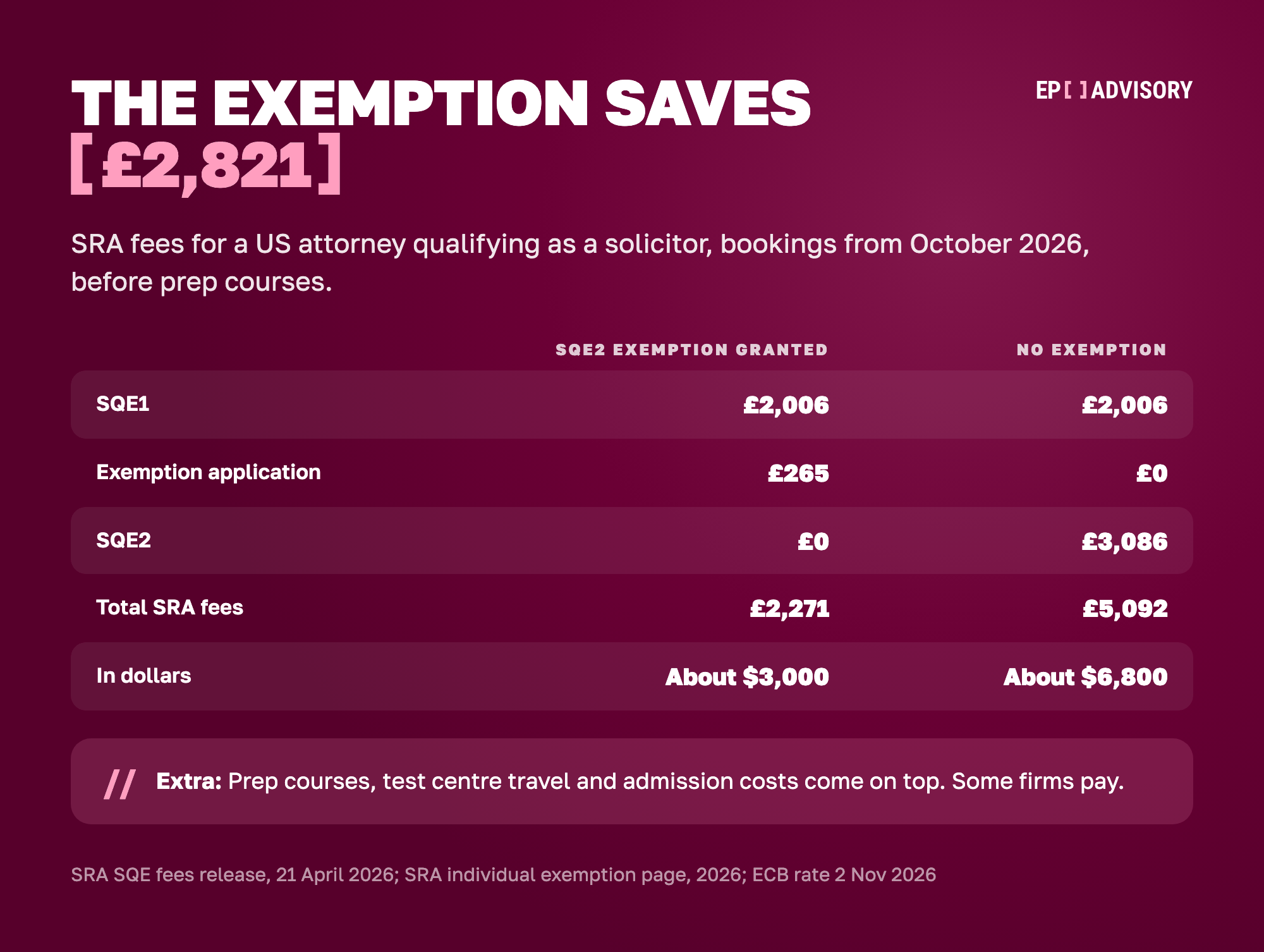
| Your case | SRA fees | In dollars |
|---|---|---|
| SQE1 plus a granted SQE2 exemption | £2,006 + £265 = £2,271 | about $3,000 |
| SQE1 and SQE2, no exemption application | £2,006 + £3,086 = £5,092 | about $6,800 |
| Exemption refused, then SQE1 and SQE2 | £265 + £2,006 + £3,086 = £5,357 | about $7,200 |
These are assessment and application fees only. Prep courses, travel to a test centre, the admission fee and your first practising certificate come on top. If you join a firm first, ask whether it pays. Some firms fund qualification for lawyers they want to keep, and it is a fair thing to raise when you negotiate. Our guide to how to negotiate salary shows how to ask.
A worked example. A New York associate with 4 years’ practice joins a US firm’s London office on her US licence. In year one, she applies for the SQE2 exemption (£265) and studies for SQE1 in the evenings. She passes SQE1 (£2,006), gets the exemption and applies for admission. Her own exam bill is £2,271. She is now dual-qualified, without a single extra year of training.
Where American lawyers work in London
In our experience, US firms’ London offices are the main employers of American lawyers, and transactional work is where demand is strongest.
Many large US firms run big London offices. Examples include Kirkland & Ellis, Latham & Watkins, Milbank, Skadden, Sullivan & Cromwell, White & Case and Willkie Farr & Gallagher. Transatlantic firms, formed by US and UK mergers, and the big English firms also hire US-qualified lawyers for their US practice groups.
Where the demand sits, based on what recruiters and firms report:
- Capital markets: high-yield bonds and equity deals sold to US investors need lawyers who know SEC rules and New York law.
- Private equity, leveraged finance and M&A: the busiest areas for US firms in London. Deal skills travel well across borders.
- Private credit, funds and energy: growing teams, often staffed with US and English lawyers side by side.
- International arbitration: London is a major seat, and US litigators with arbitration experience can fit here.
- In-house: banks, private equity houses and US companies with London headquarters hire US lawyers for US-facing work.
Pure US court litigation is the hardest to move. It is tied to US courts, so firms rarely need a US litigator in London unless the work is arbitration or cross-border investigations.
The fastest route in is usually an internal transfer. If your firm has a London office, tell your practice group leader early, and ask what the London team needs. Lateral moves for associates from the US are harder, because London teams can staff US-law work from New York. A clear reason for London and a strong deal sheet make the difference. Our guide to intra-company transfers to the UK covers the visa side of a move within your firm.
Lawyer pay in London compared with the US
London pays solicitors and lawyers a median of £80,788 a year gross, the highest of any UK region with a published figure.
The ONS Annual Survey of Hours and Earnings (ASHE) for 2026 is the official UK pay survey. Its figures are gross pay a year for full-time employees who have been in their job for more than a year, in the tax year to April 2026. They are provisional. The “solicitors and lawyers” group (code 2412) does not include barristers.
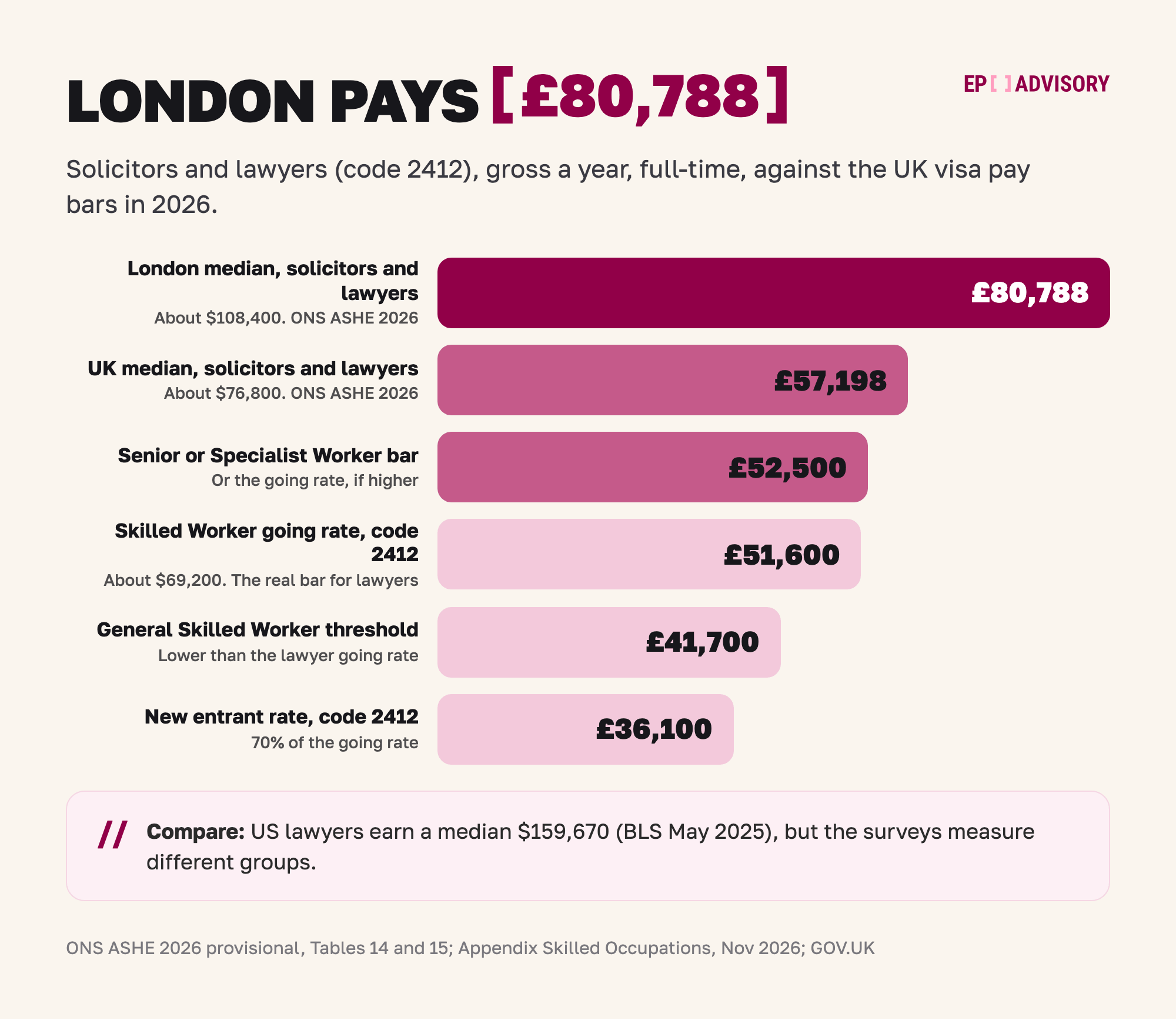
| Where | Median pay, gross a year | Source |
|---|---|---|
| London, solicitors and lawyers | £80,788 (about $108,400) | ONS ASHE 2026, Table 15 |
| UK, solicitors and lawyers | £57,198 (about $76,800) | ONS ASHE 2026, Table 14 |
| New York metro area, lawyers | $208,880 (about £155,700) | BLS OEWS, May 2025 |
| US, lawyers | $159,670 (about £119,000) | BLS OEWS, May 2025 |
The two surveys measure different groups. The UK figure covers full-time staff in the same job for over a year. The US figure covers all employees, full and part time. So treat the gap as a guide, not an exact pay cut. On these numbers, the New York median is about 1.9 times the London one.
The median hides a wide spread. Pay at the large US firms’ London offices sits well above it, at the top of the market. Those firms set pay privately and change it often, so ask a legal recruiter for the current band for your year of qualification. For a wider look at the gap by job, see our UK vs US salary comparison.
Your US taxes do not stop
US citizens file a US return wherever they live. The US-UK tax treaty stops most double taxation, but it does not cut US tax for US citizens. For 2026, the foreign earned income exclusion is $132,900, set in IRS Rev. Proc. 2025-32. On a London lawyer’s salary you will often rely on foreign tax credits as well. This is general information only, so talk to a cross-border tax adviser before you sign.
Which visas US lawyers use to work in London
For a lawyer, the Skilled Worker pay bar is £51,600, not the general £41,700 threshold.
US citizens need a visa to work in the UK. A UK employer sponsors most of them. A sponsor is an employer the Home Office has licensed to hire people from abroad. Many large law firms in London hold one. You can check any firm in our guide to UK companies that sponsor visas.
Three routes cover most American lawyers:
- Skilled Worker visa. For a new hire. Your salary must be the higher of £41,700 a year or the going rate for your job. The going rate is the minimum the Home Office sets for each occupation code. For solicitors and lawyers (code 2412) it is £51,600 a year gross (about $69,200), in the Appendix Skilled Occupations. For barristers and judges (code 2411) it is £59,400. A new entrant, such as someone under 26 or working towards a UK professional qualification, can be paid 70% of the going rate, if the salary is at least £33,400. For code 2412, that is £36,100. The visa fee is £819 for up to 3 years from outside the UK, plus a health surcharge of £1,035 a year. After 5 years you may be able to apply to settle.
- Senior or Specialist Worker visa. For a transfer to your own firm’s London office. Pay must be at least £52,500 or the going rate, whichever is higher. Below £73,900 a year, you need 12 months with the firm outside the UK first. You can stay up to 5 years in any 6 if paid under £73,900, or 9 years in any 10 at £73,900 or more. It does not lead to settlement on its own.
- High Potential Individual (HPI) visa. For recent graduates of listed top universities, awarded in the last 5 years. No job offer or sponsor needed. It lasts 2 years (3 with a PhD), costs £880 and cannot be extended. A yearly limit on applications applies. See our HPI guide for Americans.
If a grandparent was born in the UK and you also hold a Commonwealth passport, you may need no sponsor: see the UK Ancestry visa for US citizens.
Americans do not need to prove their English for a Skilled Worker visa, because the US is on the exempt list. US citizens also skip the English requirement for the HPI visa. A decision on a Skilled Worker application from outside the UK usually takes 3 weeks. Rules and fees change, so check the current rules on GOV.UK or with a regulated adviser before you or your firm apply.
Next: compare every work route side by side in our guide to the UK work visa for Americans.
How to land a London legal job from the US
The lawyers we see succeed lead with the deals they have done, in the format a London reader expects.
Here is the order we take lawyers through:
- Decide the work first. US-law transactional work means you can apply now, on your US licence. English litigation or property work means you plan the SQE first.
- Ask about London inside your firm. An internal transfer is the shortest route. Raise it at review time, with a clear reason and a time frame.
- Build a deal sheet. List your matters by type, size, your role and the governing law. London partners read this before your CV.
- Rewrite your resume as a UK CV. UK CVs run to two pages, lead with a short profile and leave out photos and dates of birth. Our guide to the UK CV vs the US resume shows the changes.
- Work with one or two specialist legal recruiters. Many lateral moves into US firms’ London offices go through them. Choose ones who give you straight feedback and know the London partners.
- Start the SQE early if you want it. Apply for the SQE2 exemption once you have 2 years’ practice. Sit SQE1 when your workload allows.
A short cover note matters too. Say why London, why now, and which US-law skills the London team is missing. “I want to live in Europe” is a fine personal reason, but it is not a business case. A deal sheet and a clean UK CV make your case for you. Before you send yours, Getting ready to apply for jobs in the UK? Check your CV for free: see it the way a recruiter does, then fix each problem.
If you are earlier in your career, the wider job market is open too. Our guide on how to get a job in the UK as an American covers the full 6-step plan.
Key takeaways
- A US attorney can work in London on US law with no exam, and usually without registering with the SRA.
- Mainly the six reserved legal activities, such as court advocacy and running litigation, and the title “solicitor” need an English qualification.
- The main reason to register as a registered foreign lawyer is to become a manager or owner of an SRA-authorised firm.
- To qualify as a solicitor, a US attorney passes SQE1 (£2,006) and passes SQE2 (£3,086) or wins an individual exemption (£265), with no 2-year work experience rule.
- The SQE2 exemption needs at least 2 years’ legal practice after qualifying as an American attorney, and the SRA aims to decide within 180 days.
- Solicitors and lawyers in London earn a median £80,788 a year gross (ONS 2026), and the Skilled Worker going rate for the job is £51,600.
- An internal transfer to your firm’s London office is the shortest route in, on the Senior or Specialist Worker visa at £52,500 or more.
See what a recruiter sees, then fix it before you apply. An instant score, then the fix for every problem.
Free, no card. A free account unlocks every fix.
Frequently asked questions
Can a US lawyer practise law in London?
Yes. A US attorney can advise on US law and do other unreserved legal work in London without an English qualification. You need to qualify as a solicitor or barrister only for reserved work, such as court advocacy or running litigation, or to use those titles.
Does a US attorney need to take the SQE?
Only to become a solicitor of England and Wales. Most US attorneys sit SQE1, because SQE1 exemptions are very rare. You can apply for an individual SQE2 exemption if you have at least two years’ legal practice after qualifying as an American attorney.
Is the QLTS still available for American lawyers?
No. The Qualified Lawyers Transfer Scheme has closed, and the SQE is now the route for qualified lawyers. The SRA’s old QLTS page now points to its SQE pages for qualified lawyers.
Do I need two years of qualifying work experience?
No. The SRA says qualified lawyers do not need two years of qualifying work experience. You add your professional title and qualification date to your mySRA account, then pass SQE1 and SQE2 or get an SQE2 exemption.
How much does it cost to qualify as a solicitor as a US attorney?
For bookings from October 2026, SQE1 costs £2,006 and SQE2 costs £3,086. An exemption application costs £265. So the SRA fees run from £2,271 with an SQE2 exemption to £5,092 without one, before prep courses and admission costs.