 By Alisa Schlosser, Career Consultant at EP Advisory
The short answer: The median full-time salary in Germany is €4,506 a month gross (€54,066 a year including bonuses; Destatis, 2025). The average is higher, €4,851 a month, pulled up by top earners. A software engineer on €70,000 in Berlin keeps about €3,500 net and roughly €1,600 after rent and bills. The EU Blue Card threshold is €50,700, or €45,934 for shortage occupations.
| Germany, 2026 | Value |
|---|---|
| Median salary (gross) | €54,066/year (≈€4,506/month) |
| Average salary (gross) | €4,851/month |
| Typical take-home (€70k role, Berlin) | ~€3,500/month net |
| EU Blue Card threshold | €50,700/year (€45,934 shortage roles) |
Germany is the biggest job market in the European Union, and for a skilled foreign professional it is often the most realistic door into Europe. The median full-time salary is €54,066 gross a year (Destatis, 2025), and in IT it climbs to roughly €66,750, with senior engineers well into six figures. But behind those numbers sits the other half of the equation: income tax and social contributions that together take around 38–42% of a good salary, €1,200–1,500 a month for a one-bedroom flat in Munich, and a bureaucracy that rewards the patient.
So here is the arithmetic behind the headlines. We break down real salaries by sector, focus on the fields where foreign professionals actually get hired, subtract every mandatory cost, and show you what’s genuinely left at the end of the month.
Over 7 years, we’ve helped more than 5,000 professionals find jobs abroad. Want to assess your chances in Germany specifically? Find your career consultant.
What Is the Average Salary in Germany Per Month? (2026)
The average salary in Germany in 2026 is €4,851 per month gross (Destatis, 2025, excluding bonuses), inflated by senior industry and finance pay. The median is the honest anchor at €4,506 per month gross (€54,066 a year including special payments, Destatis). A caution on sources: the €53,900 figure quoted around the web is Stepstone’s private-survey number, not the official one. After tax and social contributions a single worker keeps roughly €2,800–2,950 per month net.
| Salary in Germany (2026) | Per month, gross | Per month, net (single, tax class I) |
| Average full-time | €4,851 | ~€2,950 |
| Median (typical worker) | €4,506 | ~€2,800 |
| Statutory minimum wage (€13.90/hr) | ~€2,400 | ~€1,750 |
Net figures are approximate and assume a single person in tax class I. Married and dual-income households keep more. See “The Arithmetic” section below for a full Berlin worked example.
Does Germany have a minimum wage? Yes. The statutory minimum wage rose to €13.90 per hour on 1 January 2026, up from €12.82, and it climbs again to €14.60 in 2027. Full-time that is about €2,400 per month gross.
What counts as a good salary in Germany? Anything above the median, so roughly €4,500 per month gross, is comfortable outside Munich. Around €5,800 and up gives real breathing room in Munich or Frankfurt.
If the numbers work for you, the next step is practical: our guide to jobs in Germany for foreigners covers where the hiring actually happens, and the European work-visa salary thresholds show what an offer must pay before a permit is possible.
German Salaries at a Glance: The Essentials
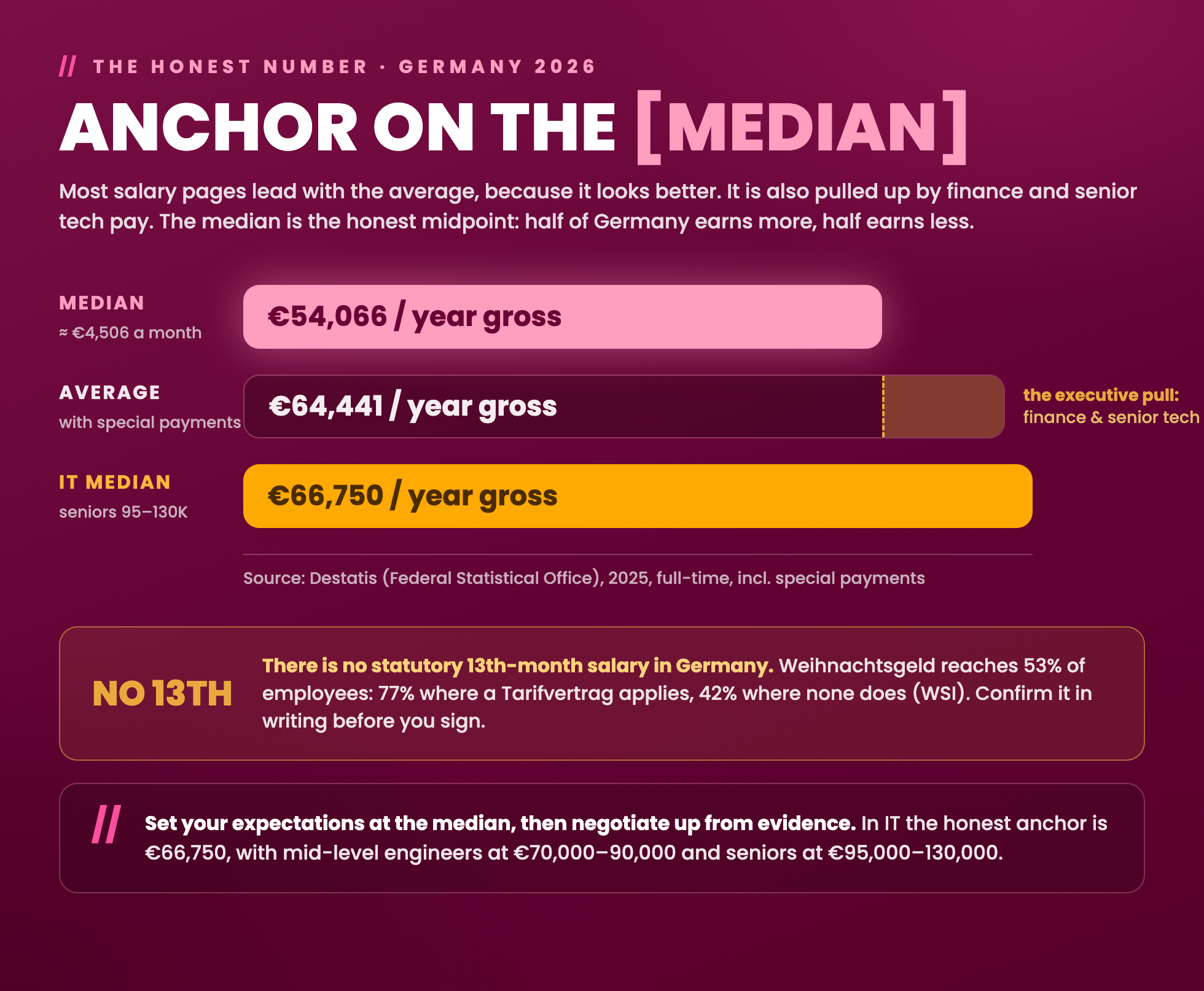
- Median salary: €54,066/year gross full-time with bonuses (about €4,506/month), the honest anchor for a typical worker (Destatis)
- Average salary: higher, €4,851/month gross (€64,441/year with bonuses), pulled up by high earners
- IT median: ~€66,750/year, with mid-level engineers at €70,000–90,000 and seniors €95,000–130,000
- Income tax: progressive, from 14% (above the €12,348 tax-free allowance) rising smoothly to 42% at €69,879, and 45% above €277,826 (Federal Ministry of Finance)
- Tax classes (Steuerklassen): your withholding depends on class I–VI, singles are class I; married couples can split into III/V or IV/IV
- Social contributions: ~20–21% of gross off your side (pension 9.3%, health 7.3% + ~1.45%, care 1.8–2.4%, unemployment 1.3%), the employer pays a near-matching share on top (GTAI)
- Church tax (Kirchensteuer): 8–9% of your income tax, but only if you’re registered with a church; you can opt out
- 13th salary: not mandatory. Weihnachtsgeld reaches 53% of employees overall, and coverage splits sharply by bargaining: 77% with a Tarifvertrag against 42% without (WSI-Tarifarchiv). Urlaubsgeld follows the same pattern
- Healthcare: included in your social contributions (public GKV), no separate premium as in Switzerland
- Rent, 1-bed: ~€1,075/month in Berlin, ~€1,200–1,500 in Munich, less in smaller cities
- EU Blue Card 2026: minimum €50,700/year, or €45,934 for shortage occupations, IT specialists and recent graduates (Make it in Germany)
- Opportunity Card (Chancenkarte): a points-based permit to enter and job-hunt for up to 12 months
An important caveat about “median” versus “average”. Most of the salary pages we checked in August 2026 lead with the average, because it looks better. But it’s dragged upward by executives, finance and senior tech pay. The median is more honest: half of all workers earn more, half earn less. Anchor your expectations to the median.
Salaries by Sector: Where Foreign Professionals Actually Get Hired
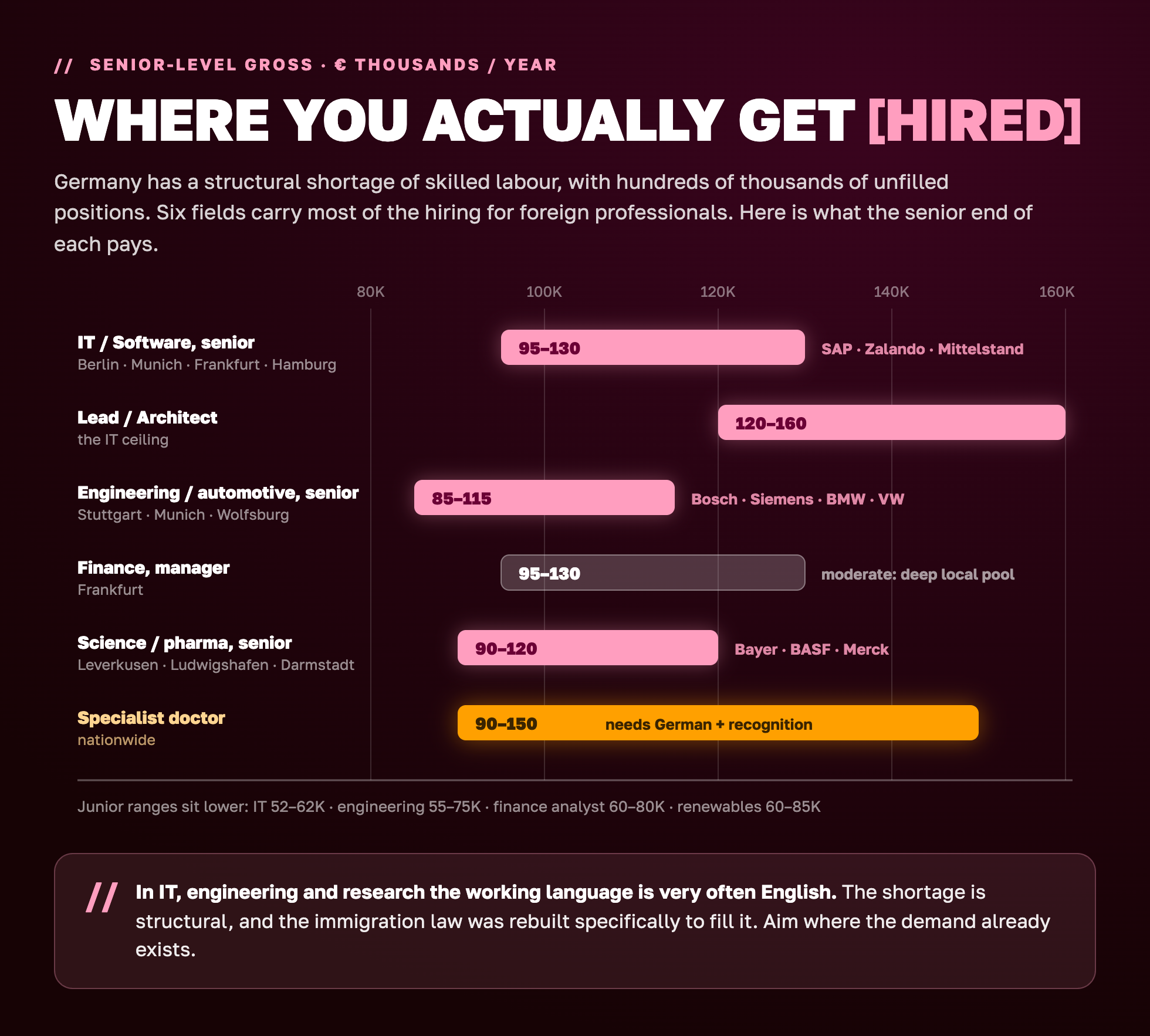
Germany has a real, structural shortage of skilled labour, the government estimates hundreds of thousands of unfilled positions, and it has rebuilt its immigration law specifically to fill them. Your best chances lie in the shortage fields, and in IT, engineering and research the working language is very often English.
Here they are, with current gross annual ranges.
| Sector | Annual salary (€ gross) | Where the jobs are | Odds for non-EU candidates |
| IT / Software development | Junior 52–62K · Senior 95–130K · Lead/Architect 120–160K | Berlin, Munich, Frankfurt, Hamburg | Very high. Google (Munich), SAP, Zalando, Celonis, N26, plus a huge Mittelstand demand |
| Engineering / Automotive / Mechanical | 55–75K · Senior 85–115K | Stuttgart, Munich, Wolfsburg, Ingolstadt | High. Bosch, Siemens, BMW, Mercedes, VW, Continental |
| Finance / Banking / Fintech | Analyst 60–80K · Manager 95–130K · Director 150K+ | Frankfurt | Moderate. Deutsche Bank, ECB, Allianz, DWS, plus fintech |
| Science / Pharma / Chemicals | 60–85K · Senior 90–120K | Leverkusen, Ludwigshafen, Darmstadt, Munich | High. Bayer, BASF, Merck, Boehringer Ingelheim |
| Renewable energy / Engineering | 60–85K · Senior 90–120K | Nationwide, north for wind | High. Energy transition (Energiewende) is a national priority |
| Healthcare / Nursing | Nurse 38–50K · Specialist doctor 90–150K | Nationwide | High demand, but German language and recognition required |
| Skilled trades (Handwerk) | 38–55K | Nationwide | Moderate–high. Recognition of your qualification is the key step |
A real example. A Senior Software Engineer in Munich earns roughly €90,000–120,000 a year; the same profile in Berlin runs €80,000–105,000, a little less, but Munich’s rents are 30–40% higher, so the lived result is often better in Berlin or a smaller hub. The headline number and what you keep can diverge sharply depending on where you land.
Critical when negotiating: there is no statutory 13th-month salary, and Weihnachtsgeld is a coin-flip: 53% of employees get it, 77% where a Tarifvertrag applies and 42% where none does (WSI-Tarifarchiv), so always confirm in writing whether it applies. One more thing German ads will not tell you: most state no pay at all. In our August 2026 sample across Arbeitsagentur, LinkedIn and Indeed, only about one ad in six carried an employer figure, and professional roles that quote pay use an annual gross range; StepStone’s ever-present numbers are its own Gehaltsprognose estimates unless the employer overrode them. Ask too about the tax class you’ll be on, whether relocation support is offered, and whether the salary clears the Blue Card threshold with a margin.
Score your CV in 30 seconds, then fix its biggest problems one by one. Both free.
Free, no card.

Salaries by City and State: Munich, Frankfurt, Berlin and Hamburg
Destatis publishes only a West/East split, so state-level pay comes from the Länder statistics offices. Average gross monthly pay, full-time, April 2025 unless noted, excluding bonuses:
| State (main city) | Average (€/month) |
|---|---|
| Hessen (Frankfurt) | 5,285 |
| Hamburg | 5,100 (April 2024) |
| Berlin | 5,060 |
| Baden-Württemberg (Stuttgart) | 5,034 |
| Bavaria (Munich) | 4,953 |
| North Rhine-Westphalia (Cologne, Düsseldorf) | 4,789 |
| Saxony (Leipzig, Dresden) | 4,143 |
| Germany | 4,784 |
Frankfurt’s banking cluster keeps Hessen on top, and Berlin now out-earns Bavaria. The east still trails the national line by roughly 13%, which is exactly why Leipzig and Dresden rents look so gentle next to Munich salaries.
Salary by Age in Germany: The Official Curve
German pay climbs fast through your twenties and early thirties, then the median flattens while the mean keeps rising, because seniority premiums concentrate at the top. Gross annual full-time earnings including special payments, 2025 (Destatis):
| Age | Median (€/year) | Mean (€/year) |
|---|---|---|
| Up to 24 | 40,800 | 42,708 |
| 25–29 | 48,095 | 51,696 |
| 30–34 | 54,252 | 59,913 |
| 35–39 | 56,767 | 64,656 |
| 40–44 | 56,931 | 67,523 |
| 45–49 | 56,803 | 69,198 |
| 50–54 | 57,027 | 70,136 |
| 55–59 | 57,287 | 70,960 |
| 60–64 | 55,605 | 67,164 |
If you arrive mid-career, benchmark against your age row, not the national line: a 40-year-old on the €54,066 national median is about €2,900 below their own cohort’s middle.
Minimum Wage in Germany 2026: €13.90 per Hour
The statutory minimum wage in Germany is €13.90 per hour from 1 January 2026, rising to €14.60 in January 2027. On a full-time 40-hour week that is about €2,400 gross per month, roughly €1,750 net in tax class I for a single person. The minimum applies to almost every employee over 18, including foreigners on a work visa; only apprentices, some mandatory interns and the long-term unemployed in their first six months are exempt. Sector agreements in construction, care and cleaning set higher floors.
Where to Look for Work: Official Resources
- Make it in Germany: the official government portal, with a jobseeker and visa guide
- Bundesagentur für Arbeit: the Federal Employment Agency’s official job board
- StepStone and LinkedIn Jobs: among the main private channels for professional and English-language roles (note StepStone attaches its own salary estimate to ads that state none)
- Xing: the German-speaking professional network, strong for local roles
Official sources worth using to verify any figure:
- Destatis (Federal Statistical Office): official salary and earnings statistics
- Federal Ministry of Finance tax calculator: official income-tax figures
- Make it in Germany: visas, the Blue Card and the Opportunity Card
- Recognition in Germany: official recognition of foreign qualifications
The Other Side: What Living Here Actually Costs
Now we subtract. Here is the structure of unavoidable costs for a single person, with Munich as the worst case.
Rent, the biggest line item (25–35% of your budget)
- Munich: a one-bedroom runs €1,200–1,500 in the centre, the most expensive city in Germany
- Frankfurt, Hamburg, Stuttgart: €1,100–1,400
- Berlin: ~€1,075 on average, though the market is tight and rising fast
- Smaller cities (Leipzig, Dortmund, Hannover): €650–950
- Deposit (Kaution): up to 3 months’ cold rent, held in a separate account; many flats are let unfurnished and without a kitchen
What you need to know: the big-city rental market is highly competitive. Expect to provide a SCHUFA credit record, proof of income and payslips, and to compete with dozens of applicants for each viewing.
Healthcare, included in your contributions
Healthcare in Germany is funded through the public statutory scheme (gesetzliche Krankenversicherung, GKV) and is already inside the social contributions taken from your pay. Once insured, GP and hospital care are covered, with only small co-pays (Make it in Germany).
- No separate premium: unlike Switzerland’s CHF 300–500/month, health cover sits inside your payroll deductions
- Higher earners (above ~€73,800/year) may opt for private insurance (PKV), which can be cheaper when young and single but riskier long-term
- Dependents: non-working spouse and children are usually covered by public insurance at no extra cost
- Dental basics are covered; cosmetic and premium work are not
Everything else you have to pay
- Groceries: €300–400/month, among the cheaper in Western Europe thanks to Aldi, Lidl and Rewe
- Public transport: the nationwide Deutschlandticket is €58/month for all regional and city transport, excellent value
- Utilities + internet: €250–350/month (Nebenkosten and electricity are often billed on top of cold rent)
- Radio/TV licence (Rundfunkbeitrag): €18.36/month, mandatory per household
- Beer / eating out: a beer is €4–5; a restaurant main €14–20. The 19% VAT (7% on food) is baked into every price
The Arithmetic: What Actually Lands in Your Account
Let’s put it together. Take a realistic scenario: a Software Engineer in Berlin on €70,000 a year, €5,833/month gross (single, tax class I, no church tax).
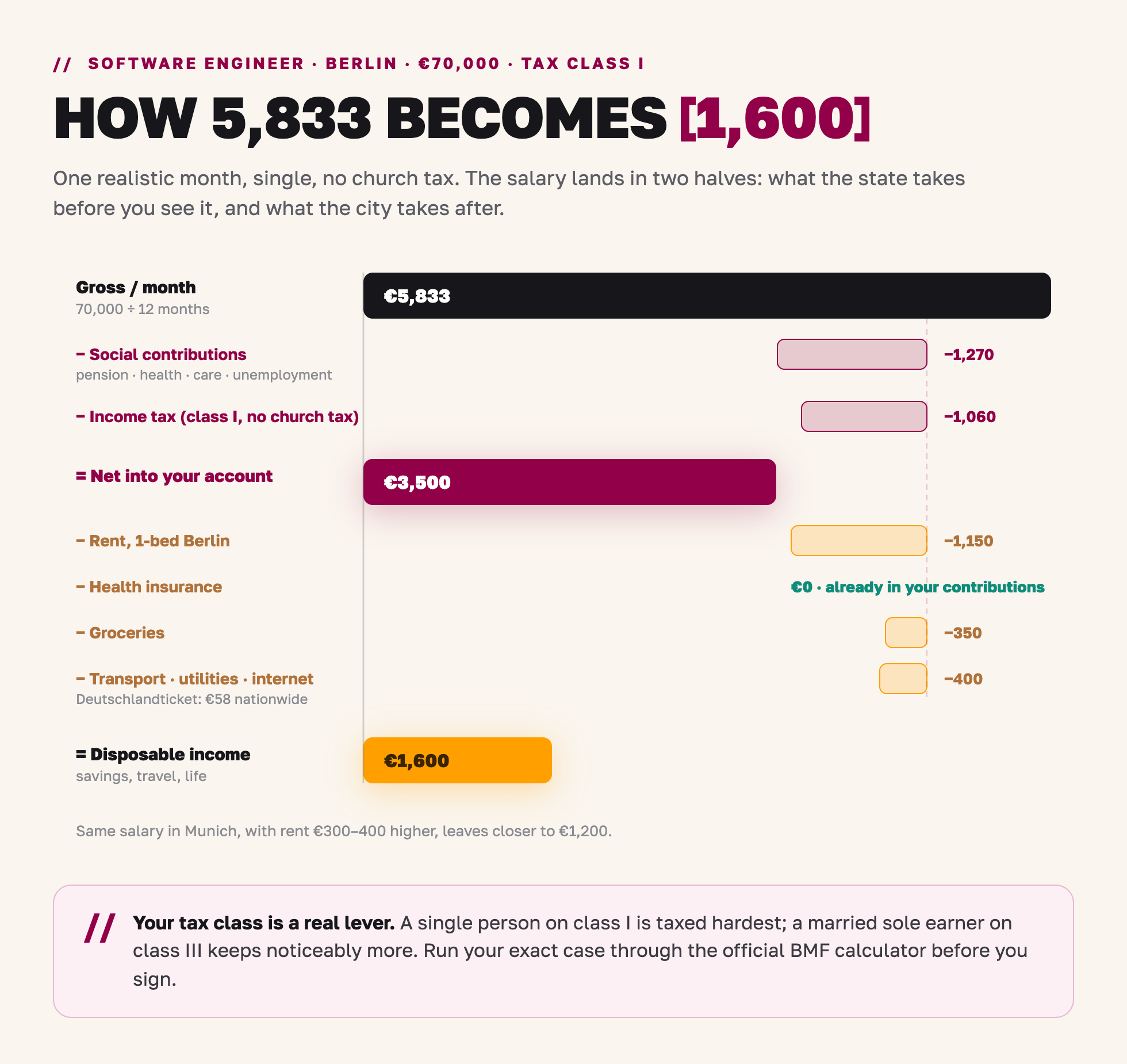
| Line item | €/month |
| Gross (70,000 ÷ 12) | 5,833 |
| − Social contributions (pension, health, care, unemployment) | −1,270 |
| − Income tax (Lohnsteuer, class I, no church) | −1,060 |
| = Net into your account | ~3,500 |
| − Rent, 1-bed Berlin | −1,150 |
| − Health insurance | 0 (already in contributions) |
| − Groceries | −350 |
| − Transport, phone, internet, utilities | −400 |
| = Disposable income | ~1,600 |
Roughly €1,600 a month of disposable income on a €70,000 salary in Berlin is a solid result, and healthcare, pension and unemployment cover are already paid for inside those deductions. The same salary in Munich, with rent €300–400 higher, leaves closer to €1,200. Note that a single person on class I is taxed hardest; a married sole earner on class III keeps noticeably more. Always run your own number through the official Federal Ministry of Finance calculator before you sign.
And on a lower salary? At €48,000 a year (net around €2,600/month), after rent and bills in a mid-sized city you’re left with roughly €800–1,000. Liveable, and comfortable outside the big cities. Note too that €48,000 clears the reduced Blue Card threshold (€45,934) but sits below the standard one, which matters for your route in.
See what a recruiter sees, then fix it before you apply. An instant score, then the fix for every problem.
Free, no card.
The Work Permit: Your Route In
EU/EEA and Swiss citizens can work in Germany with no permit. For everyone else, including citizens of Russia, Kazakhstan, Belarus and Ukraine, Germany has, since the 2023–24 Skilled Immigration Act, one of the more open systems in Europe.
- EU Blue Card: the main route for university graduates with a job offer. For 2026 the salary threshold is €50,700/year, dropping to €45,934 for shortage occupations (IT, engineering, science, medicine), IT specialists without a degree, and graduates within three years of finishing. It offers fast-track permanent residence and easy family reunification (Make it in Germany)
- Skilled Worker visa: for those with a recognised university degree or vocational qualification and a job offer, without the Blue Card salary bar
- Opportunity Card (Chancenkarte): a points-based permit that lets you enter Germany for up to 12 months to look for work, you need 6 points (for qualifications, German/English, experience, age) or a fully recognised qualification, plus proof of funds (~€1,091/month)
- Recognition matters: for regulated professions and the Skilled Worker route your foreign qualification must be recognised, check the anabin database and “Recognition in Germany” first
- Who applies: you apply for the visa yourself at the German mission once you hold the job offer (or the Chancenkarte to search on the ground)
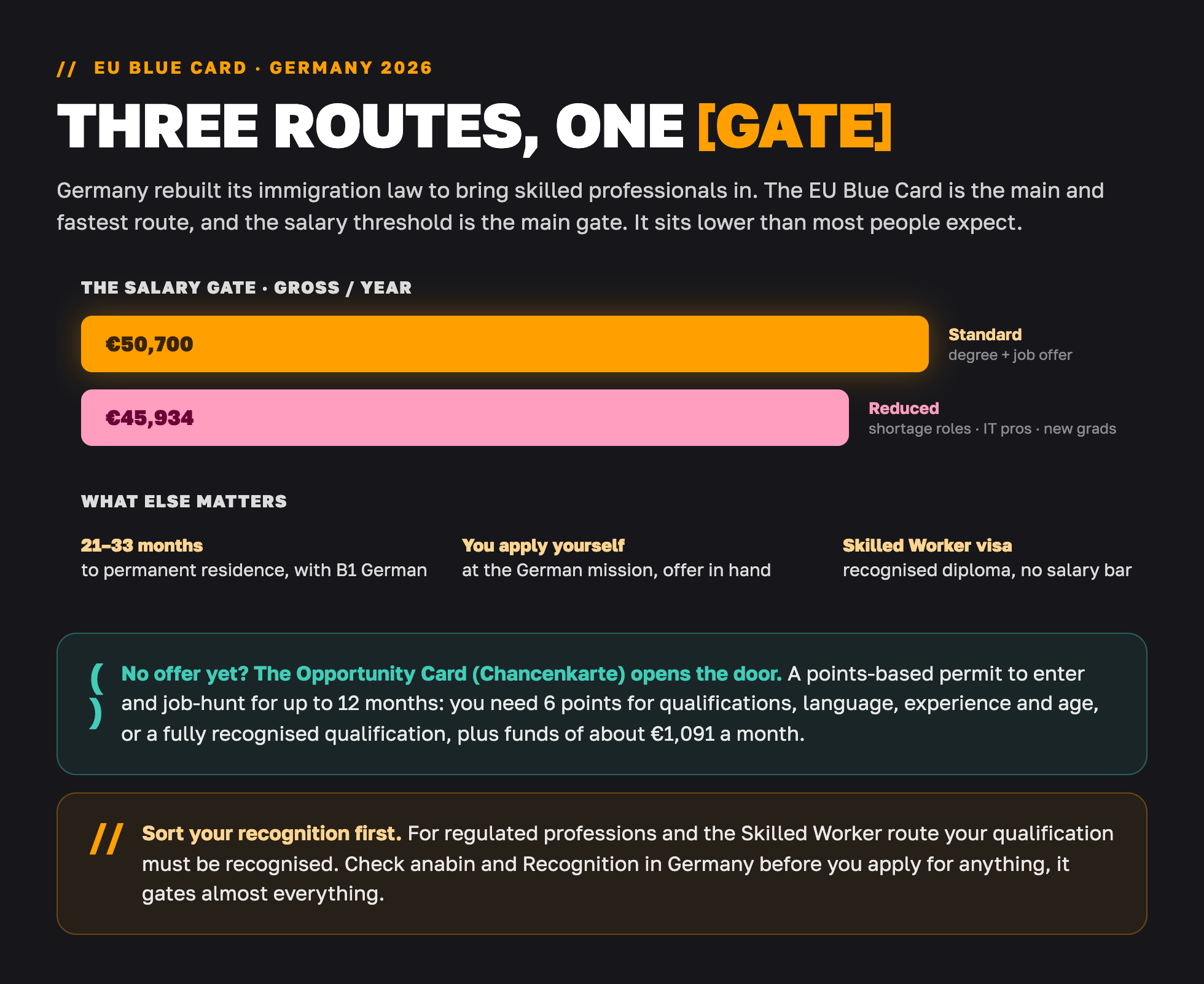
A practical detail: the Blue Card is usually the fastest path to settling permanently: with pension contributions paid, permanent residence comes after 27 months with basic German (A1), or 21 months with B1 (§18c(2) AufenthG). Get your degree recognition (or anabin listing) sorted early, because it gates almost everything.
Current rules, thresholds and application steps are published by Make it in Germany.
Related reading: Work visa & Blue Card salary thresholds in Europe 2026 · Salaries in Norway in 2026 · Salaries in the UK in 2026 · Salaries in Luxembourg · Salaries in the Czech Republic
Key Takeaways
- Anchor on the median (€54,066/year), not the average, the latter is skewed by finance and senior-tech pay.
- The strongest openings for non-EU professionals are in IT, engineering/automotive, science/pharma, renewables and healthcare, and much of it works in English.
- Healthcare, pension and unemployment cover are all inside your social contributions, there is no separate insurance premium as in Switzerland.
- There is no statutory 13th salary. Weihnachtsgeld reaches about half of employees (77% under a Tarifvertrag), so confirm it in writing.
- On €70,000 in Berlin you keep about €3,500/month net and roughly €1,600 in disposable income after rent and bills; Munich leaves less.
- Your tax class matters: a single on class I is taxed hardest; a married sole earner on class III keeps more.
- The EU Blue Card (€50,700, or €45,934 for shortage roles) is the main and fastest route; the Opportunity Card lets you job-hunt on the ground for 12 months.
Frequently Asked Questions
What is the average salary in Germany in 2026?
The median full-time salary is €54,066 gross a year including special payments (about €4,506/month) according to Destatis, while the average is higher at €4,851/month because top earners pull it up. In IT the median is closer to €66,750, with senior engineers well above that.
What is the average take-home (net) salary in Germany?
A single worker in tax class I keeps around €2,800–2,950 per month after tax and social contributions, from an average gross of €4,851. Married and dual-income households in other tax classes keep more.
Does Germany have a minimum wage?
Yes. The statutory minimum wage rose to €13.90 per hour on 1 January 2026, up from €12.82, and rises again to €14.60 in 2027. Full-time that is about €2,400 per month gross.
How much tax do you pay in Germany?
Income tax is progressive, from 14% just above the €12,348 tax-free allowance to 42% at €69,879 and 45% above €277,826. On top come social contributions of about 20–21% from your side (pension, health, care, unemployment). For a €70,000 single with no church tax the combined bite is roughly 40%, leaving about €3,500/month net.
Do you need a job to get a German work permit?
Usually yes, the EU Blue Card and Skilled Worker visa both require a concrete job offer. The exception is the Opportunity Card (Chancenkarte), a points-based permit that lets qualified people enter Germany for up to 12 months to search for work.
Is Germany a good place for foreign professionals?
Yes, it’s the largest job market in the EU with a genuine skills shortage, one of the more open immigration systems in Europe, and English is widely used in IT, engineering and research. The trade-offs are high taxes and social contributions, competitive big-city housing and a fair amount of bureaucracy, but net pay and security are strong.
If you’d like a personalised assessment of your chances in Germany, help tailoring your CV and interview preparation, find your career consultant.