 By Andre Atallah, CEO of EP Advisory

Graduate Audit – Technology Audit · ICAEW CFAB · Manchester · Autumn 2027 start
Rolling, no closing date givenClosed this yearCheck the Manchester adManchester not for you? Your options
Short answer: Apply now. KPMG recruits on a rolling basis and gives no closing date. Only Manchester had an ad on 15 October 2026.The Manchester ad had closed when we checked on 15 October 2026. Use this guide to prepare.KPMG hires Technology Audit graduates in Manchester. Check its ad for the closing date. The three-year programme leads to the ICAEW CFAB, not the full ACA. You take a quiz, a form with no CV, two online tests and a video interview with KPMG’s avatar Leah. Last is a half-day Launch Pad. Manchester is not sponsored for visas.
Applying now?Applying next year?Applying?
Apply to the Manchester role. Then take the tests soon after.The Manchester ad had closed when we checked on 15 October 2026. Prepare now for the next intake.Check the Manchester ad on KPMG’s site. How to apply
Need London or a visa?
Try Graduate Audit, a sister programme, or the Talent Community. Your options
Where are you now?
Independent guide. EP Advisory is not affiliated with KPMG.
KPMG’s Technology Audit team must “identify and mitigate the potential risks and threats” of new technology. This guide to the KPMG Technology Audit graduate application process uses KPMG’s own pages for every date and rule.
For nearly 10 years, we’ve helped more than 5,000 professionals get hired. Want to know if your CV will pass screening in the UK? Check your CV for free: a score in 30 seconds, then a fix for each problem.
01/10
Your route to an offer
Pick your stage and tick each step when done. Prep times are our suggestions.
1. Application: rolling, no closing date1. Application: closed this year1. Application: an online form
A job preview quiz, then a form with no CV. KPMG says allow up to 45 minutes.
2. Online tests: skills, then reasoning
An untimed skills assessment and a 36-minute cognitive test. Prep a few days.
3. Video interview: six questions from Leah
You record six answers for KPMG’s avatar Leah. Allow 40 minutes. Prep about a week.
4. Launch Pad: half a day, in person
A half day in person, with your final interview. Offers come within 2 working days.
Your ticks save on this device.
02/10
The role at a glance
Everything you need to decide, on one screen. If KPMG has not published something, we say so.
1 officeClosedRolling
Manchester only, on 15 Oct 2026When we checked on 15 October 2026Hiring basis, KPMG says
3 years
Programme length
CFAB
ICAEW’s first ACA level, not the full ACA
No CV
A quiz and a form only
36 min
Cognitive test, timed
Competitive
Salary, no figure published
Technology Audit: CFAB
You “complete just the initial level of the ICAEW ACA qualification”, then build work experience.
Graduate Audit: full ACA
The full ACA in three years, or the CA with ICAS in Scotland. Listed in 15 offices.
What CFAB is, in plain words
- The name. ICAEW’s Certificate in Finance, Accounting and Business. ICAEW also runs the ACA, the chartered accountancy qualification.
- Six modules. “The same six modules as the first level of” the ACA, from accounting to tax.
- Length. “12 months or less”. It is “equivalent to a foundation degree”.
- After CFAB. ICAEW says CFAB “offers a clear progression route onto the ACA qualification”. KPMG does not say whether Technology Audit trainees move on to the ACA.
- Costs. KPMG pays, including second attempts.
From KPMG’s Technology Audit page and ICAEW’s CFAB page. KPMG’s reward page says “Competitive salary”.
03/10
What KPMG Technology Audit looks for
KPMG scores the same 12 skills at every stage. The quotes below are KPMG’s own definitions.
Career Motivation
“Why you want to work for KPMG and your chosen programme and location.”
Learning & Curiosity
“Absorbing new information and techniques quickly.”
Resilience
“Keeping calm under pressure and staying positive when facing difficulties or criticism.”
Relationship Building
“Making new connections easily.”
Effective Communication
Being able to “communicate with clarity and impact”.
Initiative
“Seeking additional work and responsibilities proactively.”
Planning & Organisation
“Setting yourself clear objectives, managing your own time and work.”
Results Focused
“Getting work done to a high standard.”
Critical Thinking
“Using it to make rational judgements and decisions”, after evaluating the information.
Inclusive Collaboration
“Fostering team cohesion, appreciating others’ efforts and actively seeking their input.”
Integrity
“Always upholding ethical standards and being trusted to do the right thing.”
Applying Expertise & Technology
“Applying relevant knowledge to the job” and the right technology.
What Technology Audit adds, in KPMG’s words
CuriousAgileAttention to detailAn appetite to learn about technology
KPMG adds: “You don’t need to be a technical guru to join us.” Career Motivation means being “Fully aware of the qualifications involved”, so know CFAB.
The work, in KPMG’s words
- Your team. You work “alongside colleagues in Financial Audit”, checking “the IT systems that underpin an organisation’s key financial processes”.
- What you check. You “assess control risks (including code evaluation and system configuration), financial and operational applications, technology infrastructure and technology projects”. You also “assess the cyber security landscape”.
- Tools. KPMG gives you its “global, smart audit platform, KPMG Clara”.
- Travel and busy times. KPMG’s Audit page says “Some travel is likely for audit work”. The work is seasonal, so “expect there to be busy times of the year”.
From KPMG’s skills page. Grades: GCSE Maths and English Language at grade 5 or B, 120 UCAS points and a 2:1 in any discipline. A few grades short? KPMG still encourages you to apply.
04/10Stage 1 · Apply
How to apply
Apply now: KPMG recruits on a rolling basis. It says “some programmes fill faster than others, so we’d encourage you to apply as early as possible”. The Manchester ad showed no closing date when we checked on 15 October 2026.The Manchester ad had closed when we checked on 15 October 2026. KPMG recruits on a rolling basis, so ads close when places fill. Use these steps to plan for the next intake.Check the Manchester ad for its closing date. KPMG says “some programmes fill faster than others, so we’d encourage you to apply as early as possible”.
1
Pick your route
One application per intake year
2
Take the quiz
A job preview, not assessed
3
Fill in the form
No CV, allow up to 45 minutes
4
Watch your inbox
The tests come by automatic invite
Where Technology Audit was listed
| Office | On 15 October 2026 |
|---|---|
| Manchester | Listed, no closing date. Not sponsored for visas. |
| London | Not listed when we checked. KPMG would sponsor a London Audit role. |
| Other offices | No Technology Audit ad listed |
From KPMG’s vacancy search, checked on 15 October 2026. Check it again, or join KPMG’s Talent Community to hear about new roles.
Where to apply, the rules and KPMG’s help
- Where to apply. Use the Manchester ad.
- One at a time. “You can only make one application per intake year.” You cannot switch programme or office after you submit.
- If you are rejected. “You cannot make another application until the next intake year.”
- The form. Grades, work experience and any mitigating circumstances. KPMG’s form video walks through it.
- Be accurate. KPMG checks your certificates against your form, and “your offer could be withdrawn” if they differ.
- Adjustments. Ask on the form. KPMG lists “Extra time, larger fonts, coloured backgrounds”.
- Questions. Call KPMG on 0800 328 5764, or use its contact page.
Your form answers: do and don’t
Do
“Maths (A), Computing (B), History (B), 2024”
KPMG checks your certificates against your form. Match them exactly.
Don’t
“Applied for Technology Audit, then asked to switch to Audit ACA”
KPMG cannot change your programme or location once you submit.
KPMG asks for no CV. Our CV achievement examples help you find a result for each of KPMG’s 12 skills. Getting ready to apply for jobs in the UK? Check your CV for free: see it the way a recruiter does, then fix each problem.
Save KPMG and over 2,000 other UK schemes to one free calendar. See what closes next and what you have applied to.
Track my schemes freeFree account, no card.
Manchester not for you, or need a visa? Your options
- The rule first. One KPMG application per intake year, so choose your route first.
- Graduate Audit, full ACA. Listed in 15 offices on 15 October 2026, including Manchester, with no closing date.This year’s Audit ads had closed when we checked on 15 October 2026.KPMG hires Audit graduates across the UK. Check each office’s ad.
- Sister technology routes. Software Engineering in Tax (Glasgow) and GMS Technology (London) were listed when we checked on 15 October 2026.had closed when we checked on 15 October 2026.have their own ads on KPMG’s vacancy search. Software Engineering in Tax asks for a 2:2. GMS Technology asks for a 2:1 and trains for the ATT, a tax qualification.
- Talent Community. For when your “preferred office location or programme isn’t available right now” (sign up).
- Graduating in 2028? The Audit vacation programme for July 2027 was listed in seven offices on 15 October 2026.had closed when we checked on 15 October 2026.has its own ads on KPMG’s vacancy search. It lasts 4 weeks. Any graduate offer is only “for the same location and business area”. There is no Technology Audit version.
- Final year or graduated? Audit Talent Insight was not open when we checked on 17 October 2026. KPMG says “Sign up to hear first”.Audit Talent Insight was open when we checked on 17 October 2026.Audit Talent Insight had closed when we checked on 17 October 2026.Check KPMG’s Audit Talent Insight pages for dates. It too leads to an offer only in the same location and business area.
- Does that use your one application? KPMG does not say for vacation or Talent Insight. Ask KPMG first.
- Next cycle. No date published. KPMG typically opens “between the summer and autumn”.
- School leaver? See KPMG’s Audit apprenticeships.
05/10Stage 2 · Online tests
KPMG’s online tests
KPMG sends two online tests by automatic invite. Technology Audit adds no test or stage, and no coding test is published.
Untimed
Skills assessment, allow 20 min
36 min
Cognitive assessment, timed
Chrome
On a desktop or laptop
From KPMG’s application process page. The cognitive test asks you to “interpret information, complete numerical calculations and draw logical conclusions”.
Likely SHL; KPMG does not name the product. KPMG links SHL’s practice. SHL’s factsheet for Verify Interactive G+ gives 36 minutes and up to 24 questions. Those are SHL’s figures, not KPMG’s.
Step through the tests
Numerical: timed
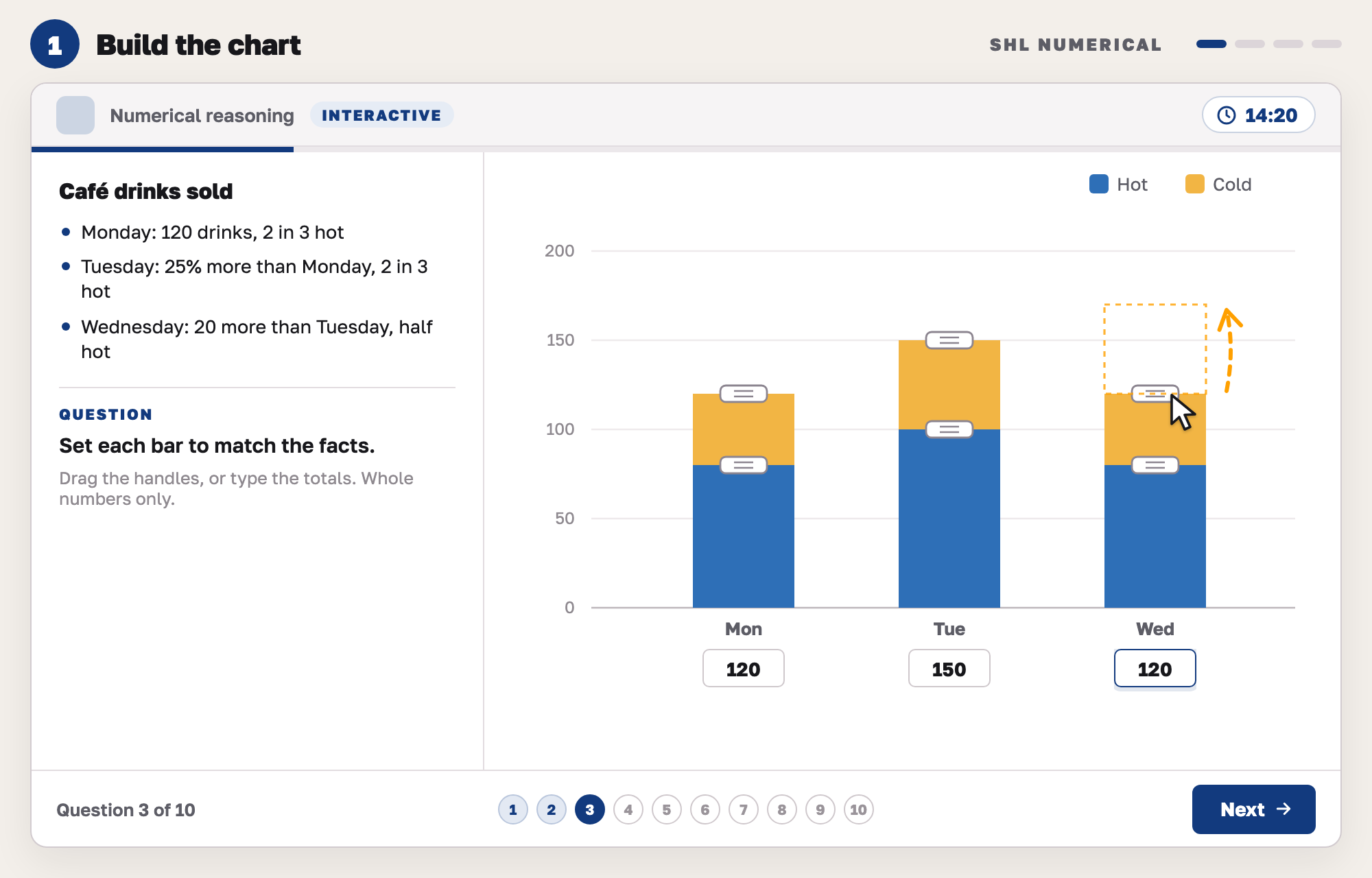
Build the chart
Read the facts on the left, then drag each bar to the right height or type the total under it. Employers set their own version, so yours may differ.
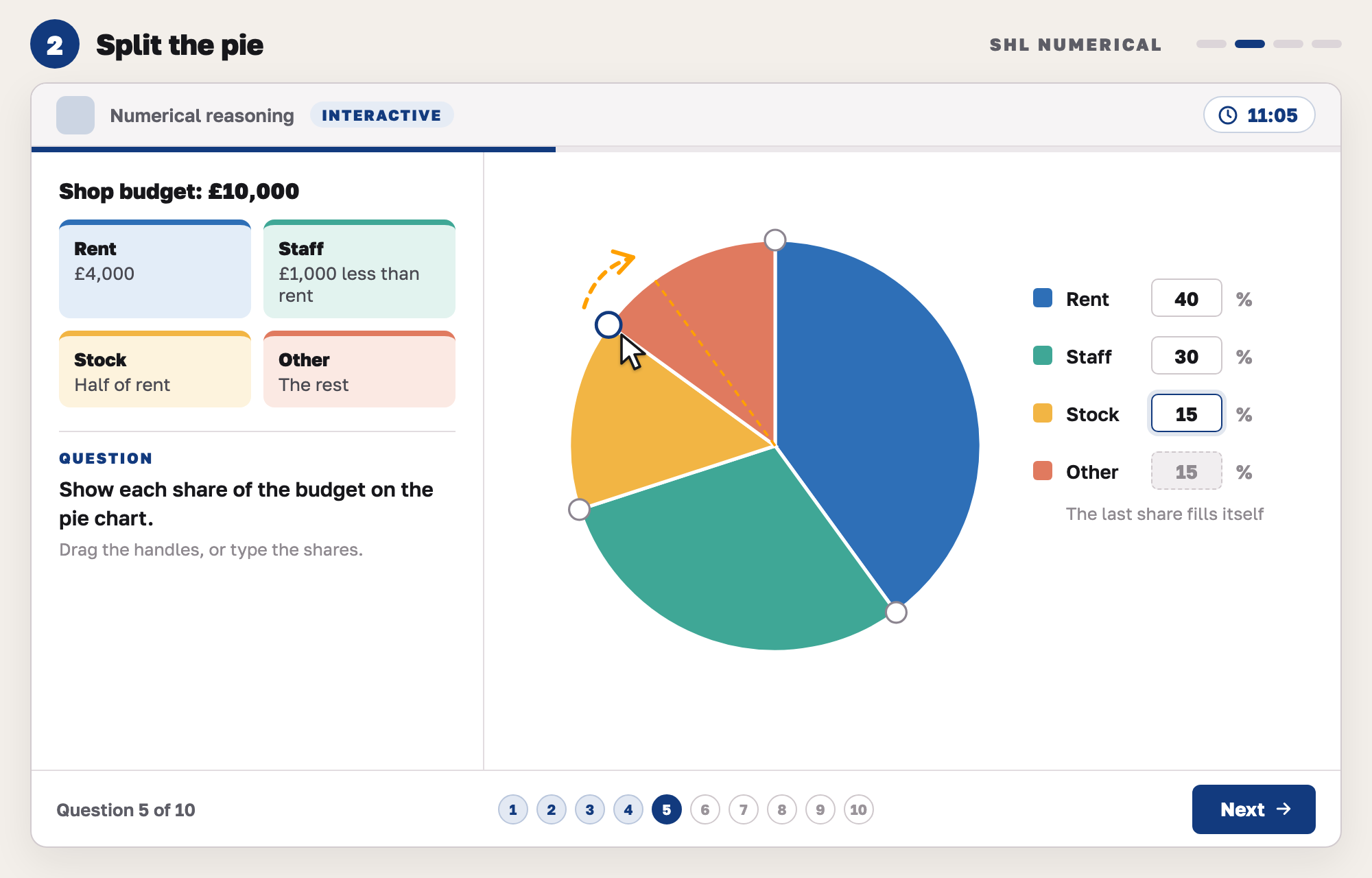
Split the pie
Work out each share of the budget, then drag the handles round the pie or type the percentages.
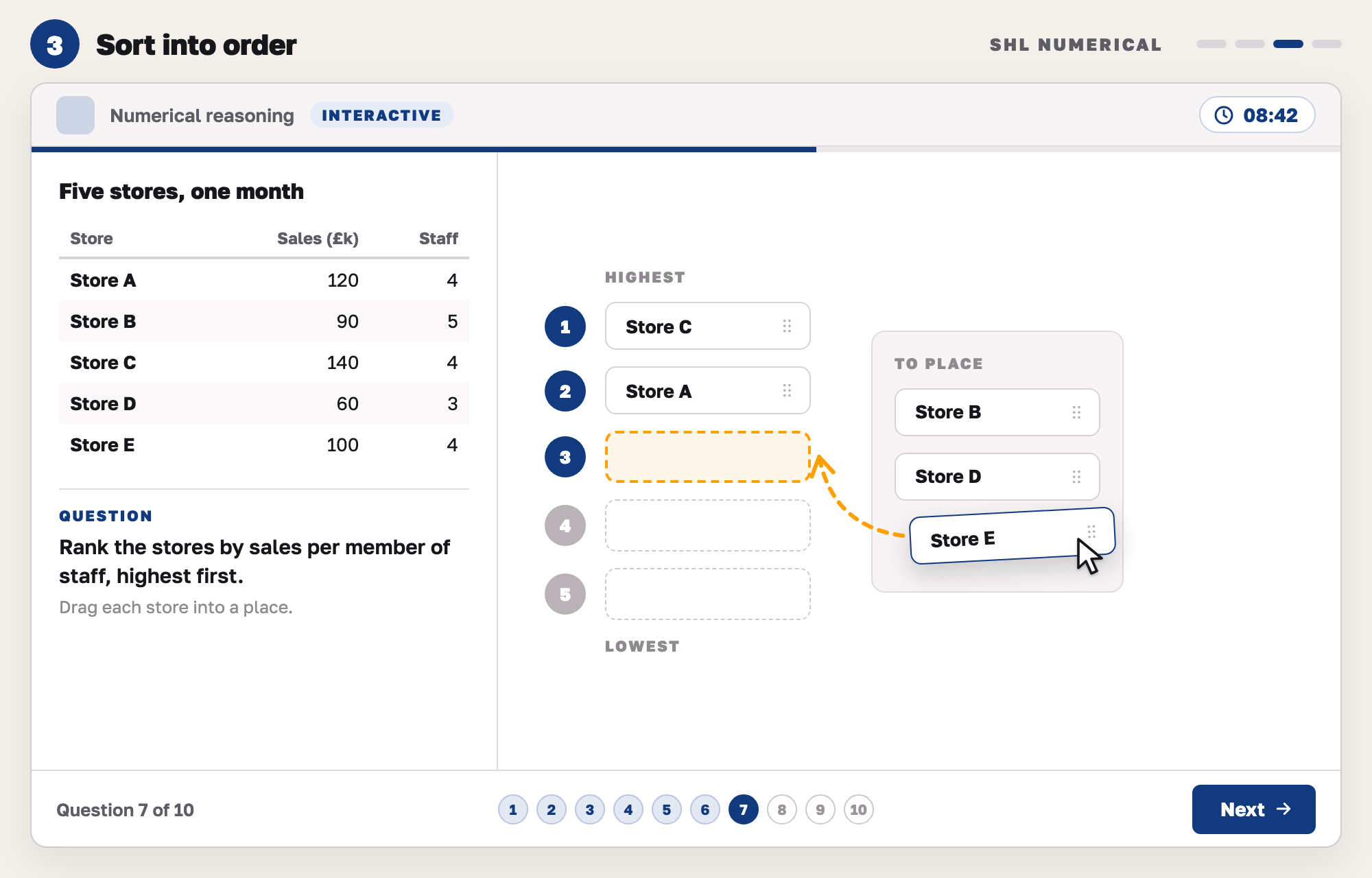
Sort into order
Work out a value for each row of the table, then drag the items into order from highest to lowest.
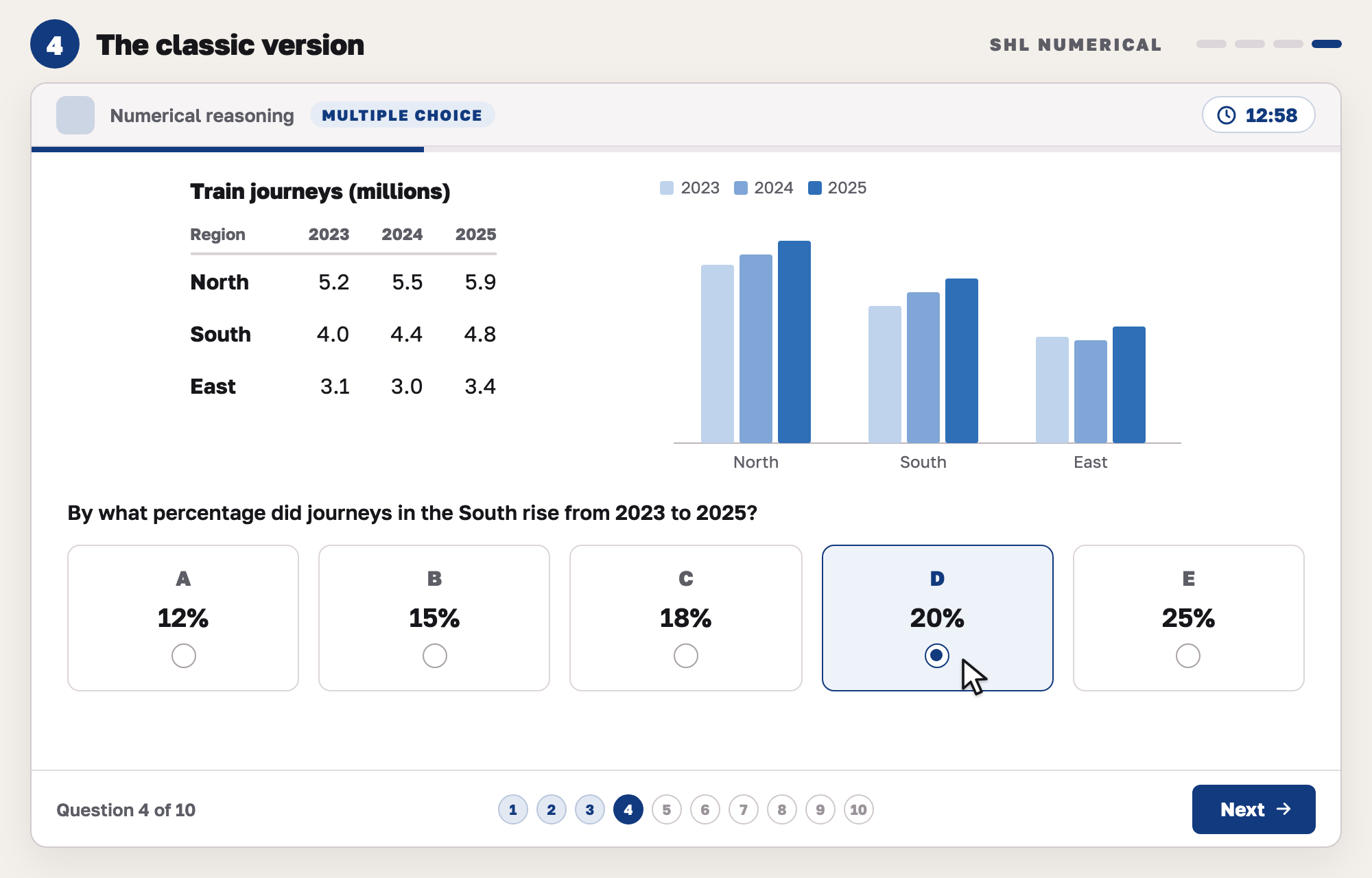
The classic version
SHL also offers a multiple-choice version. Read the table and chart, then pick one of five answers.
Your moves
- Drill percentage change and ratios from tables.
- Read the units and the axis before you drag a bar.
Inductive: timed
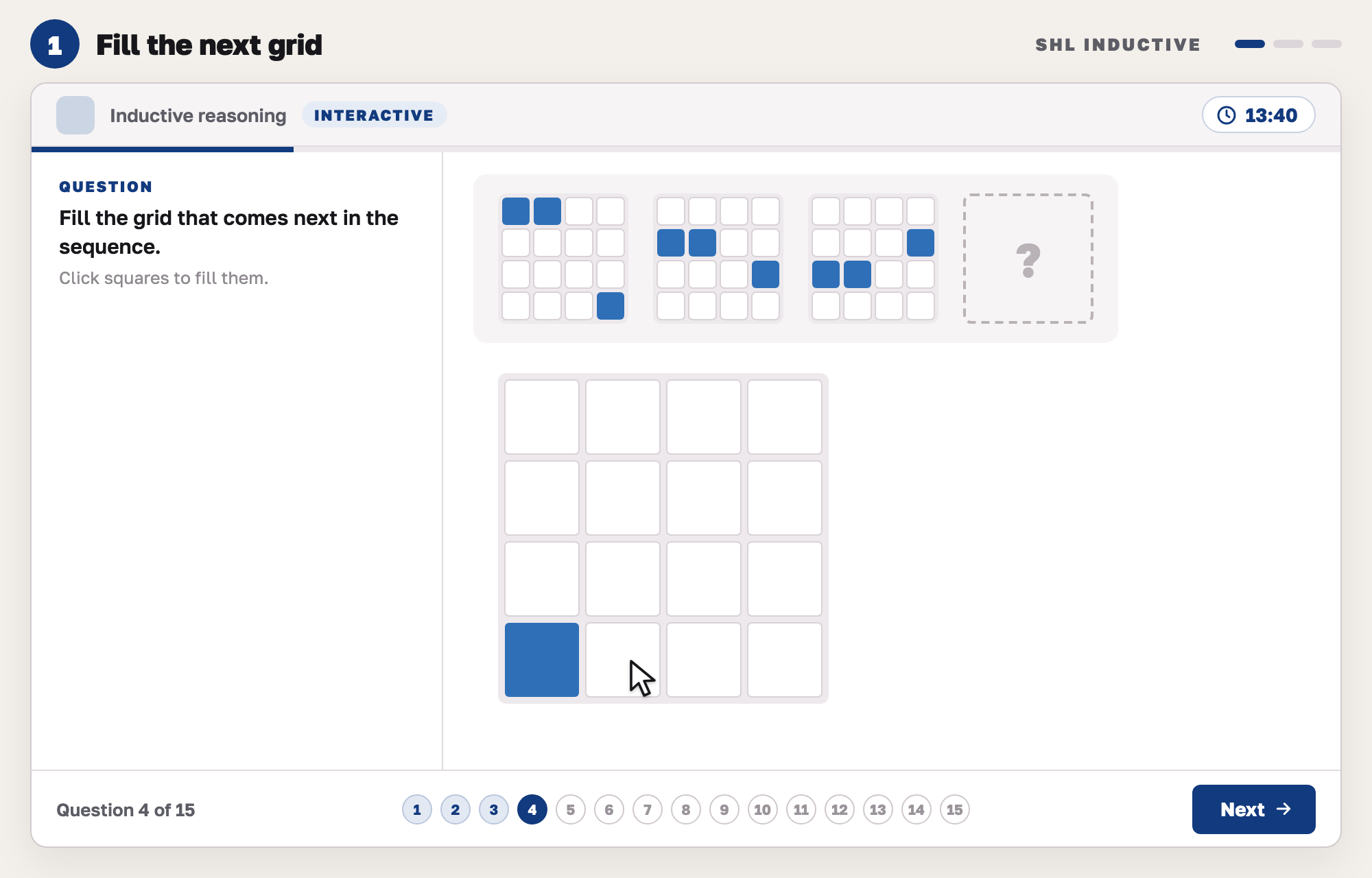
Fill the next grid
Spot how the pattern moves from grid to grid, then click squares in the big grid to draw the one that comes next. Employers set their own version, so yours may differ.
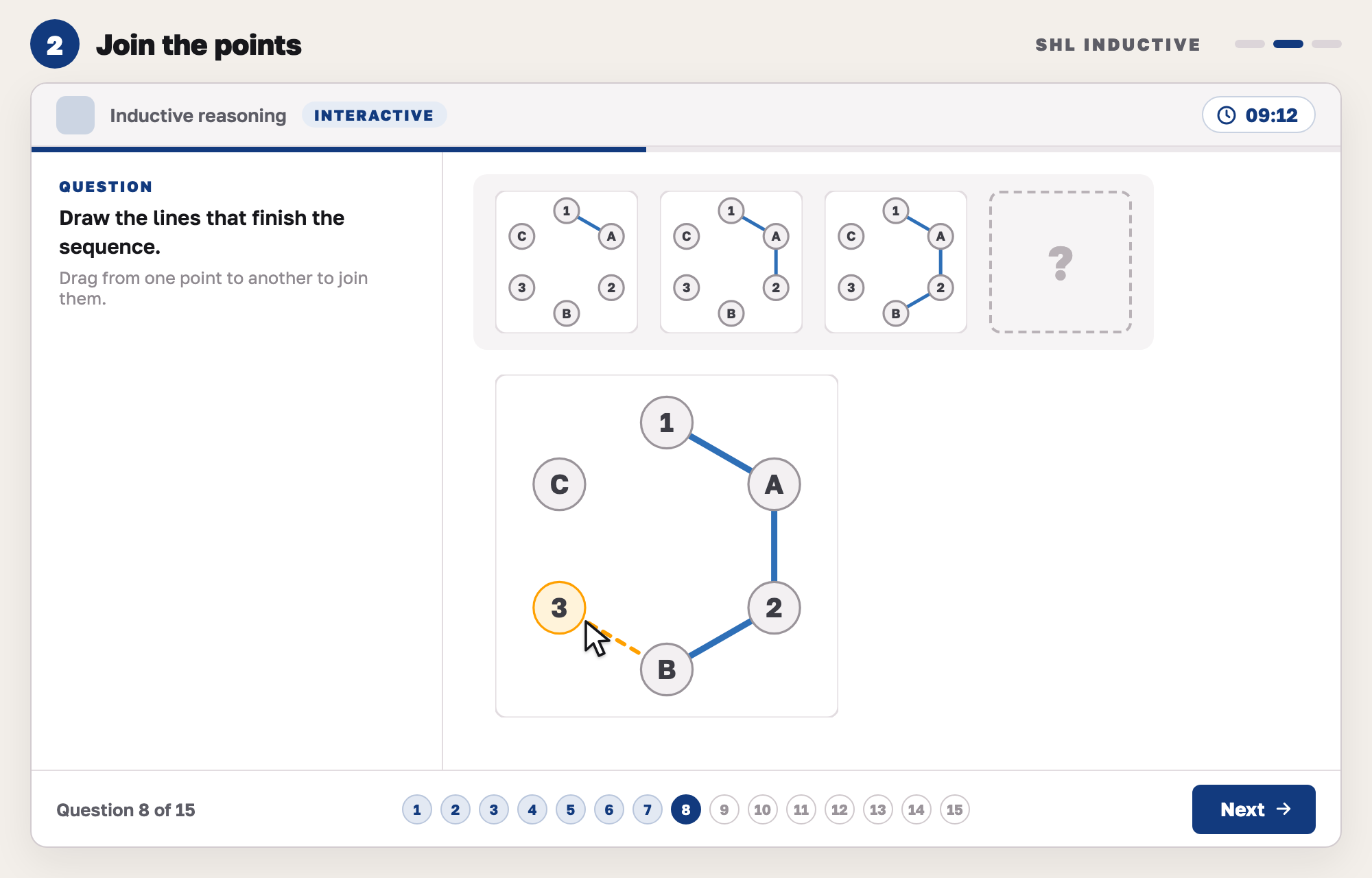
Join the points
Each step adds a line. Find the rule, then drag from point to point to draw the lines that finish the sequence.
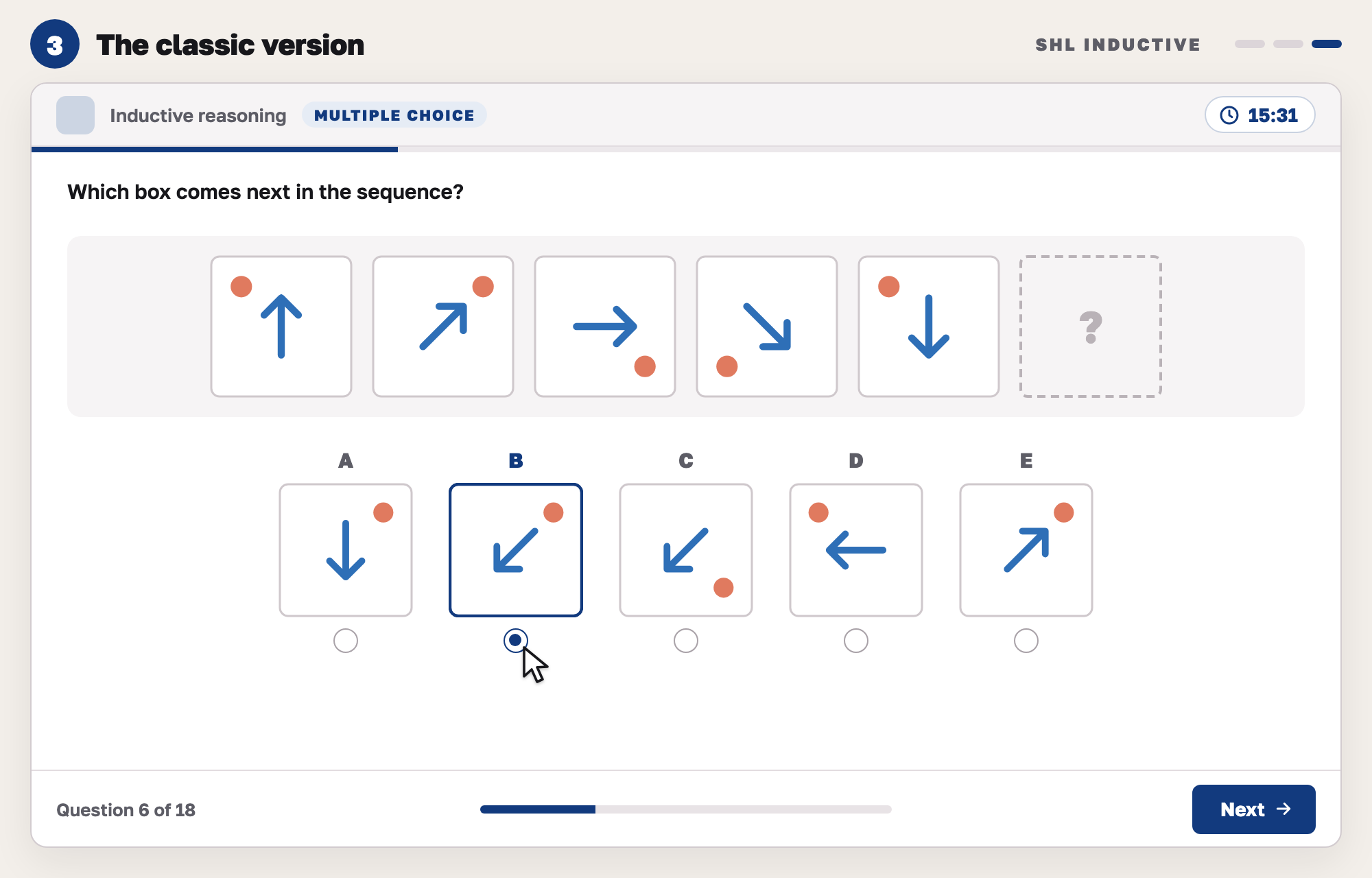
The classic version
In the multiple-choice version you see a row of figures and pick the one that comes next from five options.
Your moves
- Check one change at a time: shape, position, then count.
- Say the rule in words before you answer.
- Try SHL’s free example questions first.
Deductive: timed
KPMG says the test reviews your “numerical and logical reasoning”. SHL’s G+ includes deductive items, so expect some. You get a set of facts or rules and pick what must be true.
Your moves
- Write each rule as a short note.
- Start with the item that has the most rules.
- Check every rule again before you move on.
Skills assessment: untimed
KPMG says you “rank how you would think, feel or respond” in work scenarios. Its recruiter adds: “We recommend that you do not prepare for the skills assessment”.
Your moves
- Picture yourself at work and answer as you would really act.
- There is no timer, but KPMG suggests you allow 20 minutes.
Our own simplified drawings of SHL’s screens, not screenshots. Likely SHL; KPMG does not name the product, so your screens may differ.
For more on reasoning items, see our tips for psychometric tests.
The rules: do and don’t
Do
- Use Chrome on a desktop or laptop
- Finish each test in one sitting
- Try the practice items before the live test
- Ask for adjustments before you start
Don’t
- Use any AI tool
- Take help from anyone else
- Use other resources, such as answer packs
KPMG says to work “without the assistance of others, or any artificial intelligence or other resources”. Breaking this can mean withdrawal. KPMG adds: “We will also be re-testing elements of the online assessments.”
On the day: time, calculator and scoring
- Time to finish. Your invite gives the number of days.
- Calculator and paper. KPMG does not say. Check your invite email or ask KPMG.
- Practice. KPMG says you can try “practice tests and examples right before moving into the live assessment”.
- Scoring. KPMG publishes no pass mark.
Go further: the best outside help
Our own picks, checked on 15 October 2026. We are not linked to any of these sites and earn nothing from them.
From KPMG
- KPMG explains its two online testsKPMG UK Careers on YouTube · Jan 2026 · 3 minA KPMG recruiter explains both tests.Free
Practise
- SHL’s free practice testsSHL, the test maker · free SHL account neededThe practice KPMG itself links to.Free
- SHL’s example questionsSHL · no account neededTry numerical and inductive. Skip verbal.Free
Watch
- 15 SHL reasoning questions solved, step by stepAptitude-Test-Prep on YouTube · Mar 2025 · 54 min · the host is a JobTestPrep affiliateReasoning items in the SHL style, worked through.Free
Skip AI helpers and paid KPMG test packs. KPMG bans outside help, re-tests results and says it has no link with paid prep providers.
Next: build your speed on numbers and logic with our guide to psychometric and logic tests.
06/10Stage 3 · Video interview
The Leah video interview
You get “6 pre-recorded questions asked by our AI avatar Leah”. KPMG gives you a “set time to prepare and then record” each answer.
6
Questions from Leah
40 min
KPMG says allow this long
A person
Scores your answers
From KPMG’s application process page. Answers are “reviewed and scored by a member of our Student Recruitment team”. KPMG publishes no Technology Audit question or format.
Step through the video interview
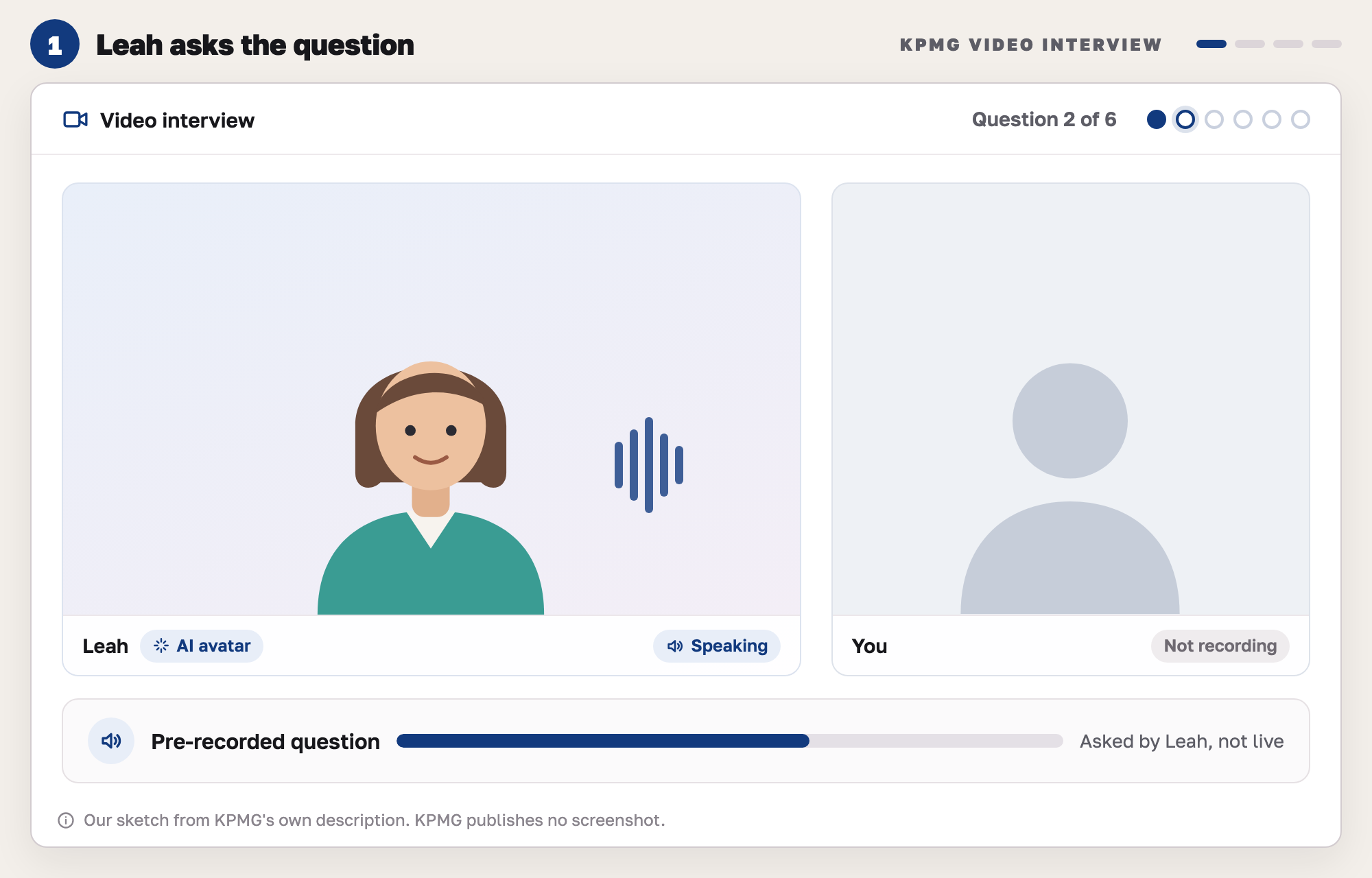
Leah asks the question
Leah, KPMG’s AI avatar, asks one of six pre-recorded questions. This is our sketch from KPMG’s description, because KPMG publishes no screenshot.
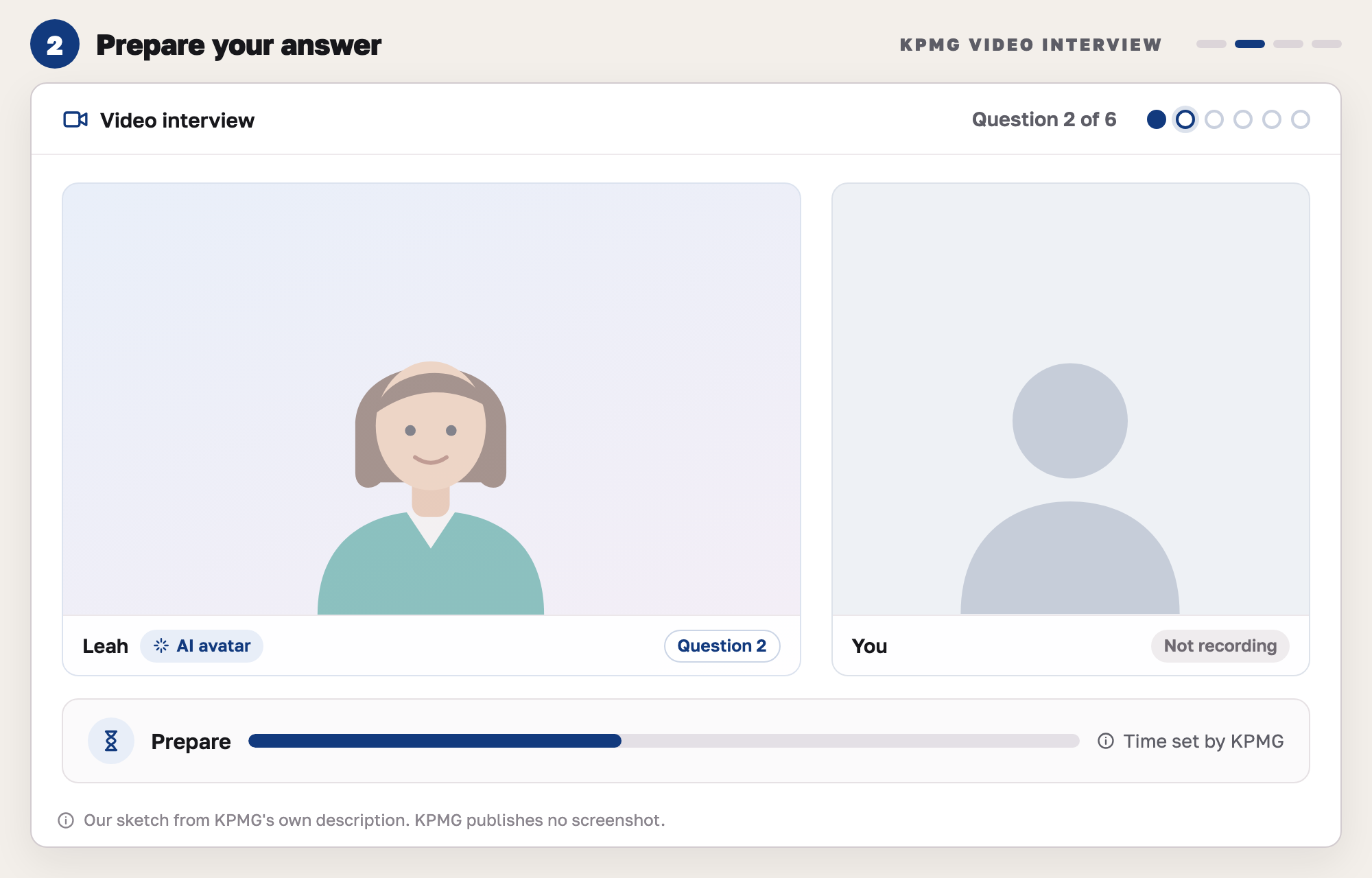
Prepare your answer
You get a set time to think before you record. KPMG sets the time and does not publish it.
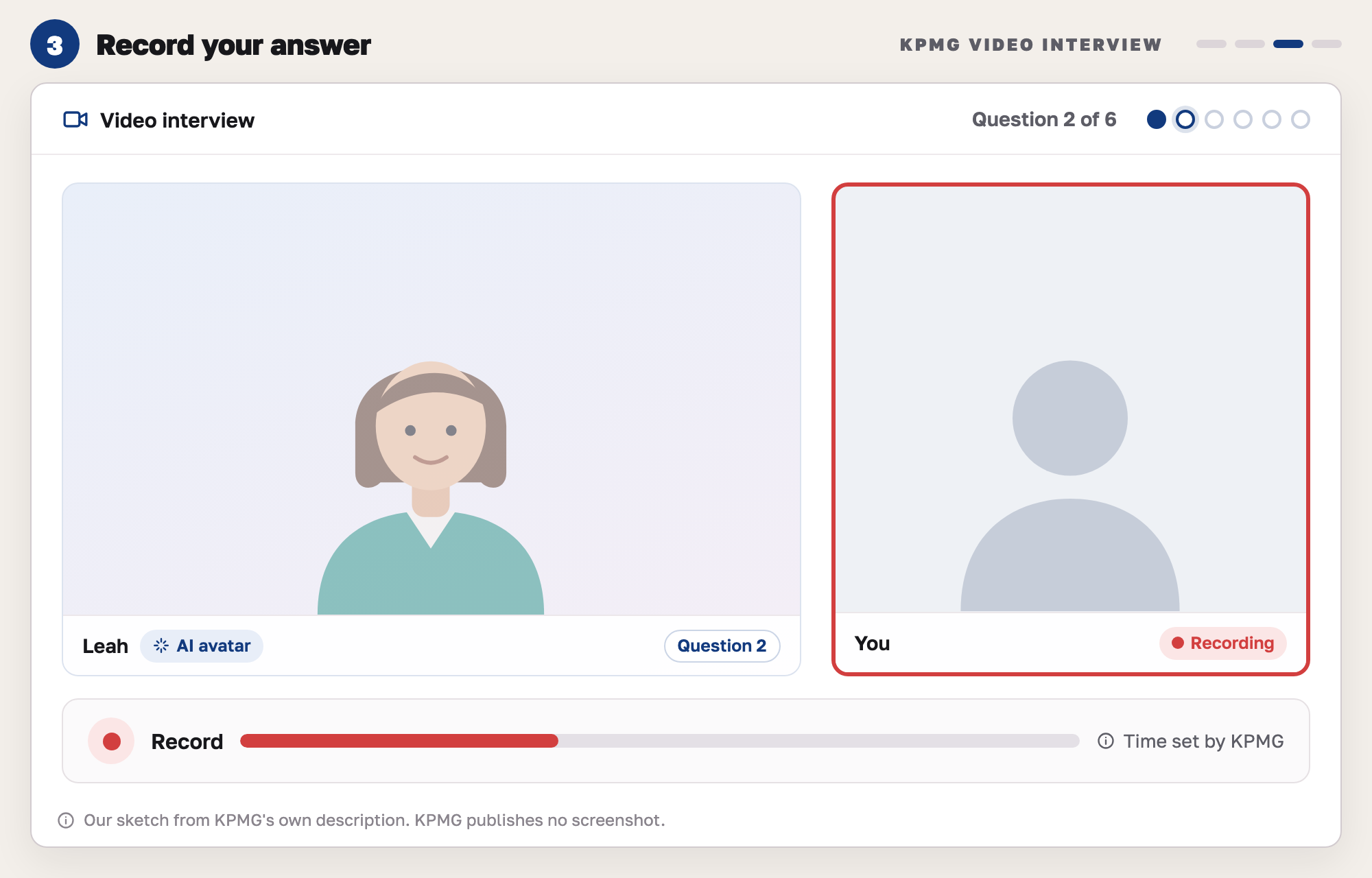
Record your answer
You record your answer on camera within a set time. KPMG does not publish the time or say if you can record again.
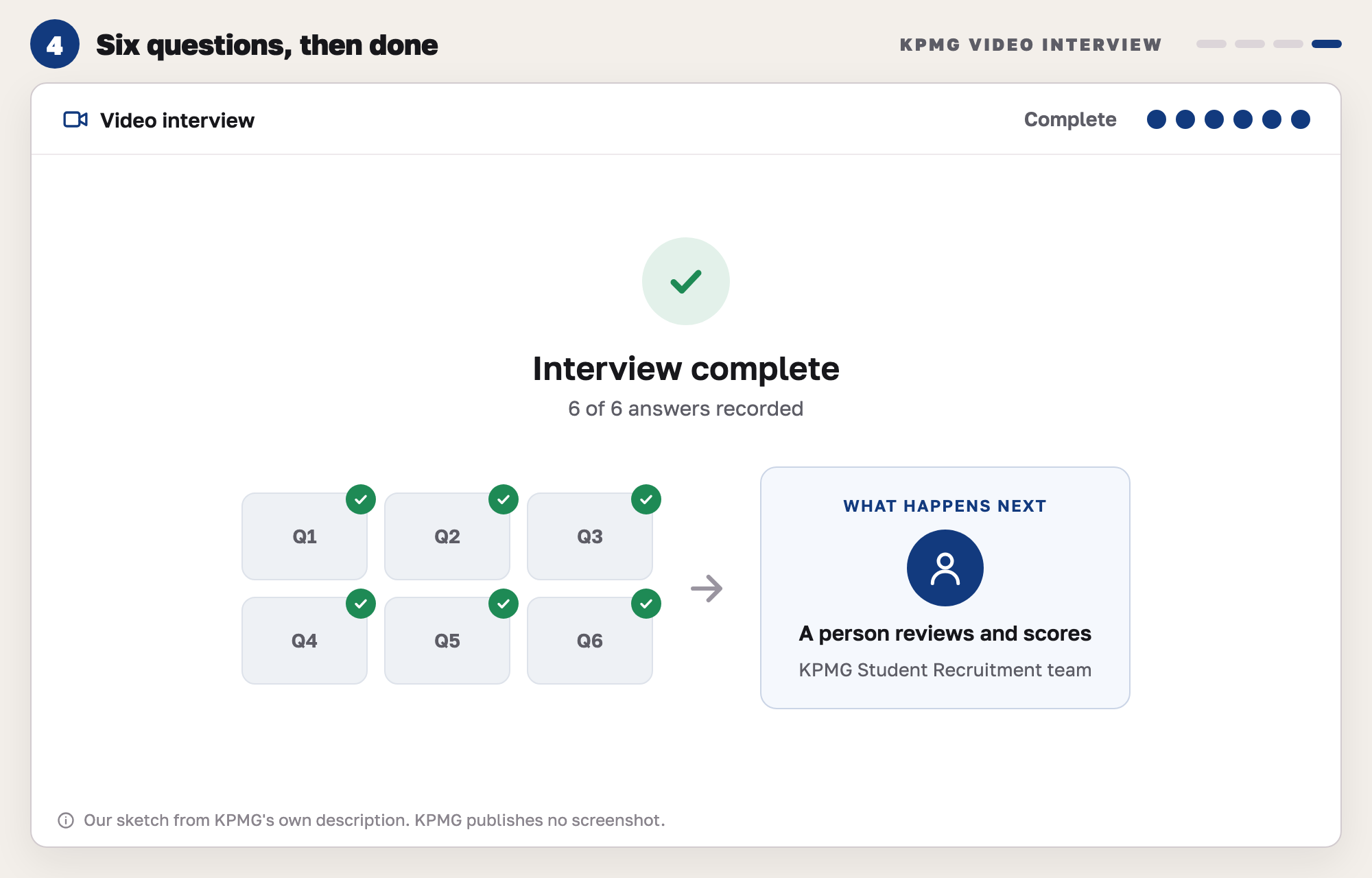
Six questions, then done
After six answers you are finished. A member of KPMG’s Student Recruitment team reviews and scores your answers, not the AI.
Your moves
- Use the prep time to pick one story and two or three points.
- Link each answer to one of KPMG’s 12 skills.
- Practise recording yourself first, as KPMG suggests.
Our own sketch from KPMG’s description. No real screen is public, and our Leah is a drawing, not KPMG’s avatar. KPMG sets the prep and answer times and does not publish them.
How to answer
Build each true story in four parts:
The moment
Where and when, in one line.
Your aim
What you set out to do, and why it was hard.
What you did
Your own steps, not the team’s.
What changed
The result, with a number if you can.
Reasons to have ready
Why Technology Audit?Why KPMG?Why Manchester?What is CFAB?What did you do, not the team?
See our guide on how to pass a job interview, then rehearse the toughest interview questions.
Practise: one question at a time
Motivation and drive
Our own practice prompts, built on KPMG’s 12 skills. KPMG publishes no interview questions.
Career Motivation
Why Technology Audit, why KPMG, and why Manchester?
What they’re testing: your “chosen programme and location”.
Show a strong answer
- Two reasons for Technology Audit and one for Manchester, each tied to something you have done.
- Show you know it leads to CFAB, not the full ACA.
Resilience
Tell me about a time something went wrong under pressure.
What they’re testing: “keeping calm under pressure”.
Show a strong answer
- The setback, your next step, the result and what you learned.
Initiative
Tell me about a time you took on work nobody asked you to do.
What they’re testing: “seeking additional work and responsibilities proactively”.
Show a strong answer
- What you saw needed doing, and why you stepped in.
- What you did on your own, and the result.
Planning & Organisation
Tell me about a time you had several deadlines at once.
What they’re testing: “managing your own time and work”.
Show a strong answer
- The deadlines, the plan you made and how you kept to it.
- KPMG calls CFAB study “front-loaded”, so show you can plan your study.
Thinking and integrity
Our own practice prompts, built on KPMG’s 12 skills. KPMG publishes no interview questions.
Integrity
Tell me about a time you did the right thing when it was not easy.
What they’re testing: being “trusted to do the right thing”.
Show a strong answer
- A real moment, what you did and why. Keep it honest and specific.
Critical Thinking
Tell me about a decision you made by weighing up information.
What they’re testing: “rational judgements and decisions”.
Show a strong answer
- The facts you checked, the options and why you chose one.
Learning & Curiosity
Tell me about a time you had to learn something new quickly.
What they’re testing: “absorbing new information and techniques quickly”.
Show a strong answer
- What you had to learn, how you learned it and how fast.
- Show the “appetite to learn about technology” KPMG asks for.
Applying Expertise & Technology
Tell me about a time you used technology to do a task better.
What they’re testing: “applying relevant technology” to do the job well.
Show a strong answer
- The task, the tool you chose and what it saved or improved.
- You need not be “a technical guru”. A simple tool used well counts.
Your story bank: a worksheet to print or copy
Two stories per row. One story can cover two rows.
| KPMG’s skills | Story 1 | Story 2 |
|---|---|---|
| Career Motivation: why Technology Audit, KPMG and Manchester | ||
| Learning & Curiosity, Initiative | ||
| Resilience | ||
| Relationship Building, Inclusive Collaboration | ||
| Planning & Organisation, Results Focused | ||
| Critical Thinking, Integrity | ||
| Effective Communication, Applying Expertise & Technology |
Go further: the best outside help
Our own picks, checked on 15 October 2026. We are not linked to any of these sites and earn nothing from them.
From KPMG
- KPMG’s guide to the Leah video interviewKPMG UK Careers on YouTube · Jan 2026 · 2 minHow the six questions work, from KPMG.Free
- KPMG’s tips for the Launch PadKPMG UK Careers on YouTube · Jan 2026 · 3 minFive tips for the final day.Free
- The 12 skills KPMG scoresKPMG Careers · with a 5 min video · no account neededPrepare one story for each skill.Free
- KPMG’s free live sessions, including AuditKPMG on Microsoft Teams · Audit 18 NovAudit session ran 18 Nov · Interview Skills 17 FebInterview Skills ran 17 Feb · free registrationAsk about Technology Audit yourself, live.Check the page for new sessions.Free
07/10Stage 4 · Launch Pad
The Launch Pad and offers
The Launch Pad is “an in-person, half day event”. It mixes “assessed and non-assessed activities”, and your final interview is part of it.
Meet the team
You meet people from your business area and office, “from partners to trainees”.
Your final interview
KPMG does not publish its format or who interviews you.
An offer within 2 working days
“If successful you will have your job offer within 2 working days!”
Feedback if not
“You will be offered the option to request feedback.”
Before the day: KPMG’s own tips
- An online session first. KPMG invites you to one before the day.
- Instructions. These arrive ahead of the event, “including travel expenses and what to wear”.
- Research. Be ready for “Why do you want to work here?” and why you chose Technology Audit.
- Your questions. KPMG says “prepare some questions to ask the interviewer”.
Launch Pad dates, 2026-27
| Date | Place |
|---|---|
| Tuesday 17 November 2026 | London, the Oval |
| Tuesday 1 December 2026 | Birmingham, NEC |
| Wednesday 9 December 2026 | Manchester, The Midland hotel |
| Tuesday 16 March 2027 | Bristol, Ashton Gate Stadium |
| Tuesday 23 March 2027 | Glasgow, Radisson Blu |
| Tuesday 27 April 2027 | London, the Oval |
| Wednesday 5 May 2027 | Leeds, New Dock Hall |
From KPMG’s application process page. KPMG does not say which offices or programmes go to which date.
When things happen: Technology Audit, 2026-27
15 October 2026
Manchester ad listed, with no closing date
15 October 2026
The Manchester ad had closed when we checked
15 October 2026
Checked. See the Manchester ad for its closing date
17 Nov 2026 to 5 May 2027
Seven Launch Pads, from London to LeedsSeven Launch Pads under way, from London to LeedsSeven Launch Pads ran, from London to Leeds
Autumn 2027
The programme starts
08/10
Visa sponsorship
Manchester Technology Audit is not on KPMG’s sponsorship list. KPMG would sponsor a London Technology Audit role. None was listed when we checked on 15 October 2026.One was listed when we checked on 15 October 2026.London’s ad had closed when we checked on 15 October 2026.Look for a London ad. Check KPMG’s vacancy search, or join the Talent Community.
Manchester
Not on KPMG’s sponsor list
London
Sponsored. No ad on 15 October 2026Sponsored. Listed on 15 October 2026Sponsored. Closed by 15 October 2026Sponsored. Look for an ad
1 Jun 2027
Accept your offer by this dateVisa needers had to accept by this date
Our reading: if you need a visa, Manchester will not work. Aim for a London Audit role, then accept any offer early.
KPMG’s rules and the GOV.UK facts
- London only. KPMG’s international students page lists “Any Audit graduate programme based in London”.
- Accept early. Accept “at least three months prior” to starting. For the Autumn 2027 intake, accept your offer by 1 June 2027. This is the date to accept an offer, not to apply.For the Autumn 2027 intake, visa needers had to accept their offer by 1 June 2027.
- Can change. Sponsorship is “subject to change with little notice”.
- Vacation and Talent Insight. Where the graduate role has no sponsorship, KPMG cannot accept applicants who will need it.
- Graduate visa. It lasts “2 years if you apply on or before 31 December 2026” and “18 months if you apply on or after 1 January 2027” (GOV.UK).
See our guides to staying in the UK after studying and UK companies that sponsor visas. This is general information, so check GOV.UK.
09/10
Key takeaways
Before your next step
- Apply now. KPMG recruits on a rolling basis and gives no closing date.The Manchester ad had closed when we checked on 15 October 2026. Prepare now for the next intake.Check the Manchester ad for its closing date. Some programmes fill faster than others.
- Technology Audit is a three-year Graduate Audit programme. It leads to the ICAEW CFAB, not the full ACA.
- Only Manchester had a Technology Audit ad on 15 October 2026.KPMG hires for Technology Audit in Manchester. You get one KPMG application per intake year.
- Technology Audit adds no test. Take both tests alone, with no AI.
- Leah asks six questions, and a person scores them. Know why Technology Audit and why Manchester.
- The Launch Pad is half a day in person. Offers come within 2 working days.
- Need a visa? Manchester is not sponsored. No London role was listed when we checked on 15 October 2026.A London role was listed when we checked on 15 October 2026.The London role had closed when we checked on 15 October 2026.Look for a London role.
When a scheme gives a close date, we email you a few days before it closes. Save KPMG once and the reminder is set.
Set my reminders freeFree account, no card.

10/10
Frequently asked questions
How does the KPMG Technology Audit graduate application process work?
You take a job preview quiz, then fill in a form with no CV. Next come a skills assessment and a 36-minute cognitive test. Then you record six answers for KPMG’s avatar Leah. Last is the Launch Pad, a half day in person with your final interview. Technology Audit adds no stage.
Does the KPMG Technology Audit graduate programme have a deadline?
KPMG gives no closing date. It recruits on a rolling basis, and some programmes fill faster than others, so apply early. On 15 October 2026, only Manchester had a Technology Audit ad.KPMG gave no closing date. It recruits on a rolling basis, so ads close when places fill. The Manchester ad had closed when we checked on 15 October 2026.Check the Manchester ad for its closing date. KPMG says some programmes fill faster than others, so apply early.
Which qualification will I study on KPMG Technology Audit?
The ICAEW CFAB, the first level of the ACA, not the full ACA. ICAEW says CFAB has six modules and takes 12 months or less. KPMG does not say whether Technology Audit trainees move on to the full ACA.
Do I need a technology degree for KPMG Technology Audit?
No. KPMG says you don’t need to be a technical guru. It asks for a 2:1 in any discipline, GCSE Maths and English Language at grade 5 or B, and 120 UCAS points.
Is there a coding test for KPMG Technology Audit?
No coding test is published. Technology Audit uses KPMG’s two standard tests: an untimed skills assessment and a 36-minute cognitive test of numerical and logical reasoning.
Does KPMG sponsor visas for Technology Audit graduates?
Not in Manchester. KPMG sponsors any Audit graduate programme based in London. No London Technology Audit role was listed when we checked on 15 October 2026.A London Technology Audit role was listed when we checked on 15 October 2026.The London Technology Audit role had closed when we checked on 15 October 2026.Check KPMG’s vacancy search for a London role. If you need sponsorship, accept your offer by 1 June 2027. This is the date to accept an offer, not to apply.Visa needers had to accept their offer by 1 June 2027.